
1. Chapter at a Glance
All animals, including humans, depend on plants for food. Green plants make their own food by photosynthesis: they use light energy to convert carbon dioxide and water into carbohydrates, releasing oxygen. Photosynthesis is important for two reasons. It is the primary source of all food on Earth, and it releases the oxygen that most living things breathe. In this chapter we follow the story of how scientists discovered photosynthesis, where it happens inside a leaf, which pigments trap light, how light energy becomes chemical energy (ATP and NADPH), how CO₂ is fixed into sugar in the Calvin cycle and the C₄ pathway, why photorespiration wastes energy, and which factors limit the rate. NEET asks about two questions from this chapter every year, very often on the Z-scheme, chemiosmosis, the first stable product of C₃ and C₄ plants, Kranz anatomy and photorespiration.
- Contributions of Priestley, Ingenhousz, Sachs, Engelmann and van Niel.
- Chlorophyll a as the chief pigment; absorption vs action spectrum.
- PS I (P700) and PS II (P680), the Z-scheme, photolysis of water and where O₂ comes from.
- Cyclic vs non-cyclic photophosphorylation; chemiosmotic synthesis of ATP.
- Calvin cycle (3 ATP + 2 NADPH per CO₂), C₄ pathway, Kranz anatomy and photorespiration.
- Blackman's law of limiting factors.
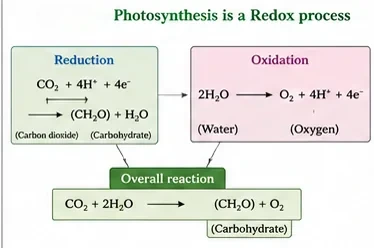
Photosynthesis is a redox process: water is oxidised (it loses electrons and releases O₂), and carbon dioxide is reduced to carbohydrate. It is also a physico-chemical process — light is trapped by pigments (physical) and used to drive chemical reactions.
2. Early Experiments: How Photosynthesis was Discovered
Our understanding of photosynthesis was built step by step by many scientists. NEET often asks "who showed what", so learn each discovery with its conclusion.
| Scientist (year) | Experiment | Conclusion |
|---|---|---|
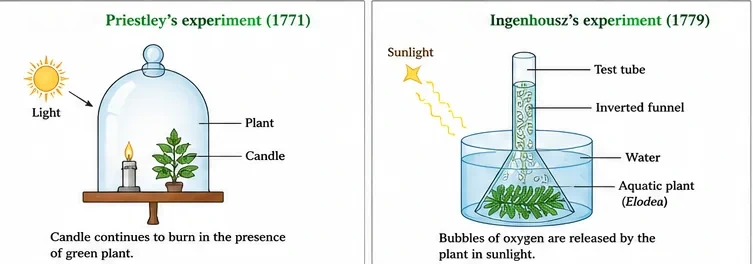
| Joseph Priestley (1770s) | A candle burning in a closed bell jar soon went out, and a mouse suffocated. When a mint plant was kept inside, the candle kept burning and the mouse survived. | Plants "restore" the air that burning candles and breathing animals spoil. He later discovered oxygen (1774). |
| Jan Ingenhousz (1730–1799) | Repeated Priestley's set-up in sunlight and in darkness; saw small bubbles around the green parts of an aquatic plant in light. | Sunlight is essential, and only the green parts of a plant release oxygen. |
| Julius von Sachs (1854) | Showed that plants make glucose, which is stored as starch. | Glucose is made in green parts that contain chlorophyll, located in chloroplasts. |
| T.W. Engelmann (1843–1909) | Split light with a prism and lit a filament of the green alga Cladophora; aerobic bacteria gathered mainly in the blue and red regions. | Gave the first action spectrum of photosynthesis; blue and red light are most effective. |
| Cornelius van Niel (1897–1985) | Studied purple and green sulphur bacteria, which use H₂S instead of H₂O and release sulphur, not oxygen. | Photosynthesis is a light-dependent reaction in which hydrogen from a suitable oxidisable compound reduces CO₂. In green plants the hydrogen donor is water, so O₂ comes from water, not CO₂ (later proved with radioactive tracers). |
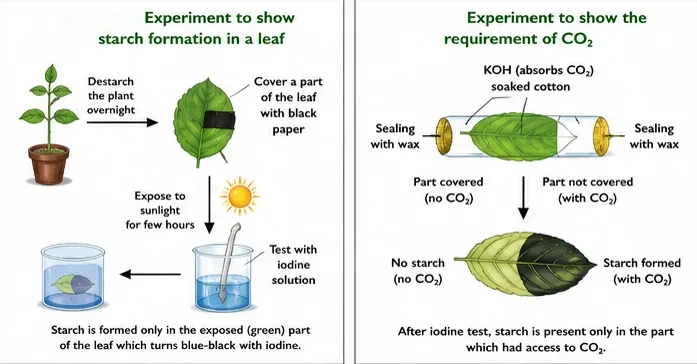
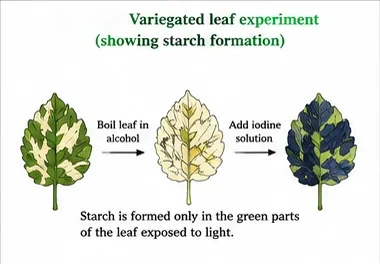
Simple school experiments. Before testing a leaf for starch, the plant is kept in the dark overnight (destarching), so any starch found later must have been made during the experiment. The leaf is boiled in alcohol to remove chlorophyll and then tested with iodine: starch turns blue-black.
- Light is needed: a leaf partly covered with black paper makes starch only in the uncovered part.
- Chlorophyll is needed: a variegated leaf (green and white patches, e.g. Croton or money plant) makes starch only in its green areas.
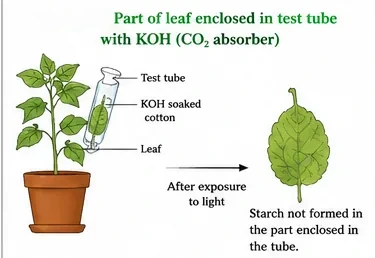
- CO₂ is needed (Moll's half-leaf experiment): part of a leaf is enclosed in a bottle or tube containing KOH, which absorbs CO₂. That part forms no starch, while the part outside does.
3. Where Does Photosynthesis Take Place?
- Photosynthesis takes place mainly in the green leaves, but also in other green parts such as young stems.
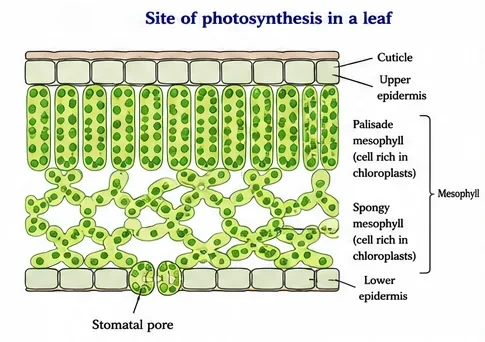
- Inside the leaf, the mesophyll cells (palisade and spongy) contain a large number of chloroplasts. The chloroplasts usually line the cell walls and arrange themselves to receive the best amount of light: they face the light when it is weak and turn edge-on when it is too strong.
- Stomata on the leaf surface let CO₂ in and O₂ out.
| Part of chloroplast | What happens there | NEET Note |
|---|---|---|
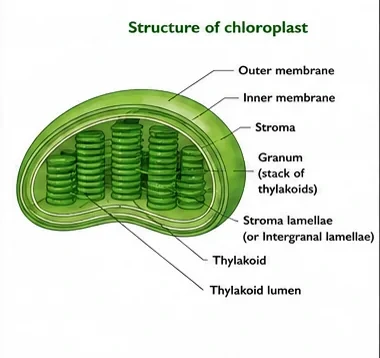
| Thylakoid membranes (grana and stroma lamellae) | Trap light; make ATP and NADPH (light reaction) | PS II mainly in grana; PS I also in stroma lamellae |
| Thylakoid lumen | H⁺ accumulates here; water is split on this side | Lumen becomes acidic |
| Stroma | Enzymes reduce CO₂ to sugar (biosynthetic or "dark" reaction) | Contains RuBisCO, ribosomes and DNA |
The reactions that do not directly need light are often called dark reactions, but this is misleading: they depend on the ATP and NADPH made in light, and they happen during the day. "Biosynthetic phase" or "carbon reactions" is a better name.
4. Pigments Involved in Photosynthesis
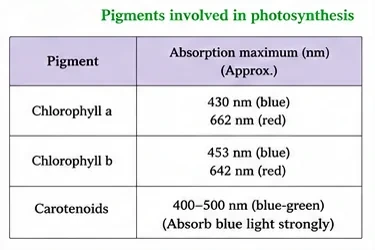
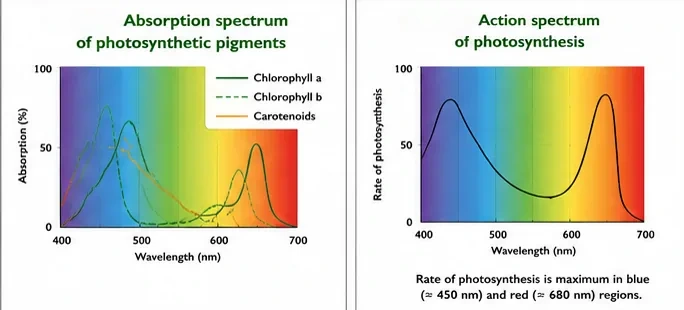
Paper chromatography of a leaf extract separates four pigments: chlorophyll a (bright or blue-green), chlorophyll b (yellow-green), xanthophylls (yellow) and carotenes (yellow to yellow-orange).
- Chlorophyll a is the chief pigment of photosynthesis. It is present in the reaction centre of both photosystems.
- Chlorophyll b, xanthophylls and carotenoids are accessory pigments. They absorb light of other wavelengths and pass the energy to chlorophyll a, widening the range of usable light. They also protect chlorophyll a from photo-oxidation.
- An absorption spectrum shows how much light of each wavelength a pigment absorbs. An action spectrum shows the rate of photosynthesis at each wavelength.
- The action spectrum closely follows the absorption spectrum of chlorophyll a, with peaks in the blue and red regions. This shows that chlorophyll a is the main pigment, though the match is not perfect because accessory pigments also contribute.
- Green light is mostly reflected, which is why leaves look green.
5. The Light Reaction (Photochemical Phase)
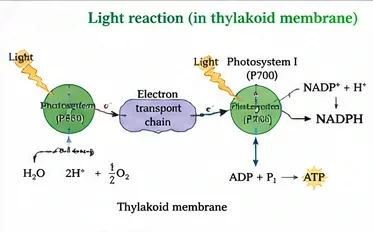
The light reaction includes light absorption, splitting of water, release of oxygen, and formation of the high-energy molecules ATP and NADPH.
- Pigments are organised into two discrete photochemical light-harvesting complexes (LHC), called Photosystem I (PS I) and Photosystem II (PS II). They are named in the order of their discovery, not the order in which they work.
- Each photosystem has many pigment molecules (an antenna) that pass absorbed energy to a single reaction centre molecule of chlorophyll a.
- In PS I the reaction centre absorbs best at 700 nm and is called P700. In PS II it absorbs best at 680 nm and is called P680.
The electron transport and the Z-scheme
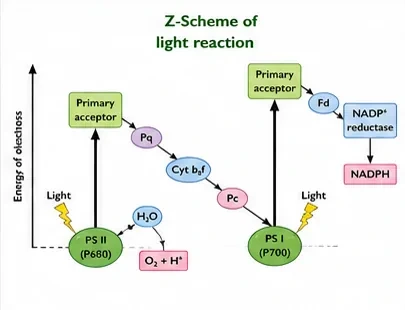
- PS II absorbs light (680 nm). Electrons in its reaction centre are excited and passed to a primary electron acceptor.
- The electrons move downhill through an electron transport chain of cytochromes (plastoquinone → cytochrome b₆f complex → plastocyanin) to PS I. On the way, energy is released.
- Electrons in PS I are excited again by light (700 nm) and passed to another acceptor with a still higher energy level.
- They then pass downhill (through ferredoxin) to NADP⁺, which is reduced to NADPH + H⁺.
When the carriers are drawn in order of their redox potential, the path looks like the letter Z — hence the name Z-scheme.
Splitting of water (photolysis)
- PS II has lost electrons, so it must get replacements. These come from the splitting of water, which is linked to PS II.
- 2H₂O → 4H⁺ + O₂ + 4e⁻. The splitting happens on the inner side (lumen side) of the thylakoid membrane.
- The water-splitting complex needs manganese (Mn) and chloride (Cl⁻) ions.
- The oxygen released in photosynthesis is the by-product of this reaction — so O₂ comes from water.
Cyclic and non-cyclic photophosphorylation
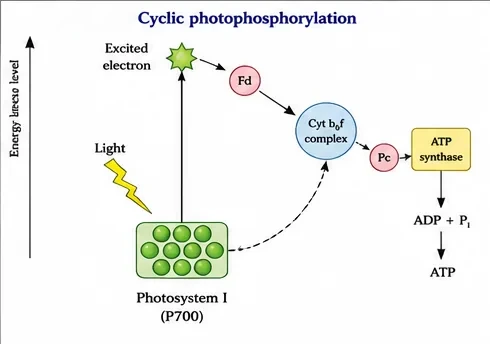
Making ATP from ADP and inorganic phosphate using light energy is called photophosphorylation.
| Feature | Non-cyclic | Cyclic |
|---|---|---|
| Photosystems | PS II and PS I both work, in series | Only PS I works |
| Electron path | Water → PS II → PS I → NADP⁺ (one way) | Electrons from PS I return to PS I through the ETC |
| Products | ATP, NADPH and O₂ | Only ATP |
| Photolysis of water | Yes | No (no O₂ released) |
| Where | Mainly grana thylakoids | Stroma lamellae (they lack PS II and NADP reductase) |
| NEET Note | Main pathway | Occurs when only light above 680 nm is available |
6. How is ATP Made? The Chemiosmotic Hypothesis
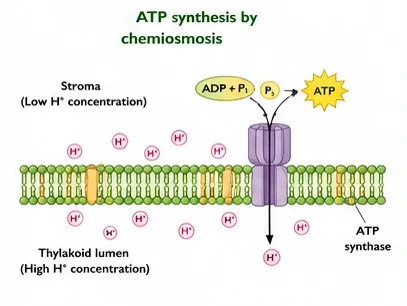
Peter Mitchell's chemiosmotic hypothesis explains how ATP is made in chloroplasts (and mitochondria). ATP synthesis is linked to the development of a proton gradient across the thylakoid membrane. Here the protons build up inside the thylakoid, in the lumen.
- Splitting of water on the lumen side releases H⁺ into the lumen.
- As electrons move through the photosystems, the primary acceptor (on the stroma side) passes them to an H carrier, which removes a proton from the stroma and releases it into the lumen.
- NADP reductase sits on the stroma side; reducing NADP⁺ to NADPH uses up H⁺ from the stroma.
So H⁺ falls in the stroma and rises in the lumen, making the lumen more acidic. This gradient stores energy. The enzyme ATP synthase has two parts: CF₀, embedded in the membrane, forms a channel through which protons diffuse back to the stroma; CF₁ sticks out into the stroma. The flow of protons causes a change in CF₁ that makes ATP. Chemiosmosis therefore needs a membrane, a proton pump, a proton gradient and ATP synthase.
7. The Biosynthetic Phase: Calvin Cycle (C₃ Pathway)
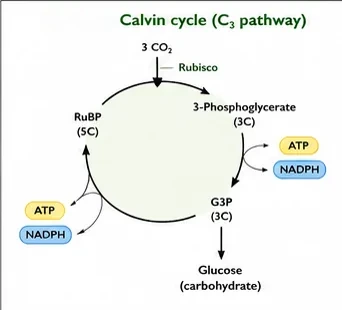
ATP and NADPH from the light reaction are used to fix CO₂ into sugar in the stroma. Melvin Calvin used radioactive 14C in algae to show that the first stable product of CO₂ fixation is a 3-carbon acid, 3-phosphoglyceric acid (PGA). Plants that fix CO₂ this way are called C₃ plants. Calvin cycle happens in all photosynthetic plants, whether they are C₃ or C₄.
- Carboxylation: CO₂ combines with the 5-carbon acceptor ribulose-1,5-bisphosphate (RuBP), giving two molecules of 3-PGA. The enzyme is RuBisCO (RuBP carboxylase-oxygenase), the most abundant enzyme on Earth.
- Reduction: 3-PGA is reduced to a triose sugar, using 2 ATP and 2 NADPH per CO₂ fixed.
- Regeneration: some triose is used to regenerate RuBP so the cycle can continue. This needs 1 ATP per CO₂.
The cyclic flow of electrons explains why plants need more ATP than NADPH: the Calvin cycle needs ATP and NADPH in a 3 : 2 ratio, and cyclic photophosphorylation supplies the extra ATP.
8. The C₄ Pathway (Hatch and Slack Pathway)
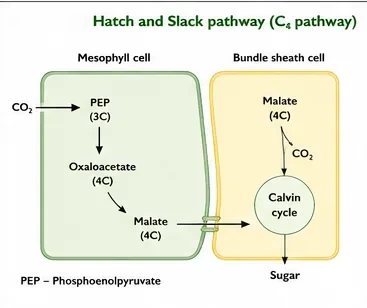
Plants adapted to dry, hot tropical regions, such as maize, sugarcane and sorghum, use a special pathway. Their first stable product is a 4-carbon acid, oxaloacetic acid (OAA), so they are called C₄ plants. They still use the Calvin cycle as their main biosynthetic pathway.
- Kranz anatomy ("Kranz" means wreath): large bundle sheath cells form a ring around the vascular bundles. They have many chloroplasts, thick walls impermeable to gas exchange, and no intercellular spaces.
- In the mesophyll cells, the primary CO₂ acceptor is the 3-carbon phosphoenol pyruvate (PEP), and the enzyme is PEP carboxylase (PEPcase). Mesophyll cells lack RuBisCO.
- OAA is converted into other 4-carbon acids such as malic acid or aspartic acid, which move into the bundle sheath cells.
- In the bundle sheath, the C₄ acid is broken down, releasing CO₂ and a 3-carbon molecule. The CO₂ enters the Calvin cycle there (bundle sheath cells are rich in RuBisCO but lack PEPcase).
- The 3-carbon molecule (pyruvate) returns to the mesophyll and is converted back into PEP, using ATP.
9. Photorespiration
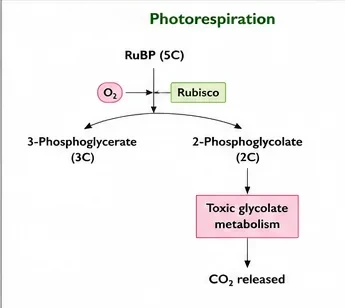
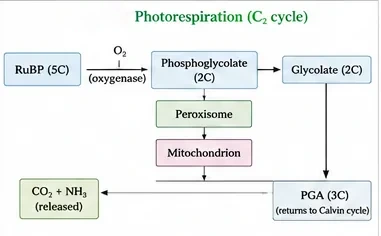
RuBisCO has a much greater affinity for CO₂ than for O₂, but it can bind either — binding is competitive, and the relative concentration of O₂ and CO₂ decides which one wins.
- When O₂ is high (or CO₂ low), RuBisCO acts as an oxygenase: RuBP + O₂ → one molecule of PGA + one molecule of phosphoglycolate (2-carbon).
- The phosphoglycolate is processed through a pathway involving chloroplast, peroxisome and mitochondrion, releasing CO₂.
- In photorespiration there is no synthesis of sugar, ATP or NADPH. Instead, ATP is used and CO₂ is released. It is therefore a wasteful process.
- It happens in C₃ plants, especially on hot, dry, bright days when stomata close and O₂ builds up inside the leaf.
- C₄ plants do not show photorespiration: their bundle sheath cells concentrate CO₂ around RuBisCO, so it works as a carboxylase. This is why C₄ plants are more productive and tolerate higher temperatures.
| Feature | C₃ plants | C₄ plants |
|---|---|---|
| First stable product | 3-PGA (3C) | OAA (4C) |
| Primary CO₂ acceptor | RuBP (5C) | PEP (3C) |
| Carboxylating enzyme | RuBisCO | PEPcase (mesophyll) + RuBisCO (bundle sheath) |
| Cells doing photosynthesis | Mesophyll | Mesophyll and bundle sheath |
| Kranz anatomy | Absent | Present |
| Photorespiration | Present | Negligible |
| Optimum temperature | 20–25 °C | 30–40 °C |
| Examples | Wheat, rice, potato, tomato | Maize, sugarcane, sorghum, Amaranthus |
10. Factors Affecting Photosynthesis
The rate of photosynthesis depends on internal factors (number, size, age and orientation of leaves; mesophyll cells and chloroplasts; internal CO₂ concentration; amount of chlorophyll — all decided by the plant's genes and growth) and external factors (sunlight, temperature, CO₂ concentration and water).
Blackman's law of limiting factors (1905): if a chemical process is affected by more than one factor, its rate is decided by the factor that is nearest to its minimal value — the factor that directly affects the process if its quantity is changed. For example, a plant with plenty of light and water but very low CO₂ cannot photosynthesise faster no matter how bright the light becomes.
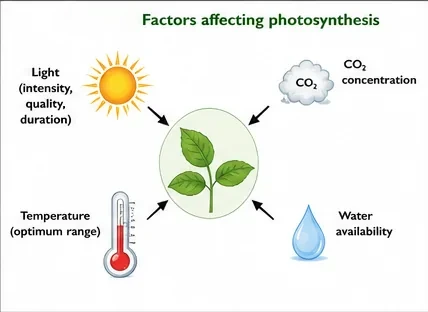
- Light: at low intensity, the rate rises in direct proportion to light. At higher intensity, it levels off as other factors become limiting. Very strong light can damage chlorophyll (photo-oxidation). Light is rarely limiting in nature, except for plants in shade or in dense forests.
- CO₂: it is the major limiting factor, because atmospheric CO₂ is only about 0.03–0.04%. Raising CO₂ up to about 0.05% increases the rate; beyond that it can be harmful over long periods. C₄ plants saturate at about 360 μL L⁻¹, while C₃ plants keep responding above 450 μL L⁻¹. Growers use this in greenhouses: tomatoes and bell peppers are grown in CO₂-enriched air for higher yields.
- Temperature: the dark reactions are enzyme-controlled and so depend on temperature, while light reactions are much less sensitive. C₄ plants have a higher optimum temperature than C₃ plants.
- Water: water affects photosynthesis mostly indirectly. Water stress closes stomata, reducing CO₂ supply, and wilting reduces leaf surface area and metabolic activity.
11. Master Summary Table
| Topic | Key fact | NEET Note |
|---|---|---|
| Source of O₂ | Photolysis of water | Proved by van Niel's idea and isotopes |
| Chief pigment | Chlorophyll a | In both reaction centres |
| PS I / PS II | P700 / P680 | Named by discovery, not sequence |
| Photolysis | Needs Mn²⁺ and Cl⁻ | On lumen side, linked to PS II |
| Non-cyclic | ATP + NADPH + O₂ | PS II and PS I |
| Cyclic | Only ATP | PS I only; stroma lamellae |
| Chemiosmosis | H⁺ gradient lumen → stroma | ATP synthase CF₀–CF₁ |
| Calvin cycle | 3 ATP + 2 NADPH per CO₂ | First product 3-PGA |
| C₄ pathway | PEP + CO₂ → OAA | Kranz anatomy, no photorespiration |
| Photorespiration | RuBisCO as oxygenase | No ATP or sugar made |
| Blackman's law | Limiting factor decides rate | CO₂ usually limiting |
12. Mind Map
- Priestley, Ingenhousz
- Sachs, Engelmann
- van Niel (O₂ from water)
- Pigments, PS I, PS II
- Z-scheme, photolysis
- Chemiosmosis
- Calvin cycle
- C₄ pathway
- Photorespiration
- Light, CO₂
- Temperature, water
- Blackman's law
13. Tips and Tricks
- "PS II comes first, but was found second": electrons flow PS II → PS I.
- P700 = PS I: the bigger number goes with the smaller numeral.
- Calvin cycle cost: "3-2 per C" (3 ATP, 2 NADPH per carbon). For glucose, multiply by six: 18 ATP and 12 NADPH.
- C₄ = "four-carbon OAA, Kranz, maize and sugarcane, no photorespiration".
- Photorespiration uses three organelles: "Chloroplast, Peroxisome, Mitochondrion — Can People Move?"
- Thinking O₂ comes from CO₂ (it comes from water).
- Saying "dark reactions" happen only at night.
- Thinking C₄ plants do not use the Calvin cycle (they do, in bundle sheath cells).
- Placing the proton build-up in the stroma (it is in the thylakoid lumen).
- Expecting cyclic photophosphorylation to release O₂ or make NADPH.
14. Important One-liners
- The first action spectrum of photosynthesis was described by Engelmann using Cladophora.
- Chlorophyll a is the primary photosynthetic pigment.
- Accessory pigments protect chlorophyll a from photo-oxidation.
- The reaction centre of PS II is P680 and that of PS I is P700.
- Photolysis of water needs manganese and chloride ions.
- Stroma lamellae lack PS II and NADP reductase, so only cyclic flow occurs there.
- RuBisCO is the most abundant enzyme in the world.
- The CO₂ acceptor in the Calvin cycle is RuBP; in C₄ mesophyll cells it is PEP.
- Kranz anatomy is a feature of C₄ plants.
- Photorespiration does not produce ATP or NADPH.
- Tomatoes and bell peppers are grown in CO₂-enriched greenhouses for higher yield.
15. NEET-pattern Questions with Detailed Answers
These questions are original and based on concepts that NEET UG asks again and again.
The oxygen released during photosynthesis comes from:
- Carbon dioxide
- Water
- Glucose
- Chlorophyll
Show solution
Photolysis of water (2H₂O → 4H⁺ + O₂ + 4e⁻) releases the oxygen. van Niel's work on sulphur bacteria first suggested this, and isotope studies later proved it. The oxygen in CO₂ ends up in carbohydrate and water, not in O₂. Glucose and chlorophyll are not oxygen sources.
Answer: (B)
The reaction centre of photosystem I absorbs maximally at:
- 680 nm
- 700 nm
- 660 nm
- 720 nm
Show solution
PS I has P700 as its reaction centre, and PS II has P680. Both reaction centres are molecules of chlorophyll a.
Answer: (B)
Which statement about cyclic photophosphorylation is correct?
- Both PS I and PS II take part
- NADPH and O₂ are produced
- Only ATP is produced, and it occurs in stroma lamellae
- Water is split
Show solution
Only PS I is involved, and its electrons cycle back to it, so only ATP is made. Stroma lamellae lack PS II and NADP reductase, so this is where cyclic flow occurs. Without PS II there is no photolysis, no O₂ and no NADPH.
Answer: (C)
In chemiosmosis during photosynthesis, protons accumulate in the:
- Stroma
- Thylakoid lumen
- Intermembrane space of the chloroplast
- Cytoplasm
Show solution
H⁺ is released into the lumen by photolysis and by the H carrier, and is removed from the stroma by NADP reductase. Protons then flow from the lumen through CF₀ to the stroma, driving ATP synthesis. In mitochondria the build-up is in the intermembrane space instead — a common source of confusion.
Answer: (B)
How many ATP and NADPH are needed to make one molecule of glucose through the Calvin cycle?
- 12 ATP and 18 NADPH
- 18 ATP and 12 NADPH
- 3 ATP and 2 NADPH
- 30 ATP and 12 NADPH
Show solution
Each CO₂ needs 3 ATP and 2 NADPH. Glucose needs 6 CO₂, so 18 ATP and 12 NADPH. Option (C) is the cost for one CO₂ only, and (A) swaps the two numbers. Option (D) corresponds to a C₄ plant (5 ATP per CO₂).
Answer: (B)
Kranz anatomy, the presence of PEP carboxylase in mesophyll cells and absence of photorespiration are features of:
- Wheat
- Rice
- Maize
- Potato
Show solution
Maize is a C₄ plant, with a wreath of bundle sheath cells, PEPcase in its mesophyll and no photorespiration. Wheat, rice and potato are C₃ plants.
Answer: (C)
Assertion (A): Photorespiration is a wasteful process.
Reason (R): In photorespiration, RuBisCO acts as an oxygenase and neither ATP nor sugar is produced.
- Both A and R are true, and R is the correct explanation of A
- Both A and R are true, but R is not the correct explanation of A
- A is true but R is false
- A is false but R is true
Show solution
When RuBisCO binds O₂, RuBP is broken down and CO₂ is released, using energy without making sugar, ATP or NADPH. That is exactly why the process is called wasteful, so R correctly explains A.
Answer: (A)
Match the scientists with their contributions: (a) Ingenhousz (b) Engelmann (c) van Niel (d) Sachs — (i) action spectrum using Cladophora (ii) O₂ released only by green parts in light (iii) glucose made in green parts, stored as starch (iv) hydrogen donor reduces CO₂; O₂ comes from water.
- a-ii, b-i, c-iv, d-iii
- a-i, b-ii, c-iii, d-iv
- a-ii, b-iv, c-i, d-iii
- a-iii, b-i, c-iv, d-ii
Show solution
Ingenhousz showed that light and green parts are needed (ii). Engelmann plotted the first action spectrum (i). van Niel proposed that the hydrogen donor reduces CO₂, so O₂ comes from water (iv). Sachs showed that glucose is made and stored as starch (iii).
Answer: (A)
In C₄ plants, the Calvin cycle takes place in:
- Mesophyll cells only
- Bundle sheath cells
- Both mesophyll and bundle sheath cells equally
- Epidermal cells
Show solution
Mesophyll cells of C₄ plants lack RuBisCO; they fix CO₂ into OAA using PEPcase. The C₄ acid moves to the bundle sheath cells, which have RuBisCO. There CO₂ is released and enters the Calvin cycle.
Answer: (B)
A plant is kept in bright light and adequate water, but the rate of photosynthesis does not increase when light intensity is raised further. Increasing CO₂ concentration then raises the rate. This illustrates:
- Emerson's enhancement effect
- Blackman's law of limiting factors
- Photo-oxidation
- Red drop
Show solution
When light stops increasing the rate, some other factor is limiting. Raising CO₂ increases the rate, so CO₂ was the limiting factor — exactly Blackman's law. The other options describe effects related to wavelength or light damage, not to limiting factors.
Answer: (B)
16. Quick Revision Summary
- Photosynthesis is a redox process: water oxidised (O₂ released), CO₂ reduced to sugar.
- Chlorophyll a is the chief pigment; action spectrum peaks in blue and red.
- PS II (P680) → ETC → PS I (P700) → NADPH: the Z-scheme; photolysis needs Mn and Cl.
- Non-cyclic gives ATP, NADPH, O₂; cyclic gives only ATP. ATP is made by chemiosmosis (H⁺ high in lumen).
- Calvin cycle: RuBP + CO₂ → 3-PGA (RuBisCO); 3 ATP + 2 NADPH per CO₂.
- C₄: PEP + CO₂ → OAA (PEPcase); Kranz anatomy; no photorespiration.
- Photorespiration: RuBisCO as oxygenase; no ATP or sugar. Blackman's law: the scarcest factor limits the rate.