
1. Chapter at a Glance
Milk turning sour, iron rusting, food being digested and a candle burning are all chemical reactions. In a chemical reaction, the original substances (reactants) change into new substances (products) with different properties. Atoms are only rearranged — they are neither created nor destroyed. This chapter teaches you how to recognise a chemical reaction, write and balance a chemical equation, identify the main types of reactions, and understand oxidation and reduction along with their everyday effects — corrosion and rancidity.
- Signs that a chemical reaction has taken place.
- Word equations, skeletal equations and balanced equations; physical states.
- Combination, decomposition, displacement and double displacement reactions.
- Exothermic and endothermic reactions; precipitation reactions.
- Oxidation, reduction and redox reactions; corrosion and rancidity.
2. How Do We Know a Reaction Has Occurred?
A chemical reaction is usually shown by one or more of these observable changes:
- Change in state — e.g. a solid forms from two liquids.
- Change in colour — e.g. blue copper sulphate solution turns pale green when iron is added.
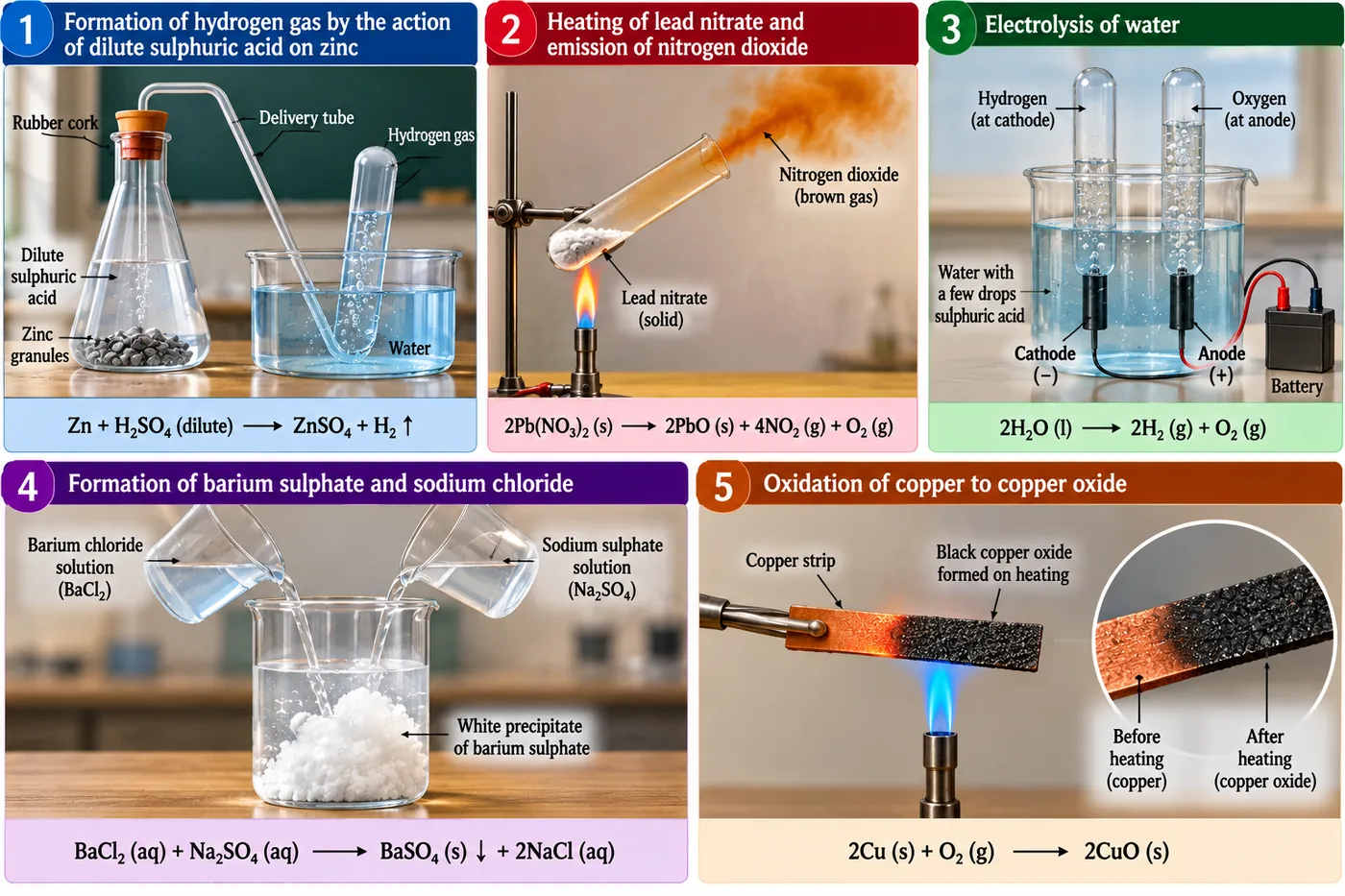
- Evolution of a gas — e.g. zinc in dilute sulphuric acid gives bubbles of hydrogen.
- Change in temperature — e.g. quicklime with water becomes very hot.
- Formation of a precipitate — an insoluble solid that separates out of a solution.
Example: a cleaned magnesium ribbon burns in air with a dazzling white flame and leaves a white powder of magnesium oxide: 2Mg + O2 → 2MgO. (Cleaning with sandpaper removes the oxide layer on the ribbon.)
3. Writing and Balancing Chemical Equations
A word equation names the substances: magnesium + oxygen → magnesium oxide. Replacing names by formulae gives a skeletal equation: Mg + O2 → MgO. Because mass is conserved (law of conservation of mass), the number of atoms of each element must be the same on both sides. An equation with equal atoms on both sides is a balanced equation.
Steps to balance (hit-and-trial method)
- Write the skeletal equation: Fe + H2O → Fe3O4 + H2.
- Start with the compound having the most atoms (Fe3O4); balance O: 4 on the right, so write 4H2O.
- Now H: 8 on the left, so write 4H2.
- Finally Fe: 3 on the right, so write 3Fe.
- Check every element: 3Fe + 4H2O → Fe3O4 + 4H2.
Never change the formula (subscripts) to balance — only change the numbers in front (coefficients). To make an equation more informative, add physical states (s), (l), (g), (aq) and conditions over the arrow, e.g. 3Fe(s) + 4H2O(g) → Fe3O4(s) + 4H2(g). Conditions such as heat, light, pressure or a catalyst are written above or below the arrow.
4. Types of Chemical Reactions
(a) Combination reaction
Two or more reactants form a single product. CaO(s) + H2O(l) → Ca(OH)2(aq) + heat. Quicklime reacts vigorously with water to give slaked lime. A solution of slaked lime is used for whitewashing; it slowly reacts with CO2 in air to form a thin shiny layer of calcium carbonate: Ca(OH)2 + CO2 → CaCO3 + H2O. Other examples: C + O2 → CO2; 2H2 + O2 → 2H2O.
(b) Exothermic and endothermic reactions
Reactions that release heat are exothermic — burning natural gas (CH4 + 2O2 → CO2 + 2H2O), respiration (C6H12O6 + 6O2 → 6CO2 + 6H2O + energy) and decomposition of vegetable matter into compost. Reactions that absorb energy are endothermic — most decomposition reactions.
(c) Decomposition reaction
A single reactant breaks into two or more simpler products. Energy is needed in the form of heat, light or electricity:
- Thermal: 2FeSO4(s) → Fe2O3(s) + SO2(g) + SO3(g) — green crystals turn brown with a burning-sulphur smell. CaCO3 → CaO + CO2 (used to make quicklime for cement). 2Pb(NO3)2 → 2PbO + 4NO2 + O2 (brown fumes of NO2).
- Electrolytic: 2H2O(l) → 2H2(g) + O2(g). Hydrogen collects at the cathode and oxygen at the anode, in a volume ratio of 2 : 1.
- Photolytic: 2AgCl(s) → 2Ag(s) + Cl2(g) in sunlight; white silver chloride turns grey. Silver bromide behaves the same way — this is used in black-and-white photography.
(d) Displacement reaction
A more reactive element displaces a less reactive element from its compound. Fe(s) + CuSO4(aq) → FeSO4(aq) + Cu(s): the iron nail becomes brownish (copper coating) and the blue solution fades to pale green. Similarly Zn + CuSO4 → ZnSO4 + Cu and Pb + CuCl2 → PbCl2 + Cu.
(e) Double displacement reaction
Two compounds exchange ions. Na2SO4(aq) + BaCl2(aq) → BaSO4(s) + 2NaCl(aq). The insoluble white BaSO4 is a precipitate, so this is also a precipitation reaction.
5. Oxidation and Reduction
When copper powder is heated in air, its surface turns black: 2Cu + O2 → 2CuO — copper has gained oxygen, so it is oxidised. If hydrogen is passed over hot copper oxide, the black coating turns brown again: CuO + H2 → Cu + H2O. Here CuO loses oxygen (is reduced) while H2 gains oxygen (is oxidised).
- Oxidation: gain of oxygen or loss of hydrogen.
- Reduction: loss of oxygen or gain of hydrogen.
- Redox reaction: one substance is oxidised while another is reduced, in the same reaction.
- The substance that brings about oxidation is the oxidising agent (it gets reduced); the one that brings about reduction is the reducing agent (it gets oxidised).
More examples: ZnO + C → Zn + CO (ZnO reduced, C oxidised); MnO2 + 4HCl → MnCl2 + 2H2O + Cl2 (MnO2 reduced, HCl oxidised).
Effects of oxidation in daily life
- Corrosion: a metal is slowly attacked by moisture, air or acids. Iron rusts (reddish-brown hydrated iron oxide), copper gets a green coating, silver turns black. Corrosion damages bridges, car bodies and ships; painting, oiling and galvanising prevent it.
- Rancidity: fats and oils in food get oxidised and develop a bad smell and taste. It is prevented by adding antioxidants, storing food in air-tight containers, and flushing chip packets with nitrogen.
6. Master Table: Key Terms
| Term | Meaning / example |
|---|---|
| Balanced equation | Equal atoms of each element on both sides |
| Combination | A + B → AB; CaO + H2O → Ca(OH)2 |
| Decomposition | AB → A + B; thermal, electrolytic, photolytic |
| Displacement | A + BC → AC + B; Fe + CuSO4 → FeSO4 + Cu |
| Double displacement | AB + CD → AD + CB; gives a precipitate |
| Exothermic / endothermic | Heat released / heat absorbed |
| Oxidation / reduction | Gain of O or loss of H / loss of O or gain of H |
| Corrosion / rancidity | Oxidation of metals / of fats and oils |
7. Master Summary Table
| Activity | Observation | Type of reaction |
|---|---|---|
| Burning Mg ribbon | Dazzling white flame, white ash | Combination, exothermic |
| Quicklime + water | Hissing, beaker gets hot | Combination, exothermic |
| Heating FeSO4 | Green → brown, smell of burning sulphur | Thermal decomposition |
| AgCl in sunlight | White → grey | Photolytic decomposition |
| Iron nail in CuSO4 | Nail brown, solution blue → pale green | Displacement |
| Na2SO4 + BaCl2 | White precipitate | Double displacement, precipitation |
| Heating copper | Brown → black | Oxidation |
Chart — volumes of gases collected in electrolysis of water (ratio):
8. Mind Map
- Gas, colour, heat
- Precipitate, state
- Skeletal → balanced
- States, conditions
- Combination, decomposition
- Displacement, double displacement
- Exothermic
- Endothermic
- Oxidation, reduction
- Corrosion, rancidity
9. Tips and Tricks
- OIL RIG (for electrons, Class 11) — at this level remember: Oxidation = Oxygen in; Reduction = oxygen Removed.
- One reactant → many products = decomposition; many reactants → one product = combination.
- Electrolysis of water: “Hydrogen is Huge” — double volume, at the cathode (–).
- When balancing, leave H and O for the end if they appear in many compounds.
- Changing subscripts to balance (writing H2O2 instead of 2H2O).
- Calling Fe + CuSO4 a double displacement — only one compound exchanges partner, so it is displacement.
- Thinking all decomposition is by heat — light and electricity also decompose substances.
- Forgetting that in a redox reaction both processes happen together.
10. Important One-liners
- Mass is conserved in a chemical reaction, so equations must be balanced.
- Magnesium burns with a dazzling white flame forming MgO.
- Quicklime is CaO; slaked lime is Ca(OH)2.
- Respiration is an exothermic process.
- Ferrous sulphate crystals lose water and turn brown on heating.
- Silver chloride turns grey in sunlight — photolytic decomposition.
- Hydrogen and oxygen form in a 2 : 1 volume ratio in electrolysis of water.
- BaSO4 is a white precipitate.
- CuO + H2 → Cu + H2O is a redox reaction.
- Chips packets are flushed with nitrogen to prevent rancidity.
11. Exam-pattern Questions with Detailed Answers
Which of the following is a decomposition reaction?
- CaO + H2O → Ca(OH)2
- 2AgBr → 2Ag + Br2
- Zn + CuSO4 → ZnSO4 + Cu
- NaOH + HCl → NaCl + H2O
Show answer
One reactant (AgBr) breaks into two products in light. (A) is combination, (C) displacement, (D) neutralisation (double displacement).
Answer: (B)
Why is a magnesium ribbon cleaned with sandpaper before burning?
Show answer
To remove the layer of magnesium oxide (and dirt) on its surface, so that the metal reacts directly with oxygen.
Answer: To remove the protective oxide layer
Balance: Al + O2 → Al2O3
Show answer
O: 2 and 3 → LCM 6, so 3O2 and 2Al2O3; Al: 4 on right, so 4Al.
Answer: 4Al + 3O2 → 2Al2O3
Assertion (A): In the reaction CuO + H2 → Cu + H2O, CuO is the oxidising agent. Reason (R): CuO gives oxygen to hydrogen and itself gets reduced.
- Both true; R explains A
- Both true; R does not explain A
- A true, R false
- A false, R true
Show answer
The oxidising agent supplies oxygen and is reduced. CuO does exactly this.
Answer: (A)
An iron nail is dipped in copper sulphate solution for 20 minutes. State two observations and write the equation. Name the type of reaction.
Show answer
(i) A reddish-brown coating of copper forms on the nail. (ii) The blue colour of the solution fades and turns pale green (FeSO4). Fe + CuSO4 → FeSO4 + Cu. Iron is more reactive than copper, so this is a displacement reaction.
Answer: Displacement reaction
Why are decomposition reactions called the opposite of combination reactions? Give one equation for each.
Show answer
In combination, two or more substances join into one; in decomposition, one substance breaks into two or more. Combination: CaO + H2O → Ca(OH)2. Decomposition: CaCO3 → CaO + CO2.
Answer: Reverse processes — joining vs breaking
In the electrolysis of water, why is the volume of gas collected in one test tube double that in the other? Name both gases.
Show answer
2H2O → 2H2 + O2: two molecules of hydrogen form for every molecule of oxygen, so hydrogen (at the cathode) has double the volume of oxygen (at the anode).
Answer: H2 : O2 = 2 : 1 from the balanced equation
What is rancidity? Give two ways to prevent it.
Show answer
Rancidity is the oxidation of fats and oils in food, giving an unpleasant smell and taste. Prevention: add antioxidants; store in air-tight containers; flush packets with nitrogen; refrigerate.
Answer: Oxidation of fats/oils; antioxidants, nitrogen flushing
A white salt on heating gives a brown gas and a yellow residue (when hot). (a) Identify the salt. (b) Write the balanced equation. (c) Name the reaction type.
Show answer
(a) Lead nitrate, Pb(NO3)2. (b) 2Pb(NO3)2(s) → 2PbO(s) + 4NO2(g) + O2(g). The brown gas is NO2; PbO is the residue. (c) Thermal decomposition (endothermic).
Answer: Lead nitrate; thermal decomposition
Case-based: A student adds a solution of sodium sulphate to barium chloride solution. A white solid settles at the bottom. (a) Name the solid. (b) Write the balanced equation with states. (c) Classify the reaction in two ways. (d) Would the reaction occur if both products were soluble? Explain.
Show answer
(a) Barium sulphate. (b) Na2SO4(aq) + BaCl2(aq) → BaSO4(s) + 2NaCl(aq). (c) Double displacement and precipitation reaction. (d) No visible change would occur; the ions would just remain mixed in solution. Formation of an insoluble product (precipitate) removes ions from solution and drives the exchange.
Answer: BaSO4; double displacement + precipitation
Identify the substance oxidised, the substance reduced, the oxidising agent and the reducing agent: ZnO + C → Zn + CO.
Show answer
ZnO loses oxygen → reduced (it is the oxidising agent). C gains oxygen → oxidised (it is the reducing agent).
Answer: Oxidised: C; reduced: ZnO; oxidising agent: ZnO; reducing agent: C
Explain why the walls become shiny two to three days after whitewashing. Write both equations involved.
Show answer
Quicklime is slaked: CaO + H2O → Ca(OH)2 (exothermic combination). The slaked-lime solution applied to walls slowly reacts with carbon dioxide in the air: Ca(OH)2 + CO2 → CaCO3 + H2O. A thin layer of calcium carbonate forms, giving the shine.
Answer: Calcium carbonate layer forms from Ca(OH)2 + CO2
12. Quick Revision Summary
- Signs of a reaction: gas, colour change, temperature change, precipitate, change of state.
- Balance equations by changing coefficients only; add states and conditions.
- Combination (A + B → AB), decomposition (AB → A + B by heat, light or electricity), displacement, double displacement.
- Exothermic reactions release heat; most decompositions are endothermic.
- Oxidation = gain of O / loss of H; reduction = loss of O / gain of H; both together = redox.
- Corrosion and rancidity are harmful effects of oxidation; prevent with painting, galvanising, antioxidants, nitrogen.