
1. Chapter at a Glance
Lemon tastes sour, soap feels slippery and table salt is neither. Sour substances are acids, bitter and soapy substances are bases, and the products formed when they react are salts. In this chapter you will test acids and bases with indicators, study their chemical reactions, discover what all acids (and all bases) have in common, measure strength with the pH scale, and learn about important salts such as common salt, bleaching powder, baking soda, washing soda and plaster of Paris.
- Natural, synthetic and olfactory indicators.
- Reactions of acids and bases with metals, carbonates, oxides and each other.
- H+ (H3O+) and OH− ions; strong and weak acids/bases; pH.
- Importance of pH in everyday life.
- Preparation and uses of NaOH, bleaching powder, baking soda, washing soda and plaster of Paris.
2. Indicators
An indicator is a substance that shows a different colour (or smell) in acidic and basic solutions.
| Indicator | In acid | In base |
|---|---|---|
| Blue litmus | Turns red | No change |
| Red litmus | No change | Turns blue |
| Phenolphthalein | Colourless | Pink |
| Methyl orange | Red | Yellow |
| Turmeric | Yellow (no change) | Reddish-brown |
| Onion / vanilla / clove (olfactory) | Smell remains | Smell disappears |
Litmus is a natural dye from lichens. Red cabbage leaves, coloured petals of hydrangea, petunia and geranium also act as natural indicators. A yellow turmeric stain on a cloth turns red when washed with soap, because soap is basic.
| Natural source | Acid present |
|---|---|
| Vinegar | Acetic (ethanoic) acid |
| Orange, lemon | Citric acid |
| Tamarind | Tartaric acid |
| Tomato | Oxalic acid |
| Sour milk (curd) | Lactic acid |
| Ant sting, nettle sting | Methanoic acid |
3. Chemical Properties of Acids and Bases
(a) With metals
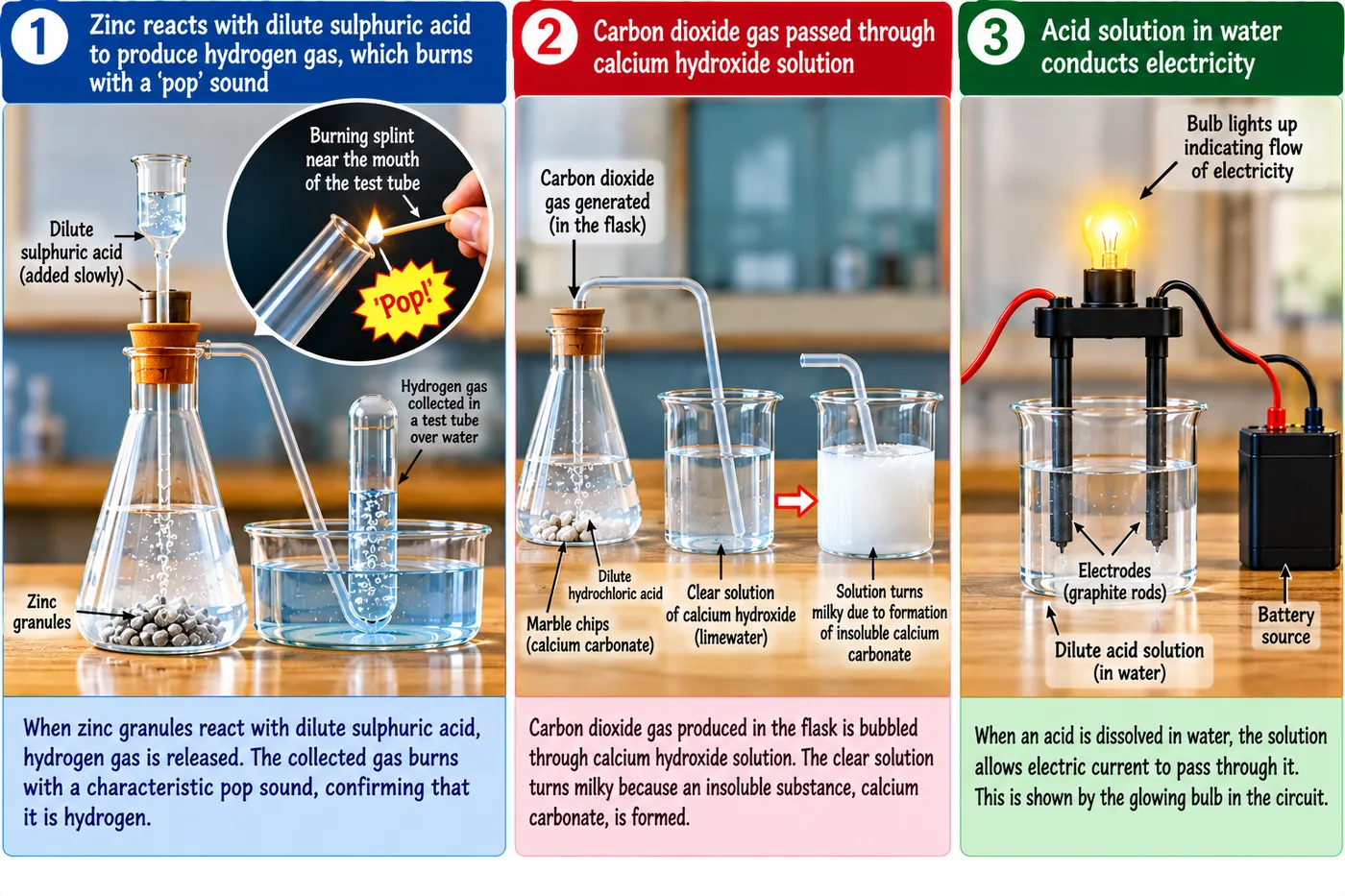
Acid + metal → salt + hydrogen. Zn + H2SO4 → ZnSO4 + H2. The gas burns with a pop sound when a burning splinter is brought near — the test for hydrogen. Some bases also give hydrogen with metals: 2NaOH + Zn → Na2ZnO2 (sodium zincate) + H2. (Not all metals react this way.)
(b) With metal carbonates and hydrogencarbonates
Acid + metal carbonate/hydrogencarbonate → salt + carbon dioxide + water. Na2CO3 + 2HCl → 2NaCl + H2O + CO2; NaHCO3 + HCl → NaCl + H2O + CO2. CO2 turns limewater milky: Ca(OH)2 + CO2 → CaCO3 + H2O. With excess CO2, the milkiness disappears as soluble calcium hydrogencarbonate forms: CaCO3 + H2O + CO2 → Ca(HCO3)2. Limestone, chalk and marble are all forms of calcium carbonate.
(c) Neutralisation
Acid + base → salt + water. NaOH + HCl → NaCl + H2O. Phenolphthalein added to NaOH is pink; adding HCl drop by drop makes it colourless at neutralisation.
(d) With oxides
Metal oxides are basic: CuO + 2HCl → CuCl2 + H2O (black powder dissolves, solution turns blue-green). Non-metal oxides are acidic: Ca(OH)2 + CO2 → CaCO3 + H2O.
4. What Do All Acids and All Bases Have in Common?
Solutions of HCl and H2SO4 conduct electricity, while solutions of glucose and alcohol do not — even though all contain hydrogen. Acids produce H+ ions in water: HCl + H2O → H3O+ + Cl−. H+ cannot exist alone; it joins water to form the hydronium ion (H3O+). Dry HCl gas does not change the colour of dry blue litmus, showing that acidic behaviour needs water.
Bases produce OH− ions in water: NaOH → Na+ + OH−. Bases that dissolve in water are called alkalis (NaOH, KOH, Ca(OH)2). Neutralisation is essentially H+ + OH− → H2O.
Dissolving acid in water is highly exothermic. Always add acid slowly to water, with stirring, never water to acid — otherwise the mixture may splash and the glass container may crack.
5. Strength of Acids and Bases: the pH Scale
The pH scale (p from the German “potenz”, meaning power) measures H+ ion concentration from 0 to 14. pH 7 is neutral; below 7 is acidic (lower = stronger); above 7 is basic (higher = stronger). A universal indicator shows different colours across the pH range. Strong acids (HCl, H2SO4, HNO3) give many H+ ions; weak acids (acetic, citric) give fewer. Strong bases: NaOH, KOH; weak base: NH4OH.
Importance of pH in everyday life
- Our body works within pH 7.0–7.8. Rain with pH below 5.6 is acid rain; it makes rivers acidic and harms aquatic life.
- Soil: plants need a suitable pH; farmers test soil and add lime or other materials to correct it.
- Digestion: the stomach makes HCl. Excess acid causes indigestion; antacids such as milk of magnesia, Mg(OH)2, neutralise it.
- Tooth decay starts when mouth pH falls below 5.5, as bacteria break down sugar into acids that corrode enamel (calcium hydroxyapatite). Basic toothpastes neutralise the acid.
- Stings: bee and ant stings inject methanoic acid; rubbing a mild base such as baking soda gives relief. The nettle sting is treated with the leaf of the dock plant growing nearby.
6. More About Salts
Salts with the same positive or negative radical belong to a family (e.g. NaCl and Na2SO4 are sodium salts; NaCl and KCl are chloride salts). Salts of strong acid + strong base are neutral (NaCl, pH 7); strong acid + weak base give acidic salts (NH4Cl); weak acid + strong base give basic salts (Na2CO3, CH3COONa).
| Chemical | Formula | Preparation | Uses |
|---|---|---|---|
| Sodium hydroxide | NaOH | Chlor-alkali process: 2NaCl + 2H2O → 2NaOH + Cl2 + H2 | Soaps, paper, degreasing metals; Cl2 and H2 also useful |
| Bleaching powder | CaOCl2 | Ca(OH)2 + Cl2 → CaOCl2 + H2O | Bleaching cotton and paper; disinfecting drinking water; oxidising agent |
| Baking soda | NaHCO3 | NaCl + H2O + CO2 + NH3 → NH4Cl + NaHCO3 | Baking powder (with tartaric acid), antacid, soda-acid fire extinguishers |
| Washing soda | Na2CO3·10H2O | Recrystallising sodium carbonate from water | Glass, soap, paper; removing permanent hardness of water; cleaning |
| Plaster of Paris | CaSO4·½H2O | Heating gypsum (CaSO4·2H2O) at 373 K | Plaster for fractures, toys, decorative items, smooth surfaces |
On heating, baking soda gives CO2, which makes cakes rise: 2NaHCO3 → Na2CO3 + H2O + CO2. Tartaric acid in baking powder neutralises the bitter sodium carbonate. Plaster of Paris mixed with water sets into hard gypsum: CaSO4·½H2O + 1½H2O → CaSO4·2H2O.
Water of crystallisation is the fixed number of water molecules in one formula unit of a salt crystal. Blue copper sulphate (CuSO4·5H2O) turns white on heating as it loses this water; adding water brings back the blue colour.
7. Master Table: Key Terms
| Term | Meaning |
|---|---|
| Acid | Gives H+ (H3O+) ions in water; pH < 7 |
| Base / alkali | Gives OH− ions; alkali = water-soluble base |
| Neutralisation | Acid + base → salt + water |
| Olfactory indicator | Odour changes in acid/base (onion, vanilla, clove) |
| pH | Scale 0–14 of H+ concentration; 7 neutral |
| Chlor-alkali process | Electrolysis of brine → NaOH, Cl2, H2 |
| Water of crystallisation | Fixed water in a salt crystal, e.g. CuSO4·5H2O |
8. Master Summary Table
| Reaction | General result | Test / observation |
|---|---|---|
| Acid + metal | Salt + H2 | Pop sound with a burning splinter |
| Acid + carbonate | Salt + CO2 + H2O | Limewater turns milky |
| Acid + base | Salt + water | Indicator colour changes |
| Acid + metal oxide | Salt + water | Metal oxides are basic |
| Base + non-metal oxide | Salt + water | Non-metal oxides are acidic |
Chart — approximate pH of some common substances:
9. Mind Map
- Litmus, phenolphthalein
- Turmeric, olfactory
- Metals, carbonates
- Neutralisation, oxides
- H3O+, OH−
- Strong vs weak
- 0–14 scale
- Body, soil, teeth
- NaOH, CaOCl2
- NaHCO3, Na2CO3·10H2O, PoP
10. Tips and Tricks
- Litmus: “BRA” — Blue turns Red in Acid.
- Phenolphthalein: “colourless in acid, pink in base” — a pink colour that disappears tells you the base has been neutralised.
- Plaster of Paris has half a water molecule; gypsum has two.
- Baking soda = NaHCO3 (one Na); washing soda = Na2CO3·10H2O (ten waters).
- All bases are not alkalis — only water-soluble ones are.
- Lower pH means more acidic, not less.
- Bleaching powder is CaOCl2, not CaCl2.
- Water must not be added to concentrated acid.
11. Important One-liners
- Litmus is extracted from lichens.
- Hydrogen gas burns with a pop sound.
- CO2 turns limewater milky; excess CO2 clears it.
- Metal oxides are basic; non-metal oxides are acidic.
- H+ ions exist in water as H3O+.
- Tooth decay starts below pH 5.5.
- Milk of magnesia is used as an antacid.
- Ant stings contain methanoic acid.
- Chlor-alkali process gives NaOH, Cl2 and H2.
- Plaster of Paris is made by heating gypsum at 373 K.
12. Exam-pattern Questions with Detailed Answers
A solution turns red litmus blue. Its pH is likely to be:
- 1
- 4
- 5
- 10
Show answer
Red litmus turns blue in a base; bases have pH above 7.
Answer: (D) 10
Name the acid present in (a) tomato (b) curd (c) ant sting.
Show answer
(a) Oxalic acid (b) Lactic acid (c) Methanoic acid.
Answer: Oxalic, lactic, methanoic
What is the common name and formula of the compound used to disinfect drinking water?
Show answer
Bleaching powder, CaOCl2.
Answer: Bleaching powder, CaOCl2
Assertion (A): Dry HCl gas does not change the colour of dry blue litmus paper. Reason (R): HCl produces H+ ions only in the presence of water.
- Both true; R explains A
- Both true; R does not explain A
- A true, R false
- A false, R true
Show answer
Without water no H+/H3O+ ions form, so there is no acidic behaviour.
Answer: (A)
Why does an aqueous solution of glucose not conduct electricity, while dilute HCl does?
Show answer
HCl ionises in water into H3O+ and Cl− ions, which carry current. Glucose does not ionise; it stays as neutral molecules, so no ions are available.
Answer: HCl forms ions; glucose does not
Why should curd and sour substances not be kept in brass or copper vessels?
Show answer
They contain acids, which react with copper and brass (an alloy of copper and zinc) to form poisonous salts that spoil the food and can harm health.
Answer: Acids react with the metal to form harmful salts
What happens when baking soda is heated? Write the equation and explain why baking powder contains tartaric acid.
Show answer
2NaHCO3 → Na2CO3 + H2O + CO2. The CO2 makes dough rise. Sodium carbonate alone would give a bitter taste; tartaric acid neutralises it and also reacts with NaHCO3 to release more CO2.
Answer: CO2 released; tartaric acid removes bitterness
Five solutions A–E have pH 4, 1, 11, 7 and 9. Which is (a) neutral (b) strongly alkaline (c) strongly acidic (d) weakly acidic (e) weakly alkaline? Arrange in increasing H+ concentration.
Show answer
(a) D (7) (b) C (11) (c) B (1) (d) A (4) (e) E (9). Lower pH = more H+, so increasing order: C < E < D < A < B.
Answer: C (11) < E (9) < D (7) < A (4) < B (1)
A milkman adds a very small amount of baking soda to fresh milk. (a) Why does he shift the pH from 6 to slightly alkaline? (b) Why does this milk take longer to set as curd?
Show answer
(a) Slightly alkaline milk does not turn sour quickly, because the lactic acid formed by bacteria is neutralised. (b) Curd forms when enough lactic acid accumulates; the baking soda first neutralises the acid, so it takes longer for the acidity needed for setting to build up.
Answer: Prevents early souring; acid is neutralised first, so setting is delayed
Case-based: Marble chips are added to dilute HCl in a flask. The gas is passed through limewater, which turns milky, and on passing more gas the milkiness disappears. (a) Name the gas. (b) Write equations for all three reactions. (c) Why does the milkiness disappear?
Show answer
(a) CO2. (b) CaCO3 + 2HCl → CaCl2 + H2O + CO2; Ca(OH)2 + CO2 → CaCO3↓ + H2O; CaCO3 + H2O + CO2 → Ca(HCO3)2. (c) Insoluble CaCO3 changes into soluble calcium hydrogencarbonate.
Answer: CO2; soluble Ca(HCO3)2 forms
Why does a 1 M solution of HCl have a lower pH than a 1 M solution of acetic acid?
Show answer
HCl is a strong acid and ionises almost completely, producing a high H+ concentration. Acetic acid is weak and ionises only partly, giving fewer H+ ions. More H+ means lower pH.
Answer: HCl ionises completely; acetic acid only partially
Plaster of Paris should be stored in a moisture-proof container. Explain with an equation. What is the role of the “half” water molecule?
Show answer
Plaster of Paris absorbs water and sets into a hard solid mass of gypsum: CaSO4·½H2O + 1½H2O → CaSO4·2H2O. Moist air would make it set in the container and become useless. “½H2O” means two formula units of CaSO4 share one water molecule as water of crystallisation.
Answer: It sets into gypsum on absorbing water
13. Quick Revision Summary
- Indicators: litmus, phenolphthalein, methyl orange, turmeric; olfactory — onion, vanilla, clove.
- Acid + metal → salt + H2; acid + carbonate → salt + CO2 + water; acid + base → salt + water.
- Acids give H3O+, bases give OH− in water; add acid to water when diluting.
- pH: 0–14; 7 neutral; important for body, soil, teeth and digestion.
- Key salts: NaOH (chlor-alkali), CaOCl2, NaHCO3, Na2CO3·10H2O, CaSO4·½H2O.