
1. Chapter at a Glance
Everything around us — air, water, soil, plants, animals and microbes — makes up our environment. Living things depend on each other and on non-living factors, forming ecosystems. Energy enters an ecosystem from the Sun and flows step by step through food chains and food webs; only a small part passes from one level to the next. Harmful chemicals, on the other hand, accumulate as they move up the chain. This chapter also examines how human activities — depleting the ozone layer and producing non-biodegradable waste — affect the environment.
- Ecosystem and its components; natural and artificial ecosystems.
- Producers, consumers, decomposers; food chains, trophic levels, food webs.
- Flow of energy and the 10 percent law.
- Biological magnification.
- Ozone layer depletion; biodegradable and non-biodegradable waste.
2. Ecosystem and Its Components
All the organisms in an area together with the non-living factors of their environment form an ecosystem. The living parts are the biotic components (plants, animals, microorganisms); the physical factors such as temperature, rainfall, wind, soil and minerals are the abiotic components. Forests, ponds and lakes are natural ecosystems; gardens, crop fields and aquariums are human-made (artificial) ecosystems. An aquarium needs regular cleaning because it has no natural decomposers to break down wastes.
- Producers: green plants and blue-green algae make food by photosynthesis using sunlight.
- Consumers: depend on producers directly or indirectly — herbivores (plant-eaters), carnivores (flesh-eaters), omnivores (both) and parasites.
- Decomposers: bacteria and fungi break down dead remains and wastes into simple substances that go back into the soil to be used again by plants — they replenish the soil.
3. Food Chains, Trophic Levels and Food Webs
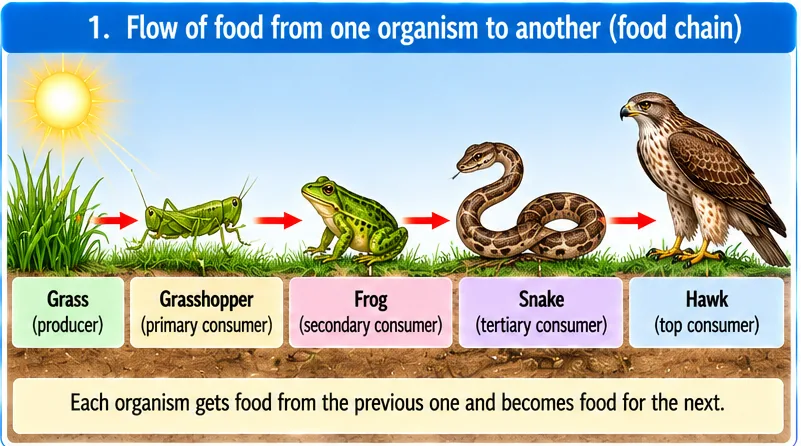
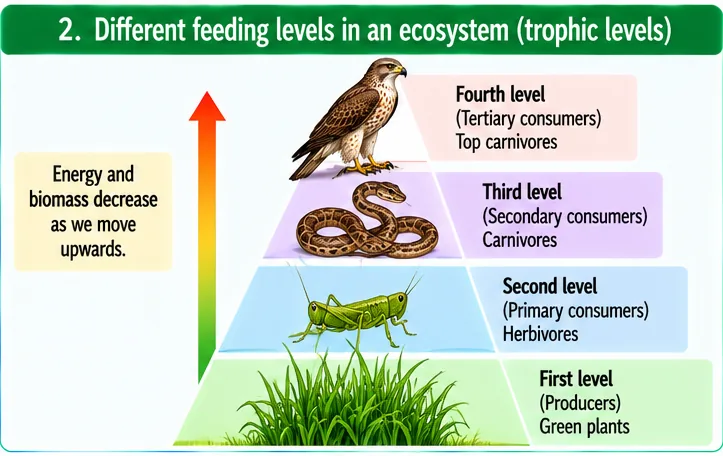
A series of organisms taking part in feeding at various levels is a food chain, e.g. grass → grasshopper → frog → snake → eagle. Each step or level of the chain is a trophic level.
- First trophic level — producers (autotrophs).
- Second — primary consumers (herbivores).
- Third — secondary consumers (small carnivores).
- Fourth — tertiary consumers (large carnivores).
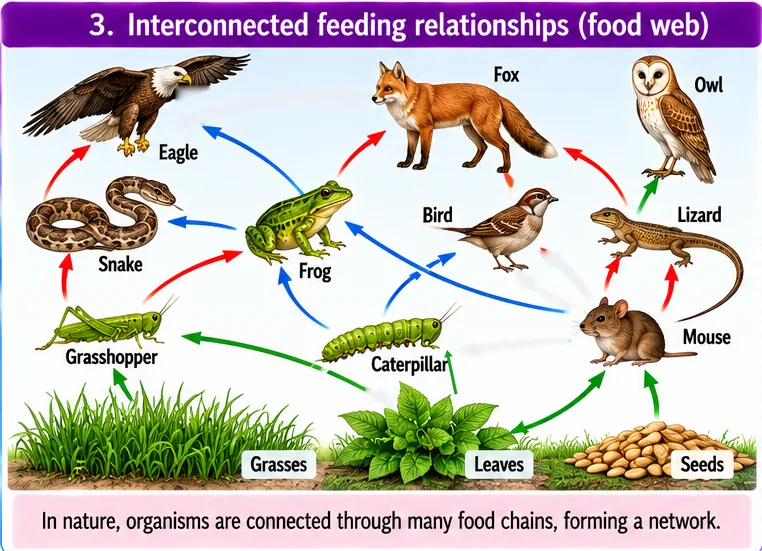
In nature, an organism is often eaten by more than one kind of animal and eats more than one kind of food. Food chains therefore interlink to form a food web. Food webs make an ecosystem more stable: if one food source becomes scarce, consumers can switch to another.
4. Flow of Energy
- Green plants capture about 1% of the energy of sunlight falling on their leaves and convert it into food energy.
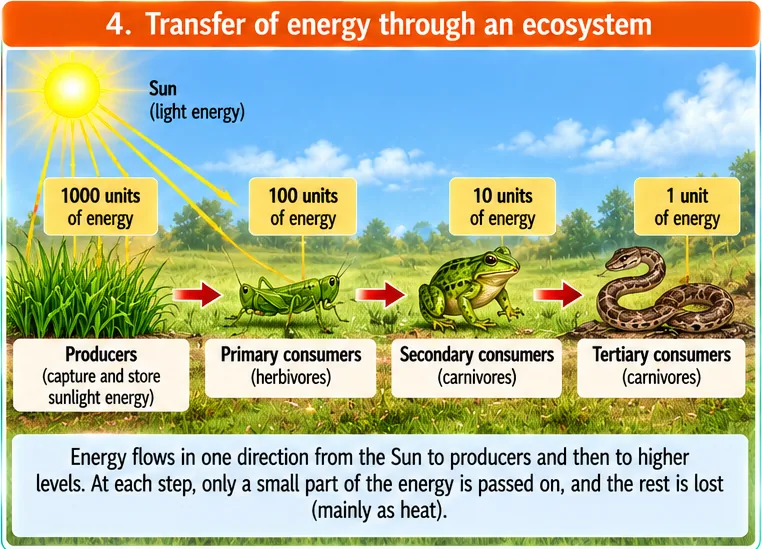
- When a herbivore eats a plant, a large part of the food energy is used for its own life processes (respiration, movement), lost as heat, or remains undigested. Only about 10% of the energy is passed on to the next trophic level as body matter — the 10 percent law.
- Because so little energy reaches higher levels, food chains generally have only three or four steps, and the number of organisms at higher levels is smaller.
- The flow of energy is unidirectional: energy captured by producers does not go back to the Sun, and energy passed to herbivores does not return to plants. It moves progressively through the levels and is no longer available to the previous level.
5. Biological Magnification
Pesticides and other chemicals used to protect crops are washed into the soil and water bodies. Plants absorb them along with water and minerals, and they enter food chains. These chemicals are not degradable, so they accumulate progressively at each trophic level. This increase in the concentration of harmful chemicals at higher trophic levels is biological magnification. Human beings occupy the top level in many food chains, so the maximum concentration accumulates in our bodies. This is why food grains such as wheat and rice, vegetables, fruits and even meat can contain pesticide residues that cannot always be removed by washing.
6. Ozone Layer and Its Depletion
Ozone (O3) is a molecule of three oxygen atoms. At ground level it is a deadly poison, but in the higher atmosphere it forms a shield that absorbs harmful ultraviolet (UV) radiation from the Sun, which can cause skin cancer. Ozone forms when high-energy UV radiation splits oxygen molecules: O2 → O + O, and the free oxygen atoms combine with O2: O + O2 → O3.
The amount of ozone began to drop sharply in the 1980s. This decrease was linked to synthetic chemicals such as chlorofluorocarbons (CFCs), used as refrigerants and in fire extinguishers. In 1987, the United Nations Environment Programme (UNEP) succeeded in forging an agreement to freeze CFC production at 1986 levels. Manufacturers now make CFC-free refrigerators.
7. Managing the Garbage We Produce
Substances broken down by biological processes (decomposers) are biodegradable — vegetable peels, paper, leaves, cotton, wood. Substances not broken down by biological processes are non-biodegradable — plastics, polythene, glass, metals, some pesticides like DDT. Non-biodegradable materials may be inert and simply persist for a long time, or may harm various members of the ecosystem.
- Segregate kitchen waste (biodegradable) from plastic and glass.
- Compost biodegradable waste; recycle paper, plastic and metals.
- Avoid single-use plastics; use cloth or jute bags.
- Changes in packaging (disposable cups replacing kulhads or reusable cups) increase waste; reusable alternatives help.
8. Master Table: Key Terms
| Term | Meaning |
|---|---|
| Ecosystem | Biotic + abiotic components of an area interacting together |
| Trophic level | Each step of a food chain |
| Food web | Network of interconnected food chains |
| 10 percent law | ~10% of energy passes to the next trophic level |
| Biological magnification | Increase of harmful chemicals up the food chain |
| Ozone | O3; absorbs UV in the upper atmosphere |
| Biodegradable | Broken down by decomposers |
9. Master Summary Table
| Trophic level | Organisms | Example | Energy (10% law, illustrative) |
|---|---|---|---|
| 1st | Producers | Grass | 10 000 J |
| 2nd | Primary consumers | Grasshopper, deer | 1000 J |
| 3rd | Secondary consumers | Frog | 100 J |
| 4th | Tertiary consumers | Snake, eagle | 10 J |
Chart — energy available at each trophic level by the 10 percent law (starting from 1000 units, illustrative):
10. Mind Map
- Biotic, abiotic
- Natural, artificial
- Chains, trophic levels
- Food webs
- 1% captured by plants
- 10% law, one-way flow
- Biomagnification
- Ozone depletion (CFCs)
- Biodegradable / not
- Reduce, reuse, recycle
11. Tips and Tricks
- Energy: divide by 10 at each step. Chemicals (pesticides): increase at each step.
- Arrows in food chains point from the eaten to the eater (direction of energy flow).
- Ozone: “good up high, bad nearby”.
- Drawing arrows from the eater to the food.
- Saying energy flow is cyclic — it is one-way; nutrients cycle.
- Saying plants capture 10% of sunlight — it is about 1%.
- Calling ozone harmless everywhere — it is toxic at ground level.
12. Important One-liners
- Decomposers return nutrients to the soil.
- An aquarium is an artificial ecosystem.
- The first trophic level is always the producers.
- About 10% energy passes to the next level.
- Food chains usually have 3–4 trophic levels.
- Energy flow in an ecosystem is unidirectional.
- Pesticides accumulate most in top consumers.
- CFCs deplete the ozone layer.
- UNEP agreement in 1987 froze CFC production at 1986 levels.
- Plastics are non-biodegradable.
13. Exam-pattern Questions with Detailed Answers
Which of the following constitutes a food chain?
- Grass, wheat, mango
- Grass, goat, human
- Goat, cow, elephant
- Grass, fish, goat
Show answer
Grass (producer) is eaten by goat (herbivore), which is eaten by humans.
Answer: (B)
Which of these are biodegradable: polythene, grass, glass, paper, aluminium foil, cow dung?
Show answer
Grass, paper and cow dung are broken down by decomposers.
Answer: Grass, paper, cow dung
Why does an aquarium need regular cleaning while a pond does not?
Show answer
An aquarium lacks natural decomposers to break down wastes; a pond has decomposers and is self-sustaining.
Answer: No decomposers in an aquarium
Assertion (A): The number of trophic levels in a food chain is limited. Reason (R): Only about 10% of energy is transferred to the next trophic level.
- Both true; R explains A
- Both true; R does not explain A
- A true, R false
- A false, R true
Show answer
After 3–4 steps, too little energy remains to support another level.
Answer: (A)
If 10 000 J of solar energy is captured by plants in a food chain plant → deer → lion, how much energy is available to the lion?
Show answer
Deer: 10% of 10 000 = 1000 J; lion: 10% of 1000 = 100 J.
Answer: 100 J
What will happen if all the organisms in one trophic level are killed?
Show answer
Organisms of the next level would lose their food and decline; organisms of the previous level would multiply without control. The balance of the ecosystem would be disturbed. (If producers die, all other levels collapse.)
Answer: Ecosystem balance is upset
How is ozone formed in the upper atmosphere? Why is its depletion a concern?
Show answer
UV radiation splits O2 into free oxygen atoms (O2 → O + O), which combine with O2 to form O3. Depletion allows more UV to reach the Earth, causing skin cancer, eye damage and harm to plants and aquatic life.
Answer: O2 → O + O; O + O2 → O3; UV harm
Why is the flow of energy said to be unidirectional?
Show answer
Energy captured by producers does not return to the Sun, and energy passed to herbivores does not return to producers. It moves only forward through trophic levels and is partly lost as heat at each level.
Answer: It never moves back to a previous level
A pesticide reaches a lake at 0.02 ppm. It is found at 5 ppm in fish and 25 ppm in fish-eating birds. (a) Name this phenomenon. (b) Why does the concentration increase? (c) Which organism would be most affected?
Show answer
(a) Biological magnification. (b) The pesticide is non-biodegradable and is not excreted; each consumer eats many organisms of the lower level, so the chemical accumulates. (c) The fish-eating birds (top level) — illustrative values given in the question.
Answer: Biomagnification; top consumers most affected
Case-based: Study the food web in this chapter. (a) Name two food chains from it ending in the eagle. (b) Name an organism that is both a secondary and a tertiary consumer. (c) Why is a food web more stable than a single food chain?
Show answer
(a) Grass → grasshopper → snake → eagle; grass → grasshopper → frog → eagle (or frog → snake → eagle). (b) The snake — secondary when it eats a grasshopper, tertiary when it eats a frog. (c) Consumers have alternative food sources; if one population falls, others can be eaten, so the ecosystem is not disrupted easily.
Answer: Snake can occupy two levels; webs offer alternative food
Why are decomposers called the “cleaning agents” of an ecosystem? What would happen without them?
Show answer
They break down dead plants, animals and wastes into simple substances, returning nutrients to soil and water for reuse by plants. Without them, dead matter would pile up, nutrients would be locked away, and plants would eventually lack minerals — the ecosystem would break down.
Answer: They recycle nutrients and remove dead matter
Suggest four practical ways your school can reduce non-biodegradable waste.
Show answer
(1) Separate dustbins for biodegradable and non-biodegradable waste; (2) compost canteen and garden waste; (3) ban single-use plastic cups and bags — use steel tumblers and cloth bags; (4) collect paper, bottles and cans for recycling; (5) print on both sides and use digital notices.
Answer: Segregate, compost, avoid single-use plastic, recycle
14. Quick Revision Summary
- Ecosystem = biotic + abiotic; producers, consumers, decomposers.
- Food chains (3–4 levels) link into food webs; arrows from food to eater.
- Plants capture ~1% of sunlight; ~10% passes to each next level; energy flow is one-way.
- Non-biodegradable chemicals magnify up the chain; humans at the top are most affected.
- Ozone (O3) shields UV; CFCs deplete it; UNEP agreement 1987.
- Biodegradable vs non-biodegradable waste; reduce, reuse, recycle.