
1. Chapter at a Glance
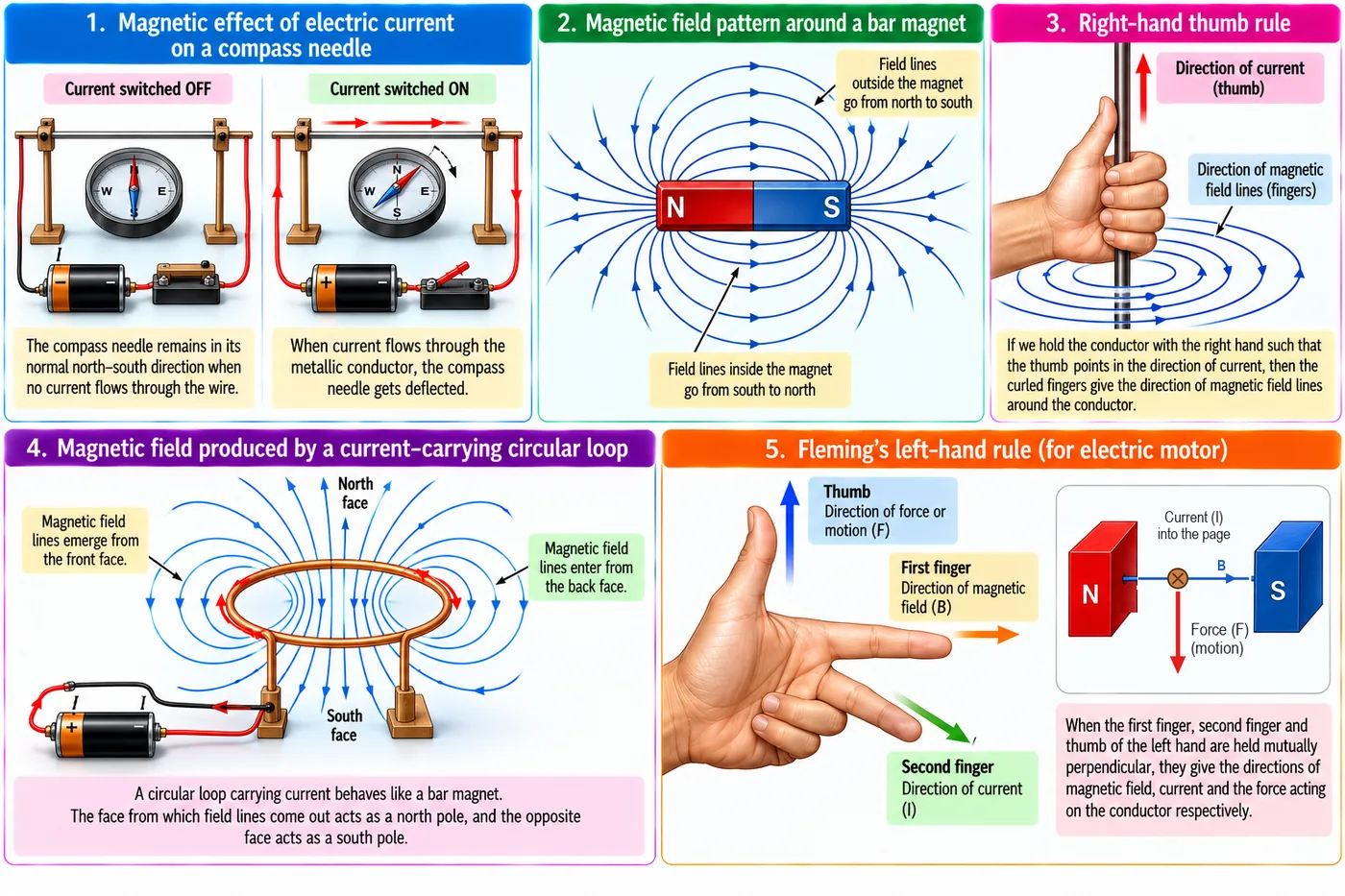
In 1820, Hans Christian Oersted noticed that a compass needle placed near a current-carrying wire was deflected. Electricity and magnetism are linked: an electric current produces a magnetic field, and a magnetic field exerts a force on a current-carrying conductor. This chapter describes magnetic fields and field lines, the fields produced by a straight wire, a circular loop and a solenoid, the rules that give their directions, the force on a conductor (Fleming's left-hand rule), and how electricity is safely distributed in domestic electric circuits.
- Magnetic field and properties of field lines.
- Field due to a straight conductor (right-hand thumb rule), circular loop and solenoid; electromagnets.
- Force on a current-carrying conductor; Fleming's left-hand rule; applications.
- Domestic circuits: live, neutral and earth wires; fuse; short-circuit and overloading.
2. Magnetic Field and Field Lines
A compass needle is a small bar magnet; its north-pointing end is the north pole. Like poles repel, unlike poles attract. The region around a magnet where its force can be detected is the magnetic field — a quantity with both magnitude and direction. Iron filings sprinkled around a bar magnet arrange themselves along magnetic field lines.
- Outside the magnet, field lines go from the north pole to the south pole; inside, from south to north. They are closed curves.
- The direction of the field at a point is the direction in which the north pole of a compass points.
- Where lines are crowded, the field is stronger (near the poles).
- No two field lines intersect — otherwise a compass at the crossing would point in two directions at once.
3. Magnetic Field Due to a Current
Straight conductor
The field lines around a straight current-carrying wire are concentric circles centred on the wire, in a plane perpendicular to it. Reversing the current reverses the field direction. The field increases with current and decreases with distance from the wire.
Right-hand thumb rule (Maxwell's corkscrew rule): hold the wire in your right hand with the thumb pointing along the current; the curled fingers give the direction of the magnetic field lines.
Circular loop
Near any part of the loop the field lines are almost concentric circles; at the centre of the loop they become nearly straight lines. Each segment of the loop contributes in the same direction inside, so the field at the centre is strengthened. A coil of n turns gives a field n times stronger than a single turn. One face of the loop acts as a north pole and the other as a south pole.
Solenoid
A solenoid is a long coil of many circular turns of insulated copper wire wrapped closely in the shape of a cylinder. Its field pattern is just like that of a bar magnet: one end behaves as a north pole, the other as south. Inside, the field lines are parallel straight lines — the field is uniform. A soft iron core placed inside a solenoid becomes strongly magnetised when current flows — an electromagnet. Its magnetism disappears when the current is switched off, unlike a permanent magnet. Electromagnets are used in cranes, electric bells and relays.
4. Force on a Current-carrying Conductor in a Magnetic Field
André-Marie Ampère suggested that if a current produces a force on a magnet, a magnet must also exert an equal and opposite force on the current. When a small aluminium rod carrying current is placed between the poles of a horseshoe magnet, it moves. The displacement (force) reverses if the current or the field is reversed, and it is largest when the current is perpendicular to the field. If the conductor is parallel to the field, no force acts.
Stretch the thumb, forefinger and middle finger of the left hand so that they are mutually perpendicular. If the forefinger points in the direction of the magnetic field and the middle finger in the direction of the current, then the thumb points in the direction of motion (force) on the conductor.
Devices using current-carrying conductors and magnetic fields include electric motors, electric generators, loudspeakers and microphones. Weak electric currents in the heart and brain also produce magnetic fields inside the body; these are used in MRI (magnetic resonance imaging) to obtain images of internal organs.
5. Domestic Electric Circuits
Electric power reaches our homes through a main supply (mains) by overhead poles or underground cables. One wire, usually with red insulation, is the live (positive) wire; the other, with black insulation, is the neutral (negative) wire. In India, the potential difference between them is 220 V. These wires pass through the electricity meter into the main switch and then connect to the house lines.
- Two separate circuits are often used: a 15 A rating for high-power appliances (geysers, air coolers) and a 5 A rating for bulbs and fans.
- The earth wire (green insulation) is connected to a metal plate deep in the earth near the house. Appliances with metal bodies (iron, toaster, refrigerator) are earthed so that any leaked current flows to the earth and the user does not get a severe shock. Earthing keeps the metal body at the potential of the earth.
- Each appliance has its own switch and all are connected in parallel, so each gets equal voltage.
- The fuse (or MCB — miniature circuit breaker) in series with the circuit protects against overloading and short-circuiting by melting (or tripping) when the current exceeds a safe value.
Short-circuit: the live and neutral wires come into direct contact (insulation damaged or appliance fault), so resistance becomes very low and current becomes very large. Overloading: too many appliances on one socket, or an accidental rise in supply voltage, draws excess current. Both can overheat wires and cause fires.
6. Master Table: Rules and Facts
| Rule / quantity | Use / statement |
|---|---|
| Field lines | N → S outside, S → N inside; closed; never cross |
| Right-hand thumb rule | Thumb = current; curled fingers = field direction |
| Straight wire field | ∝ current; decreases with distance |
| Coil of n turns | Field at centre n times one turn |
| Solenoid | Uniform field inside; acts like a bar magnet |
| Fleming's left-hand rule | Forefinger = field, middle = current, thumb = force |
| Domestic supply (India) | 220 V; live red, neutral black, earth green |
7. Master Summary Table
| Source of field | Shape of field lines | Strength depends on |
|---|---|---|
| Bar magnet | Curves from N to S | The magnet |
| Straight wire | Concentric circles | Current, distance |
| Circular loop | Circles near wire; straight at centre | Current, number of turns, radius |
| Solenoid | Parallel lines inside; bar-magnet pattern outside | Current, turns, iron core |
Chart — typical current ratings of household circuits (A):
8. Mind Map
- Field lines, compass
- Never intersect
- Straight wire, loop
- Solenoid, electromagnet
- Fleming's left-hand rule
- Motor, loudspeaker, MRI
- Live, neutral, earth
- Fuse, MCB, short-circuit
9. Tips and Tricks
- Fleming's left hand, from thumb down: “F-B-I” — thumb = Force (motion), first finger = B (field), second finger = I (current).
- Right hand for the field around a wire; left hand for the force on a wire (“Left for Lorentz force / motor”).
- Wire colours: Red = Risky live; Green = Ground (earth).
- Saying a force acts on a conductor parallel to the field — it is zero.
- Saying field lines can cross.
- Connecting a fuse in parallel — it must be in series.
- Confusing earthing (safety from leakage) with the neutral wire.
10. Important One-liners
- Oersted discovered that a current deflects a compass needle.
- Magnetic field lines are closed curves.
- Crowded field lines mean a stronger field.
- Field around a straight wire forms concentric circles.
- The field inside a long solenoid is uniform.
- A soft iron core makes an electromagnet.
- Force is maximum when current is perpendicular to the field.
- MRI uses magnetic fields produced inside the body.
- Domestic supply in India is 220 V.
- The earth wire has green insulation.
11. Exam-pattern Questions with Detailed Answers
The magnetic field lines inside a long current-carrying solenoid are:
- Circles
- Zero
- Parallel straight lines
- Random
Show answer
The field inside is uniform, shown by parallel straight lines.
Answer: (C)
Why don't two magnetic field lines intersect?
Show answer
At the point of intersection, a compass needle would point in two directions at once, which is impossible.
Answer: The field has only one direction at a point
State the colour of insulation of live, neutral and earth wires.
Show answer
Live — red; neutral — black; earth — green.
Answer: Red, black, green
Assertion (A): Metal-bodied appliances are earthed. Reason (R): Earthing provides a low-resistance path for any leaked current, protecting the user from shock.
- Both true; R explains A
- Both true; R does not explain A
- A true, R false
- A false, R true
Show answer
Leaked current flows to earth instead of through the person touching the body.
Answer: (A)
A current flows vertically upwards in a straight wire. What is the direction of the magnetic field at a point due east of the wire?
Show answer
Using the right-hand thumb rule (thumb up), the fingers curl anticlockwise when viewed from above. At a point to the east, the anticlockwise circle is heading north.
Answer: Towards the north
List three ways to increase the magnetic field of a solenoid.
Show answer
Increase the current; increase the number of turns; place a soft iron core inside.
Answer: More current, more turns, soft iron core
What is the difference between short-circuiting and overloading?
Show answer
Short-circuit: live and neutral wires touch directly, resistance drops to almost zero and a very large current flows. Overloading: too many appliances on one circuit or a voltage surge draws more current than the circuit is rated for. Both cause heating; a fuse/MCB protects against them.
Answer: Direct contact vs excess load
When is the force on a current-carrying conductor in a magnetic field (a) maximum (b) zero?
Show answer
(a) When the conductor (current) is perpendicular to the field. (b) When it is parallel (or antiparallel) to the field.
Answer: Perpendicular — maximum; parallel — zero
An electron beam moves horizontally from south to north, and a magnetic field acts vertically downward. In which direction is the beam deflected?
Show answer
Current is opposite to electron motion: north to south. Apply Fleming's left-hand rule — forefinger pointing down (field), middle finger pointing south (current): the thumb points towards the east.
Answer: Towards the east
Case-based: In a house, the fuse blows every time the geyser and the air conditioner are switched on together on the same socket circuit. (a) What is happening? (b) Why does the fuse melt? (c) Suggest a safe solution. (d) Why should a fuse of higher rating not simply be fitted?
Show answer
(a) Overloading — total current exceeds the circuit's rating. (b) The large current heats the fuse wire (H = I2Rt) above its melting point. (c) Run high-power appliances on separate 15 A power circuits, or use them one at a time. (d) The wiring itself may overheat and catch fire before a higher-rated fuse melts.
Answer: Overloading; use separate circuits, keep correct fuse rating
How does the magnetic field at the centre of a circular loop change if (a) current is doubled (b) radius is doubled (c) the loop has 50 turns?
Show answer
(a) Doubles (field ∝ current). (b) Becomes half (field decreases as radius increases — inversely proportional). (c) 50 times that of one turn, as fields of all turns add.
Answer: Doubles; halves; 50 times
Why is a solenoid with a soft iron core preferred to a permanent magnet in a crane that lifts scrap iron?
Show answer
The electromagnet's magnetism can be switched on to lift the scrap and switched off to release it; its strength can also be increased by more current or turns. A permanent magnet cannot release its load easily and its strength cannot be controlled.
Answer: Can be switched on/off and its strength controlled
12. Quick Revision Summary
- Field lines: N → S outside, closed, never cross; denser = stronger.
- Straight wire: concentric circles; right-hand thumb rule; ∝ I, weaker with distance.
- Loop: field at centre ∝ turns; solenoid: uniform inside, like a bar magnet; soft iron → electromagnet.
- Force on conductor: maximum ⊥ field; Fleming's left-hand rule; motors, loudspeakers, MRI.
- Home wiring: 220 V; live red, neutral black, earth green; parallel connections; fuse/MCB against short-circuit and overloading.