
1. Chapter at a Glance
Have you seen a magnet holding a note on a fridge door, or a magnetic pencil box that snaps shut? Magnets seem almost magical — they pull certain things without touching them. This chapter explores which materials magnets attract, where a magnet is strongest, how a magnet helps us find directions, and how two magnets attract or push each other.
- Natural magnets (lodestone) and artificial magnets of different shapes.
- Magnetic and non-magnetic materials.
- Poles of a magnet — North and South.
- Finding directions with a freely suspended magnet and a compass; making your own compass.
- Attraction and repulsion; magnets acting through non-magnetic materials; storing magnets safely.
2. Natural and Artificial Magnets
Long ago, people found a kind of rock that could attract pieces of iron. This naturally occurring magnet is called lodestone. Today, magnets are made in factories from iron and other materials. These are artificial magnets, and they come in many shapes: bar, U-shaped (horseshoe), ring, disc, cylindrical and spherical magnets.
3. Magnetic and Non-magnetic Materials
Bring a magnet close to different objects. Some stick to it; others do not.
- Magnetic materials are attracted by a magnet — iron, nickel and cobalt and objects made from them (iron nails, steel paper clips, pins).
- Non-magnetic materials are not attracted — wood, rubber, plastic, glass, paper, cloth and even many metals such as aluminium, copper and gold.
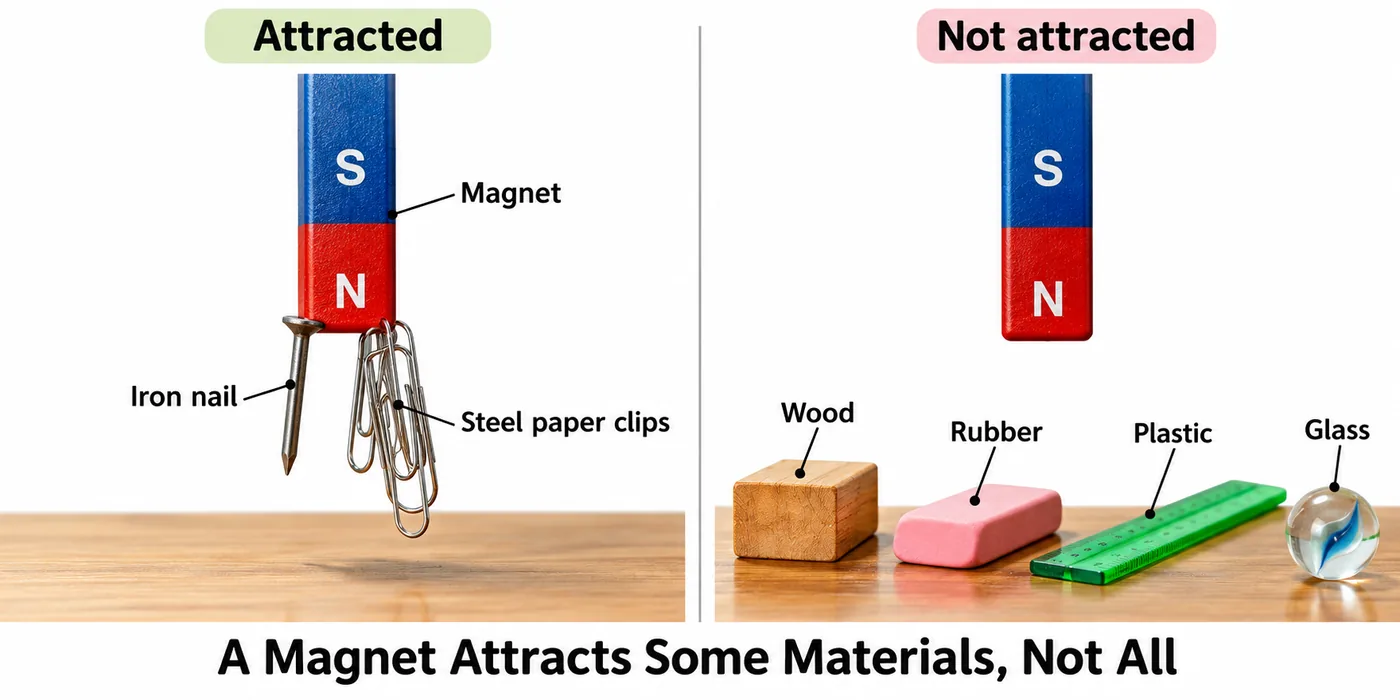
“All metals are attracted by a magnet” is wrong. Copper, aluminium, brass and gold are metals but non-magnetic.
4. Poles of a Magnet
Spread iron filings on a paper and roll a bar magnet in them. Most filings stick near the two ends, very few in the middle. The ends, where the attraction is strongest, are the poles of the magnet — the North pole (N) and the South pole (S).
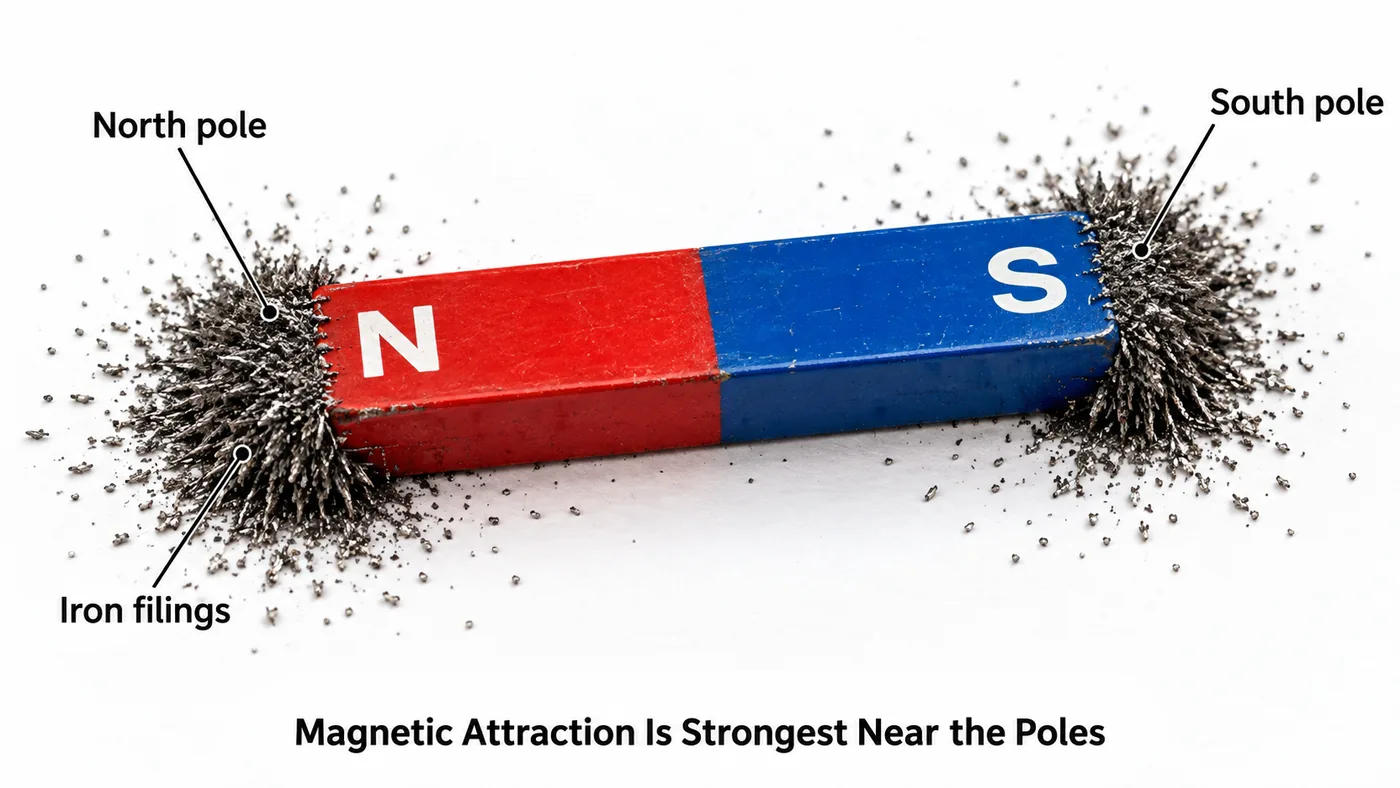
Poles always exist in pairs. If you break a magnet into two, each piece becomes a complete magnet with its own N and S pole. A single pole can never exist alone.
5. Finding Directions
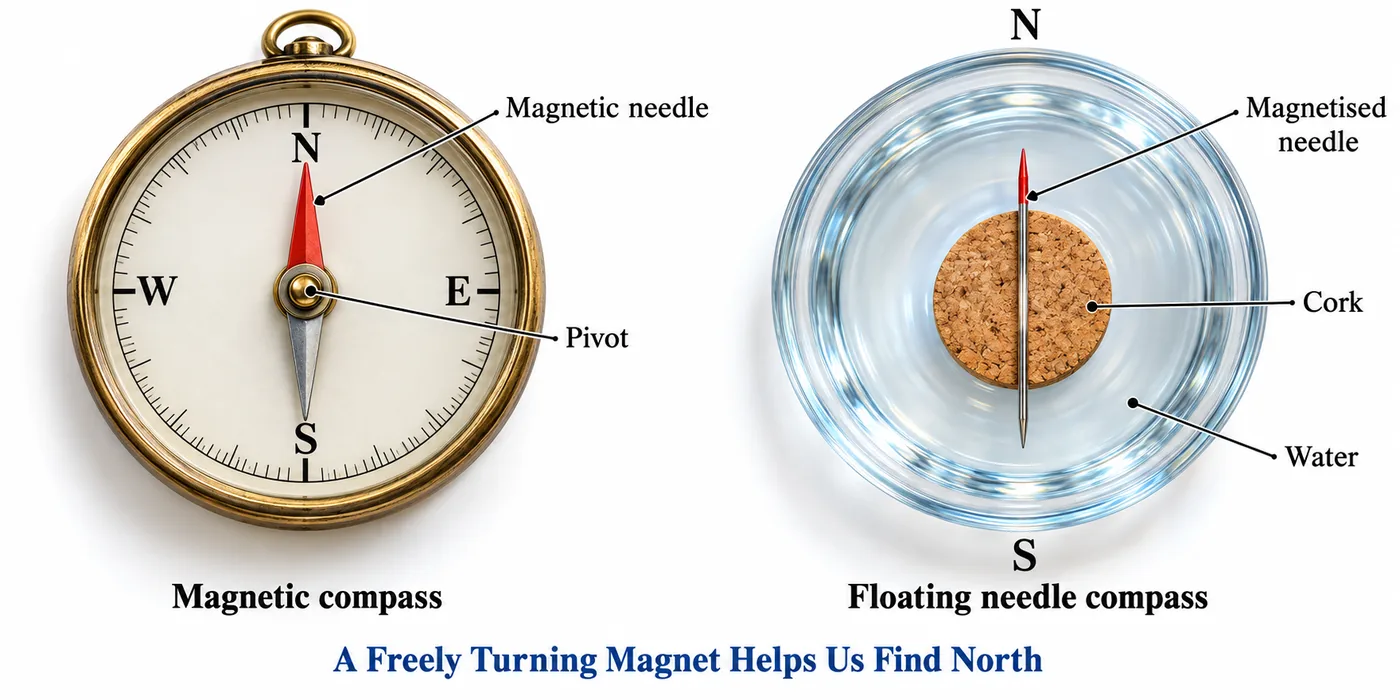
Hang a bar magnet freely by a thread from its middle. It turns and finally comes to rest in the north–south direction. Each time you disturb it, it settles in the same direction. This happens because the Earth itself behaves like a giant magnet. The end of the magnet that points towards the geographic north is its North-seeking pole, or simply the North pole.
A magnetic compass uses this property. It has a small magnetised needle that can rotate freely on a pivot inside a box with directions marked on the dial. The needle always points north–south, so travellers, sailors and pilots use compasses to find directions.
Make your own compass
- Take a sewing needle and stroke it about 30–40 times with one pole of a bar magnet, always in the same direction, lifting the magnet away after each stroke. The needle becomes a magnet.
- Push the needle through a small piece of cork.
- Float the cork in a bowl of water, away from other magnets and iron objects.
- The needle turns and settles in the north–south direction.
6. Attraction and Repulsion between Magnets
Place two bar magnets on round pencils so they can roll easily. Bring them near each other:
- Unlike poles attract — N and S pull towards each other.
- Like poles repel — N and N, or S and S, push each other away.
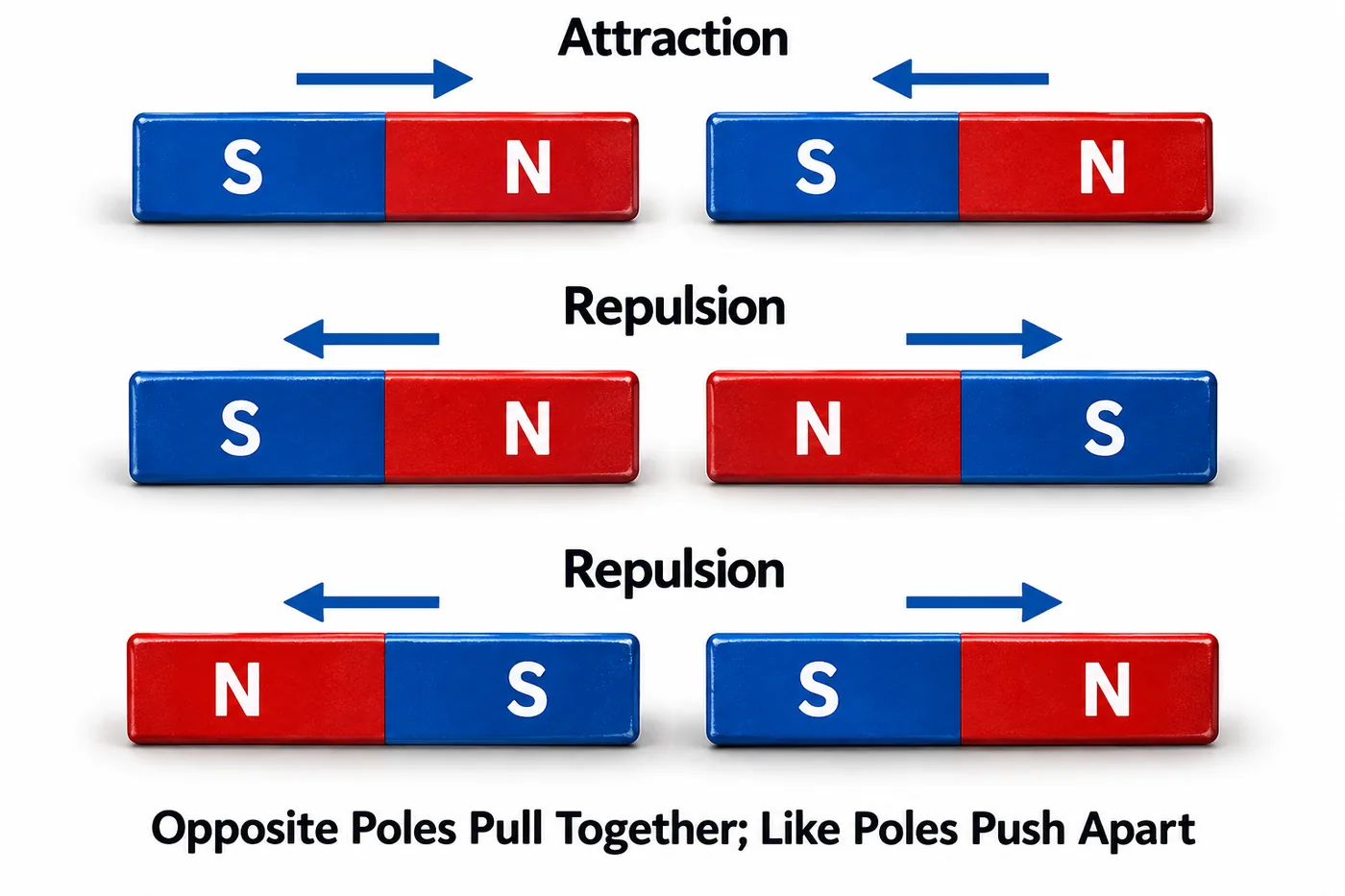
An iron bar is attracted to both poles of a magnet, so attraction cannot tell us whether the bar is a magnet. But only a magnet can repel a pole of another magnet. So repulsion is the sure test for a magnet.
When a bar magnet is brought near a compass, the needle turns: the N pole of the magnet attracts the S end of the needle and repels its N end. This is why compasses must be kept away from magnets.
Magnets act through non-magnetic materials. If a sheet of wood, cardboard, plastic or glass is placed between a magnet and a compass, the needle still turns by about the same amount. That is why a magnet can move a paper clip across the other side of a sheet of paper.
7. Fun with Magnets and Caring for Them
Magnets are used in fridge door seals, pencil boxes, toys, cranes that lift scrap iron, and in separating iron from waste. To keep magnets strong:
- Store bar magnets in pairs with unlike poles on the same side, separated by a piece of wood, with soft iron pieces placed across their ends (keepers).
- Do not heat, hammer or drop magnets — they lose their magnetism.
- Keep magnets away from mobile phones, TVs, remote controls, computers and cards.
8. Master Table: Key Terms
| Term | Meaning |
|---|---|
| Lodestone | A naturally occurring magnet |
| Artificial magnet | Magnet made in factories: bar, U-shaped, ring, disc, cylindrical, spherical |
| Magnetic material | Attracted by a magnet: iron, nickel, cobalt |
| Non-magnetic material | Not attracted: wood, plastic, glass, rubber, copper |
| Poles | Ends where attraction is strongest — North and South |
| Magnetic compass | Device with a freely rotating magnetic needle that points north–south |
| Rule of poles | Unlike poles attract; like poles repel |
| Sure test of a magnet | Repulsion |
9. Master Summary Table
| Situation | What happens | Exam note |
|---|---|---|
| Magnet near iron filings | Filings gather at the ends | Poles are strongest |
| Freely suspended magnet | Rests north–south | Earth behaves like a magnet |
| N near S | Attraction | Unlike poles attract |
| N near N / S near S | Repulsion | Like poles repel |
| Magnet broken in two | Two complete magnets | Poles exist in pairs |
| Card between magnet and compass | Needle still deflects | Magnetism acts through non-magnetic materials |
Chart — strength of attraction along a bar magnet (iron filings collected):
The bars show the pattern seen in the iron-filings activity, not measured values.
10. Mind Map
- Natural: lodestone
- Artificial: bar, U, ring
- Magnetic: Fe, Ni, Co
- Non-magnetic: wood, plastic
- N and S, always in pairs
- Like repel, unlike attract
- Rests north–south
- Compass, floating needle
11. Tips and Tricks
- “Opposites attract, same ones fight” — easy way to remember attraction and repulsion.
- To find the poles of an unmarked magnet, hang it freely: the end pointing north is the N pole.
- To find which of two identical bars is a magnet without other tools: hold bar A’s end at the middle of bar B. If they attract strongly, A is the magnet (a magnet’s middle is weak).
- Using attraction to identify a magnet — iron is also attracted; only repulsion confirms a magnet.
- Stroking the needle back and forth — always stroke in one direction only.
- Writing that a single N pole can be separated by cutting a magnet.
12. Important One-liners
- Lodestone is a natural magnet.
- Iron, nickel and cobalt are magnetic materials.
- The attraction of a magnet is strongest at its poles.
- Every magnet has two poles: North and South.
- A freely suspended magnet always rests in the north–south direction.
- The Earth behaves like a giant magnet.
- Like poles repel; unlike poles attract.
- Repulsion is the sure test of a magnet.
- Magnets work through paper, wood, plastic and glass.
- Heating, hammering or dropping weakens a magnet.
13. Exam-pattern Questions with Detailed Answers
Which of these is attracted by a magnet?
- Plastic scale
- Iron nail
- Glass marble
- Rubber eraser
Show answer
Iron is a magnetic material. Plastic, glass and rubber are non-magnetic.
Answer: (B) Iron nail
Fill in the blank: Like poles ______ each other.
Show answer
N–N or S–S push each other away.
Answer: repel
True or False: A magnet can have only one pole.
Show answer
False. Poles always exist in pairs; even a broken piece has both N and S poles.
Answer: False
Why do most iron filings stick to the ends of a bar magnet?
Show answer
The magnetic attraction is strongest at the poles, which are near the ends. In the middle, attraction is very weak.
Answer: Poles are at the ends, where attraction is strongest
Describe how you can make a compass at home.
Show answer
Magnetise a sewing needle by stroking it 30–40 times in one direction with one pole of a magnet. Push it through a cork and float the cork in a bowl of water. The needle settles north–south and works like a compass.
Answer: Magnetised needle on floating cork
Why should a compass be kept away from magnets and iron objects?
Show answer
The compass needle is itself a magnet. Nearby magnets or iron attract or repel it and turn it away from the north–south direction, giving a wrong reading.
Answer: They deflect the needle and give wrong directions
How should bar magnets be stored to keep them strong?
Show answer
In pairs with unlike poles on the same side, separated by wood, with soft iron pieces across the ends. They should not be heated, dropped or hammered.
Answer: In pairs, unlike poles together, with soft-iron keepers
A sheet of cardboard is placed between a magnet and a compass. Will the needle deflect? Why?
Show answer
Yes. Magnetic effect acts through non-magnetic materials like cardboard, so the needle deflects by about the same amount.
Answer: Yes — magnetism acts through non-magnetic materials
You have two identical-looking metal bars. One is a magnet, the other is plain iron. How can you find which is the magnet without any other object?
Show answer
Touch one end of bar A to the middle of bar B. If they attract strongly, A is the magnet (its pole attracts iron anywhere). If there is little or no attraction, B is the magnet, because a magnet’s middle has very weak attraction.
Answer: End of one bar to the middle of the other
A mechanic drops a tiny iron screw into a narrow gap in a machine. How can a magnet help?
Show answer
Tie a small magnet to a string or fix it at the end of a thin stick and lower it into the gap. The iron screw is attracted and sticks to the magnet, so it can be pulled out.
Answer: Lower a magnet to attract and lift the screw
Ring magnets placed on a pencil float one above the other without touching. Explain.
Show answer
The rings are arranged so that like poles face each other. Like poles repel, and this push balances the weight of the upper ring, so it appears to float in the air.
Answer: Like poles facing — repulsion balances weight
The N pole of a freely suspended magnet points to geographic north. What can you guess about the magnetic pole of the Earth near geographic north?
Show answer
Unlike poles attract. Since the magnet’s N pole is pulled towards geographic north, the Earth’s magnetic pole near geographic north must behave like a magnetic south pole.
Answer: It behaves like a magnetic south pole
14. Quick Revision Summary
- Lodestone is natural; artificial magnets are bar, U, ring, disc, cylindrical and spherical.
- Magnetic: iron, nickel, cobalt. Non-magnetic: wood, plastic, glass, rubber, copper.
- Attraction is strongest at the two poles (N and S); poles come in pairs.
- Freely suspended magnet rests north–south; compass uses this; make one with a magnetised needle on cork.
- Unlike poles attract, like poles repel; repulsion is the sure test of a magnet.
- Store in pairs with keepers; avoid heating, hammering, dropping.