
1. Chapter at a Glance
What did you eat yesterday? Rice and dal, roti and sabzi, idli and sambar, or fish curry? People across India eat very different foods, yet every healthy meal must give the body the same things — nutrients. Mindful eating means choosing food wisely: knowing what it contains, eating a balanced diet, avoiding too much junk food and respecting the long journey food makes from the farm to our plate.
- Food habits of different regions and how cooking practices have changed.
- Components of food: carbohydrates, fats, proteins, vitamins, minerals, dietary fibres and water.
- Simple tests for starch, fats and proteins.
- Balanced diet, deficiency diseases and the harm of junk food.
- Millets as nutrition-rich cereals, and food miles.
2. What Do We Eat?
Food differs from region to region because it depends on locally grown crops, climate, soil, taste and culture. Rice is a staple in Kerala, West Bengal and Assam; wheat in Punjab and Haryana; millets like bajra and jowar in Rajasthan and Maharashtra; fish is popular in coastal states.
Cooking practices have also changed over time. Earlier, food was cooked on a chulha and spices were ground on a sil-batta. Today most homes use gas stoves, pressure cookers and electric grinders. These save time and effort, but some traditional practices (like eating seasonal, local food) are still very healthy.
3. Components of Food
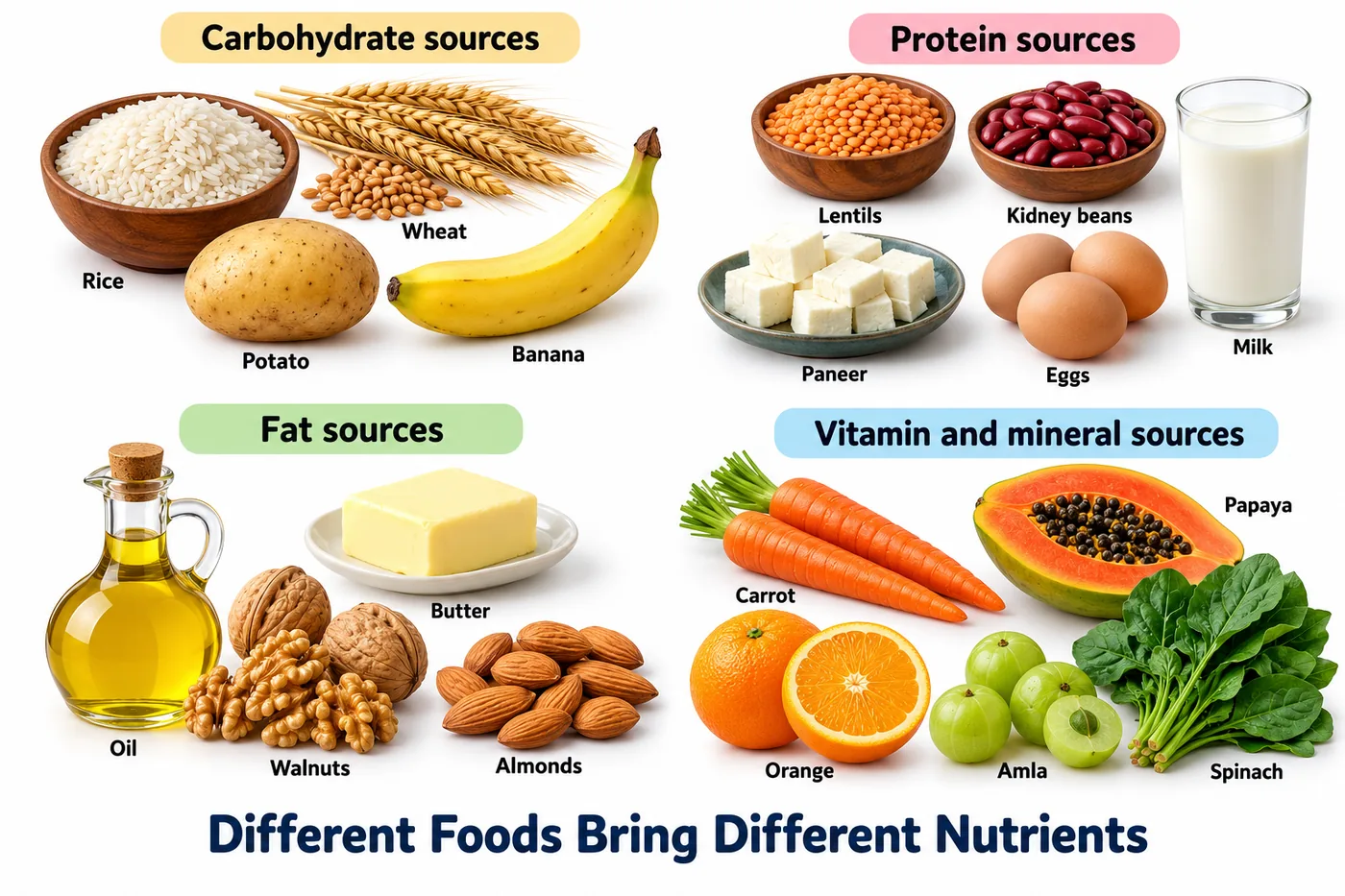
Nutrients are the components of food that give energy, help growth and repair, protect the body from diseases and keep it working properly.
| Component | Main work | Sources | Group |
|---|---|---|---|
| Carbohydrates | Main source of energy | Rice, wheat, potato, banana, sugar | Energy-giving |
| Fats | Stored energy (more than carbohydrates) | Oil, ghee, butter, nuts | Energy-giving |
| Proteins | Growth and repair of the body | Dal, beans, milk, paneer, eggs, fish | Body-building |
| Vitamins | Protect from diseases | Fruits, green vegetables, milk | Protective |
| Minerals | Protect body; build bones and blood | Milk (calcium), iodised salt (iodine), spinach and jaggery (iron) | Protective |
| Dietary fibres (roughage) | No nutrients, but help remove undigested food; prevent constipation | Whole grains, fruits, vegetables, pulses | — |
| Water | Absorbs nutrients, removes wastes, controls body temperature | Drinking water, fruits, milk | — |
4. How to Test Different Components of Food
| Test for | What we do | Positive result |
|---|---|---|
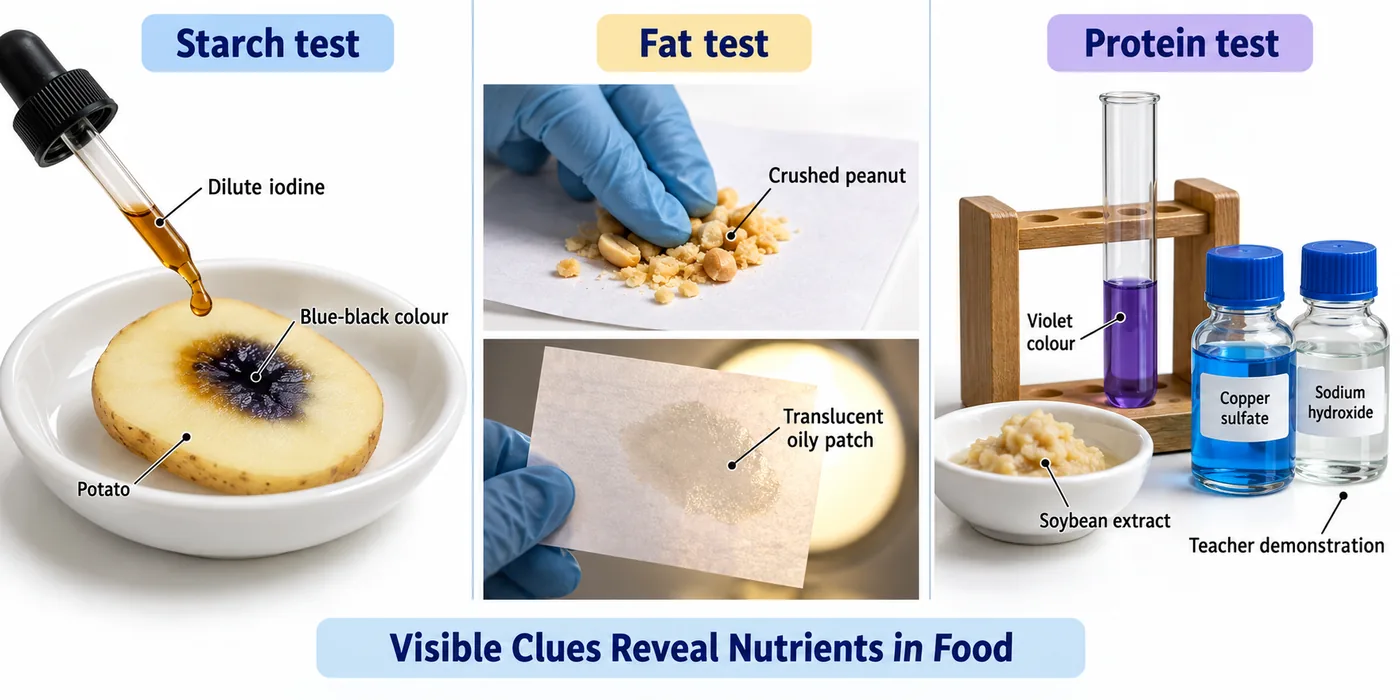
| Starch | Put 2–3 drops of dilute iodine solution on the food (e.g. a potato slice) | Blue-black colour |
| Fat | Rub the food (e.g. crushed peanut) on a piece of paper and hold it against light | Translucent, oily patch |
| Protein | Mix food paste with water; add 2 drops of copper sulphate solution and 10 drops of sodium hydroxide (caustic soda) solution (teacher demonstration) | Violet colour |
Copper sulphate and caustic soda are harmful. The protein test should be done only under the teacher’s supervision. Never taste chemicals in the laboratory.
When iodine is put on sugar, there is no blue-black colour. Sugar is a carbohydrate but not starch. So all starches are carbohydrates, but not all carbohydrates are starches.
5. Balanced Diet and Deficiency Diseases
A balanced diet contains all the essential nutrients, roughage and water in the right amounts for proper growth and development. It depends on age, gender, work and health.
When the diet lacks a nutrient for a long time, deficiency diseases can occur:
| Deficiency of | Disease | Symptoms | Good sources |
|---|---|---|---|
| Vitamin A | Night blindness | Poor vision in dim light | Carrot, papaya, green leafy vegetables, milk |
| Vitamin B1 | Beriberi | Weak muscles, little energy | Whole grains, pulses |
| Vitamin C | Scurvy | Bleeding, swollen gums; slow healing | Amla, lemon, orange, guava |
| Vitamin D | Rickets | Soft, bent bones | Sunlight, milk, eggs, fish |
| Calcium | Weak bones and teeth | Bones break easily | Milk, curd, ragi |
| Iodine | Goitre | Swelling at the front of the neck | Iodised salt, seafood |
| Iron | Anaemia | Tiredness, pale skin | Spinach, jaggery, pulses, ragi |
Junk food (chips, sugary drinks, fried snacks) has a lot of fat, sugar and salt but few nutrients. Eating it often can cause obesity and other health problems. Reading the nutrition label on packets helps us compare foods — for example, roasted chana gives far more protein and fibre than potato wafers.
6. Millets: Nutrition-rich Cereals
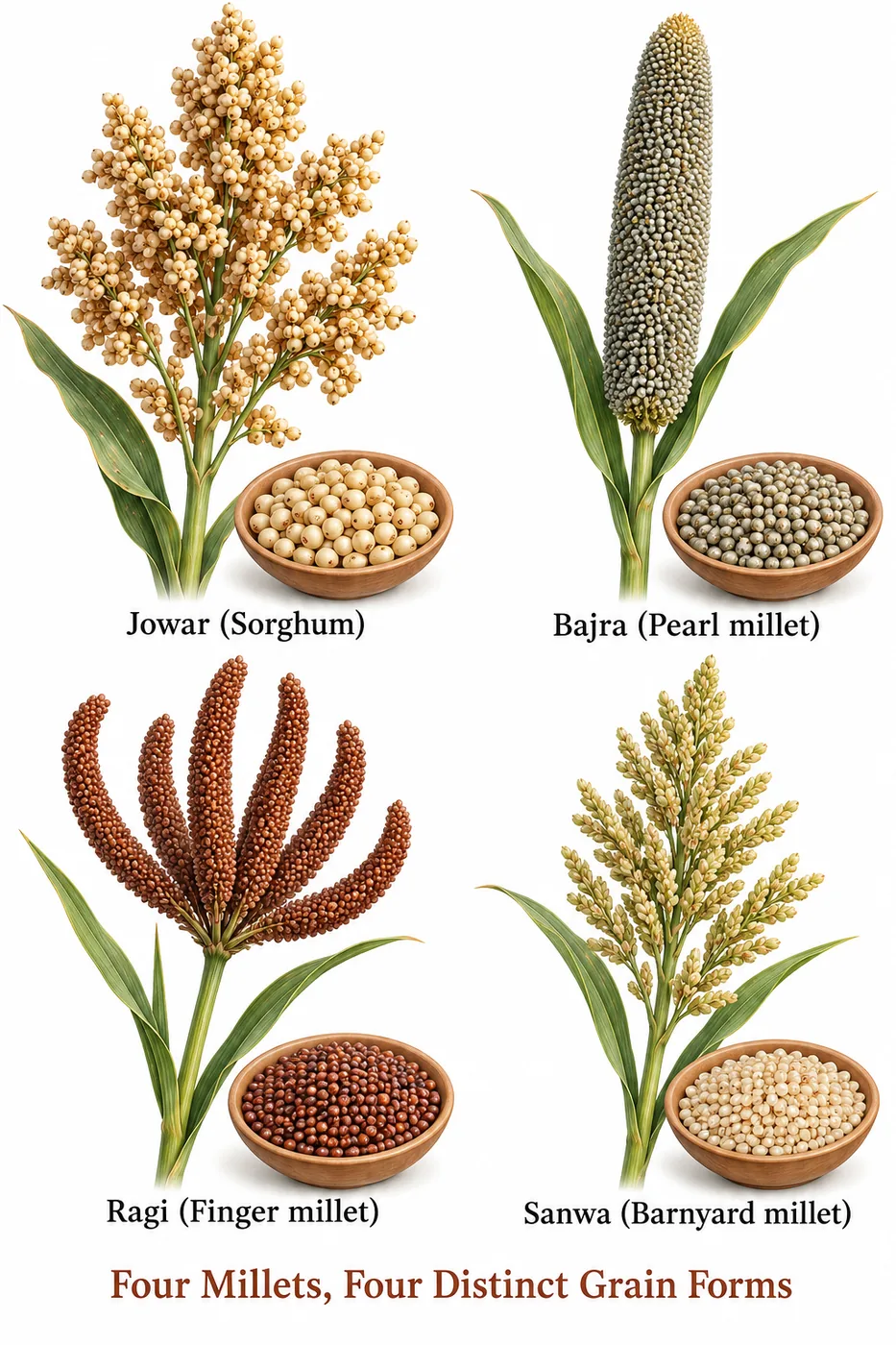
Millets are small-grained cereal crops native to India. They are rich in fibre, minerals (like calcium and iron) and vitamins, and grow well even in dry areas with little water. Because of these qualities they are also called nutri-cereals.
| Millet | Other name | Special point |
|---|---|---|
| Jowar | Sorghum | Used for roti and porridge |
| Bajra | Pearl millet | Grows in hot, dry regions like Rajasthan |
| Ragi | Finger millet | Very rich in calcium |
| Sanwa | Barnyard millet | Quick-growing; often eaten during fasts |
Millets are healthy, but no single food can give all nutrients. Millets should be part of a balanced diet along with pulses, vegetables, fruits and milk.
7. Food Miles: From Farm to Our Plate
Food miles are the total distance a food item travels from the producer (farmer) to the consumer. A chapati reaches us after many steps:
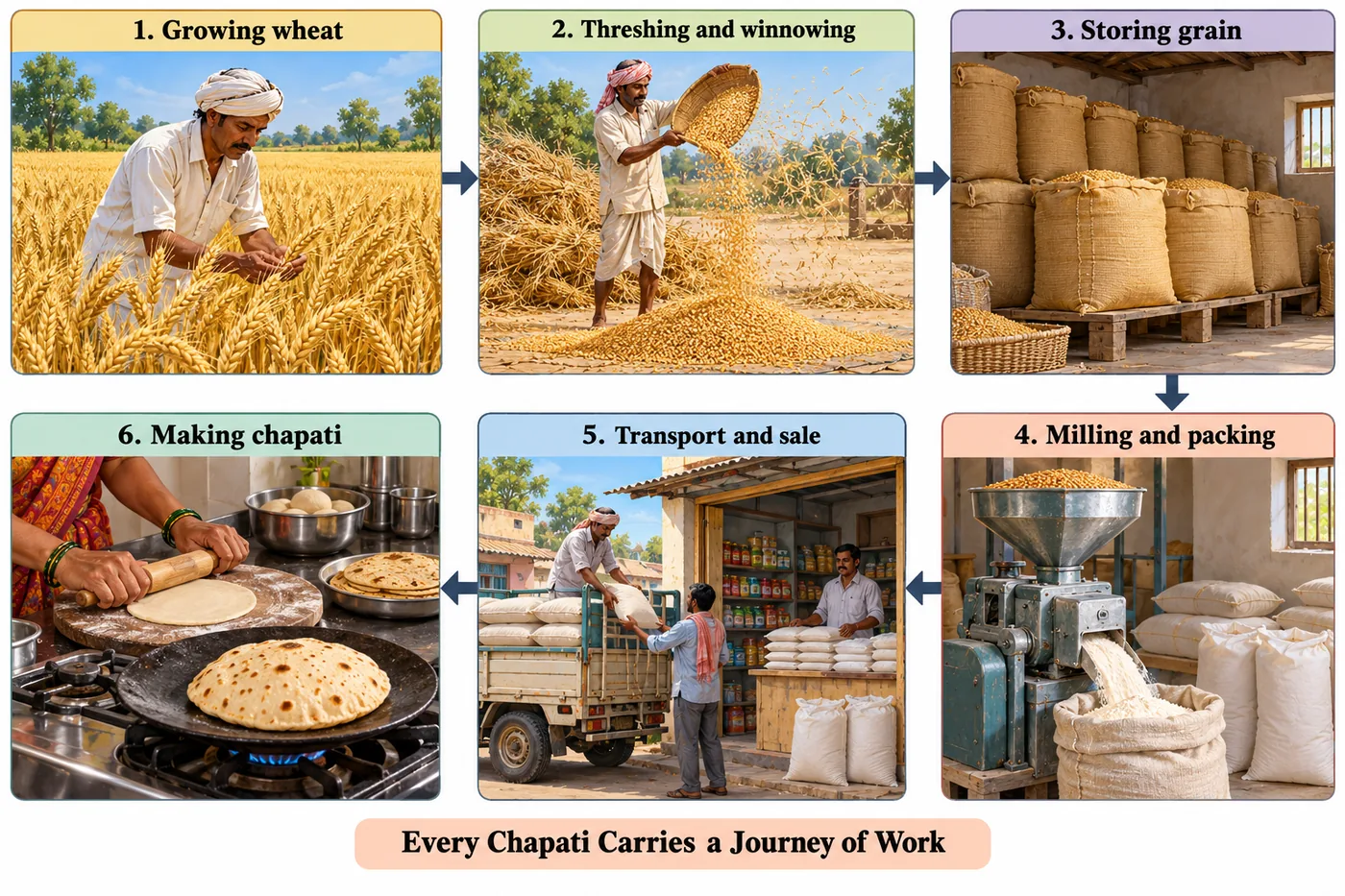
- Growing and harvesting wheat.
- Threshing and winnowing to separate grain.
- Storing grain safely.
- Milling into flour (atta) and packing.
- Transport to shops and sale.
- Cooking chapati at home.
Food that travels long distances uses more fuel and may lose freshness. Eating local and seasonal food reduces food miles. In India, the Food Safety and Standards Authority of India (FSSAI) checks food quality and safety. Since every grain carries so much effort, we should never waste food.
8. Master Table: Key Terms
| Term | Meaning |
|---|---|
| Nutrients | Food components giving energy, growth, repair and protection |
| Energy-giving foods | Carbohydrates and fats |
| Body-building foods | Protein-rich foods |
| Protective nutrients | Vitamins and minerals |
| Roughage | Dietary fibre; no nutrients, helps remove undigested food |
| Balanced diet | All nutrients, roughage and water in the right amounts |
| Deficiency disease | Disease due to long-term lack of a nutrient |
| Iodised salt | Common salt with added iodine salts; prevents goitre |
| Millets | Small native cereals; nutri-cereals |
| Food miles | Distance food travels from producer to consumer |
9. Master Summary Table
| Nutrient | Test | Result | Deficiency |
|---|---|---|---|
| Starch (carbohydrate) | Iodine | Blue-black | Low energy |
| Fat | Paper rub | Oily patch | — |
| Protein | CuSO₄ + NaOH | Violet | Poor growth |
| Vitamin C | — | — | Scurvy |
| Iodine | — | — | Goitre |
Chart — main job of food components:
The bars show the type of role, not exact amounts.
10. Mind Map
- Carbs, fats — energy
- Proteins — build
- Vitamins, minerals — protect
- Iodine → blue-black
- Paper → oily patch
- CuSO₄ + NaOH → violet
- Balanced diet
- Deficiency diseases, junk food
- Millets
- Food miles, FSSAI
11. Tips and Tricks
- Memory trick for diseases: “C-Scurvy, D-Doubled bones (rickets), A-After dark (night blindness), I-In the neck (goitre)”.
- Test colours: S-B (Starch–Blue-black), P-V (Protein–Violet), F-O (Fat–Oily patch).
- For “suggest a diet” questions, name the missing nutrient first, then two foods rich in it.
- Saying roughage gives energy — it gives no nutrients but helps digestion and bowel movement.
- Writing that all carbohydrates give blue-black with iodine — only starch does.
- Thinking a fruit juice from a can is as good as a fresh fruit — fresh fruit keeps fibre and has no added sugar.
12. Important One-liners
- Carbohydrates are the main source of energy.
- Fats give more energy than the same amount of carbohydrates.
- Proteins are body-building foods.
- Vitamins and minerals are protective nutrients.
- Iodine turns starch blue-black.
- Deficiency of vitamin C causes scurvy; of iodine causes goitre.
- Lack of vitamin D causes rickets; sunlight helps the body make vitamin D.
- Ragi is very rich in calcium.
- Food miles = distance from farm to plate.
- FSSAI regulates food safety in India.
13. Exam-pattern Questions with Detailed Answers
Which colour appears when iodine is put on a potato slice?
- Violet
- Blue-black
- Red
- Yellow
Show answer
Potato is rich in starch, and starch gives a blue-black colour with iodine. Violet is the protein test colour.
Answer: (B) Blue-black
Name the disease caused by deficiency of iodine.
Show answer
Lack of iodine causes swelling at the front of the neck (goitre). Iodised salt prevents it.
Answer: Goitre
Pick the odd one out: rice, wheat, potato, paneer. Give a reason.
Show answer
Rice, wheat and potato are rich in carbohydrates; paneer is rich in protein.
Answer: Paneer — protein-rich, others carbohydrate-rich
A person has difficulty seeing in dim light. Which nutrient is lacking? Suggest two foods.
Show answer
This is night blindness, caused by deficiency of vitamin A. Carrots, papaya, green leafy vegetables and milk are good sources.
Answer: Vitamin A — carrot, papaya
A child often has stomach ache and constipation. What change in diet would you suggest?
Show answer
The diet probably lacks roughage and water. Add whole grains, fruits, green vegetables and pulses, drink enough water and reduce junk food.
Answer: More fibre-rich foods and water
Which is the best choice — canned juice, fresh juice or a fresh fruit? Why?
Show answer
A fresh fruit is best: it keeps all its fibre, vitamins and minerals and has no added sugar or preservatives. Fresh juice loses fibre; canned juice often has added sugar and less vitamin C.
Answer: Fresh fruit
Why are millets called nutri-cereals? Are millets alone enough for good health?
Show answer
Millets are rich in fibre, minerals and vitamins and grow with little water, so they are nutritious and eco-friendly. But they alone cannot give all nutrients in the right amounts; we also need pulses, vegetables, fruits and milk — a balanced diet.
Answer: Very nutritious, but must be part of a balanced diet
What are food miles? How can we reduce them?
Show answer
Food miles are the total distance food travels from producer to consumer. We can reduce them by buying local and seasonal foods, which also stay fresher and save fuel.
Answer: Farm-to-plate distance; eat local, seasonal food
Design an activity to show that “all starches are carbohydrates but not all carbohydrates are starches.”
Show answer
Take samples of potato, rice, sugar and glucose (all carbohydrates). Add dilute iodine to each. Potato and rice turn blue-black (starch present). Sugar and glucose show no blue-black colour, though they are carbohydrates. So starch is only one kind of carbohydrate.
Answer: Iodine test on starchy foods vs sugars
An elderly person’s bones break easily. Which nutrients may be lacking and how can the diet help?
Show answer
Calcium (needed for strong bones) and vitamin D (needed to absorb calcium) may be lacking. Include milk, curd, ragi and green leafy vegetables, and spend some time in morning sunlight.
Answer: Calcium and vitamin D — milk, ragi, sunlight
A drop of iodine on a white cotton cloth leaves a blue-black stain, but not on a white polyester cloth. Explain.
Show answer
Cotton cloth is often stiffened with starch, so iodine reacts with it to give blue-black colour. Polyester is not starched, so iodine only leaves its own brownish colour.
Answer: Starch on cotton reacts with iodine
“Delicious food is not always healthy food.” Explain with examples.
Show answer
Chips, cold drinks and fried snacks taste good but have excess fat, sugar and salt and few nutrients; eating them often may cause obesity. Simple foods like dal, roti, sprouts, fruits and vegetables give balanced nutrition. Mindful eating means choosing for health, not only taste.
Answer: Junk food tasty but poor in nutrients; choose balanced meals
14. Quick Revision Summary
- Food varies with region, climate and culture; cooking tools have changed over time.
- Nutrients: carbohydrates and fats (energy), proteins (body-building), vitamins and minerals (protective), plus fibre and water.
- Tests: iodine → blue-black (starch); paper → oily patch (fat); CuSO₄ + NaOH → violet (protein).
- Balanced diet prevents deficiency diseases like scurvy, goitre, rickets, night blindness, anaemia, beriberi.
- Millets are nutri-cereals; eat local food to reduce food miles; FSSAI ensures food safety.