
1. Chapter at a Glance
Why does the Moon change its shape? Where does the water in a puddle go after the rain stops? Why do some seeds sprout while others do not? Questions like these come to every child. Science begins with such questions. This first chapter of Curiosity invites you into the world of science. It explains what science is, why curiosity matters, and how anyone can find answers in a step-by-step way called the scientific method.
- Science is a way of thinking, observing and doing things to understand the world.
- Curiosity — the wish to know — is the starting point of all science.
- Science is like a never-ending jigsaw puzzle: each discovery adds a new piece.
- The steps of the scientific method: observe, question, guess, test and analyse.
- Anyone who follows these steps — a cook, a mechanic, an electrician or you — works like a scientist.
2. What is Science?
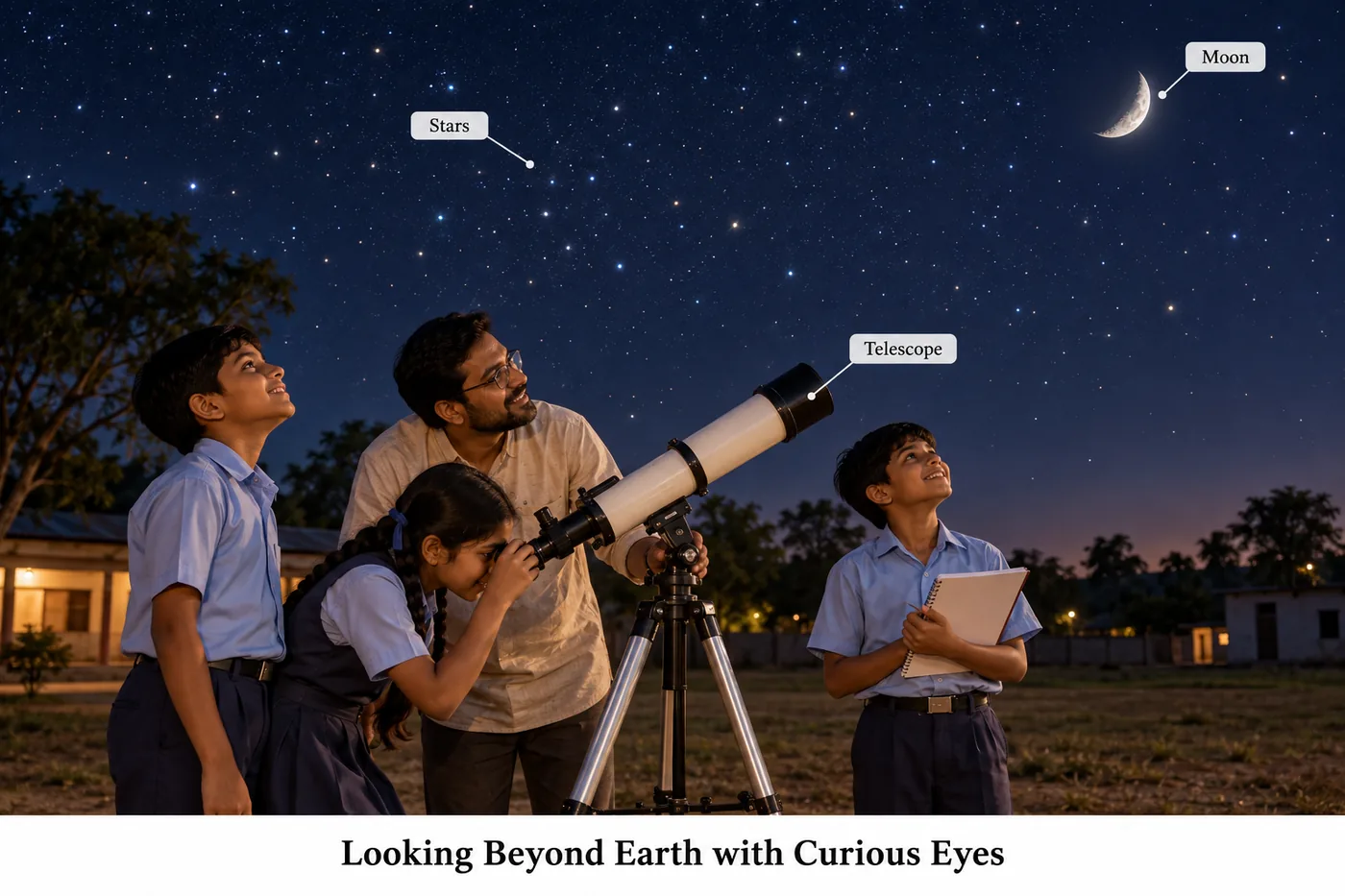
Science is not just a school subject or a list of facts in a book. It is a way of thinking, observing and doing things to understand the world we live in and to uncover the secrets of the universe. Everything around us — the air we breathe, the food we eat, the stars above us and the tiny ant on the ground — can be studied with science.
Think of science as a giant jigsaw puzzle that never ends. Each new discovery fits in as one more piece and shows a little more of the full picture. Sometimes a new piece even shows that an old piece was placed wrongly, and scientists happily correct it. That is why science keeps growing.
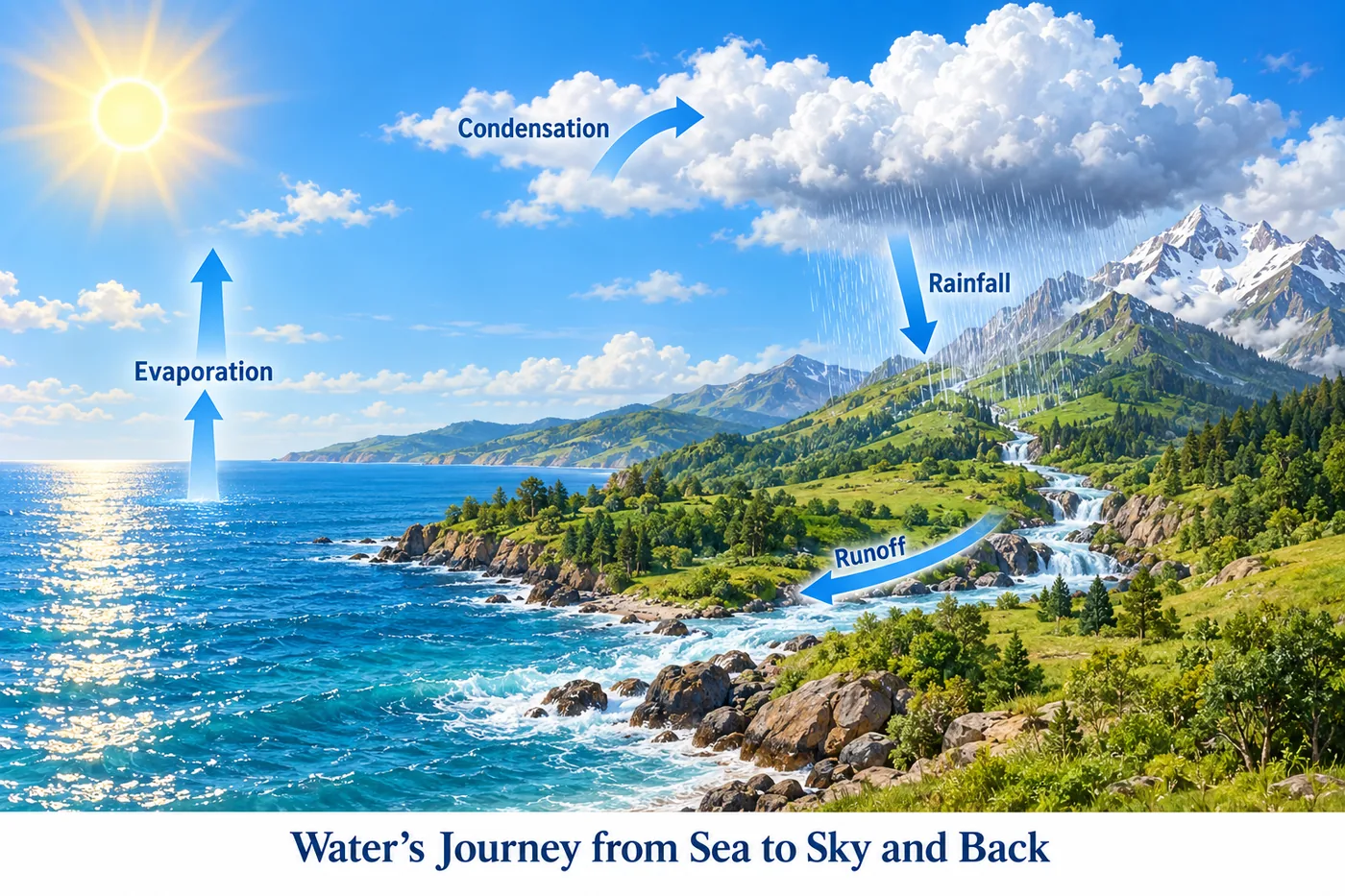
The Earth is the only known planet that supports life. It has an amazing variety of plants and animals, from huge trees and elephants to microscopic living things. Water moves from the sea to the sky and back again, keeping life going. Understanding such natural processes is part of science.
3. Curiosity — The Key to Science
Curiosity means the desire to know and to understand. A curious person keeps asking What? Why? How? — Why is the sky blue? How does a seed know which way is up? What happens if I mix salt in water? Curiosity is the most important tool for exploring the world. Great scientists were, first of all, very curious people.
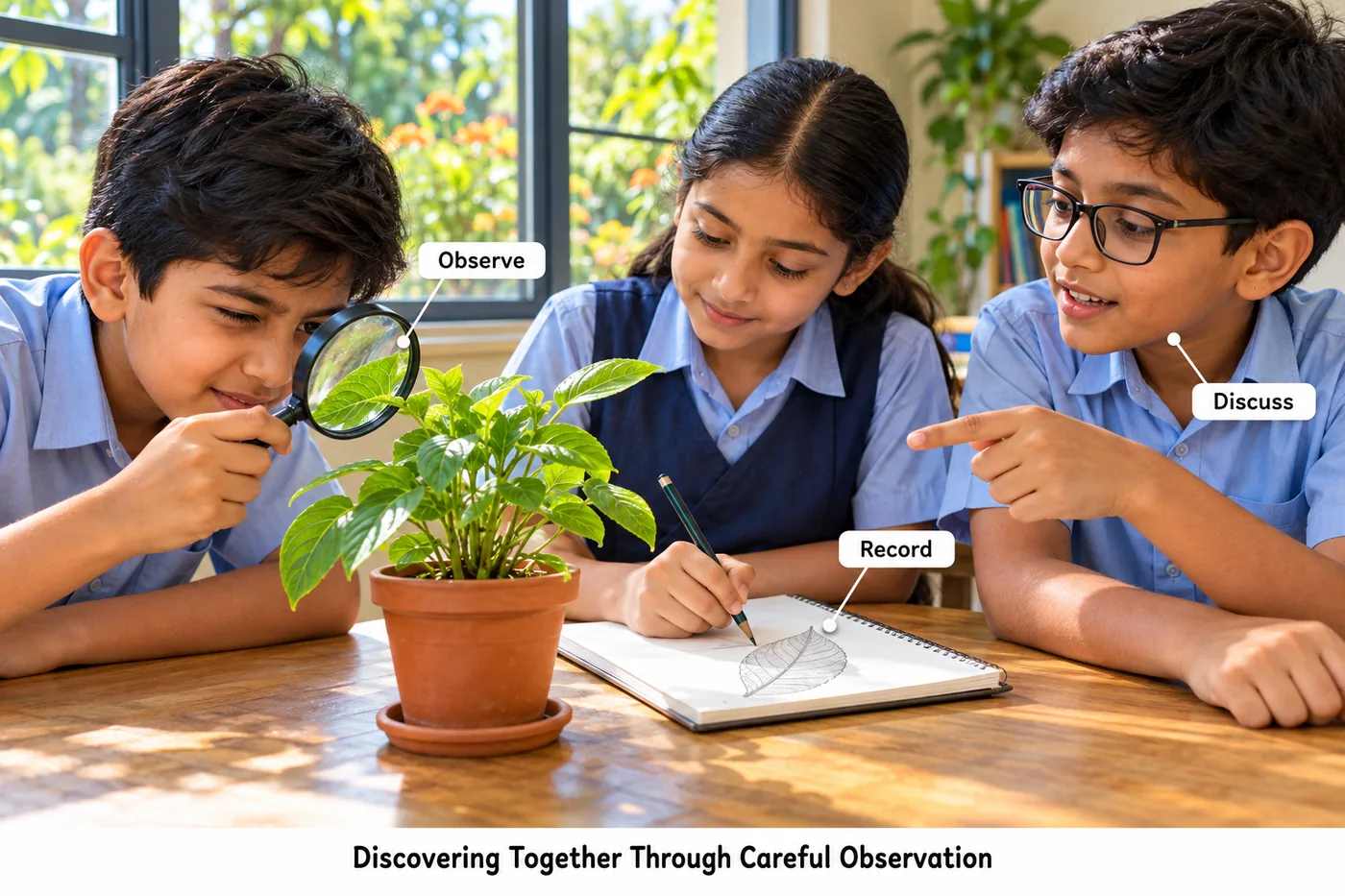
Science is also rarely done alone. People share ideas, discuss, argue politely, check each other’s work and build on one another’s discoveries. It is a joyful exploration, not a burden.
4. The Scientific Method
How can we try to find answers to our questions on our own? Scientists follow a set of steps called the scientific method:
- Observe — notice something interesting or something you do not understand.
- Wonder and question — think of a clear question about it.
- Guess — suggest a possible answer (a sensible guess).
- Test — check your guess by doing an experiment or making more observations.
- Analyse — study the results. Do they answer the question? If not, make a new guess and test again.
Observe: Rani’s torch does not light up. Question: Why is the torch not working? Guess: Maybe the cells are dead. Test: She puts in new cells. Analyse: If the torch glows, her guess was right. If it still does not glow, she makes a new guess (perhaps the bulb is fused) and tests again by changing the bulb.
A cook notices that the dal tastes bland (observe). She asks: does it need more salt? (question). She guesses that salt is less (guess), adds a pinch and tastes again (test), and decides whether it is now right (analyse). Without knowing it, she has used the scientific method.
5. Everyone Can Be a Scientist
Scientists are people who follow the scientific method to understand the world. But you do not need a laboratory coat to think scientifically. A bicycle repair person who finds out why a tyre keeps going flat, an electrician who traces a fault in the wiring, or a farmer who tries a new way of watering crops — all of them observe, guess, test and analyse. Whenever you solve a problem step by step and check your ideas with evidence, you are working like a scientist.
| Person | Problem observed | How they test |
|---|---|---|
| Bicycle mechanic | Tyre keeps losing air | Dips the tube in water to see where bubbles come out |
| Electrician | Fan does not run | Checks the switch, then the wire, then the fan, one at a time |
| Student | Plant on the window bends one way | Turns the pot around and watches for a few days |
6. Master Table: Key Terms
| Term | Meaning |
|---|---|
| Science | A way of thinking, observing and doing things to understand the world |
| Curiosity | The desire to know and understand; the starting point of science |
| Observation | Noticing something carefully using our senses or instruments |
| Guess (prediction) | A possible answer to a question that can be tested |
| Experiment | A test done to check whether a guess is correct |
| Scientific method | Observe → question → guess → test → analyse |
| Scientist | Anyone who follows the scientific method to find answers |
7. Master Summary Table
| Idea | Key point | Example |
|---|---|---|
| Nature of science | Way of thinking, not just facts | Asking why the Moon changes shape |
| Science grows | Like an unending jigsaw puzzle | New discoveries add new pieces |
| Curiosity | Most important tool | “What happens if…?” questions |
| Scientific method | Five steps, repeated if needed | Finding why a torch does not glow |
| Teamwork | Science is rarely done alone | Students observing, recording, discussing |
8. Mind Map
- Thinking, observing, doing
- Unending jigsaw puzzle
- What? Why? How?
- Starting point
- Observe, question, guess
- Test, analyse
- Cook, mechanic, electrician
- Teamwork and sharing
9. Tips and Tricks
- Memory trick — “O Q G T A”: Only Questions Give True Answers (Observe, Question, Guess, Test, Analyse).
- In answers, always give one daily-life example of the scientific method — it earns full marks.
- When a test fails, the method does not end: write “make a new guess and test again”.
- Saying science is only done by scientists in laboratories — anyone can follow the scientific method.
- Mixing up “guess” and “result”: a guess comes before testing, a result comes after.
- Thinking science is finished — it keeps growing and correcting itself.
10. Important One-liners
- Science is a way of thinking, observing and doing things to understand the world.
- Curiosity is the most important thing for exploring the world.
- Science is like a giant, unending jigsaw puzzle.
- Earth is the only known planet that supports life.
- The scientific method begins with observation.
- A guess must be tested by experiments or more observations.
- If results do not support a guess, a new guess is made.
- Science is rarely done alone; it is a shared, joyful exploration.
11. Exam-pattern Questions with Detailed Answers
Which is the first step of the scientific method?
- Testing
- Observing
- Analysing
- Guessing
Show answer
We first notice (observe) something; only then can we ask a question, guess, test and analyse.
Answer: (B) Observing
Fill in the blank: ______ is the most important thing for exploring the world.
Show answer
The desire to know drives every question and investigation.
Answer: Curiosity
True or False: Only people working in laboratories can be scientists.
Show answer
False. Anyone who follows the scientific method — a cook, a mechanic, a student — is working like a scientist.
Answer: False
Why is science compared to a jigsaw puzzle?
Show answer
Each new discovery adds a piece to our understanding of the world, slowly revealing a bigger picture. The puzzle never ends because there is always more to discover, and pieces placed wrongly can be corrected.
Answer: Discoveries add pieces to an ever-growing picture that is never complete
Arrange in the correct order: Test, Question, Analyse, Observe, Guess.
Show answer
We observe something, ask a question, make a guess, test the guess and finally analyse the results.
Answer: Observe → Question → Guess → Test → Analyse
Describe one daily-life situation in which someone follows the scientific method.
Show answer
A mobile phone is not charging. Observe: the battery icon does not change. Question: why? Guess: the charger is faulty. Test: try another charger. Analyse: if the phone charges, the old charger was faulty; if not, guess again (maybe the socket) and test.
Answer: Any step-wise example with observe, question, guess, test, analyse
What should you do if the result of your test does not support your guess?
Show answer
Do not give up. Make a new guess based on what you learnt and test it again. This repetition is a normal part of the scientific method.
Answer: Make a new guess and test again
Give two reasons why science is usually done in groups.
Show answer
(1) Different people notice different things and share ideas, so problems are solved faster. (2) Others can check results and point out mistakes, which makes conclusions more reliable.
Answer: Sharing ideas and checking each other’s work
Meera thinks plants need sunlight to stay green. Plan a simple test using the scientific method.
Show answer
Take two similar potted plants. Keep one in sunlight and one in a dark cupboard; water both equally. After a week, compare their leaves. If the plant in darkness turns pale while the other stays green, the guess is supported. Keeping everything else the same makes the test fair.
Answer: Two identical plants, only light differs; compare leaf colour
A student says, “Science is a collection of facts in a textbook.” Do you agree? Explain.
Show answer
Not fully. Facts are part of science, but science is mainly a way of thinking — asking questions, testing ideas and checking evidence. Facts can change when new evidence appears, so science is a process, not just a list.
Answer: Disagree — science is a process of enquiry, not only facts
Ravi’s bicycle tyre goes flat every morning. Write a question, a guess and a test he could try.
Show answer
Question: Why does the tyre lose air overnight? Guess: there is a tiny hole in the tube. Test: pump the tube and dip it in a bucket of water — bubbles show the leak. If no bubbles appear, a new guess (a loose valve) is tested.
Answer: Question → guess (hole) → water-bubble test
12. Quick Revision Summary
- Science = a way of thinking, observing and doing things to understand the world.
- Curiosity is the starting point; science is a never-ending jigsaw puzzle.
- Earth is the only known planet with life.
- Scientific method: Observe → Question → Guess → Test → Analyse (repeat if needed).
- Anyone who follows these steps works like a scientist; science is a shared, joyful journey.