
1. Chapter at a Glance
Take a walk around your school or a park. You will see tall trees and tiny grasses, ants and birds, frogs near a pond and fish in the water. This huge variety of living things is called biodiversity. To study so many plants and animals, we put them into groups based on common features. In this chapter you will learn how to group plants and animals, and how they are suited (adapted) to the places where they live.
- Biodiversity — the variety of plants and animals in a region.
- Grouping plants: herbs, shrubs, trees, climbers and creepers; leaf venation; root types; monocot and dicot seeds.
- Grouping animals by where they live and how they move.
- Habitats (terrestrial and aquatic) and adaptations.
- Why we must protect biodiversity — Project Tiger, cheetah reintroduction, sacred groves.
2. Diversity in Plants and Animals Around Us
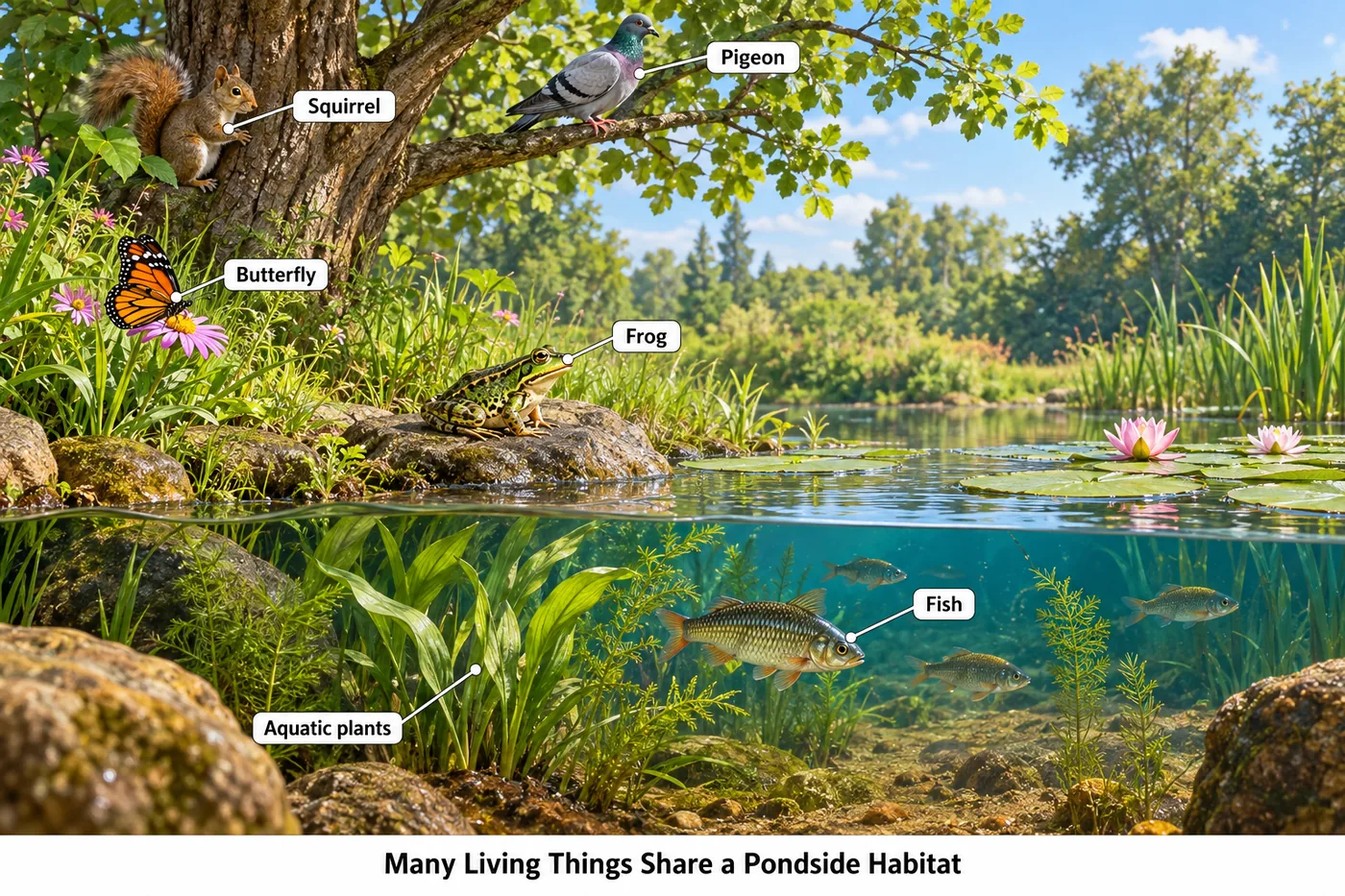
Biodiversity is the variety of plants and animals found in a particular region. A single pond and its banks can hold ants, earthworms, centipedes, tortoises, birds, ducks, butterflies, fish, frogs, snakes and grazing animals like cows and rabbits — each living in its own way.
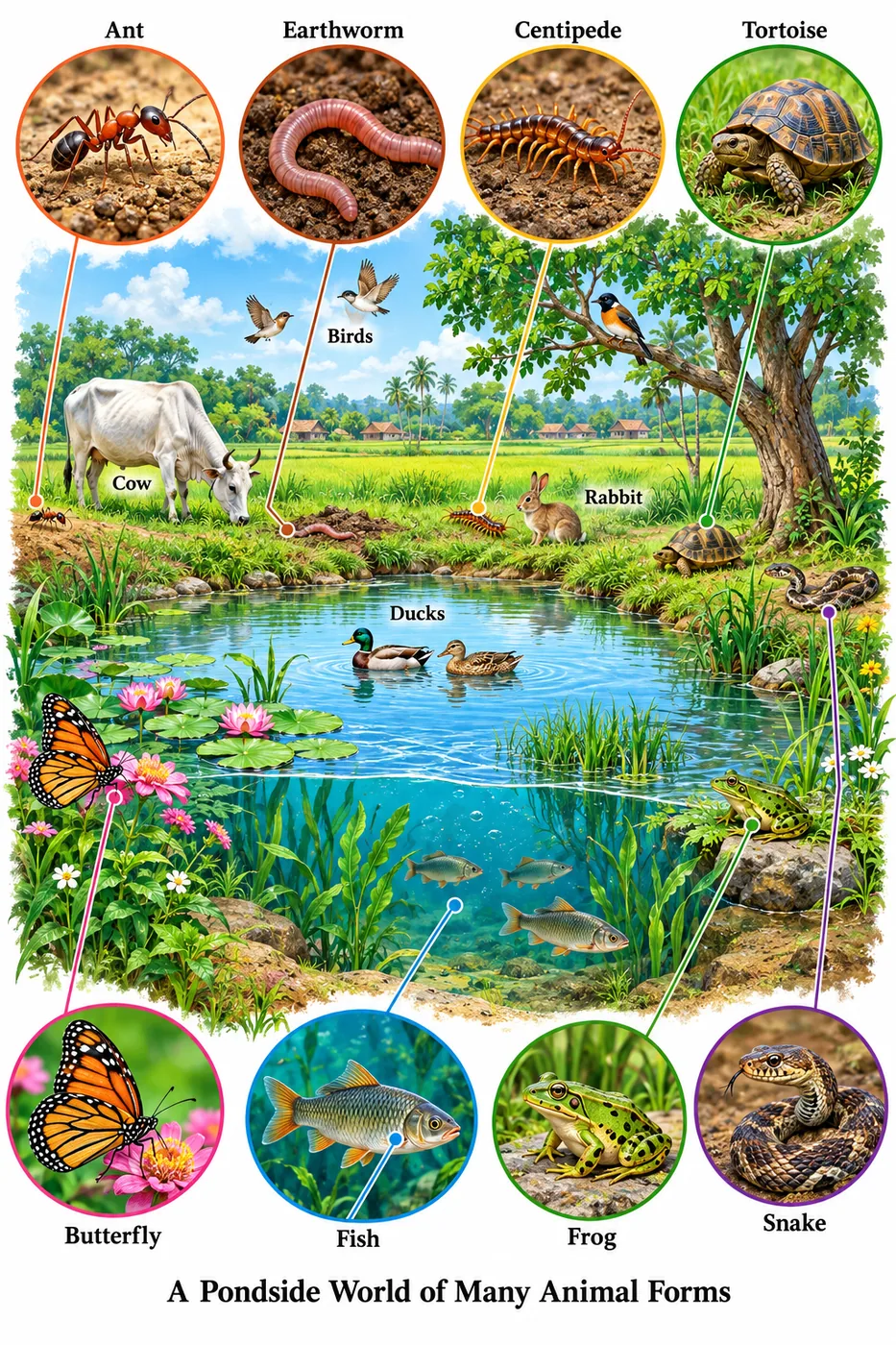
Recording what we see is the first step. Note the name, colour, size and where you found each plant or animal. Such records help us notice similarities and differences.
3. How to Group Plants?
Grouping means arranging things into groups based on common features. It makes the study of a large number of living things easier.
(a) By height and stem
| Group | Stem | Examples | Note |
|---|---|---|---|
| Herbs | Soft, green, short | Tomato, mint, coriander | Usually small plants |
| Shrubs | Many hard woody stems from near the ground; not very thick | Rose, hibiscus, tulsi (bushy) | Medium height |
| Trees | Tall, hard, thick brown trunk; branches high up | Mango, neem, peepal | Tallest plants |
| Climbers | Weak stem that needs support to climb | Money plant, grapevine, bottle gourd | Grow upwards on a support |
| Creepers | Weak stem that spreads on the ground | Pumpkin, watermelon, sweet potato | Grow along the ground |
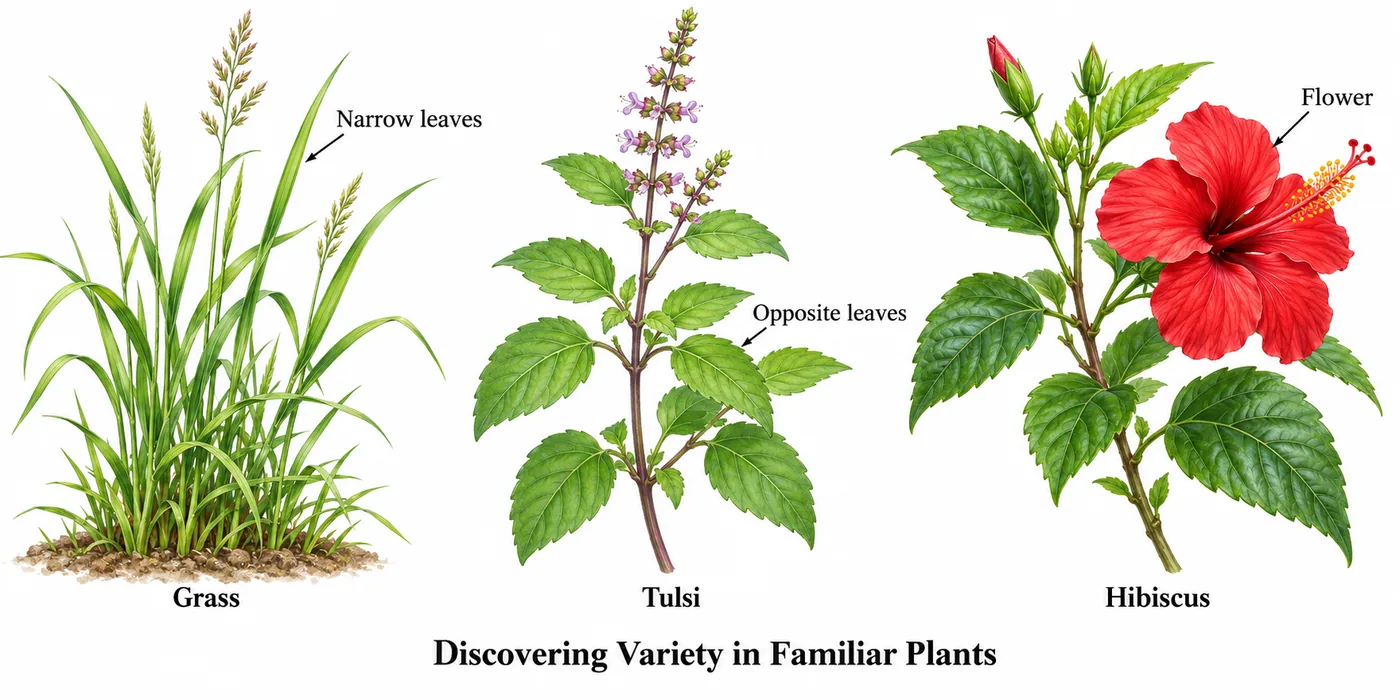
(b) By leaf venation
The lines on a leaf are veins, and their pattern is called venation.
- Reticulate venation — veins form a net-like pattern (hibiscus, tulsi, mango).
- Parallel venation — veins run parallel to each other (grass, wheat, banana).
(c) By roots
- Taproot — one main thick root with small side roots (mustard, radish, gram).
- Fibrous roots — a bunch of thin roots of similar size from the base of the stem (wheat, maize, grass).
(d) By seeds
A seed has parts called cotyledons. Seeds that split into two equal halves have two cotyledons — such plants are dicots (chickpea, pea, bean). Seeds with a single cotyledon are monocots (maize, wheat, rice).
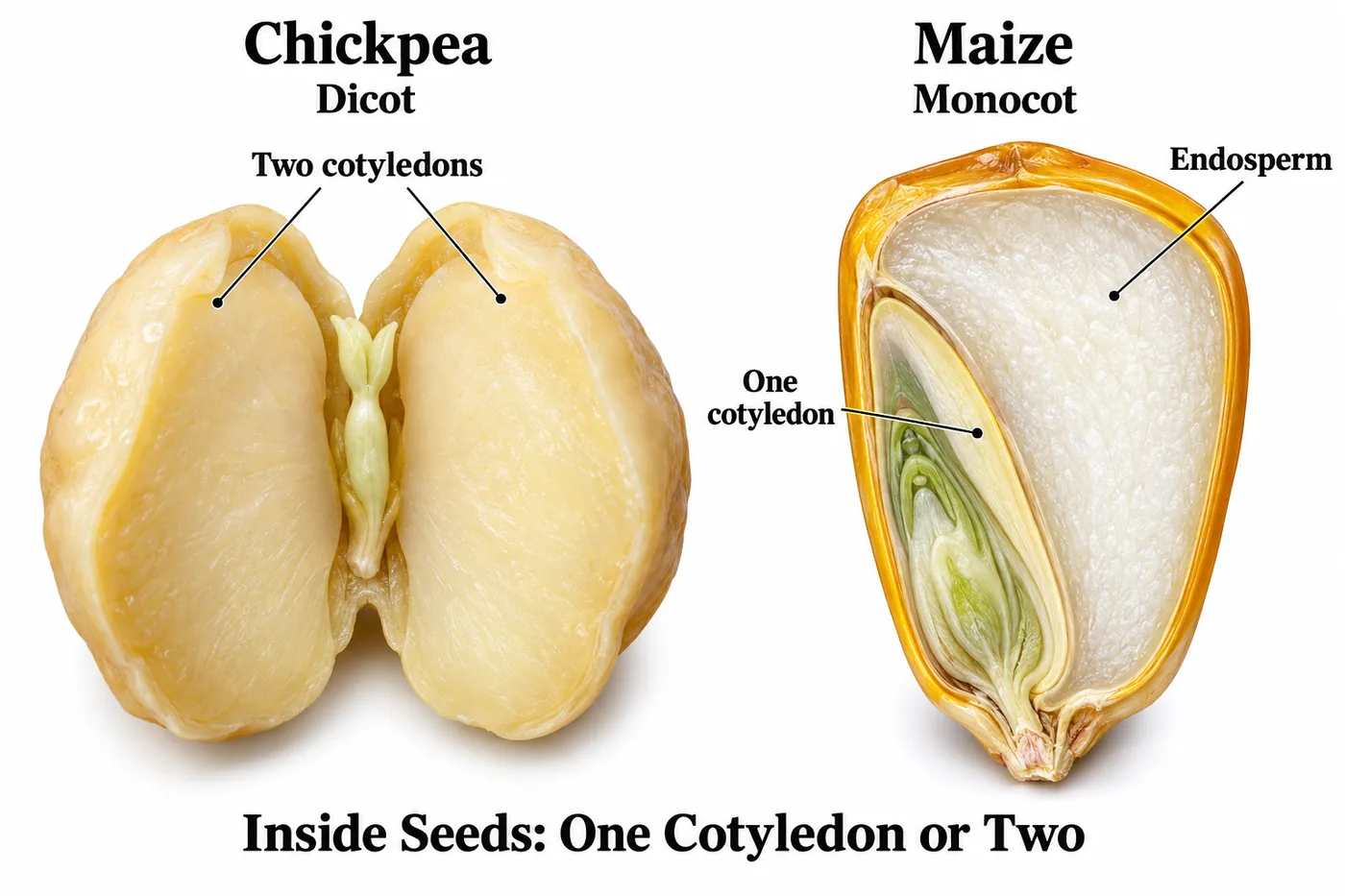
Plants with reticulate venation usually have taproots and dicot seeds. Plants with parallel venation usually have fibrous roots and monocot seeds.
4. How to Group Animals?
Animals can be grouped in many ways — by where they live, by how they move, or by what they eat.
| Way of moving | Body part used | Examples |
|---|---|---|
| Walking / running | Legs | Goat, cow, dog |
| Flying | Wings | Pigeon, sparrow, butterfly |
| Swimming | Fins and tail | Fish |
| Paddling / swimming | Webbed feet | Duck, frog |
| Crawling | Body muscles / many legs | Snake, earthworm, centipede |
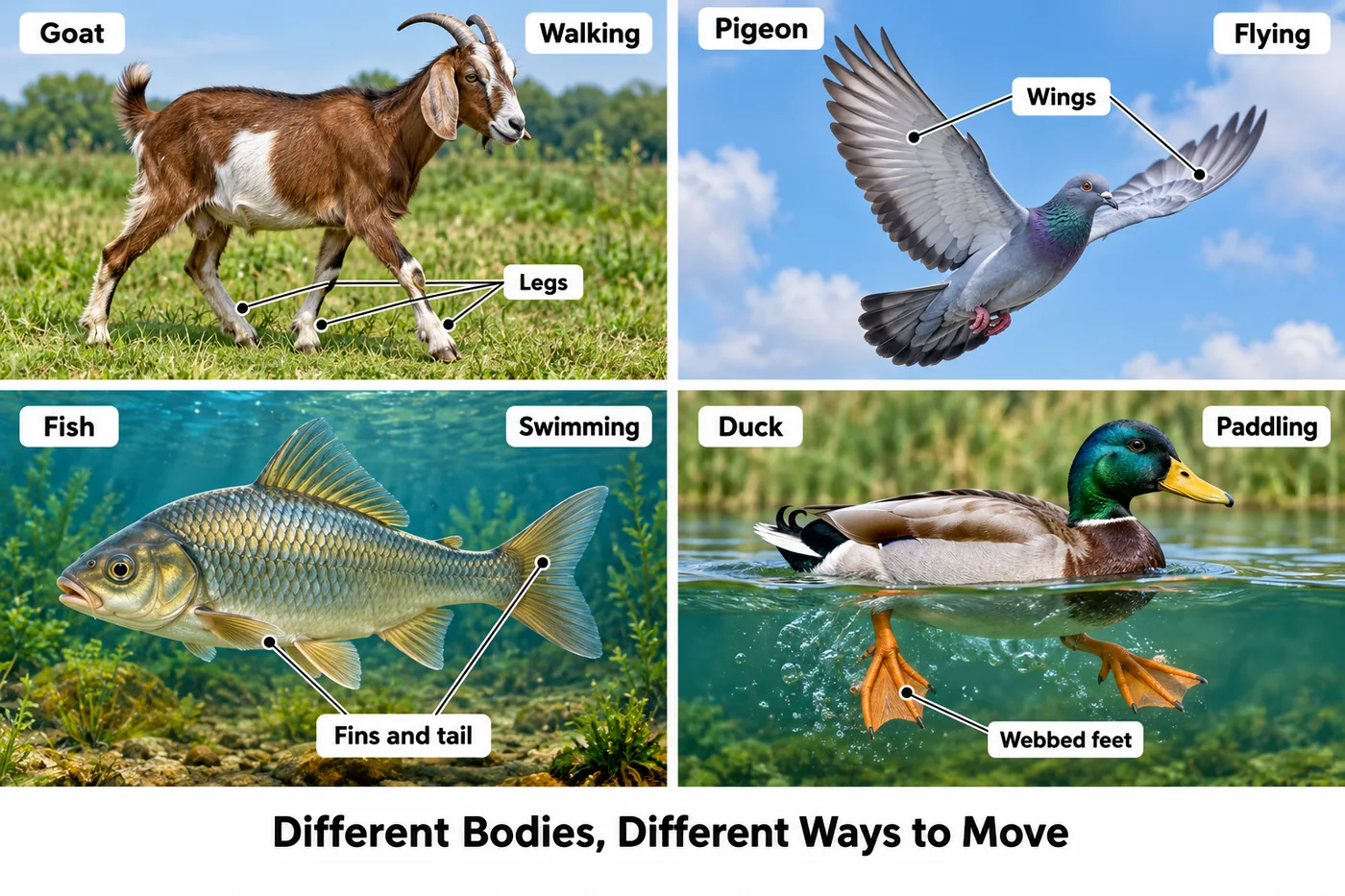
By habitat, animals can be terrestrial (live on land, like the goat), aquatic (live in water, like fish) or both. Animals such as frogs that can live in water as well as on land are called amphibians.
5. Plants and Animals in Different Surroundings
The place where a plant or animal lives is its habitat. A habitat provides food, water, air, shelter and other needs. Terrestrial habitats are on land — forests, deserts, grasslands and mountains. Aquatic habitats are in water — ponds, lakes, rivers and oceans.
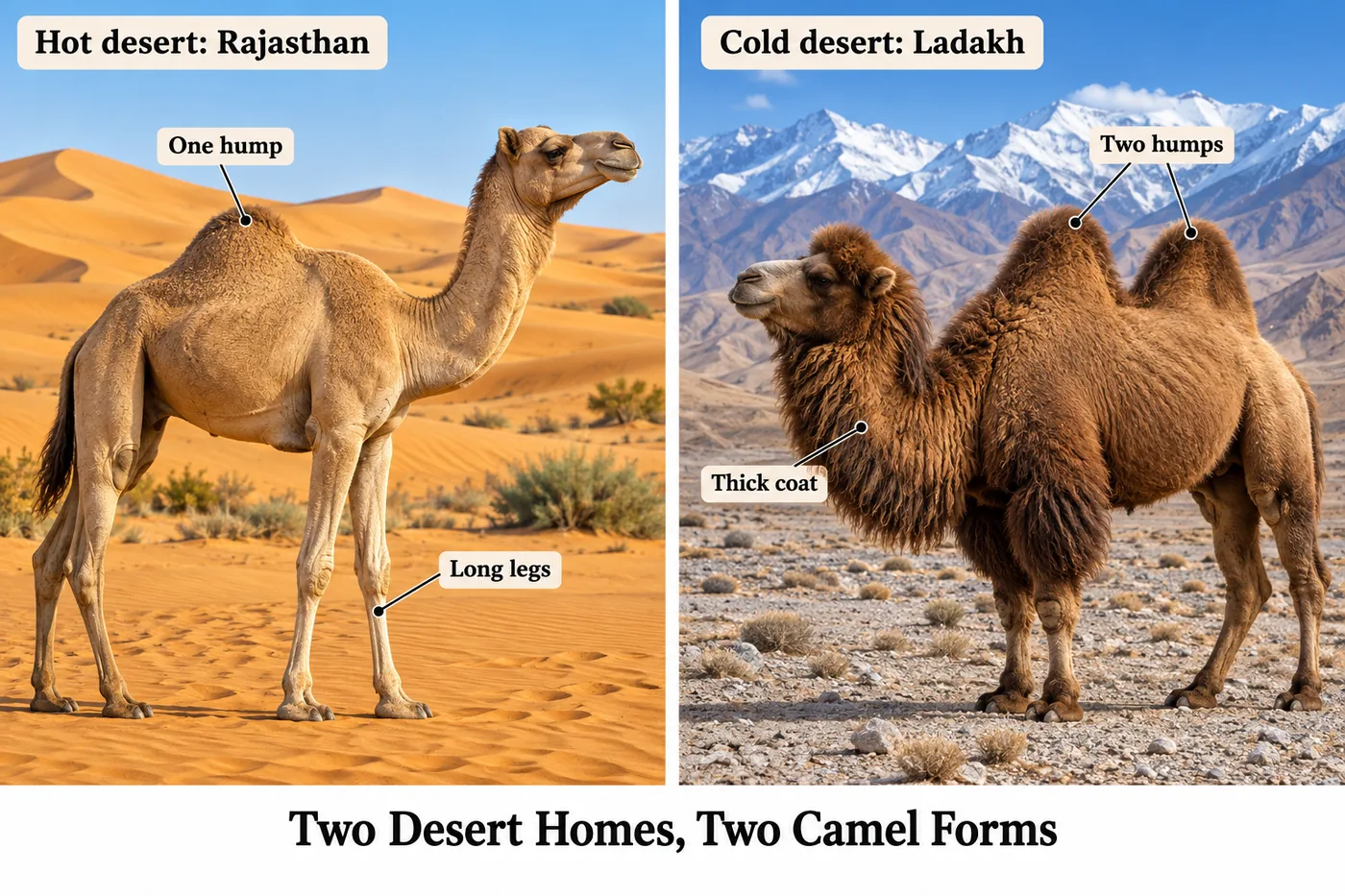
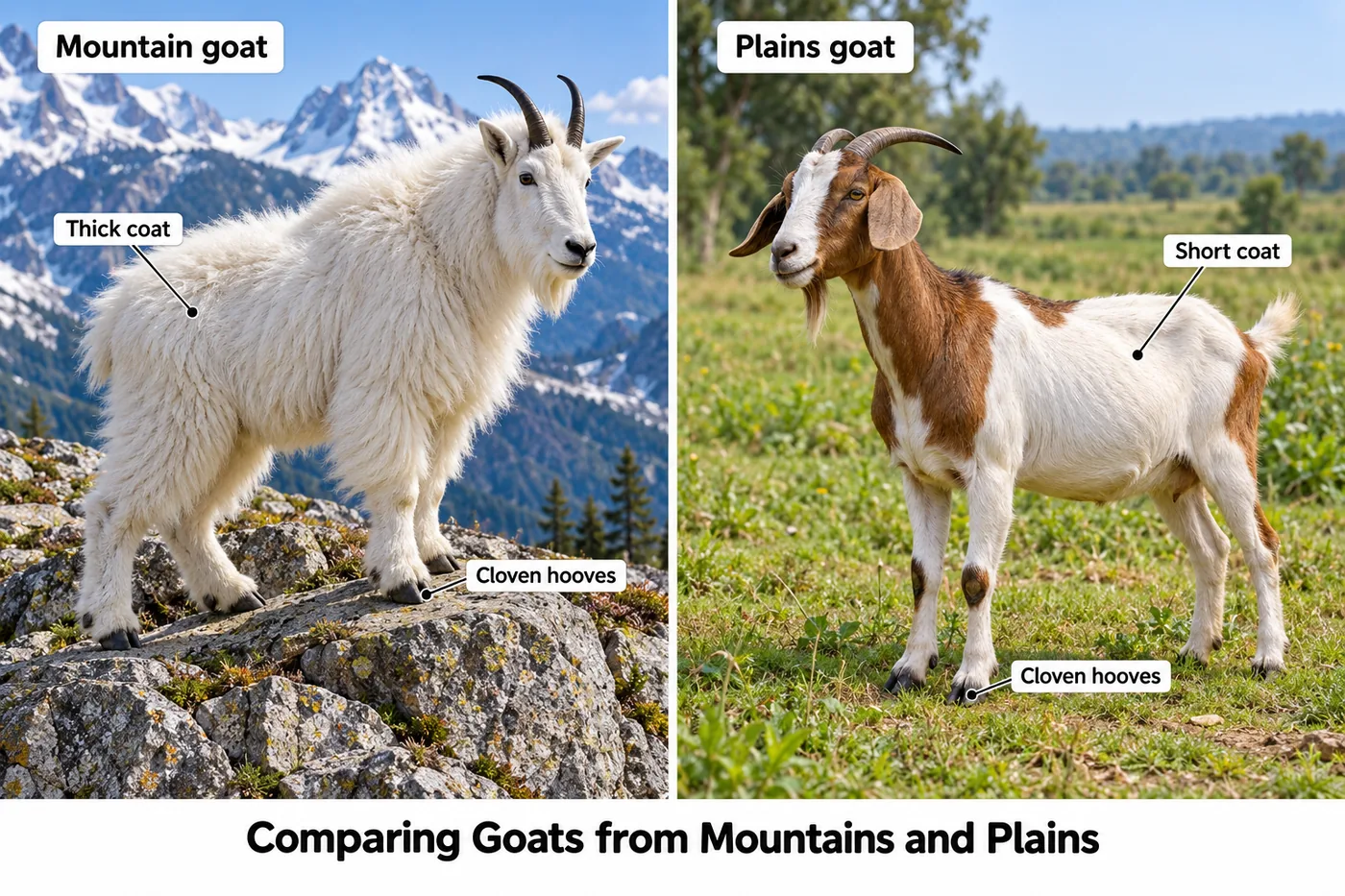
Adaptations are special features that help a plant or animal survive in its habitat. The same kind of animal may look different in different habitats:
| Animal | Habitat | Adaptation | Why it helps |
|---|---|---|---|
| Camel (Rajasthan) | Hot desert | One hump, long legs | Long legs keep the body away from hot sand; can go long without water |
| Camel (Ladakh) | Cold desert | Two humps, thick coat | Thick hair keeps the body warm in freezing cold |
| Mountain goat | Snowy mountains | Thick coat, strong hooves | Warmth and firm grip on rocky slopes |
| Plains goat | Plains | Short coat | Does not overheat in warm weather |
| Duck | Pond | Webbed feet | Paddles easily through water |
6. Protecting Biodiversity
When forests are cut down or grasslands are destroyed, animals lose their homes and food, and many may disappear forever. Protecting habitats is the best way to protect wildlife.
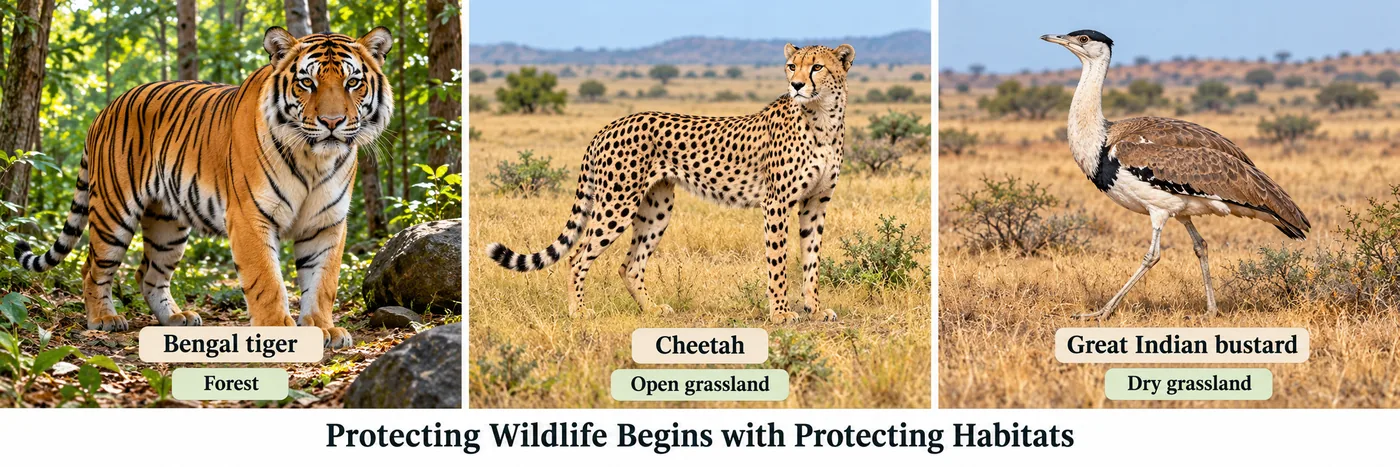
- Project Tiger (started in 1973) protects tigers and their forest homes.
- The Cheetah Reintroduction Project (started in 2022) brought cheetahs back to Indian grasslands.
- Protected areas have been set up for the Great Indian Bustard, a bird of dry grasslands.
- Sacred groves are patches of forest protected by local communities, often for religious reasons — they are treasure houses of biodiversity.
7. Master Table: Key Terms
| Term | Meaning |
|---|---|
| Biodiversity | Variety of plants and animals in a region |
| Grouping | Arranging things into groups by common features |
| Herb / Shrub / Tree | Soft green stem / many woody stems near ground / tall thick trunk |
| Climber / Creeper | Weak stem climbing a support / spreading on ground |
| Venation | Pattern of veins on a leaf: reticulate (net) or parallel |
| Taproot / Fibrous roots | One main root with side roots / bunch of thin similar roots |
| Dicot / Monocot | Seed with two cotyledons / with one cotyledon |
| Habitat | Place providing food, water, air and shelter to living things |
| Adaptation | Special feature helping survival in a habitat |
| Amphibian | Animal living both in water and on land (frog) |
8. Master Summary Table
| Feature | Type 1 | Type 2 | Exam note |
|---|---|---|---|
| Leaf venation | Reticulate (net) | Parallel | Radish has reticulate venation |
| Root | Taproot | Fibrous | Goes with venation type |
| Seed | Dicot (2 cotyledons) | Monocot (1 cotyledon) | Chickpea vs maize |
| Habitat | Terrestrial | Aquatic | Frog uses both |
| Camel | Hot desert: 1 hump | Cold desert: 2 humps | Adaptation to climate |
Chart — how plants can be grouped (number of groups in each way):
9. Mind Map
- Herb, shrub, tree, climber, creeper
- Venation, roots, seeds
- Legs, wings, fins, webbed feet
- Land, water, both
- Terrestrial, aquatic
- Adaptations
- Project Tiger 1973, Cheetah 2022
- Sacred groves
10. Tips and Tricks
- “Net–Tap–Two”: Net (reticulate) venation → Taproot → Two cotyledons. “Para–Fibre–One”: Parallel → Fibrous → One cotyledon.
- To check if a seed is a dicot, soak it overnight and try to split it into two equal halves.
- Look at the leaf to guess the root — a useful trick in field questions.
- Calling every short plant a herb — shrubs are short too but have hard, woody stems.
- Confusing climbers (go up) with creepers (spread on the ground).
- Thinking the two camels are adapted to the same climate — one is for heat, the other for cold.
11. Important One-liners
- Biodiversity is the variety of plants and animals in a region.
- Grouping makes it easier to study living things.
- Tomato is a herb, rose is a shrub and mango is a tree.
- Climbers need support; creepers spread on the ground.
- Grass and wheat have parallel venation and fibrous roots.
- Chickpea seeds have two cotyledons; maize has one.
- Frogs are amphibians — they live in water and on land.
- Webbed feet help ducks to paddle in water.
- Project Tiger began in 1973; cheetah reintroduction in 2022.
- Sacred groves are forests protected by local communities.
12. Exam-pattern Questions with Detailed Answers
Which plant has a weak stem and needs support to grow upwards?
- Mango
- Money plant
- Rose
- Wheat
Show answer
Money plant is a climber. Mango is a tree, rose is a shrub and wheat is a herb.
Answer: (B) Money plant
What type of venation is seen in a radish leaf?
Show answer
Radish leaves have a net-like vein pattern. Radish also has a taproot.
Answer: Reticulate venation
Name an animal that can live both in water and on land.
Show answer
Frogs spend time in water and on land; such animals are called amphibians.
Answer: Frog
Write two differences between the seeds of chickpea and maize.
Show answer
Chickpea seed splits into two equal halves (two cotyledons — dicot); maize has one cotyledon (monocot) and a large food store (endosperm). Chickpea plants have taproots; maize has fibrous roots.
Answer: Two vs one cotyledon; taproot vs fibrous root plant
Group these animals by habitat: fish, goat, frog, duck, cow, crocodile.
Show answer
Aquatic: fish. Terrestrial: goat, cow. Both water and land: frog, duck, crocodile.
Answer: Water — fish; Land — goat, cow; Both — frog, duck, crocodile
State two similarities and two differences between a mountain goat and a plains goat.
Show answer
Similarities: both have four legs with cloven hooves; both eat plants. Differences: the mountain goat has a thick coat for cold, the plains goat a short coat; the mountain goat has strong hooves to grip rocky slopes.
Answer: Same body plan; coat thickness and grip differ (adaptations)
A plant has parallel venation. What type of root and seed is it likely to have?
Show answer
Parallel venation usually goes with fibrous roots and monocot seeds (one cotyledon), as in wheat and maize.
Answer: Fibrous roots; monocot seed
Look at a duck’s feet. How are they different from a hen’s feet, and what does this tell us?
Show answer
Duck’s toes are joined by a skin (webbed feet), while a hen’s toes are separate. Webbed feet work like paddles, showing the duck is adapted to swim in water.
Answer: Webbed feet — adaptation for swimming
Two friends argue whether hibiscus is a shrub or a tree. What questions should they ask to decide?
Show answer
Is the stem hard and woody? Do many stems arise close to the ground, or is there a single thick trunk with branches high up? How tall is the plant? Hibiscus usually has several woody stems branching near the ground and medium height, so it is generally a shrub.
Answer: Ask about stem hardness, number of stems, branching height — hibiscus is a shrub
What may happen if a forest is cut down? Suggest ways to solve this problem.
Show answer
Animals lose food and shelter and may die or move away; some species may disappear; soil gets washed away; rainfall and air quality may be affected. Solutions: plant more trees, protect forests through sanctuaries and national parks, support community efforts like sacred groves, and use resources wisely.
Answer: Loss of habitat and biodiversity; protect and replant forests
Why does a camel in Ladakh have two humps and a thick coat while one in Rajasthan has one hump and long legs?
Show answer
Each is adapted to its habitat. Ladakh is a cold desert, so a thick coat keeps the camel warm. Rajasthan is a hot desert, so long legs keep the body away from the hot sand. This shows that adaptations match the conditions of the habitat.
Answer: Adaptations to cold vs hot desert
Group these animals in your own way (not by habitat or movement): cow, lion, goat, tiger, rabbit, crow.
Show answer
By food: plant-eaters — cow, goat, rabbit; flesh-eaters — lion, tiger; eats both — crow. (Any sensible feature, such as body covering, is acceptable if the groups follow it.)
Answer: e.g. by food — herbivores, carnivores, omnivores
13. Quick Revision Summary
- Biodiversity = variety of living things in a region; grouping helps us study them.
- Plants: herbs, shrubs, trees, climbers, creepers; reticulate/parallel venation; taproot/fibrous roots; dicot/monocot seeds.
- Animals move by legs, wings, fins or webbed feet; live on land, in water or both.
- Habitat gives food, water, air and shelter; adaptations help survival.
- Protect habitats: Project Tiger (1973), cheetah reintroduction (2022), sacred groves.