
1. Chapter at a Glance
Why does the Sun rise in the east and set in the west? Why are days longer in summer? Why can we sometimes see the Sun disappear in the middle of the day? The answers lie in the movements of the Earth and the Moon. This chapter explains the Earth’s rotation (day and night), its revolution around the Sun (year, changing day length, changing night sky) and eclipses of the Sun and Moon.
- Rotation of the Earth — day and night, apparent motion of the Sun and stars.
- Revolution of the Earth — a year, tilted axis, longer and shorter days.
- Why the night sky changes with months.
- Solar and lunar eclipses; umbra and penumbra; safety while viewing.
2. Rotation of the Earth — Day and Night
The Earth spins about an imaginary line called its axis, passing through the North and South Poles. This spinning is rotation. The Earth rotates from west to east and completes one rotation in about 24 hours (one day).
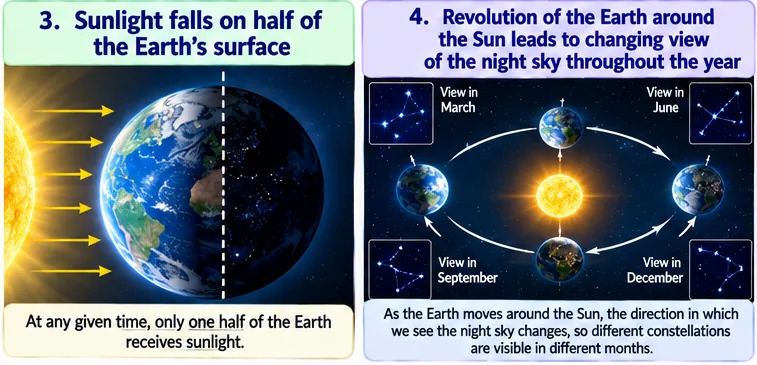
The Earth is a sphere and the Sun lights only one half of it at a time. The half facing the Sun has day; the other half has night. As the Earth rotates, places move from the lit half into the dark half and back, causing day and night.
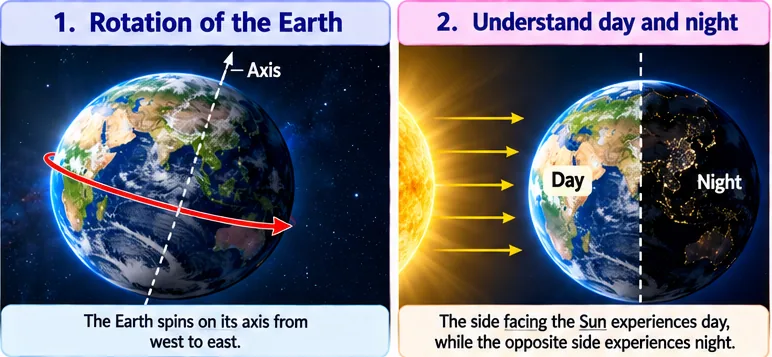
Because the Earth rotates west to east, the Sun, Moon and stars appear to move from east to west across the sky. The Sun seems to rise in the east and set in the west, though it is the Earth that is turning. (Similarly, trees seem to run backwards when we travel in a train.) The Pole Star appears nearly fixed because it lies almost directly above the Earth’s axis.
3. Revolution of the Earth
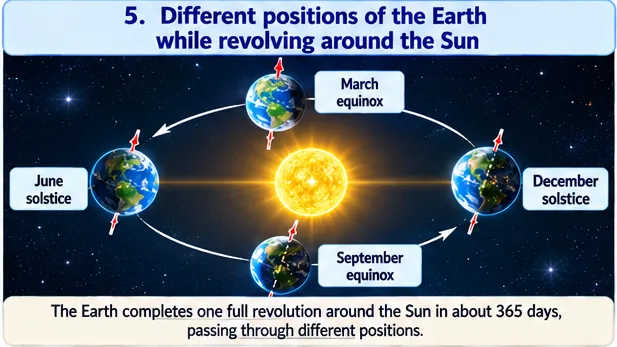
The Earth also moves around the Sun in a fixed path called its orbit. This is revolution. One revolution takes about 365¼ days — one year. The extra quarter day adds up to one extra day every four years, giving a leap year of 366 days (29 February).
Tilted axis and changing day length
The Earth’s axis is tilted (at about 23.5° to the perpendicular of its orbit) and always points in the same direction in space. So, as the Earth revolves:
| Around | Northern Hemisphere | Result in India |
|---|---|---|
| 21 June (June solstice) | Tilted towards the Sun | Longest day, shortest night; summer |
| 22 December (December solstice) | Tilted away from the Sun | Shortest day, longest night; winter |
| 21 March and 23 September (equinoxes) | Neither towards nor away | Day and night nearly equal |
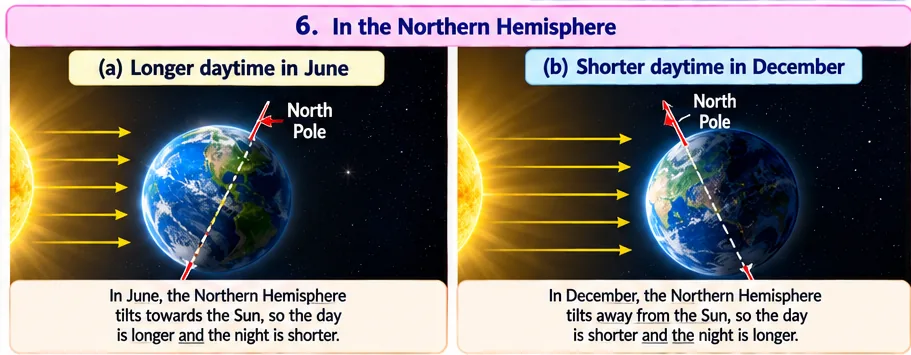
When the Northern Hemisphere has summer, the Southern Hemisphere (Australia, for example) has winter, and vice versa.
Changing night sky
At night we look away from the Sun into space. As the Earth moves around its orbit, the direction we face at night changes, so different constellations are visible in different months. Orion, for example, is easily seen on winter evenings in India.
4. Eclipses
The Sun is luminous; the Earth and Moon are opaque and cast long shadows in space. When the Sun, Earth and Moon come in a straight line, one body falls into the shadow of another — an eclipse. Each shadow has a dark inner part, the umbra (complete shadow), and a lighter outer part, the penumbra (partial shadow).
Solar eclipse
A solar eclipse occurs when the Moon comes between the Sun and the Earth and the Moon’s shadow falls on the Earth. It can happen only on a new moon day.
- People in the umbra see a total solar eclipse — the Sun is completely hidden, the sky darkens and the Sun’s glowing outer layer (corona) becomes visible.
- People in the penumbra see a partial solar eclipse.
- When the Moon is a little farther and cannot cover the Sun fully, a bright ring is seen — an annular eclipse.
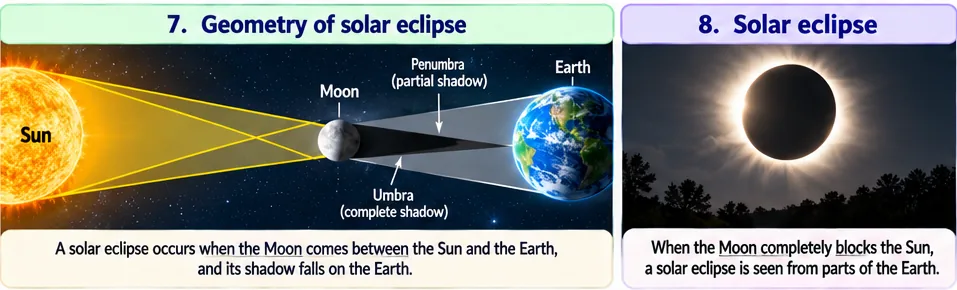
Even during an eclipse, the Sun’s rays can permanently damage the eyes. Use certified solar-viewing filters, or project the Sun’s image through a pinhole onto a screen.
Lunar eclipse
A lunar eclipse occurs when the Earth comes between the Sun and the Moon and the Moon passes through the Earth’s shadow. It can happen only on a full moon night. During a total lunar eclipse the Moon often looks reddish, because a little sunlight bends through Earth’s atmosphere and reaches it. A lunar eclipse is safe to watch with naked eyes and can be seen from the whole night side of the Earth.
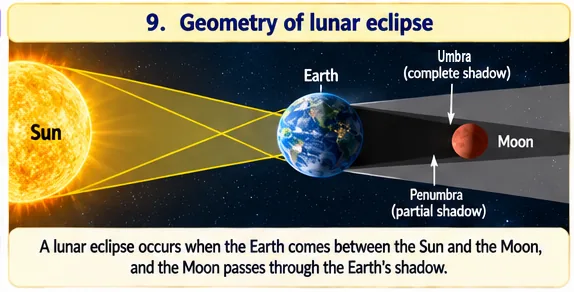
Eclipses do not happen every month because the Moon’s orbit is slightly tilted compared with the Earth’s orbit; usually the Moon passes a little above or below the line joining the Sun and the Earth.
5. Master Table: Key Terms and Values
| Term | Meaning / value |
|---|---|
| Rotation | Spinning on axis, west to east; ~24 h |
| Revolution | Moving around the Sun; ~365¼ days |
| Leap year | 366 days, every 4 years |
| Axial tilt | About 23.5°; causes changing day length and seasons |
| Solstice | 21 June (longest day in N. Hemisphere), 22 December (shortest) |
| Equinox | 21 March, 23 September — day ≈ night |
| Umbra / Penumbra | Complete shadow / partial shadow |
| Solar / Lunar eclipse | Sun–Moon–Earth on new moon / Sun–Earth–Moon on full moon |
6. Master Summary Table
| Feature | Solar eclipse | Lunar eclipse |
|---|---|---|
| Middle body | Moon | Earth |
| Moon phase | New moon | Full moon |
| Shadow falls on | Earth | Moon |
| Seen from | A narrow region | Whole night side |
| Safe to view directly? | No — use filters | Yes |
Chart — approximate day length at about 28° N (e.g. Delhi):
7. Mind Map
- West to east, 24 h
- Day and night
- 365¼ days, leap year
- Tilt → day length
- Changes with months
- Pole Star nearly fixed
- Solar: new moon
- Lunar: full moon
8. Tips and Tricks
- “S-M-E = Solar” (Sun, Moon, Earth); “S-E-M = lunar” (Sun, Earth, Moon).
- Solar eclipse ↔ new moon; lunar eclipse ↔ full moon.
- Rotation → day; revolution → year.
- Saying the Sun moves around the Earth each day — it only appears to.
- Thinking seasons happen because the Earth goes closer to and farther from the Sun — they happen mainly because of the tilted axis.
- Calling the dark central shadow the penumbra — it is the umbra.
9. Important One-liners
- The Earth rotates from west to east in about 24 hours.
- Rotation causes day and night.
- Only half of the Earth is lit by the Sun at any time.
- The Earth revolves around the Sun in about 365¼ days.
- Every fourth year is a leap year of 366 days.
- The Earth’s axis is tilted, causing longer and shorter days.
- 21 June is the longest day in the Northern Hemisphere.
- A solar eclipse occurs on a new moon day.
- A lunar eclipse occurs on a full moon night.
- Umbra is the complete shadow; penumbra is the partial shadow.
10. Exam-pattern Questions with Detailed Answers
Day and night are caused by:
- Revolution of the Earth
- Rotation of the Earth
- Revolution of the Moon
- Tilt of the Earth
Show answer
Rotation brings places alternately into the lit and dark halves. Revolution causes the year.
Answer: (B) Rotation of the Earth
On which day does a lunar eclipse occur?
Show answer
Only on a full moon night, when the Earth can come between the Sun and the Moon.
Answer: Full moon
How many days are there in a leap year?
Show answer
366 days (with 29 February).
Answer: 366
Why does the Sun appear to rise in the east?
Show answer
The Earth rotates from west to east. As our place turns towards the Sun, the Sun first becomes visible on the eastern horizon, so it appears to rise in the east.
Answer: Earth rotates west to east
Why are days longer in June than in December in India?
Show answer
The Earth’s axis is tilted. In June the Northern Hemisphere (with India) is tilted towards the Sun, so it remains in sunlight longer; in December it is tilted away, so days are shorter.
Answer: Tilt towards the Sun in June
Why should we not view a solar eclipse with naked eyes?
Show answer
Intense sunlight can burn the retina and cause permanent blindness. Use certified solar filters or a pinhole projector.
Answer: Can permanently damage the eyes
Why do we see different constellations in different months?
Show answer
As the Earth revolves around the Sun, the night side faces different directions in space through the year, so different parts of the sky — and different constellations — are visible at night.
Answer: Revolution changes the direction of our night sky
What are umbra and penumbra?
Show answer
Umbra is the dark central part of a shadow where light is completely blocked. Penumbra is the lighter outer part where light is only partly blocked.
Answer: Complete shadow and partial shadow
Why does a solar eclipse not occur on every new moon day?
Show answer
The Moon’s orbit is tilted slightly relative to the Earth’s orbit. On most new moons, the Moon passes a little above or below the Sun–Earth line, so its shadow misses the Earth. An eclipse happens only when new moon occurs near the points where the two orbits cross.
Answer: The Moon’s orbit is tilted; alignment is rarely exact
During a total lunar eclipse the Moon looks reddish instead of disappearing. Explain.
Show answer
Sunlight passing through the Earth’s atmosphere is bent into the umbra. Blue light is scattered away, while red light passes through and reaches the Moon, giving it a reddish colour.
Answer: Red sunlight bent through Earth’s atmosphere reaches the Moon
When it is summer in India, it is winter in Australia. Why?
Show answer
Because of the tilted axis, when the Northern Hemisphere (India) leans towards the Sun around June, the Southern Hemisphere (Australia) leans away. So India gets longer days and more direct sunlight (summer) while Australia gets shorter days (winter).
Answer: Hemispheres tilt in opposite directions relative to the Sun
11. Quick Revision Summary
- Rotation: west to east, ~24 h → day and night; Sun and stars appear to move east to west.
- Revolution: ~365¼ days → year; leap year every 4 years.
- Tilted axis → longest day 21 June, shortest 22 December, equal day and night at equinoxes.
- Night sky changes with months because of revolution.
- Solar eclipse: Sun–Moon–Earth, new moon, view with filters; lunar eclipse: Sun–Earth–Moon, full moon, Moon reddish. Umbra = complete, penumbra = partial shadow.