
1. Chapter at a Glance
We see the world because of light. Light from the Sun, a lamp or a candle falls on objects and bounces into our eyes. If an opaque object blocks light, a dark shadow forms behind it. If light falls on a smooth shiny surface like a mirror, it bounces back neatly and we see an image. This chapter explores sources of light, how light travels, shadows, the pinhole camera, reflection and images in a plane mirror.
- Luminous and non-luminous objects.
- Light travels in a straight line — rectilinear propagation.
- Transparent, translucent and opaque materials; formation and parts of shadows.
- Pinhole camera and its inverted image.
- Reflection, laws of reflection, regular and diffuse reflection, image in a plane mirror, lateral inversion.
2. Sources of Light
- Luminous objects give out their own light — the Sun, stars, a burning candle, a glowing bulb, fireflies.
- Non-luminous objects do not have their own light; we see them when light from a luminous source falls on them and reflects into our eyes — the Moon, a book, a table.
Never look directly at the Sun or a very bright light, even through glasses — it can permanently damage the eyes.
3. Light Travels in a Straight Line
Look at a candle flame through a straight pipe — you can see it. Bend the pipe — the flame disappears. Similarly, three cardboard sheets with holes in a straight line let you see the flame only when all holes are aligned. Beams of sunlight entering a dark room through a gap also look straight. This shows that light travels in straight lines (rectilinear propagation).
4. Transparent, Translucent and Opaque
| Type | Light passes? | Examples |
|---|---|---|
| Transparent | Almost completely; objects seen clearly | Clear glass, clean water, air |
| Translucent | Partly; objects seen unclearly | Butter paper, frosted glass, oiled paper |
| Opaque | Not at all | Wood, metal, cardboard, stone |
5. Shadows
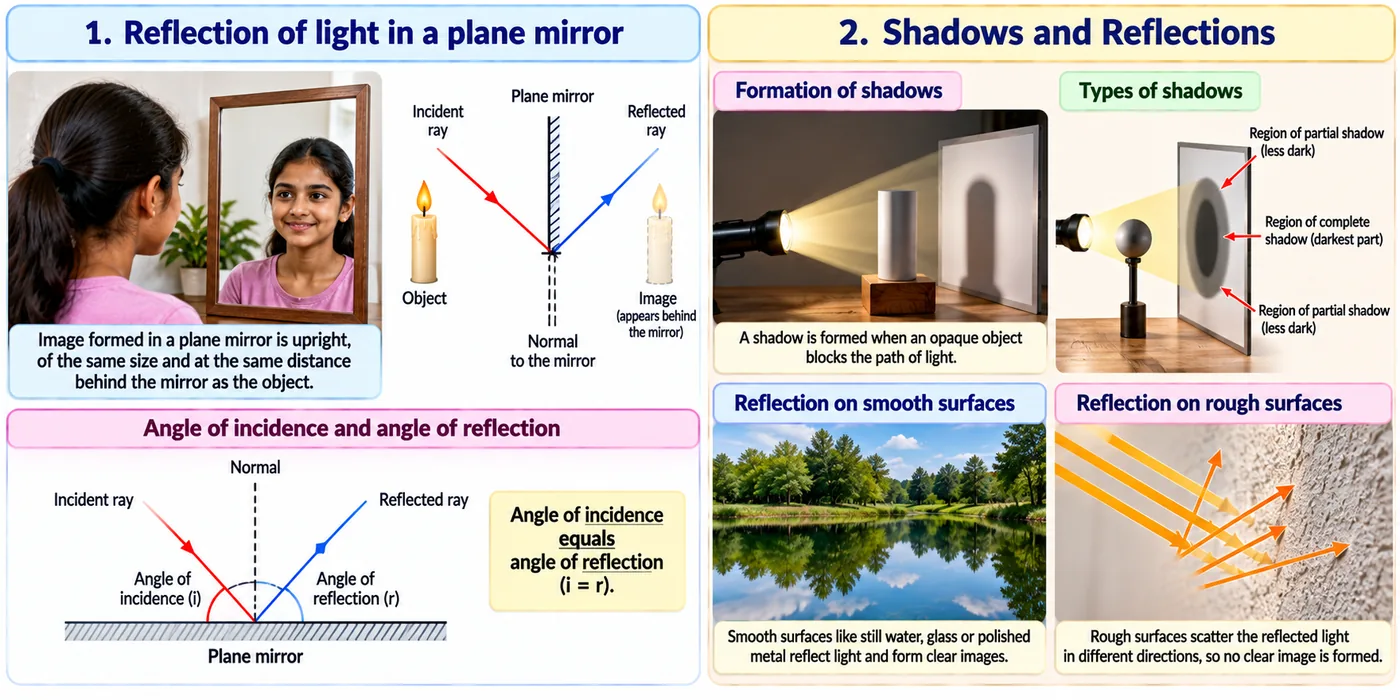
A shadow is the dark area formed behind an opaque object when it blocks light. To see a shadow we need three things: a source of light, an opaque object and a screen (wall, ground) behind it. Shadows show that light travels in straight lines.
- A shadow is always dark (black), whatever the colour of the object.
- Its shape depends on the outline of the object and on the angle at which light falls.
- Moving the object closer to the light source makes the shadow larger.
- With a large source, a shadow has a dark central part — the umbra (complete shadow) — surrounded by a lighter part — the penumbra (partial shadow).
6. The Pinhole Camera
A pinhole camera is a closed box with a tiny hole on one side and a translucent screen (butter paper) on the opposite side. Light rays from the top of an object pass through the hole in a straight line and reach the bottom of the screen; rays from the bottom reach the top. So the image formed is inverted (upside down) and also laterally reversed. A pinhole camera works because light travels in straight lines. During a partial solar eclipse, gaps between leaves act like pinholes and form crescent images of the Sun on the ground.
7. Reflection of Light
When light falls on a surface and bounces back, it is called reflection. A mirror reflects almost all the light falling on it.
- Incident ray — the ray falling on the surface.
- Reflected ray — the ray bouncing back.
- Normal — a line perpendicular (at 90°) to the surface at the point where light falls.
- Angle of incidence (∠i) — between incident ray and normal; angle of reflection (∠r) — between reflected ray and normal.
- The angle of incidence is equal to the angle of reflection (∠i = ∠r).
- The incident ray, the normal and the reflected ray all lie in the same plane.
Regular and diffuse reflection
A smooth, shiny surface (mirror, still water, polished metal) reflects parallel rays in one direction — regular reflection — and forms clear images. A rough surface (wall, paper, cloth) scatters light in many directions — diffuse reflection — so no clear image forms. The laws of reflection still hold at every tiny point of a rough surface. Diffuse reflection lets us see objects from all directions.
8. Image in a Plane Mirror
| Property of the image | Explanation |
|---|---|
| Erect (upright) | Not upside down |
| Same size as the object | Not magnified or diminished |
| Behind the mirror, at the same distance as the object is in front | Move 1 m back, the image moves 1 m back |
| Virtual | Cannot be obtained on a screen |
| Laterally inverted | Left appears right and right appears left |
Because of lateral inversion, the word AMBULANCE is written in mirror-reversed form on the front of ambulances so drivers ahead can read it correctly in their rear-view mirrors.
Useful items using reflection: a periscope (two plane mirrors at 45°) to see over obstacles; a kaleidoscope (three mirrors) that makes beautiful repeating patterns.
9. Master Table: Key Terms
| Term | Meaning |
|---|---|
| Luminous / Non-luminous | Gives own light / does not |
| Rectilinear propagation | Light travels in straight lines |
| Shadow | Dark area behind an opaque object |
| Umbra / Penumbra | Complete shadow / partial shadow |
| Reflection | Bouncing back of light from a surface |
| Law of reflection | ∠i = ∠r; rays and normal in one plane |
| Lateral inversion | Left–right reversal in a mirror image |
| Virtual image | Cannot be formed on a screen |
10. Master Summary Table
| Device / situation | Image or effect | Reason |
|---|---|---|
| Pinhole camera | Inverted, real image on screen | Straight-line travel |
| Plane mirror | Erect, same size, virtual, laterally inverted | Reflection |
| Shadow | Dark; umbra and penumbra | Opaque object blocks light |
| Periscope | See over walls | Two reflections |
| Rough wall | No image | Diffuse reflection |
11. Mind Map
- Luminous, non-luminous
- Straight-line travel
- Source + opaque + screen
- Umbra, penumbra
- Inverted image
- ∠i = ∠r
- Plane mirror image, periscope
12. Tips and Tricks
- Plane mirror image: “SEVL” — Same size, Erect, Virtual, Laterally inverted.
- Angles of incidence and reflection are measured from the normal, not the mirror.
- Pinhole image is inverted; mirror image is erect.
- Calling the Moon luminous — it reflects sunlight.
- Thinking a red ball casts a red shadow — shadows are always dark.
- Measuring the angle between the ray and the mirror surface.
13. Important One-liners
- Objects that emit their own light are luminous.
- Light travels in straight lines.
- Opaque objects form shadows.
- A shadow needs a source, an opaque object and a screen.
- The image in a pinhole camera is inverted.
- Angle of incidence = angle of reflection.
- A plane mirror forms an erect, virtual image of the same size.
- Lateral inversion swaps left and right.
- A periscope uses two plane mirrors.
14. Exam-pattern Questions with Detailed Answers
Which of these is a luminous object?
- Moon
- Mirror
- Candle flame
- Book
Show answer
A candle flame gives its own light. The Moon, mirror and book only reflect light.
Answer: (C) Candle flame
If the angle of incidence is 35°, what is the angle of reflection?
Show answer
By the law of reflection, ∠r = ∠i = 35°.
Answer: 35°
What is the nature of the image in a pinhole camera?
Show answer
Inverted (upside down) and real (formed on the screen).
Answer: Inverted, real
Why is “AMBULANCE” written in reverse on the front of the vehicle?
Show answer
Drivers ahead see it in their rear-view mirrors. A mirror laterally inverts the reversed letters, so they read “AMBULANCE” correctly and give way.
Answer: Lateral inversion makes it readable in mirrors
Give one activity to show that light travels in a straight line.
Show answer
Look at a candle flame through a straight pipe — it is visible. Bend the pipe — it is not visible. Light cannot follow the bent path.
Answer: Straight vs bent pipe activity
Distinguish between regular and diffuse reflection.
Show answer
Regular: from smooth surfaces; parallel rays reflect in one direction; clear image (mirror). Diffuse: from rough surfaces; rays scatter in many directions; no clear image (wall).
Answer: Smooth vs rough surface; image vs no image
A girl stands 2 m in front of a plane mirror. How far is she from her image? If she moves 0.5 m closer, what is the new distance?
Show answer
Image is 2 m behind the mirror, so the distance between girl and image = 4 m. After moving closer she is 1.5 m from the mirror, image 1.5 m behind: distance = 3 m.
Answer: 4 m; 3 m
What three things are needed to form a shadow?
Show answer
A source of light, an opaque object and a screen or surface behind the object.
Answer: Source, opaque object, screen
Why does a shadow of an object have a dark centre and a lighter edge when the light source is large?
Show answer
From the central region behind the object, no part of the large source is visible, so it is completely dark (umbra). Near the edges, part of the source is still visible, so some light reaches — partial shadow (penumbra). With a point source, the shadow is sharp.
Answer: Umbra gets no light; penumbra gets part of it
How does a periscope help a soldier in a trench see over the wall?
Show answer
A periscope has two plane mirrors fixed parallel to each other at 45° to the tube. Light from the scene reflects from the top mirror down the tube to the bottom mirror, which reflects it into the eye. The soldier sees what is above without exposing himself.
Answer: Two 45° mirrors redirect light down to the eye
During a partial solar eclipse, crescent-shaped patches of light appear under a tree. Explain.
Show answer
Tiny gaps between leaves act like pinholes. Each forms an image of the Sun on the ground. As the Sun is partly covered by the Moon and looks like a crescent, the images are crescent-shaped.
Answer: Leaf gaps act as pinhole cameras
15. Quick Revision Summary
- Luminous objects emit light; non-luminous objects reflect it.
- Light travels in straight lines — shown by pipes, shadows and pinhole cameras.
- Shadows need source + opaque object + screen; umbra and penumbra.
- Laws of reflection: ∠i = ∠r; rays and normal in one plane; regular vs diffuse reflection.
- Plane mirror image: erect, same size, virtual, same distance behind, laterally inverted; periscope and kaleidoscope use mirrors.