
1. Chapter at a Glance
In Grade 6 you discovered that science is a way of thinking — observing, asking questions, guessing and testing. In Grade 7 the journey continues. This opening chapter shows that science is ever-evolving: scientific ideas grow, get tested and are sometimes corrected as new evidence appears. It also gives a preview of what you will explore this year — materials and their changes, life processes, time and motion, light, and the Earth, Moon and Sun.
- Why science keeps changing and improving.
- Curiosity, careful observation and evidence as the heart of science.
- A preview of Grade 7 themes: properties and changes of materials, life processes, measuring time, light and shadows, eclipses.
- How one simple observation — a curved shadow on the Moon — told ancient thinkers that the Earth is round.
- Good habits of a young scientist: questioning, recording, sharing and staying safe.
2. Science Is Ever-Evolving
Science is not a fixed book of answers. It is a growing body of knowledge built by many people over thousands of years. When scientists find new evidence, they test old ideas again. If an idea still fits the evidence, it becomes stronger. If it does not, it is improved or replaced. This willingness to change is a strength, not a weakness.
| Old idea | New evidence | Improved idea |
|---|---|---|
| The Earth is flat | Ships disappear hull-first over the horizon; Earth’s shadow on the Moon is always curved | The Earth is round (nearly spherical) |
| Living things can appear from non-living matter (like maggots from meat) | Covered meat does not get maggots; flies lay eggs | Living things come only from living things |
| Diseases are caused by “bad air” | Microscopes revealed germs | Many diseases are caused by microorganisms |
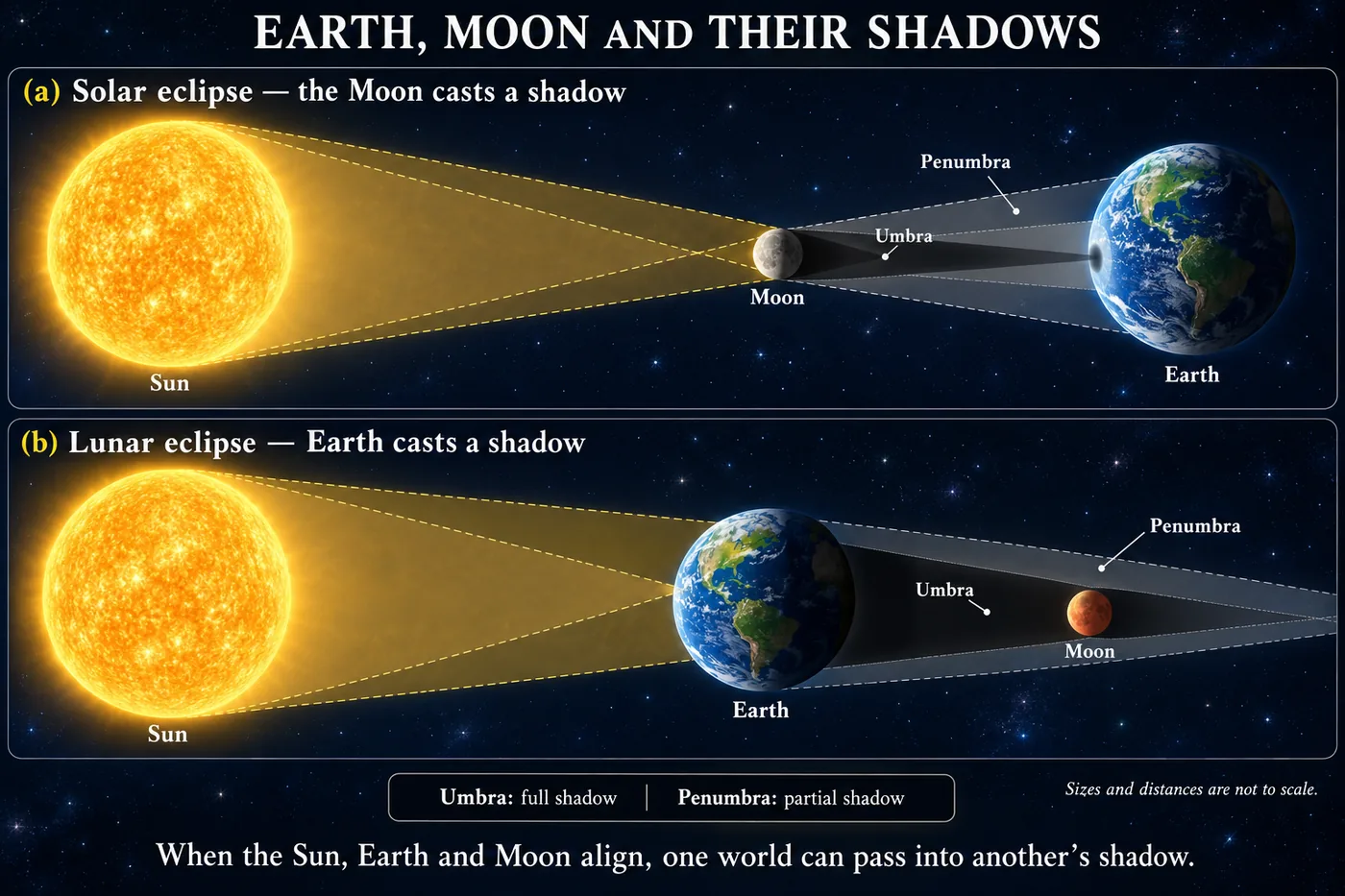
During a lunar eclipse, the Earth comes between the Sun and the Moon and its shadow falls on the Moon. Ancient observers, including Indian astronomers like Āryabhaṭa (5th century CE), noticed that the edge of this shadow is always curved. Only a round body casts a curved shadow in every position — strong evidence that the Earth is round. You will study eclipses in detail in Chapter 12.
3. Curiosity, Observation and Evidence
Every discovery begins with a question. “Why does iron rust but gold does not?” “How does a plant make food without a kitchen?” “How did people tell time before clocks?” A curious mind notices such puzzles and looks for answers through observation and experiments, not guesswork alone.
- Observation — using the senses and instruments carefully.
- Recording — writing down what we see, with numbers and units where possible.
- Evidence — results that anyone can check by repeating the experiment.
- Fair test — changing only one thing at a time so we know what caused the result.
- Sharing — discussing results with others, who may spot mistakes or suggest better ideas.
4. Your Grade 7 Journey — A Preview
| Theme | Big questions | Chapter |
|---|---|---|
| Substances | Why is lemon sour and soap bitter? How can we test them safely? | 2 — Acidic, Basic and Neutral |
| Electricity | How does a torch work? What makes a circuit complete? | 3 — Circuits and Components |
| Materials | Why are utensils made of metals and wires of copper? | 4 — Metals and Non-metals |
| Changes | Which changes can be reversed? Why does iron rust? | 5 — Physical and Chemical Changes |
| Growing up | What changes happen in our body and mind as teenagers? | 6 — Adolescence |
| Heat | How does heat travel? Why do sea breezes blow? | 7 — Heat Transfer |
| Time | How do we measure time and speed? | 8 — Time and Motion |
| Living things | How do animals digest food and breathe? How do plants make food? | 9 and 10 — Life Processes |
| Light | Why do shadows form? How does a mirror make an image? | 11 — Light |
| Sky | Why do we have day and night, seasons and eclipses? | 12 — Earth, Moon and Sun |
5. Habits of a Young Scientist
- Ask “why” and “how” — and then try to find out.
- Measure, don’t just guess — use scales, thermometers and clocks.
- Be honest with results — record what really happened, even if it was unexpected.
- Work together — share ideas and respect others’ views.
- Stay safe — follow teachers’ instructions with heat, sharp objects and chemicals; never taste or smell chemicals directly.
- Care for nature — science should help people and protect the environment.
6. Master Table: Key Terms
| Term | Meaning |
|---|---|
| Science | A growing body of knowledge built through observation and experiment |
| Evidence | Observations and results that support or reject an idea |
| Fair test | Experiment where only one factor is changed at a time |
| Ever-evolving | Always developing; ideas are improved with new evidence |
| Lunar eclipse | Earth’s shadow falls on the Moon (Sun–Earth–Moon in a line) |
| Solar eclipse | Moon’s shadow falls on the Earth (Sun–Moon–Earth in a line) |
7. Master Summary Table
| Idea | Key point | Example |
|---|---|---|
| Science changes | Ideas are tested again with new evidence | Flat Earth → round Earth |
| Evidence | Must be repeatable by others | Curved shadow in every lunar eclipse |
| Fair test | Change one factor only | Testing which material conducts heat |
| Grade 7 themes | Matter, life, energy, Earth and space | Acids, circuits, digestion, eclipses |
8. Mind Map
- Grows and corrects itself
- Based on evidence
- Observe, record
- Fair test, share
- Materials and changes
- Life processes
- Time, light, sky
- Curved shadow on Moon
- Earth is round
9. Tips and Tricks
- For “science is ever-evolving” questions, always give one old idea → new evidence → new idea example.
- A fair test = one change, everything else same.
- Remember eclipse order by the middle body: solar eclipse — Moon in the middle; lunar eclipse — Earth in the middle.
- Thinking that a changed scientific idea means science “failed” — correction is how science improves.
- Calling a single observation “proof”; results should be repeatable.
- Mixing up solar and lunar eclipses.
10. Important One-liners
- Science is a growing and self-correcting body of knowledge.
- Scientific ideas are tested again when new evidence appears.
- Evidence must be repeatable by others.
- In a fair test, only one factor is changed at a time.
- Earth’s curved shadow on the Moon shows that the Earth is round.
- In a lunar eclipse, the Earth is between the Sun and the Moon.
- Curiosity, honesty and teamwork are habits of a good scientist.
11. Exam-pattern Questions with Detailed Answers
“Science is ever-evolving” means that:
- Scientific ideas never change
- Scientific ideas improve with new evidence
- Science is only about memorising facts
- Only scientists can do science
Show answer
Science changes and improves as new evidence is found. The other options contradict the nature of science.
Answer: (B)
In a lunar eclipse, which body comes between the other two?
Show answer
The Earth comes between the Sun and the Moon, so its shadow falls on the Moon.
Answer: The Earth
What is a fair test?
Show answer
An experiment in which only one factor is changed while all others are kept the same, so the effect of that factor can be known.
Answer: Change one factor, keep others same
How did the shadow seen during a lunar eclipse help people conclude that the Earth is round?
Show answer
In every lunar eclipse, the edge of the Earth’s shadow on the Moon is curved. A flat disc would sometimes cast a straight or oval shadow, but a sphere always casts a round shadow. So the Earth must be round.
Answer: The shadow is always curved — only a sphere does that
Give one example of a scientific idea that was changed by new evidence.
Show answer
People once believed diseases spread through “bad air”. When microscopes showed germs, scientists learnt that many diseases are caused by microorganisms, which led to better hygiene and medicines.
Answer: “Bad air” theory replaced by germ idea
Why should results of an experiment be shared with others?
Show answer
Others can repeat the experiment to check the results, point out errors and suggest improvements. This makes conclusions reliable and helps knowledge grow.
Answer: For checking, correcting and building on them
List any three safety rules to follow while doing science activities.
Show answer
Work only under the teacher’s guidance; do not taste or directly smell chemicals; handle hot objects and flames carefully; keep the work area clean.
Answer: Teacher supervision, no tasting chemicals, care with heat
Distinguish between a solar eclipse and a lunar eclipse.
Show answer
Solar eclipse: the Moon comes between the Sun and the Earth, and the Moon’s shadow falls on Earth. Lunar eclipse: the Earth comes between the Sun and the Moon, and Earth’s shadow falls on the Moon.
Answer: Middle body — Moon (solar) vs Earth (lunar)
Two students test which cloth dries fastest. One uses cotton in sunlight and polyester in shade. Is this a fair test? How would you correct it?
Show answer
No. Two factors (material and sunlight) are changed together, so we cannot tell which caused the difference. Correct test: same size pieces, equally wet, dried at the same place and time; only the type of cloth differs.
Answer: Not fair — change only the cloth type
“A good scientist should be ready to change their mind.” Explain with reason.
Show answer
Scientific ideas must match evidence. If careful new observations disagree with an old idea, holding on to it would spread wrong knowledge. Accepting correction keeps science accurate and useful.
Answer: Evidence decides; ideas must change to fit it
Ships far out at sea seem to disappear from the bottom up. What does this suggest about the Earth? Explain.
Show answer
If the Earth were flat, the whole ship would just look smaller as it moved away. Because the hull disappears first and the mast last, the ship must be going over a curved surface — the Earth is round.
Answer: Earth’s surface is curved
12. Quick Revision Summary
- Science is ever-evolving: ideas are tested, improved or replaced with new evidence.
- Curiosity, observation, recording, fair tests and sharing are its key habits.
- Earth’s curved shadow on the Moon during a lunar eclipse shows the Earth is round.
- Grade 7 covers substances, electricity, metals, changes, adolescence, heat, time, life processes, light and the Earth–Moon–Sun system.
- Always work safely and honestly.