
1. Chapter at a Glance
Everything around us — the desk, a shirt button, the electricity in the fan — can be traced back to Nature. This chapter explains when a part of Nature becomes a resource, how resources are classified, why their uneven distribution shapes trade, jobs and conflicts, what happens when we over-exploit them (with case studies of Punjab's groundwater and cement pollution), and how we can act as responsible stewards through restoration, regeneration and wise use.
- How do we categorise natural resources?
- How does the distribution of resources affect different aspects of life?
- What are the effects of unsustainable use and over-exploitation?
2. When Does Nature Become a Resource?
Nature is all living and non-living things in our environment that humans did not create. A part of Nature becomes a resource when humans use it — a tree is part of Nature; its wood turned into furniture is a resource. For something to count as a resource it must be:
- Technologically accessible — we must have the means to reach it (oil deep under the ocean may be out of reach);
- Economically feasible — extraction must not cost more than it is worth;
- Culturally acceptable — e.g. communities do not cut trees in sacred groves.
So, natural resources are materials and substances found in Nature that are valuable to humans — water, air, soil, timber, coal, petroleum, metal ores, precious stones. Many indigenous traditions treat Nature as sacred, a nurturer — seen in practices like offering arghyam (water) to the Sun or worshipping the tulasī.
3. Categories of Natural Resources
(a) By use
| Category | Examples |
|---|---|
| Essential for life | Air, water, food from soil — things we cannot make |
| For materials | Wood, marble, clay, iron, gold — made into tools, buildings, art |
| For energy | Coal, petroleum, natural gas, sunlight, wind, flowing water |
(b) Renewable and non-renewable
Nature works through restoration (returning to a healthy state — a cut heals, a forest recovers after fire) and regeneration (creating new life and conditions to thrive). A fallen tree decays, enriches the soil, and new plants grow — Nature works in cycles with no waste.
| Renewable | Non-renewable |
|---|---|
| Can be replenished by natural processes in a human time-scale | Formed over millions of years; cannot be replaced as fast as we use them |
| Sunlight, wind, flowing water, forests, soil, fish | Coal, petroleum, natural gas, iron, copper, gold |
| Stay renewable only if we do not disturb Nature's rhythm | Must be used judiciously to last until alternatives are ready |
- Cutting timber faster than forests grow back depletes the forest.
- Rising temperatures make some Himalayan glaciers melt faster than snowfall replaces them — threatening the rivers that the plains depend on; the Himalaya is often called a “water tower”.
- Commercial over-fishing has reduced fish such as tuna, though traditional communities avoided fishing during the spawning season.
- Untreated industrial waste poisons rivers so they can no longer support life.
Ecosystem functions and services: a forest naturally filters water, holds soil and shelters animals (functions); when we benefit through clean water, protected farmland and pollinated crops, these are ecosystem services.
4. Uneven Distribution and Its Effects
Resources are not spread evenly. Coal is concentrated in the Damodar valley (Jharia, Bokaro, Raniganj), Korba, Talcher and Singareni; iron ore in Odisha–Jharkhand (Keonjhar, Mayurbhanj, Gua), Chhattisgarh (Bailadila, Durg) and Karnataka (Ballari, Kudremukh); bauxite in Odisha (Koraput), Amarkantak and Ratnagiri; petroleum at Mumbai High, Ankleshwar and in Assam (Digboi, Naharkatia).
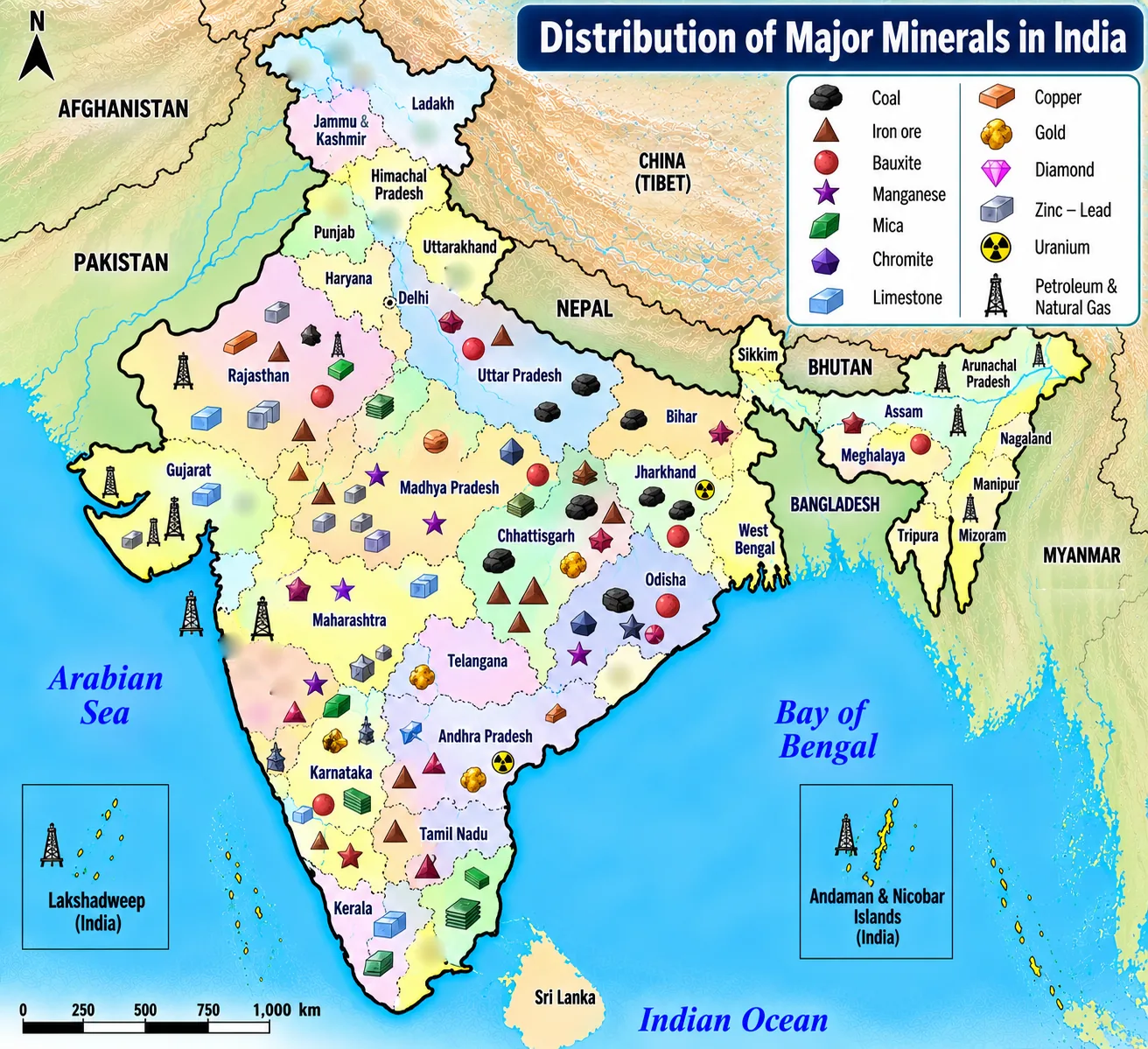
- Benefits: industries near resources create jobs; townships grow; services improve. Skill plus resources gave India unique products such as Wootz steel, which fuelled ancient trade.
- Costs: people in resource-rich areas may be displaced, sacred places threatened, and land and water polluted.
- Sharing disputes: Nature ignores political borders. The Kaveri waters are shared by Karnataka, Tamil Nadu, Kerala and Puducherry (the Mettur dam is in Tamil Nadu); careful negotiation and legal settlement were needed. Between countries it is harder — the Brahmaputra rises in Tibet (China) as the Yarlung Tsangpo, flows through India and enters Bangladesh as the Jamuna.
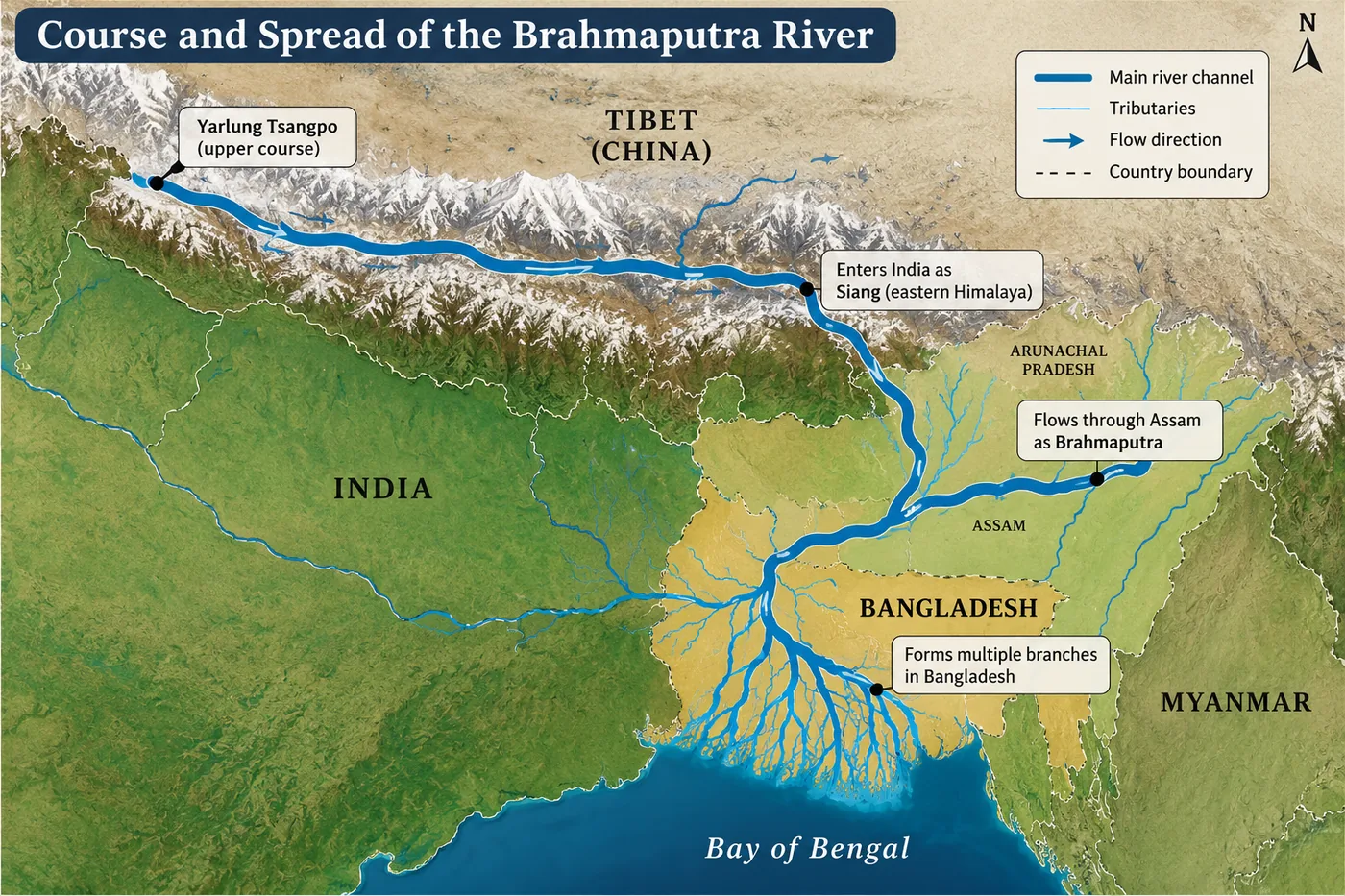
Having lots of natural resources does not automatically make a country rich — economists call this the resource curse. Countries that only export raw materials, without building industries and skills to turn them into higher-value products, may grow slowly. India has largely avoided this by developing its own industries. Knowledge, good governance and planning decide whether resources bring lasting benefit or a short-lived windfall.
5. Over-exploitation: Two Case Studies
(a) Groundwater in Punjab
- In the 1960s Green Revolution, farmers adopted high-yielding wheat and paddy needing far more water.
- Free or cheap electricity encouraged over-pumping of groundwater for irrigation.
- Chemical fertilisers and pesticides seeped into the groundwater, creating health risks.
- Result: in much of Punjab the water table has fallen below about 30 metres, and the Central Ground Water Board classifies the large majority of its blocks as over-exploited — water is drawn far faster than rain can recharge it.
Food security was gained in the short run; repairing the long-term damage will take time. Many other States and growing cities face the same risk. Remedies: rainwater harvesting, reviving ponds and tanks, less water-hungry crops, drip irrigation, and treating and reusing water.
(b) The case of cement
Cement is used in houses, bridges, roads and airports, but it is among the most polluting industries — its fine dust harms lungs, coats leaves (reducing yields) and pollutes soil and water. The Central Pollution Control Board sets guidelines to curb it. Alternatives combine tradition and technology: stone and mud (the 12th-century Jaisalmer fort was originally a mud structure), stabilised-earth buildings like those of the Auroville Earth Institute, plant-based and recycled-plastic materials — less polluting, locally made and suited to the climate.
Improper use of fertilisers also degrades soil. Traditional practices — cow-dung manure, mulching, multi-cropping — and the ancient science of Vṛikṣhāyurveda (Surapāla, c. 10th century CE: soil-specific planting, seed treatment, irrigation by plant and season, natural pest control, crop rotation, gentle ploughing that protects soil life) offer lessons for today.
6. Stewardship: Responsible and Wise Use
- Restore and regenerate renewables — e.g. Sikkim became India's first fully organic State in 2016. Farmers like the illustrative Pema switched to compost and neem–garlic sprays; yields dipped at first but recovered as the soil healed, and biodiversity returned.
- Use non-renewables judiciously so they last until clean alternatives are widespread, and switch to renewable energy wherever possible.
- International Solar Alliance — launched by India and France in 2015 to bring sunshine-rich countries together for solar power. The Bhadla Solar Park in Rajasthan is among the world's largest; there are big solar farms near Raichur (Karnataka) too.
- Fairness — clean water and air are often unequally available; the poor suffer most from pollution and shortages.
- The Bhagavad Gītā's idea of lokasaṅgraha — acting for the welfare of all, beyond personal desire — is a guide for stewardship.
7. Master Table: Key Terms
| Term | Meaning |
|---|---|
| Natural resource | Material in Nature valuable to humans |
| Restoration | Returning to an original healthy state |
| Regeneration | Creating new life and conditions to thrive |
| Renewable resource | Replenished naturally if used sustainably |
| Non-renewable resource | Formed over ages; cannot be replaced at our pace of use |
| Ecosystem services | Benefits people get from Nature's functions |
| Biodiversity loss | Decline in the variety of life |
| Over-exploited | Used faster than it can be replenished |
| Resource curse | Resource-rich areas failing to prosper |
| Stewardship | Responsible care of resources for all, now and later |
8. Master Summary Table
| Issue | Cause | Solution |
|---|---|---|
| Groundwater depletion (Punjab) | Water-hungry crops, free power, over-pumping | Water harvesting, drip irrigation, crop change |
| Soil degradation | Excess chemicals | Organic manure, mulching, multi-cropping (Sikkim) |
| Cement pollution | Dust, emissions | CPCB rules, mud/stone and recycled materials |
| Glacier melt | Global warming, deforestation | Clean energy, forest protection |
| Coal dependence | Rising electricity demand | Solar (ISA, Bhadla), wind, efficiency |
Chart — how fast resources renew (illustrative ranking, not data):
9. Mind Map
- Technology
- Cost, culture
- Life, materials, energy
- Renewable / non-renewable
- Jobs, trade, displacement
- Kaveri, Brahmaputra; resource curse
- Punjab groundwater
- Cement, soil
- Sikkim organic, ISA
- Lokasaṅgraha
10. Tips and Tricks
- Resource test “TEC”: Technologically accessible, Economically feasible, Culturally acceptable.
- Restoration = Repair; Regeneration = Rebirth.
- Renewable stays renewable only if use rate ≤ renewal rate.
- Water and forests are renewable, but can be exhausted by over-use — don't call them “unlimited”.
- Plenty of resources ≠ automatic prosperity (resource curse).
11. Important One-liners
- Nature becomes a resource when humans can use it.
- Sacred groves show cultural limits on resource use.
- Coal and petroleum are non-renewable fossil fuels.
- Over-pumping has severely depleted Punjab's groundwater.
- The Kaveri is shared by Karnataka, Tamil Nadu, Kerala and Puducherry.
- The Brahmaputra is called Yarlung Tsangpo in Tibet and Jamuna in Bangladesh.
- Cement production is a major source of dust pollution.
- Vṛikṣhāyurveda is an ancient Indian science of plant care.
- Sikkim became fully organic in 2016.
- India and France launched the International Solar Alliance in 2015.
- Bhadla Solar Park is in Rajasthan.
12. Exam-pattern Questions with Detailed Answers
Which is a non-renewable resource?
- Solar energy
- Timber
- Petroleum
- Wind
Show answer
Petroleum forms over millions of years and cannot be replaced as fast as we use it. The others renew naturally.
Answer: (C)
Name the three conditions for something in Nature to be called a resource.
Show answer
Technologically accessible, economically feasible and culturally acceptable.
Answer: As above
What are ecosystem services? Give two examples.
Show answer
Benefits humans receive from Nature's functions — clean water filtered by forests, pollination of crops, soil protection, oxygen from trees, flood control by wetlands.
Answer: Benefits from Nature's working, e.g. clean water, pollination
What can make a renewable resource non-renewable? How can it be prevented?
Show answer
Using it faster than it renews or damaging its renewal cycle — over-cutting forests, over-pumping groundwater, over-fishing, polluting rivers. Prevent by limiting use to the renewal rate, replanting native trees, rainwater harvesting, fishing bans in breeding season, and treating waste.
Answer: Over-use/damage; sustainable limits and restoration
How does the uneven distribution of resources affect people?
Show answer
It decides where industries, jobs and towns grow; shapes trade between regions and countries; can cause displacement and pollution in resource-rich areas; and leads to disputes over shared resources such as river water.
Answer: Jobs/trade, but also displacement and conflict
Why is cement production a concern, and what are the alternatives?
Show answer
Its dust harms lungs of people and animals, coats plant leaves and pollutes soil and water. Alternatives: CPCB pollution controls, and building with stone, mud (stabilised earth), plant-based and recycled materials.
Answer: Dust pollution; greener materials and rules
What is the International Solar Alliance?
Show answer
A grouping launched by India and France in 2015 to help sunshine-rich countries develop solar power through shared technology and affordable finance.
Answer: India–France led alliance for solar energy
Explain the Punjab groundwater crisis — causes, effects and solutions.
Show answer
Causes: Green Revolution wheat–paddy needing much water; free power encouraging over-pumping; chemical inputs. Effects: water table below ~30 m in large areas, most blocks over-exploited, costlier pumping, contaminated water and health risks, threat to future farming. Solutions: rainwater harvesting and recharge, shifting from paddy to less thirsty crops, drip/sprinkler irrigation, metered power, reviving ponds, organic practices.
Answer: Short-term food gain, long-term water loss; recharge and crop change
What is the “paradox of plenty”? How has India tried to avoid it?
Show answer
Resource-rich regions sometimes grow slowly because they export raw materials without building industries, skills or good governance. India invested in industries (steel, refining, power) to convert raw materials into higher-value goods for its own needs, creating jobs and value at home.
Answer: Plenty without processing ≠ prosperity; India built industries
Why are river-sharing disputes harder between countries than between States? Use the Brahmaputra.
Show answer
Within India, the Constitution, tribunals and the Supreme Court can settle disputes like the Kaveri. Between countries there is no common authority; agreements depend on diplomacy. The Brahmaputra flows from China to India to Bangladesh — upstream dams or diversions affect downstream people, so trust, data sharing and treaties are vital.
Answer: No shared legal authority; needs diplomacy and treaties
Use Sikkim's example to show that sustainable farming can work.
Show answer
Sikkim phased out chemical fertilisers and pesticides and became fully organic in 2016. Farmers used compost and natural repellents; yields dipped while the soil recovered but then improved; beneficial insects and birds returned; organic products and eco-tourism created new income. It shows transition is possible with policy support and patience.
Answer: Organic shift restored soil, biodiversity and income
13. Quick Revision Summary
- Resource = part of Nature that is technologically accessible, economically feasible, culturally acceptable.
- Categories: life, materials, energy; renewable vs non-renewable; Nature restores and regenerates.
- Uneven distribution → jobs, trade, displacement, disputes (Kaveri, Brahmaputra); resource curse.
- Over-use: Punjab groundwater, soil degradation, cement pollution; Vṛikṣhāyurveda wisdom.
- Stewardship: Sikkim organic, ISA (2015), Bhadla solar, fairness, lokasaṅgraha.