
1. Chapter at a Glance
Why are mangoes expensive at the start of summer and cheap by its end? Why do tomatoes cost more in the morning market than just before closing time? Why does the same flight cost very different amounts depending on when you book? Behind each of these "price puzzles" are two forces that run every market: demand (what buyers are willing and able to buy) and supply (what sellers are willing and able to sell). When these two forces meet, they settle on a price.
This chapter explains demand and supply, the laws that govern them, the factors that shift them, how they combine to produce a market equilibrium, and why real-world prices keep changing. It also discusses when and how the government steps into markets — and the limits of such intervention.
- Purchasing power and the meaning of demand.
- The law of demand, demand schedules and demand curves; individual and market demand.
- Other determinants of demand: related goods, income, tastes, seasons, expectations.
- The law of supply and determinants of supply.
- Market equilibrium, excess demand and excess supply.
- Dynamic pricing in real markets (hotels, flights, festival sales).
- Role of government: price ceilings and floors, regulators, public goods, and the limits of intervention.
2. Demand
Demand is the quantity of a good or service that buyers are willing and able to buy at a particular price during a given period.
Wanting something is not enough; a buyer must also have the money to pay for it. The ability to pay depends on income and on purchasing power — how much one unit of money can buy at a given time. If prices in general rise, the same ₹100 buys fewer goods, so purchasing power falls.
The Law of Demand
Other things remaining the same, when the price of a good falls, the quantity demanded rises; when the price rises, the quantity demanded falls. Price and quantity demanded move in opposite directions (an inverse relationship).
Why does demand slope downward?
- Diminishing marginal utility: the first mango on a hot day gives great satisfaction; the fourth gives much less. A buyer will purchase more units only if the price falls to match the lower extra satisfaction.
- Income effect: a lower price leaves more money in the pocket, so the buyer can afford more.
- Substitution effect: when a good becomes cheaper than its substitutes, people switch towards it.
- New buyers: at lower prices, people who could not afford the good earlier enter the market.
Demand schedule and demand curve
Illustrative example: Srishti's weekly demand for mangoes at different prices.
| Price per mango (₹) | Srishti (A) | Arjun (B) | Market demand (A + B) |
|---|---|---|---|
| 50 | 1 | 0 | 1 |
| 40 | 2 | 1 | 3 |
| 30 | 3 | 2 | 5 |
| 20 | 4 | 4 | 8 |
| 10 | 6 | 5 | 11 |
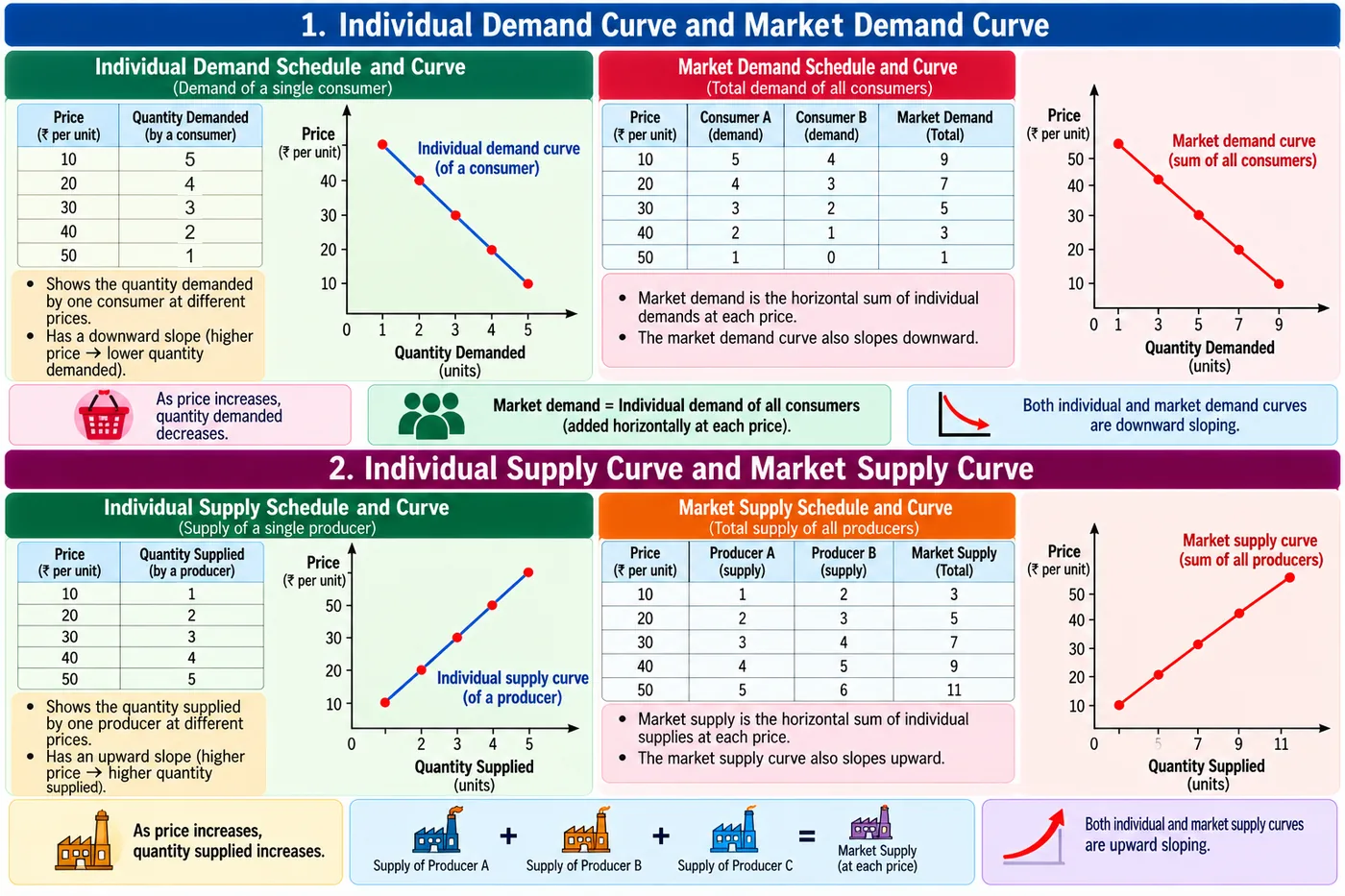
(Illustrative numbers.) An individual demand schedule shows one buyer's quantities; the market demand is the horizontal sum of all individual demands at each price.
3. Other Determinants of Demand
A change in the good's own price causes a movement along the demand curve. Changes in other factors shift the whole curve — to the right (more demanded at every price) or to the left.
| Factor | How it works | Example |
|---|---|---|
| Price of substitutes | If a substitute becomes dearer, demand for this good rises | Tea and coffee: costlier coffee → more tea demanded |
| Price of complements | If a complement becomes dearer, demand for this good falls | Cars and petrol: costlier petrol → fewer cars demanded |
| Income of consumers | For most goods, higher income raises demand | More demand for fruits and branded clothes as income rises |
| Tastes and preferences | Fashion, health awareness, advertising | Rising demand for millets as health food |
| Season and festivals | Demand peaks at certain times | Sweaters in winter; sweets at Diwali; books in April |
| Future price expectations | If prices are expected to rise, people buy now | Buying appliances before an expected price hike |
No. For some goods, demand falls as income rises because people switch to better alternatives — for example, coarse cloth or a very cheap brand. Such goods are called inferior goods. For most goods (normal goods), demand rises with income.
4. Supply
Supply is the quantity of a good that sellers are willing and able to offer for sale at a particular price during a given period.
Law of Supply: other things remaining the same, a higher price leads to a larger quantity supplied, and a lower price to a smaller quantity supplied.
Sellers supply more at higher prices because it becomes more profitable; existing sellers expand and new sellers are attracted. Individual supply is one seller's schedule; market supply is the sum of all sellers' quantities at each price.
Other determinants of supply
| Factor | Effect | Example |
|---|---|---|
| Price of related goods | If another crop becomes more profitable, farmers shift land to it | Higher chickpea price → less wheat supplied |
| Number of sellers | More sellers → more market supply | Many new mobile brands entering the market |
| Technology | Better technology lowers cost and raises supply | Drip irrigation raising farm output |
| Input costs | Costlier inputs reduce supply | Rise in diesel or fertiliser prices |
| Weather | Good monsoon raises farm supply; drought cuts it | Vegetable supply after heavy rain damage |
| Future expectations | If sellers expect higher prices later, they may hold back stock now | Storing onions to sell later |
5. Market Equilibrium
Market equilibrium is the price at which quantity demanded equals quantity supplied. At this price there is neither excess demand nor excess supply, so there is no pressure for the price to change.
Illustrative market for guavas (kg per day):
| Price (₹/kg) | Quantity demanded | Quantity supplied | Situation | Pressure on price |
|---|---|---|---|---|
| 20 | 100 | 40 | Excess demand (shortage) 60 | Rises |
| 25 | 85 | 55 | Excess demand 30 | Rises |
| 30 | 70 | 70 | Equilibrium | None |
| 35 | 55 | 85 | Excess supply (surplus) 30 | Falls |
| 40 | 40 | 100 | Excess supply 60 | Falls |
(Illustrative numbers.)
- Below equilibrium (₹20): buyers want more than sellers offer; queues form, sellers raise prices.
- Above equilibrium (₹40): unsold stock piles up; sellers cut prices to clear it.
- These pressures push the market towards ₹30 and 70 kg — the equilibrium.
Tomatoes are perishable. In the evening, sellers still have stock that will spoil overnight, and fewer buyers remain. Supply on hand is high relative to demand, so sellers cut prices to clear the stock — a new, lower equilibrium for the evening market.
6. Do Real Markets Stay in Equilibrium?
Real markets are dynamic: demand and supply keep shifting, so equilibrium keeps moving. Hotels in tourist destinations, for instance, charge much higher room tariffs in peak season (holidays, festivals, new year) when demand is high and rooms are limited, and offer discounts in the off-season. Airlines and ride-hailing apps change prices continuously based on how many seats or vehicles are left and how many people are searching. During the COVID-19 pandemic, the sudden rise in demand for masks and sanitisers pushed their prices up sharply until supply caught up.
Online festival sales offer very low prices because sellers want to clear old stock, attract new customers and sell large volumes; buyers benefit from lower prices and sellers from higher turnover.
7. Role of Government in Markets
Markets usually allocate goods well, but sometimes they produce unfair or harmful outcomes. Governments then step in:
| Tool | Meaning | Example |
|---|---|---|
| Price ceiling | Maximum legal price, set below market price to protect buyers | Capped prices of essential medicines |
| Price floor | Minimum legal price, set above market price to protect sellers/workers | Minimum wages; minimum support prices for some crops |
| Regulators | Bodies that check unfair practices | RBI (banking), SEBI (securities), TRAI (telecom), Central Consumer Protection Authority |
| Laws against hoarding | Prevent stocking goods to create artificial shortages | Essential Commodities Act, 1955 |
| Public goods | Goods markets under-supply | Roads, bridges, street lights, defence, sanitation, drainage |
Limits of government intervention
- Price distortions: a ceiling set too low reduces producers' incentive to supply, causing shortages, hoarding and black marketing.
- Compliance burden: too many licences, forms and inspections raise costs, especially for small businesses like a neighbourhood restaurant.
- Less innovation: heavy regulation can discourage new firms and new ideas.
The aim is balance — enough intervention to protect consumers, workers and fairness, but not so much that markets stop working.
8. Case Studies and Solved Problems
What happens to demand for (a) diesel cars, (b) electric cars, (c) car accessories, (d) public transport?
Answer: (a) Diesel cars become relatively attractive (substitute) — demand may rise, though fuel prices often move together. (b) Electric cars (substitute) — demand rises. (c) Car accessories (complement to cars) — demand may fall as fewer petrol cars are bought and used. (d) Public transport (substitute for private driving) — demand rises.
A farmer shifts from manual irrigation to drip irrigation. Effect on cost and supply?
Answer: Water and labour costs per unit fall and yields may rise, so the farmer is willing to supply more at every price. If many farmers adopt it, the market supply curve shifts to the right, lowering the equilibrium price and raising the quantity sold.
The government fixes a maximum price for an essential vaccine below the market price. What follows?
Answer: Quantity demanded rises and quantity supplied falls — a shortage. To manage it, the government may need to buy and distribute the vaccine itself, ration it, or support producers.
9. Master Table: Key Terms and Relationships
| Concept | Rule |
|---|---|
| Law of demand | Price ↑ ⇒ quantity demanded ↓ (inverse) |
| Law of supply | Price ↑ ⇒ quantity supplied ↑ (direct) |
| Market demand | Sum of individual demands at each price |
| Market supply | Sum of individual supplies at each price |
| Equilibrium | Quantity demanded = quantity supplied |
| Excess demand | Qd > Qs (price below equilibrium) ⇒ price rises |
| Excess supply | Qs > Qd (price above equilibrium) ⇒ price falls |
| Substitutes | Price of one ↑ ⇒ demand for other ↑ |
| Complements | Price of one ↑ ⇒ demand for other ↓ |
| Price ceiling / floor | Maximum price (below eq.) / minimum price (above eq.) |
10. Master Summary Table
| Change | Curve affected | Effect on equilibrium price and quantity |
|---|---|---|
| Income rises (normal good) | Demand shifts right | Price ↑, quantity ↑ |
| Substitute becomes cheaper | Demand shifts left | Price ↓, quantity ↓ |
| Better technology | Supply shifts right | Price ↓, quantity ↑ |
| Crop failure (drought) | Supply shifts left | Price ↑, quantity ↓ |
| Festival season | Demand shifts right | Price ↑, quantity ↑ |
| Own price changes | Movement along the curve | No shift |
11. Mind Map
- Law of demand
- Related goods, income, season
- Law of supply
- Technology, sellers, costs
- Qd = Qs
- Shortage, surplus
- Ceiling, floor
- Regulators, public goods
12. Tips and Tricks
- Ask first: did the good's own price change (movement along) or did something else change (shift)?
- Remember "substitutes move together, complements move opposite" for the related good's price and demand.
- In equilibrium questions, compute Qd − Qs at each price: positive = shortage, negative = surplus, zero = equilibrium.
- Saying "demand increased" when only quantity demanded rose due to a lower price.
- Confusing a price ceiling (maximum) with a price floor (minimum).
- Assuming higher income always increases demand — not for inferior goods.
13. Important One-liners
- Demand requires both willingness and ability to pay.
- The law of demand shows an inverse relation between price and quantity demanded.
- Diminishing marginal utility explains why demand curves slope downward.
- The law of supply shows a direct relation between price and quantity supplied.
- At equilibrium, there is neither shortage nor surplus.
- A price ceiling below equilibrium causes shortages; a price floor above equilibrium causes surpluses.
- Hoarding and black marketing are punishable under laws such as the Essential Commodities Act, 1955.
14. Exam-pattern Questions with Detailed Answers
Which pair are complementary goods?
- Tea and coffee
- Pen and ink refill
- Apple and banana
- AC and cooler
Show answer
A pen and its ink refill are used together. The others are substitutes for each other.
Answer: (B)
State the law of supply.
Show answer
Other things remaining the same, quantity supplied rises when price rises and falls when price falls.
Answer: Direct relation between price and quantity supplied
What happens in a market when the price is below the equilibrium price?
Show answer
Quantity demanded exceeds quantity supplied (shortage), so competition among buyers pushes the price up towards equilibrium.
Answer: Excess demand; price tends to rise
Classify as substitutes or complements: movie ticket–popcorn, eraser–pencil, laptop–desktop, mobile–earphones, apple–banana.
Show answer
Complements: movie ticket–popcorn, eraser–pencil, mobile–earphones. Substitutes: laptop–desktop, apple–banana.
Answer: As classified
"An increase in income always increases demand." Defend or refute.
Show answer
Refute. For normal goods, demand rises with income. But for inferior goods (very cheap, low-quality items), demand may fall as people switch to better products. Also, for goods already consumed fully (salt), demand hardly changes.
Answer: Not always — inferior goods are an exception
Why do bookshops get crowded in April and sweet shops before Diwali? Which determinant of demand is at work?
Show answer
New academic sessions start around April, raising demand for books; festivals raise demand for sweets. This is the seasonal/occasion determinant of demand, shifting demand curves to the right for a period.
Answer: Seasonality/festivals shift demand
Explain why hotel tariffs in a tourist destination vary across seasons.
Show answer
The number of rooms (supply) is fixed in the short run. In peak season, demand rises sharply, so equilibrium tariffs rise; in the off-season, demand falls and hotels offer discounts. Prices adjust continuously as demand shifts — a dynamic market.
Answer: Seasonal shifts in demand with fixed supply
Distinguish a price ceiling from a price floor with one example each.
Show answer
A price ceiling is a legal maximum price (below equilibrium) to protect buyers, e.g. caps on essential medicine prices. A price floor is a legal minimum (above equilibrium) to protect sellers or workers, e.g. minimum wages.
Answer: Ceiling = maximum price; floor = minimum price
Using the guava table, what happens if the price is fixed at ₹20? At ₹40?
Show answer
At ₹20: Qd = 100, Qs = 40 → shortage of 60 kg; buyers queue, black market may appear. At ₹40: Qd = 40, Qs = 100 → surplus of 60 kg; unsold guavas may rot. Free-market forces would move the price to ₹30, where Qd = Qs = 70.
Answer: ₹20 → shortage of 60; ₹40 → surplus of 60
Explain, using demand and supply, why sellers offer very low prices in online festival sales. Who benefits?
Show answer
Sellers want to clear stock and gain market share; lower prices raise quantity demanded sharply (law of demand). Festivals also shift demand to the right. Volume sales can compensate for lower margins. Consumers benefit from lower prices; sellers benefit from higher turnover and new customers, though small offline shops may lose sales.
Answer: Lower prices + festive demand → large sales volume; both buyers and big sellers gain
"Excessive government regulation can hurt markets." Explain with examples.
Show answer
Price ceilings set too low reduce supply and create shortages and black markets. Heavy paperwork and multiple licences raise costs for small enterprises such as a local eatery, discouraging new businesses. Over-regulation can also slow innovation. However, some regulation is necessary to protect consumers; the goal is balanced, transparent rules.
Answer: Yes, through distortions, compliance burdens and reduced innovation
During a pandemic, demand for sanitisers jumps and some traders hoard stock. Analyse the effects and suitable government responses.
Show answer
Demand shifts sharply right, so prices rise. Hoarding reduces the supply reaching the market, shifting supply left and pushing prices even higher, harming consumers. The government can act against hoarding under essential-commodity laws, temporarily cap prices, and encourage more producers (relaxing licences, supporting production) so supply shifts right and prices normalise.
Answer: Prices rise sharply; anti-hoarding action, temporary caps and higher production help
15. Quick Revision Summary
- Demand = willingness + ability to buy; law of demand: price and quantity demanded move oppositely.
- Demand shifts with related goods, income, tastes, seasons and expectations.
- Supply = willingness + ability to sell; law of supply: price and quantity supplied move together.
- Supply shifts with technology, number of sellers, input costs, weather and expectations.
- Equilibrium: Qd = Qs; below it shortage, above it surplus.
- Government uses ceilings, floors, regulators and public goods — but over-regulation has costs.