
1. Chapter at a Glance
Every day you make choices. Should you spend your pocket money on snacks today or save it for a cricket bat next month? Should you spend the evening revising science or playing with friends? A farmer decides which crop to sow, a company decides whether to buy a new machine or hire more workers, and the government decides whether to build a highway or a hospital. All these decisions have one thing in common: the resources available are limited, but the things we want are many. This simple fact — scarcity — is the starting point of economics.
Economics is the study of how people, businesses and governments make choices when resources are scarce. This chapter introduces the building blocks of that study: needs and wants, scarcity, choice, opportunity cost, the production possibility curve, the three central questions every economy must answer, and the three types of economic systems — planned, market and mixed.
- Needs and wants, and why human wants are unlimited.
- Scarcity of resources and the necessity of choice.
- Opportunity cost — the real cost of every decision.
- The Production Possibility Curve (PPC) as a picture of choice.
- The central problems: what to produce, how to produce and for whom to produce.
- Economic entities, data and policy — the role of surveys such as the Economic Survey.
- Planned, market and mixed economies, with real-world examples.
2. Needs, Wants and Resources
Needs are things essential for survival and a decent life — food, clean water, clothing, shelter, basic health care and education. Wants are things we desire beyond these needs — a new phone, a holiday, branded shoes, eating out. The line between them is not fixed: what is a want for one family (a scooter) may be a need for another (a delivery worker who earns a living with it).
Human wants have three important features:
- They are unlimited. When one want is satisfied, another appears. A student who gets a bicycle soon dreams of a motorbike, and later of a car.
- They keep changing with age, income, technology and fashion. Twenty years ago few families wanted a smartphone; today it feels essential to many.
- They recur. Hunger returns every few hours; clothes wear out and must be replaced.
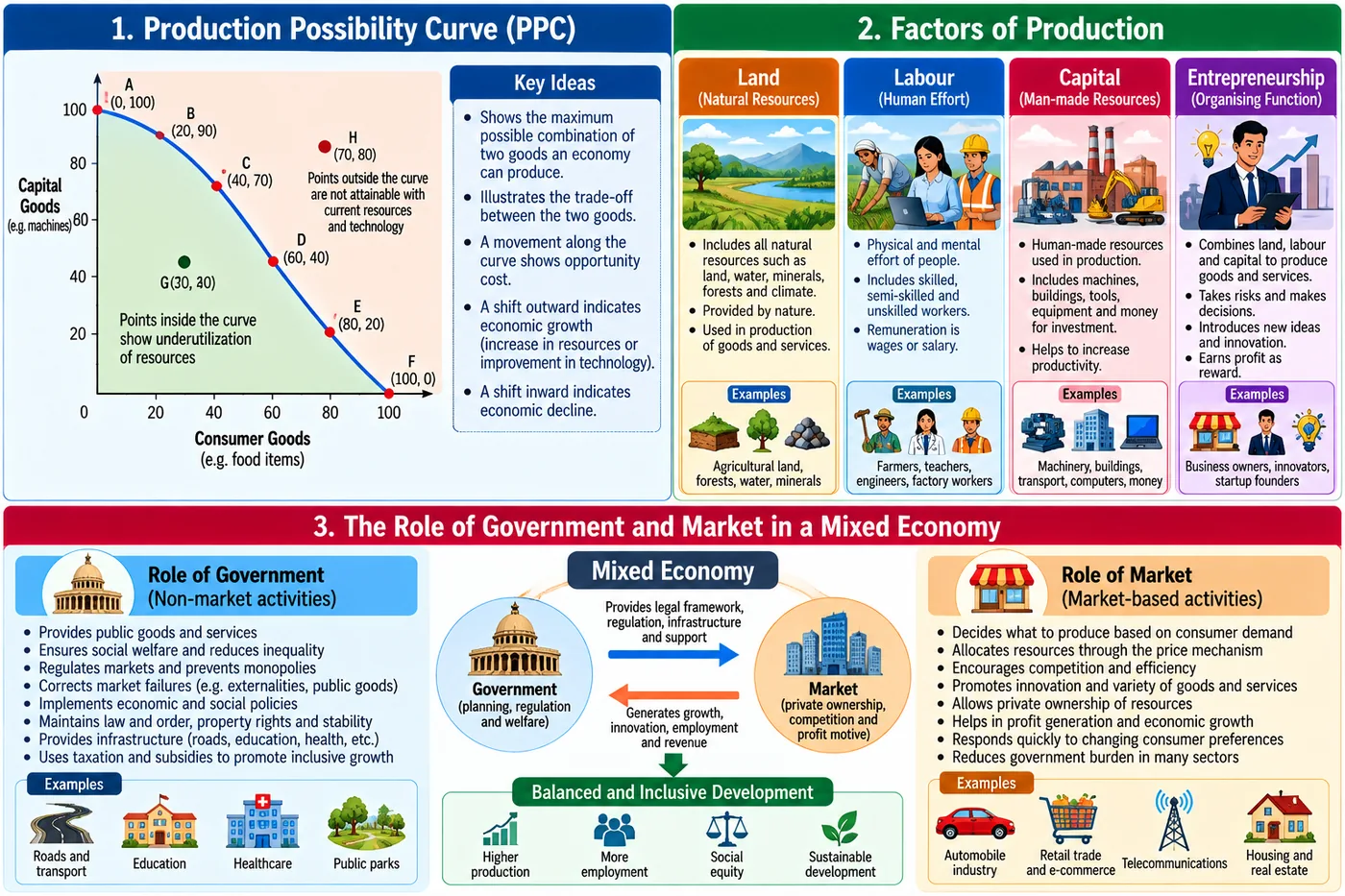
To satisfy wants, we produce goods and services using resources (also called factors of production). Resources may be natural (land, water, minerals, coal, forests) or human-made (machines, buildings, tools, technology — called capital), together with human effort (labour and the organising skill of entrepreneurs).
3. Scarcity and Choice
Scarcity means that the resources available are limited compared with the wants they could satisfy. It does not mean that something is rare; it means there is not enough of it to satisfy everyone's wants at once.
Imagine a school library with only 5 copies of a popular new storybook and 20 students who want to read it this week. The books are scarce relative to demand, so someone must decide how to share them — first come first served, a rotation list, or a waiting period. Similarly:
- A family's monthly income is limited, but it must cover food, rent, medicines, school fees and savings.
- A farmer has limited land, water and labour for the season.
- The government collects a limited amount of tax but faces demands for roads, schools, hospitals, defence and research.
- Time itself is scarce: you have only 24 hours a day.
Because resources also have alternative uses, scarcity forces us to choose. Steel, for example, can be used to make surgical instruments, aircraft parts or refrigerators. Using a tonne of steel for one purpose means it cannot be used for another.
A family of four divides its monthly spending into three groups. Classify: rice and dal, school books, a gold ring, a movie outing, medicines, a recurring deposit in the bank.
Solution: Essential (needs): rice and dal, school books, medicines. Non-essential (wants): gold ring, movie outing. Savings: recurring deposit. Every rupee moved from one group reduces another — this is the problem of choice inside a household.
4. Opportunity Cost
The opportunity cost of a choice is the value of the next best alternative given up when that choice is made.
If Riya has ₹100 and chooses a notebook over saving towards a tennis racket, the opportunity cost of the notebook is the progress she gave up towards the racket. If you spend two hours watching a film instead of preparing for a test, the opportunity cost is the learning (and perhaps the marks) you gave up. Opportunity cost is not always measured in money; it may be time, comfort, leisure or an opportunity.
Thinking in terms of opportunity cost improves decisions because it forces us to ask, "What am I really giving up?" A government that spends more on space research must ask what that money could have achieved in primary health care, and vice versa. A good decision is one where the benefit of the chosen option is at least as large as the opportunity cost.
A farmer can use one plot either for sugarcane (needs a lot of water) or for millets and pulses (need little water). Water in the area is scarce. What is the opportunity cost of choosing sugarcane?
Solution: The opportunity cost of sugarcane is the millet and pulse crop that could have been grown — and also the water saved for future seasons and neighbours. If groundwater is falling, the hidden cost of water-hungry crops grows over time.
5. The Production Possibility Curve
The Production Possibility Curve (PPC) shows all the combinations of two goods that can be produced when all available resources are used fully and efficiently, with a given technology.
Illustrative example: a farmer with fixed land, water and labour can grow wheat and barley. The possible combinations (in quintals) might be:
| Combination | Wheat | Barley | Barley given up for each extra 10 quintals of wheat |
|---|---|---|---|
| A | 0 | 50 | — |
| B | 10 | 45 | 5 |
| C | 20 | 37 | 8 |
| D | 30 | 25 | 12 |
| E | 40 | 0 | 25 |
(Illustrative numbers for learning.)
- Scarcity: combinations beyond the curve cannot be produced.
- Choice: the economy must pick one point on the curve.
- Opportunity cost: moving along the curve to get more wheat means giving up some barley.
- Increasing opportunity cost: the curve bows outwards because resources are not equally suited to both crops, so each extra unit of wheat costs more barley.
- Inefficiency: a point inside the curve shows idle or wasted resources.
- Growth: new technology, more capital or better skills shift the whole curve outward.
6. The Central Problems of an Economy
Because of scarcity, every society — rich or poor, ancient or modern — must answer three questions:
| Question | What it means | Example |
|---|---|---|
| What to produce, and how much? | Which goods and services, in what quantities | More food grains or more cars? Hospitals or highways? |
| How to produce? | Which technique — more labour or more machines | A garment unit may use many tailors (labour-intensive) or automated machines (capital-intensive) |
| For whom to produce? | How output is distributed among people | School shoes, office shoes, sports shoes, or slippers — for which groups and at what prices? |
In a country like India, with a very large workforce, labour-intensive techniques can create more jobs, while capital-intensive techniques may raise productivity and quality. Choosing between them is a real policy question.
7. Economic Entities, Data and Policy
The main participants in an economy — economic entities — are consumers (households), producers (farmers, firms, enterprises) and the government. Each makes choices: households about spending and saving, firms about production and prices, government about taxes, spending and rules.
Good choices need good data — facts and figures collected for analysis — usually gathered through surveys. In India, the Ministry of Finance presents the Economic Survey every year before the Union Budget; it reviews the performance of the economy and discusses challenges. Data feeds into policy, a planned course of action such as a farm support scheme or a skill-training programme. Without reliable data, a government might, for example, build cold-storage units where farmers grow no perishable crops.
8. Economic Systems
An economic system is the way a society organises answers to the central problems. There are three broad types:
| Feature | Planned economy | Market economy | Mixed economy |
|---|---|---|---|
| Who decides what, how, for whom? | Government / central planning authority | Buyers and sellers through prices | Both; markets work within government rules |
| Ownership of resources | Mostly the state | Mostly private | Both public and private |
| Prices set by | Government | Demand and supply | Mostly markets; some controlled |
| Strength | Can direct resources to national priorities and reduce inequality | Freedom of choice, competition, innovation, efficiency | Balance of efficiency and welfare |
| Weakness | Little freedom, weak incentives, shortages | Inequality; may ignore public goods and the poor | Can suffer from both excessive regulation and market failures |
| Examples | Former Soviet Union, North Korea, Cuba | Closest examples often cited: USA, Japan, Hong Kong | India, China (after reforms), Germany, Sweden |
Public goods — roads, street lights, police, parks, national defence, basic education — are available to everyone, and one person's use does not prevent another's. Markets tend to under-supply them because it is hard to charge each user, so governments provide them even in market economies.
India's journey: after Independence in 1947, India chose a mixed economy with a large public sector and five-year plans. Facing a serious balance-of-payments crisis in 1991, India launched reforms that gave a bigger role to markets and private enterprise, while the government kept its role in welfare, regulation and public goods. Today almost every economy in the world is mixed; pure planned or pure market economies hardly exist.
9. Case Studies and Solved Problems
A district has falling groundwater. Many farmers grow paddy and sugarcane because they fetch good prices. What would an economist suggest?
Answer: Water is scarce and has an opportunity cost for the future. Shifting part of the land to millets and pulses, using drip irrigation, and pricing electricity for pumps sensibly would save water. Data on water levels (from surveys) should guide the policy.
A garment unit can buy cutting machines that replace 20 workers. What are the trade-offs?
Answer: Machines raise speed and uniform quality and may lower long-run cost (capital-intensive). Hiring workers creates jobs and needs less upfront money (labour-intensive). The choice depends on wages, the cost of machines, the skill of workers and the scale of orders — the "how to produce" problem.
Using the illustrative table, what is the opportunity cost of moving from C to D?
Answer: Wheat rises by 10 quintals and barley falls from 37 to 25, so the opportunity cost of 10 more quintals of wheat is 12 quintals of barley.
10. Master Table: Key Terms
| Term | Meaning in one line |
|---|---|
| Scarcity | Limited resources compared with unlimited wants |
| Choice | Selecting among alternative uses of scarce resources |
| Opportunity cost | Value of the next best alternative forgone |
| Resources | Natural, human-made (capital) and human (labour, enterprise) |
| PPC | Combinations of two goods possible with full use of resources |
| Opportunity cost on a PPC | Units of good Y given up ÷ extra units of good X gained |
| Public goods | Available to all; one person's use does not reduce another's |
| Planned / market / mixed | State decides / prices decide / both |
| Economic Survey | Annual review of India's economy by the Ministry of Finance |
11. Master Summary Table
| Idea | Key point | Exam focus |
|---|---|---|
| Wants | Unlimited, changing, recurring | Why all wants cannot be met |
| Scarcity | Root cause of economic problems | Examples from home, farm, government |
| Opportunity cost | Next best alternative forgone | Identify in a situation |
| PPC | Choice, efficiency, growth | Points inside/on/outside; shifts |
| Central problems | What, how, for whom | Labour- vs capital-intensive |
| Economic systems | Planned, market, mixed | Compare; why mixed is common |
12. Mind Map
- Unlimited wants
- Scarce resources
- Opportunity cost
- PPC
- What, how
- For whom
- Planned, market
- Mixed (India)
13. Tips and Tricks
- In any situation question, first name the scarce resource, then the alternatives, then the opportunity cost.
- Remember the PPC with three positions: inside = waste, on = efficient, outside = impossible (for now).
- For "which system is best" questions, give strengths and weaknesses of each, then justify the mixed economy.
- Thinking scarcity means "rare". Even common things are scarce if wants exceed supply.
- Listing all alternatives as the opportunity cost — it is only the next best one.
- Saying the PPC shifts outward when the economy merely moves along it.
14. Important One-liners
- Economics is the study of choice under scarcity.
- Human wants are unlimited; resources are limited and have alternative uses.
- Opportunity cost is the next best alternative given up.
- A point inside the PPC shows unemployment or wastage of resources.
- Technological progress shifts the PPC outward.
- Every economy faces three central problems: what, how and for whom to produce.
- Public goods are usually provided by the government.
- India adopted a mixed economy after Independence and began major reforms in 1991.
15. Exam-pattern Questions with Detailed Answers
Riya has ₹100. She can buy a notebook or save it towards a tennis racket. Which concept best explains her decision?
- Inflation
- Opportunity cost
- Public goods
- Monopoly
Show answer
Whichever she chooses, she gives up the other. The value of the alternative given up is opportunity cost. Inflation is a general rise in prices; public goods and monopoly are unrelated to this personal choice.
Answer: (B) Opportunity cost
Which of these is a public good: (a) a mobile phone (b) a street light (c) a pizza (d) a private car?
Show answer
A street light lights the road for everyone; one person's use does not reduce another's, and no one can easily be excluded.
Answer: (b) a street light
Name the three central problems of an economy.
Show answer
What to produce (and how much), how to produce (technique), and for whom to produce (distribution).
Answer: What, how and for whom to produce
Why do human wants change over time? How does this affect production?
Show answer
Wants change with income, age, technology, fashion and awareness. As incomes rise, people want better-quality and new products (for example, from feature phones to smartphones). Producers respond by changing what they make, investing in new technology and dropping products that are no longer wanted. Thus changing wants shape the "what to produce" decision.
Answer: Wants change with income, technology and lifestyle; production adjusts to new demand
Explain, with an example, why time is a scarce resource.
Show answer
Everyone has only 24 hours a day, and time has alternative uses — study, sleep, sport, work, family. An hour spent on social media is an hour not spent on revision; that lost revision is the opportunity cost. Because time is limited and has alternative uses, it is scarce.
Answer: Time is limited and has alternative uses, so using it one way has an opportunity cost
What does a point inside the PPC indicate? Suggest one way to move to the curve.
Show answer
A point inside means resources are unemployed or used inefficiently, so the economy produces less than it could. Employing idle workers, repairing unused machines or removing bottlenecks (like power cuts) can move it to the curve.
Answer: Under-utilisation of resources; full employment moves it to the curve
Distinguish between labour-intensive and capital-intensive techniques. Which may suit India and why?
Show answer
Labour-intensive techniques use more workers relative to machines; capital-intensive techniques use more machines relative to workers. With a large and growing workforce, labour-intensive methods can create more employment in India, though capital-intensive methods may be needed where precision, scale or safety matter. A balanced mix is usually best.
Answer: Labour-intensive generates jobs (suits labour-rich India); capital-intensive raises productivity
Why is reliable data important for economic decisions? Give an example.
Show answer
Decisions based on wrong or missing information waste scarce resources. For example, if data on crop production is wrong, the government might build storage godowns in the wrong district, or import a crop that is actually in surplus, hurting farmers. Surveys such as the annual Economic Survey help policy makers plan.
Answer: Data guides correct allocation of scarce resources
"Pure economic systems rarely exist." Critically examine this statement and justify why mixed economies are practical.
Show answer
A pure planned economy places all decisions with the state; it struggled with shortages, weak incentives and low innovation (the former Soviet Union's experience is often cited). A pure market economy leaves everything to prices; it can neglect public goods, the poor and the environment, and can suffer monopolies. Real economies therefore combine both: markets for efficiency and innovation, government for public goods, regulation and welfare. India after 1991, China after 1978, Germany and Sweden show different mixes. Hence mixed economies are practical because they use the strengths of both while limiting their weaknesses.
Answer: Both pure systems have serious flaws; mixing gives efficiency with welfare
How does the constant desire for more create pressure on the environment? Can we balance wants with resource use?
Show answer
Unlimited wants lead to more production, which uses more minerals, water, forests and energy and produces more waste and pollution. Balance is possible through efficient technology, recycling, renewable energy, sensible pricing of natural resources, and changing consumer habits (reduce, reuse). Treating the environment as a scarce resource with an opportunity cost for future generations is the key idea.
Answer: Yes — through efficiency, renewable resources and responsible consumption
Show, with the help of a PPC, the effect of a new high-yield seed for wheat only.
Show answer
The maximum wheat that can be produced rises, but maximum barley is unchanged. So the PPC rotates outward along the wheat axis while staying fixed at the barley axis. Most combinations now include more wheat for the same barley.
Answer: The PPC rotates outward on the wheat axis
"Choices made today shape tomorrow." Analyse with one personal and one national example.
Show answer
Personal: a student who saves time today for skill-building (coding, languages) raises future earning ability, though they give up some leisure now. National: a government that invests in education and health today may spend less on immediate subsidies, but builds a more productive workforce for the future. In both cases, future benefits are part of today's opportunity cost calculation.
Answer: Investment choices trade present consumption for future gains
16. Quick Revision Summary
- Wants are unlimited; resources are scarce and have alternative uses — so we must choose.
- Opportunity cost = next best alternative given up.
- PPC: on = efficient, inside = waste, outside = impossible now; bowed out due to rising opportunity cost; shifts out with growth.
- Central problems: what, how, for whom to produce.
- Economic entities: consumers, producers, government; data and surveys guide policy.
- Planned, market and mixed systems; most economies, including India, are mixed.