
1. Chapter at a Glance
Earth is not a collection of separate parts. Its air (atmosphere), water (hydrosphere), rocks and soil (geosphere) and living things (biosphere) are linked into one system. Energy from the Sun drives this system: it heats the land, oceans and air unevenly, and this uneven heating creates winds, ocean currents and weather. At the same time, matter such as water, carbon, nitrogen and oxygen moves again and again between living and non-living parts in biogeochemical cycles. Human activities now change many of these processes. This chapter connects energy, matter and life on Earth.
- Solar radiation, the electromagnetic spectrum and the layers of the atmosphere.
- Why Earth is heated unevenly — latitude, the shape of the Earth, land and water.
- How uneven heating causes pressure belts, planetary winds, local winds and ocean currents.
- The water, carbon, nitrogen and oxygen cycles.
- Human impact: global warming, eutrophication and ozone depletion.
2. Solar Radiation and the Earth's Surface
The Sun gives out energy as electromagnetic radiation. These waves need no medium and travel through space at about 3 × 10⁸ m/s. Arranged by wavelength they form the electromagnetic spectrum: radio waves, microwaves, infrared, visible light, ultraviolet, X-rays and gamma rays. Shorter wavelength means higher energy. Most of the Sun's energy reaching Earth is visible light and infrared, with a small share of ultraviolet.
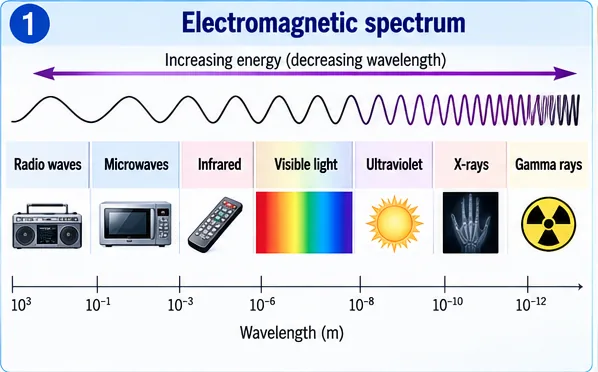
What happens to sunlight reaching Earth? About 30% is reflected back to space by clouds, ice, snow and bright surfaces — this reflecting power is called albedo. Some is absorbed by the atmosphere (ultraviolet by ozone, infrared by water vapour and carbon dioxide). The rest is absorbed by land and oceans, which warm up and give out heat as infrared radiation. Gases such as carbon dioxide, methane and water vapour trap part of this outgoing heat — the natural greenhouse effect, which keeps Earth's average temperature suitable for life.
Layers of the atmosphere
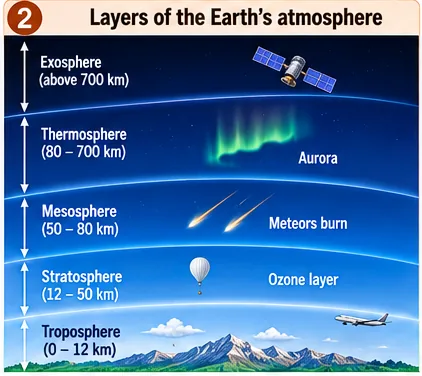
| Layer | Approx. height | Key features |
|---|---|---|
| Troposphere | 0–12 km (about 8 km at poles, 18 km at equator) | All weather, clouds and rain; temperature falls with height |
| Stratosphere | 12–50 km | Ozone layer absorbs UV; calm air, used by jet aircraft near its base |
| Mesosphere | 50–80 km | Coldest layer; meteors burn up here |
| Thermosphere | 80–700 km | Very thin air; aurora; reflects radio waves (ionosphere) |
| Exosphere | Above 700 km | Outermost layer; merges into space; satellites orbit |
3. Uneven Heating: Latitude and Earth's Shape
Earth is a sphere, so sunlight strikes different places at different angles. Near the equator, rays fall almost vertically; the same beam of energy falls on a small area, so the area heats strongly. Towards the poles, rays fall at a slant; the same energy spreads over a larger area and passes through more atmosphere, so heating is weak. That is why the tropics are hot and the polar regions cold. The tilt of Earth's axis (about 23.5°) changes the angle through the year, giving seasons.
Land and water heat differently. Water has a high specific heat capacity and mixes, so it warms and cools slowly. Land warms and cools quickly. So coastal places have mild climates, while places deep inside continents have hot summers and cold winters.
4. Uneven Heating Causes Winds
Warm air expands, becomes lighter and rises, leaving low pressure below. Cool air is denser and sinks, creating high pressure. Wind is air moving from high pressure to low pressure. Bigger pressure difference means stronger wind.
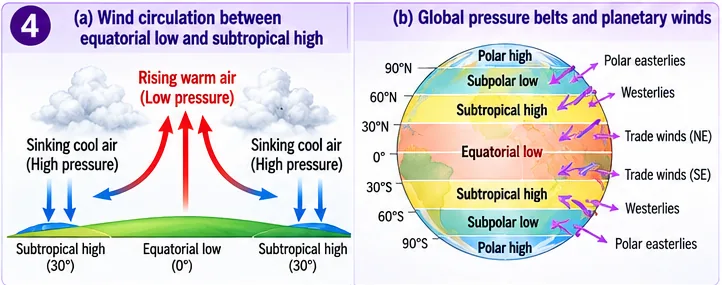
| Pressure belt | Latitude | Planetary wind blowing out of it |
|---|---|---|
| Equatorial low | 0° (around the equator) | Receives trade winds from both sides; rising air, heavy rain |
| Subtropical highs | about 30° N and S | Trade winds (towards the equator) and westerlies (towards the poles) |
| Subpolar lows | about 60° N and S | Receive westerlies and polar easterlies |
| Polar highs | 90° N and S | Polar easterlies |
Because Earth rotates, winds do not blow straight; they bend to the right in the Northern Hemisphere and to the left in the Southern Hemisphere (the Coriolis effect). That is why the northern trade winds blow from the north-east and the southern ones from the south-east.
5. Local Winds
Daily heating differences produce small-scale winds:
- Sea breeze (day): land heats faster, air over land rises, and cool air from the sea moves in.
- Land breeze (night): land cools faster, so air flows from land to sea.
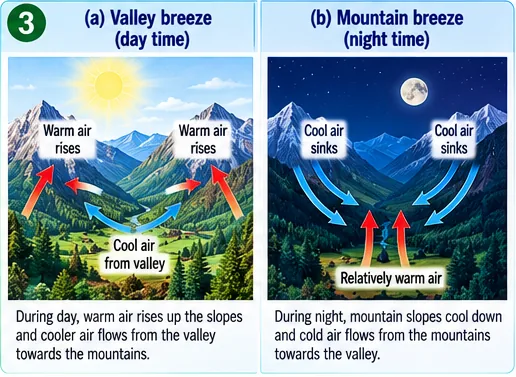
- Valley breeze (day): mountain slopes heat up, warm air rises up the slopes, and air from the valley moves upward.
- Mountain breeze (night): slopes cool quickly, cold dense air flows down into the valley.
India's monsoon is a seasonal version of the same idea: in summer the land becomes much hotter than the Indian Ocean, so moist winds blow from sea to land and bring rain; in winter the flow reverses.
6. Ocean Currents
An ocean current is a large, steady movement of ocean water in a definite direction. Currents are driven mainly by planetary winds blowing over the sea surface and by differences in temperature and salinity (density). Earth's rotation and the shapes of continents turn them into huge circular loops called gyres.
- Warm currents flow from the equator towards the poles (e.g. the Gulf Stream in the North Atlantic, which keeps north-western Europe milder than other places at the same latitude).
- Cold currents flow from polar regions towards the equator (e.g. the Labrador Current, the Humboldt/Peru Current).
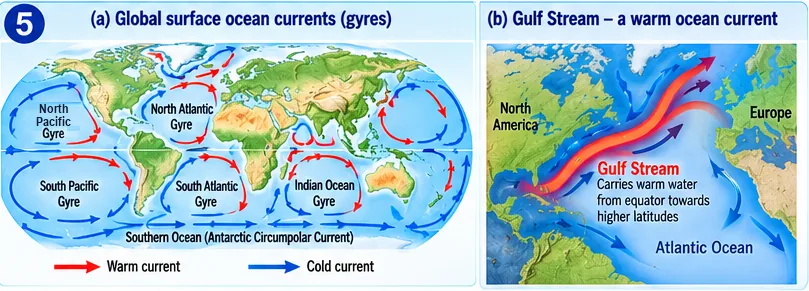
Ocean currents move heat from the tropics to higher latitudes, influence rainfall, and carry nutrients. Where cold and warm currents meet (e.g. near Newfoundland), plankton grows well, making these areas rich fishing grounds.
7. Biogeochemical Cycles
Energy flows through Earth's system and is finally lost as heat, but matter is recycled. The movement of an element or compound between living things (bio-), rocks and soil (geo-) and air and water (chemical) is a biogeochemical cycle.
Water cycle
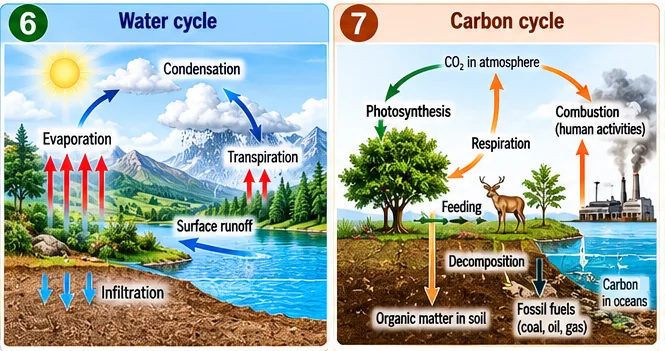
The Sun's heat evaporates water from oceans, lakes and soil; plants also release water vapour by transpiration. Rising vapour cools and condenses into clouds, which return water as precipitation (rain, snow, hail). On land, water flows as surface runoff into rivers and seas or soaks in by infiltration to recharge groundwater.
Carbon cycle
Plants take in CO2 for photosynthesis and make food. Carbon passes to animals through feeding. Respiration by plants and animals and decomposition of dead matter return CO2 to air. Some carbon is stored for millions of years as fossil fuels (coal, oil, gas) and carbonate rocks, and a lot is dissolved in oceans. Combustion of fuels by humans releases this stored carbon quickly.
Nitrogen cycle
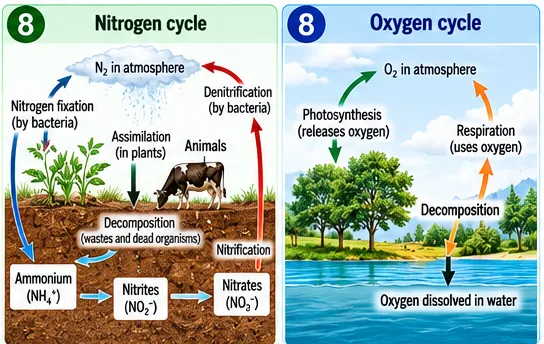
Air is about 78% nitrogen, but plants and animals cannot use N2 gas directly. Steps:
- Nitrogen fixation: bacteria such as Rhizobium (in root nodules of legumes) and some free-living bacteria convert N2 into ammonia/ammonium; lightning also fixes some nitrogen.
- Nitrification: soil bacteria change ammonium to nitrites (NO2−) and then nitrates (NO3−).
- Assimilation: plants absorb nitrates to make proteins and nucleic acids; animals get nitrogen by eating plants.
- Ammonification (decomposition): decomposers turn wastes and dead bodies back into ammonium.
- Denitrification: other bacteria convert nitrates back to N2 gas, completing the cycle.
Oxygen cycle
Oxygen (about 21% of air) is released by photosynthesis and used in respiration, decomposition and combustion. Some dissolves in water and supports aquatic life. In the stratosphere, oxygen forms ozone (O3), which shields life from harmful UV.
8. Human Impact on Earth's Processes
- Enhanced greenhouse effect: burning fossil fuels and cutting forests raise CO2 levels, trapping more heat — global warming, melting glaciers, rising sea levels and extreme weather.
- Ozone depletion: chlorofluorocarbons (CFCs) once used in refrigerators and sprays break down ozone, letting more UV reach the surface. The Montreal Protocol (1987) phased them out.
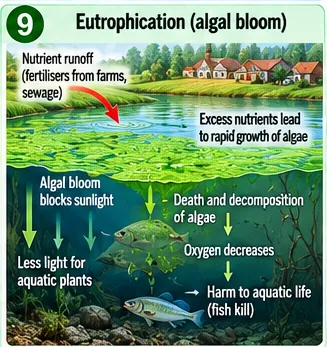
- Eutrophication: fertiliser runoff and sewage add excess nitrates and phosphates to lakes. Algae grow explosively (algal bloom), block sunlight, then die; decomposers use up dissolved oxygen, and fish die.
- Air and water pollution, deforestation and over-use of groundwater disturb the water and carbon cycles.
Energy flows in one direction (Sun → Earth → space as heat), but matter cycles. Disturbing one part of the Earth system (for example adding CO2 or nitrates) affects air, water, land and life together.
9. Master Table: Key Terms
| Term | Meaning |
|---|---|
| Albedo | Fraction of sunlight reflected by a surface (Earth ≈ 30%) |
| Greenhouse effect | Trapping of outgoing heat by CO2, CH4, water vapour |
| Wind | Air moving from high pressure to low pressure |
| Coriolis effect | Deflection of winds/currents due to Earth's rotation (right in N, left in S) |
| Ocean current | Steady flow of ocean water; warm (equator → poles) or cold (poles → equator) |
| Gyre | Large circular system of ocean currents |
| Nitrogen fixation | N2 → ammonia/ammonium by bacteria or lightning |
| Eutrophication | Nutrient enrichment of water → algal bloom → oxygen loss |
10. Master Summary Table
| Cycle | Main reservoir | Into living things by | Back to environment by |
|---|---|---|---|
| Water | Oceans | Absorption by roots, drinking | Transpiration, evaporation, excretion |
| Carbon | Rocks, fossil fuels, oceans, air (CO2) | Photosynthesis | Respiration, decomposition, combustion |
| Nitrogen | Atmosphere (N2) | Fixation → nitrates absorbed by plants | Ammonification, denitrification |
| Oxygen | Atmosphere, water | Respiration | Photosynthesis |
Chart — composition of dry air by volume (approximate):
11. Mind Map
- EM spectrum, albedo
- Greenhouse effect
- Atmosphere layers
- Latitude, tilt
- Land vs water
- Pressure belts, winds
- Local winds, monsoon
- Ocean currents, gyres
- Water, carbon
- Nitrogen, oxygen
- Global warming
- Ozone loss, eutrophication
12. Tips and Tricks
- Atmosphere layers bottom to top: “The Smart Monkey Thinks Everything” — Troposphere, Stratosphere, Mesosphere, Thermosphere, Exosphere.
- Electromagnetic spectrum (long to short wavelength): “Raging Martians Invaded Venus Using X-ray Guns”.
- Breezes are named after where the wind comes from: sea breeze comes from the sea; valley breeze comes from the valley.
- Nitrogen cycle order: Fixation → Nitrification → Assimilation → Ammonification → Denitrification (“F-N-A-A-D”).
- Saying wind blows from low to high pressure — it is from high to low.
- Confusing nitrification (ammonium → nitrate) with denitrification (nitrate → N2).
- Thinking the greenhouse effect is entirely harmful — the natural effect keeps Earth warm; the enhanced effect causes global warming.
- Mixing up ozone depletion (UV, CFCs) with global warming (heat, CO2).
13. Important One-liners
- Earth's four spheres: atmosphere, hydrosphere, geosphere and biosphere.
- Shorter wavelength in the EM spectrum means higher energy.
- All weather occurs in the troposphere.
- The ozone layer lies in the stratosphere and absorbs UV.
- Meteors burn up in the mesosphere.
- The equator is heated most because sunlight falls almost vertically.
- Wind blows from high pressure to low pressure.
- Trade winds blow from the subtropical highs to the equatorial low.
- The Gulf Stream is a warm current of the North Atlantic.
- Rhizobium fixes nitrogen in root nodules of legumes.
- Denitrifying bacteria return N2 to air.
- Excess nutrients in water cause eutrophication.
14. Exam-pattern Questions with Detailed Answers
In which layer of the atmosphere does all weather occur?
- Stratosphere
- Troposphere
- Mesosphere
- Thermosphere
Show answer
The troposphere contains almost all water vapour and clouds, so rain, storms and winds occur here.
Answer: (B) Troposphere
Which radiation in the electromagnetic spectrum has the highest energy?
- Radio waves
- Visible light
- Ultraviolet
- Gamma rays
Show answer
Gamma rays have the shortest wavelength, hence the highest energy.
Answer: (D) Gamma rays
Name the bacterium that fixes nitrogen in the root nodules of leguminous plants.
Show answer
Rhizobium lives in root nodules of pea, gram and other legumes and converts N2 into ammonia.
Answer: Rhizobium
Why are the polar regions colder than the equatorial region, though both receive sunlight?
Show answer
Because Earth is spherical, sunlight falls almost vertically at the equator and is concentrated on a small area. Near the poles it falls at a slant, so the same energy spreads over a larger area and travels through more atmosphere, so each square metre gets less heat. Snow and ice also reflect much of it (high albedo).
Answer: Slanting rays spread energy over a larger area; high albedo
Assertion (A): Coastal areas have a moderate climate. Reason (R): Water heats up and cools down more slowly than land.
- Both true; R explains A
- Both true; R does not explain A
- A true, R false
- A false, R true
Show answer
The sea stays cooler in summer and warmer in winter than land, and sea and land breezes carry this effect to coastal places.
Answer: (A)
Explain the formation of a sea breeze and a land breeze.
Show answer
Day: land heats faster than sea, air above land rises (low pressure), and cooler air from the sea (high pressure) moves in — sea breeze. Night: land cools faster, so air over the sea is warmer and rises; air flows from land to sea — land breeze.
Answer: Unequal heating of land and water reverses the wind between day and night
Match: (a) nitrification (b) denitrification (c) assimilation (d) ammonification — with (i) nitrate → N2 (ii) dead matter → ammonium (iii) ammonium → nitrate (iv) plants absorb nitrate.
Show answer
(a)–(iii), (b)–(i), (c)–(iv), (d)–(ii).
Answer: a-iii, b-i, c-iv, d-ii
How does the Gulf Stream affect the climate of north-western Europe?
Show answer
The Gulf Stream and its extension carry warm water from the tropics across the North Atlantic. Westerly winds blowing over this warm water bring mild, moist air to north-western Europe, keeping winters warmer than in other places at the same latitude.
Answer: Warm current + westerlies keep winters mild
Why do trade winds in the Northern Hemisphere blow from the north-east and not from due north?
Show answer
Air moves from the subtropical high (30° N) towards the equatorial low. As Earth rotates, moving air is deflected to the right in the Northern Hemisphere (Coriolis effect). A wind heading south is turned towards the west, so it arrives from the north-east.
Answer: Deflection to the right by Earth's rotation (Coriolis effect)
Case-based: A lake near farmland turns bright green in summer. Weeks later, many dead fish float on it. (a) Name the process. (b) Explain the sequence of events. (c) Suggest two remedies.
Show answer
(a) Eutrophication. (b) Fertiliser runoff adds nitrates and phosphates → algae multiply rapidly (algal bloom) → the bloom blocks sunlight, so submerged plants die → algae die → decomposers use dissolved oxygen while breaking them down → oxygen falls → fish suffocate. (c) Use fertilisers in correct amounts or organic manure; treat sewage before discharge; keep vegetation buffers along lake banks.
Answer: Eutrophication; nutrients → bloom → decay → oxygen loss → fish kill
“Energy flows but matter cycles.” Explain with reference to the carbon cycle.
Show answer
Solar energy is trapped in photosynthesis, passed along food chains and at each step partly lost as heat; it finally radiates to space and is not reused, so it must be supplied continuously by the Sun. Carbon atoms, however, move from CO2 in air → plants → animals → back to air by respiration and decomposition, again and again; the same atoms are reused.
Answer: Energy is lost as heat (one-way); carbon atoms are reused (cyclic)
Distinguish between the natural greenhouse effect and global warming. Give two human activities responsible for the latter.
Show answer
The natural greenhouse effect is the trapping of outgoing heat by water vapour, CO2 and methane; it keeps Earth warm enough for life. Global warming is the rise in average temperature due to an enhanced greenhouse effect as humans add more greenhouse gases. Causes: burning fossil fuels in vehicles and power plants; deforestation (fewer trees to absorb CO2); also methane from rice fields, cattle and landfills.
Answer: Natural = life-supporting; global warming = enhanced effect due to fossil fuels and deforestation
15. Quick Revision Summary
- Earth is one system of atmosphere, hydrosphere, geosphere and biosphere, powered by the Sun.
- Sunlight: part reflected (albedo ≈ 30%), part absorbed; greenhouse gases trap outgoing heat.
- Atmosphere layers: troposphere, stratosphere (ozone), mesosphere, thermosphere, exosphere.
- Uneven heating (latitude, tilt, land vs water) → pressure belts → planetary and local winds, monsoon.
- Winds and density differences drive ocean currents and gyres; warm currents like the Gulf Stream carry heat poleward.
- Water, carbon, nitrogen and oxygen cycle between life and environment; humans disturb them through fossil fuels, CFCs and fertilisers.