
1. Chapter at a Glance
From bacteria invisible to the eye to the blue whale, from mosses on a wall to the banyan tree, life on Earth shows astonishing variety — biodiversity. India is one of the world’s richest countries in biodiversity. How did such diversity arise, and how can we study millions of species? Scientists look for patterns — similarities and differences — and group organisms into a system called classification. This chapter covers India’s biodiversity, how diversity evolved, the need for and history of classification, the five-kingdom system, major plant and animal groups, and adaptations.
- Biodiversity; India as a mega-diverse country with biodiversity hotspots.
- How biodiversity evolved — variation, natural selection, adaptation.
- Need for classification; hierarchy (kingdom → species); binomial nomenclature.
- Classification systems over time — two, three and five kingdoms.
- Groups of plants (thallophytes to angiosperms) and animals (porifera to chordata).
2. India as a Biodiversity Hotspot
Biodiversity is the variety of living organisms — genes, species and ecosystems — in an area. India, with only about 2.4% of the world’s land area, has around 7–8% of recorded species. It contains parts of four of the world’s 36 biodiversity hotspots — regions very rich in endemic species but under threat: the Western Ghats, the Himalaya, Indo-Burma (north-east India) and Sundaland (Nicobar Islands).
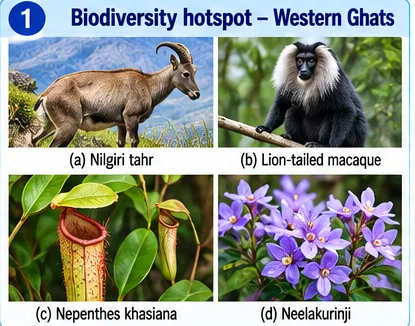
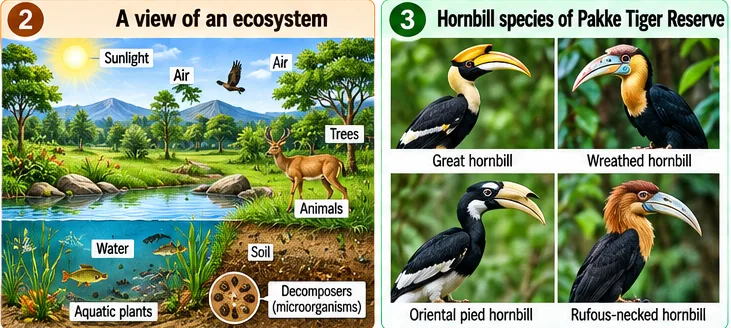
Endemic species are found naturally in only one region — e.g. the lion-tailed macaque and Nilgiri tahr of the Western Ghats, and the pitcher plant Nepenthes khasiana of Meghalaya. Protected areas such as the Pakke Tiger Reserve in Arunachal Pradesh shelter several hornbill species, which disperse seeds of forest trees.
3. How Has Biodiversity Evolved?
Life began with simple single-celled organisms more than 3.5 billion years ago. Over very long periods, organisms changed — evolution. Individuals of a species show small differences (variations). In a given environment, some variations help survival and reproduction; these individuals leave more offspring, so useful traits become common — natural selection, explained by Charles Darwin. Over many generations, populations living in different environments became different species, producing today’s diversity. Organisms sharing a recent common ancestor show more similarities.
4. How and Why to Classify Organisms
Classification is arranging organisms into groups based on similarities and differences. It:
- makes the study of millions of organisms easy and systematic;
- shows relationships among organisms and their evolution;
- gives a universal system of naming understood worldwide;
- helps identify new organisms and conserve biodiversity.
Basic characteristics used: cell type (prokaryotic or eukaryotic), number of cells (unicellular or multicellular), mode of nutrition (autotrophic or heterotrophic), body organisation and presence of a cell wall.
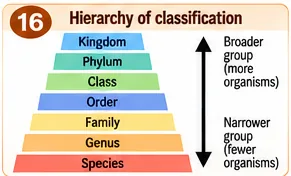
Hierarchy of classification
Kingdom → Phylum (Division for plants) → Class → Order → Family → Genus → Species. Moving down, groups become smaller and members more alike. A species is a group of similar organisms that can interbreed to produce fertile offspring.
Binomial nomenclature
Introduced by Carolus Linnaeus, every species has a two-part scientific name: Genus (capital first letter) + species (small letter), printed in italics or underlined when handwritten — e.g. Homo sapiens (human), Panthera tigris (tiger), Mangifera indica (mango).
5. Classification Systems Over Time
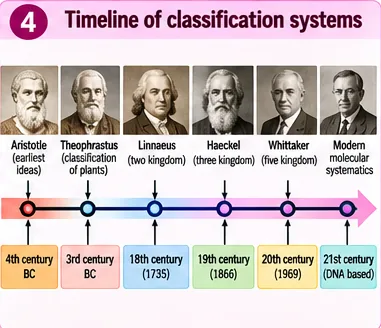
| Scientist | Year | System |
|---|---|---|
| Aristotle | 4th century BCE | Animals by habitat (land, water, air) |
| Linnaeus | 1735 onwards | Two kingdoms — Plantae, Animalia; binomial names |
| Ernst Haeckel | 1866 | Three kingdoms — added Protista |
| R. H. Whittaker | 1969 | Five kingdoms — Monera, Protista, Fungi, Plantae, Animalia |
| Modern scientists | Present | Molecular (DNA) evidence; domains |
6. The Five-Kingdom Classification
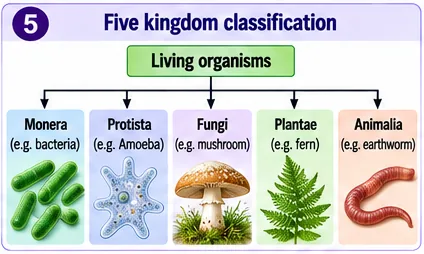
| Kingdom | Cell type | Body | Nutrition | Examples |
|---|---|---|---|---|
| Monera | Prokaryotic | Unicellular | Autotrophic or heterotrophic | Bacteria, cyanobacteria |
| Protista | Eukaryotic | Unicellular | Auto- or heterotrophic | Amoeba, Paramecium, Euglena, diatoms |
| Fungi | Eukaryotic, cell wall of chitin | Mostly multicellular | Heterotrophic (saprophytic) | Mushroom, yeast, Rhizopus |
| Plantae | Eukaryotic, cell wall of cellulose | Multicellular | Autotrophic | Mosses, ferns, pine, mango |
| Animalia | Eukaryotic, no cell wall | Multicellular | Heterotrophic | Hydra, insects, fish, humans |
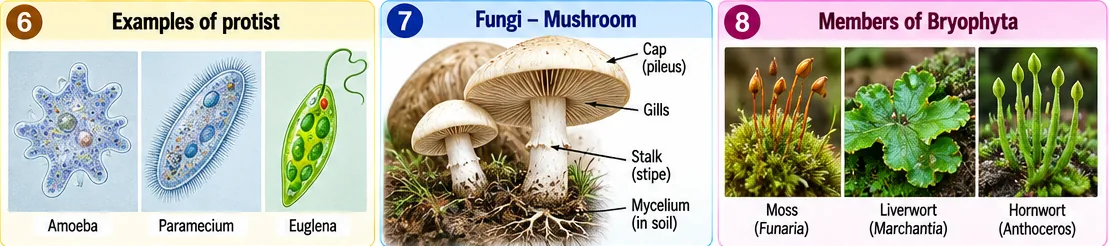
Kingdom Plantae — major groups
| Group | Features | Examples |
|---|---|---|
| Thallophyta (algae) | No distinct root, stem or leaves; mostly aquatic | Spirogyra, Ulothrix, Chara |
| Bryophyta | “Amphibians of the plant kingdom”; simple stem and leaf-like parts; no vascular tissue | Moss (Funaria), liverwort (Marchantia) |
| Pteridophyta | Roots, stem and leaves; vascular tissue; spores, no seeds | Ferns, Marsilea |
| Gymnosperms | Naked seeds (not in fruits), often in cones | Pine, cycas, deodar |
| Angiosperms | Seeds enclosed in fruits; flowers; monocots and dicots | Mango, wheat, gulmohar |
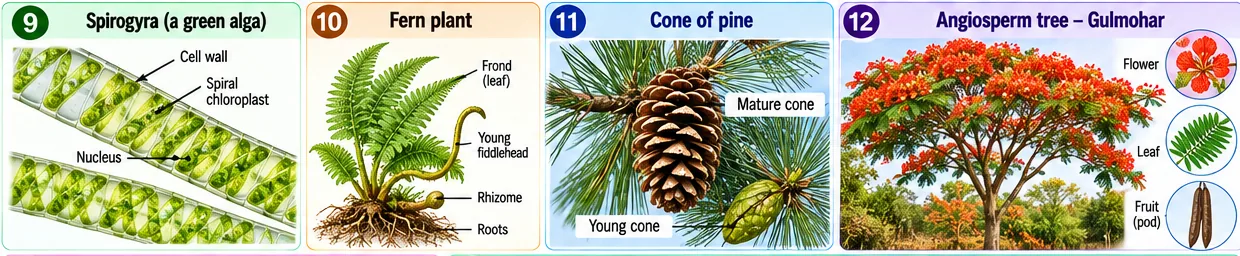
Kingdom Animalia — major phyla
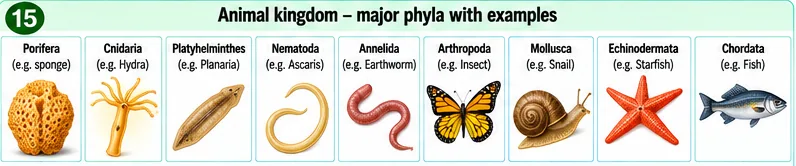
| Phylum | Key feature | Examples |
|---|---|---|
| Porifera | Pores all over body; sponges | Sycon, Euplectella |
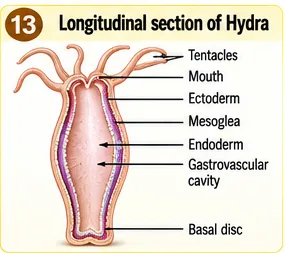
| Cnidaria (Coelenterata) | Body cavity, tentacles with stinging cells | Hydra, jellyfish, sea anemone |
| Platyhelminthes | Flatworms; bilaterally symmetric | Planaria, tapeworm, liver fluke |
| Nematoda | Roundworms; many parasites | Ascaris, Wuchereria (filaria) |
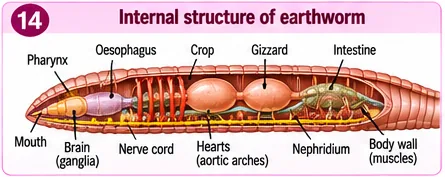
| Annelida | Segmented body | Earthworm, leech, Nereis |
| Arthropoda | Jointed legs; largest phylum | Insects, spiders, crabs, prawns |
| Mollusca | Soft body, usually a shell | Snail, octopus, Pila |
| Echinodermata | Spiny skin; marine; water-vascular system | Starfish, sea urchin |
| Chordata | Notochord, dorsal nerve cord; vertebrates | Fish, frogs, reptiles, birds, mammals |
Vertebrate classes (Chordata): Pisces (fish — gills, fins, scales), Amphibia (frog — moist skin, live in water and on land), Reptilia (snake, lizard — dry scaly skin, eggs with shell), Aves (birds — feathers, beaks, hollow bones) and Mammalia (mammary glands, hair; most give birth to young).
7. Adaptations as Outcomes of Structural Change
Over generations, structures change in ways that fit organisms to their habitats — adaptations. Examples: streamlined bodies and fins in fish; webbed feet in ducks; thick fur and fat in polar bears; spines (modified leaves) and thick stems in cacti to reduce water loss; air-filled tissues in aquatic plants like water hyacinth; pitcher-shaped leaves in Nepenthes that trap insects in nitrogen-poor soils.
8. Master Table: Key Terms
| Term | Meaning |
|---|---|
| Biodiversity | Variety of genes, species and ecosystems |
| Hotspot | Region rich in endemic species and under threat |
| Endemic species | Found naturally only in one region |
| Natural selection | Survival and reproduction of better-adapted variants (Darwin) |
| Species | Similar organisms that interbreed to give fertile offspring |
| Hierarchy | Kingdom → Phylum → Class → Order → Family → Genus → Species |
| Binomial nomenclature | Genus + species (Linnaeus), italicised |
| Five kingdoms | Monera, Protista, Fungi, Plantae, Animalia (Whittaker, 1969) |
9. Master Summary Table
| Plant group | Vascular tissue | Seeds | Flowers/fruits |
|---|---|---|---|
| Thallophyta | No | No | No |
| Bryophyta | No | No | No |
| Pteridophyta | Yes | No (spores) | No |
| Gymnosperms | Yes | Yes, naked | No (cones) |
| Angiosperms | Yes | Yes, enclosed | Yes |
Chart — approximate share of described animal species by group:
Rounded, approximate proportions to show that arthropods are by far the largest group.
10. Mind Map
- India: 4 hotspots
- Endemic species
- Variation
- Natural selection
- Hierarchy, binomial names
- 2 → 3 → 5 kingdoms
- Plants: algae → angiosperms
- Animals: Porifera → Chordata
11. Tips and Tricks
- Hierarchy: “King Philip Came Over For Good Soup” — Kingdom, Phylum, Class, Order, Family, Genus, Species.
- Five kingdoms: “My Pet Frog Plays Alone” — Monera, Protista, Fungi, Plantae, Animalia.
- Scientific names: Genus capital, species small, both italic.
- Writing homo Sapiens — the correct form is Homo sapiens.
- Putting fungi in the plant kingdom — they are a separate kingdom (no chlorophyll, chitin walls).
- Saying gymnosperms have fruits — their seeds are naked.
12. Important One-liners
- India has parts of four global biodiversity hotspots.
- The lion-tailed macaque is endemic to the Western Ghats.
- Darwin explained evolution by natural selection.
- The basic unit of classification is species.
- Linnaeus introduced binomial nomenclature.
- Whittaker proposed five kingdoms in 1969.
- Monera are prokaryotes.
- Bryophytes are called amphibians of the plant kingdom.
- Gymnosperms have naked seeds; angiosperms have seeds inside fruits.
- Arthropoda is the largest animal phylum.
13. Exam-pattern Questions with Detailed Answers
The five-kingdom classification was proposed by:
- Linnaeus
- Haeckel
- Whittaker
- Darwin
Show answer
R. H. Whittaker (1969). Linnaeus gave two kingdoms, Haeckel three.
Answer: (C) Whittaker
Write the scientific name of humans correctly.
Show answer
Homo sapiens — genus capitalised, species in lower case, italicised.
Answer: Homo sapiens
Which kingdom contains prokaryotic organisms?
Show answer
Monera — bacteria and cyanobacteria.
Answer: Monera
Assertion (A): Fungi are placed in a separate kingdom from plants. Reason (R): Fungi lack chlorophyll and are heterotrophic.
- Both true; R explains A
- Both true; R does not explain A
- A true, R false
- A false, R true
Show answer
Fungi cannot make food and have chitin cell walls, unlike plants, so they form a separate kingdom.
Answer: (A)
Why are bryophytes called the amphibians of the plant kingdom?
Show answer
They live on land but need water (moist places) for fertilisation, as their male gametes swim to the egg.
Answer: Live on land but depend on water for reproduction
Give two differences between gymnosperms and angiosperms.
Show answer
Gymnosperms: naked seeds, no flowers or fruits (cones), e.g. pine. Angiosperms: seeds enclosed in fruits, flowers present, e.g. mango.
Answer: Naked vs enclosed seeds; cones vs flowers
What is a biodiversity hotspot? Name the hotspots that cover parts of India.
Show answer
A region with very high numbers of endemic species that is under serious threat of habitat loss. India: Western Ghats, Himalaya, Indo-Burma and Sundaland (Nicobar Islands).
Answer: Rich, threatened, endemic-heavy region; four in India
Name the phylum: (a) jointed legs, (b) segmented body, (c) spiny skin, (d) pores all over the body.
Show answer
(a) Arthropoda (b) Annelida (c) Echinodermata (d) Porifera.
Answer: Arthropoda, Annelida, Echinodermata, Porifera
Explain how natural selection could lead to the long neck of the giraffe.
Show answer
Ancestral giraffes showed variation in neck length. When food on low branches became scarce, those with longer necks reached higher leaves, survived better and produced more offspring, passing on the trait. Over many generations, long necks became common.
Answer: Variation + survival advantage + inheritance over generations
Case-based: An organism is eukaryotic, multicellular, has a cell wall of chitin and absorbs food from decaying matter. (a) Identify its kingdom. (b) Give one example. (c) State its role in an ecosystem.
Show answer
(a) Fungi. (b) Mushroom / Rhizopus. (c) Decomposer — breaks down dead matter and recycles nutrients.
Answer: Fungi; mushroom; decomposer
Why was the two-kingdom system replaced by the five-kingdom system?
Show answer
The two-kingdom system placed prokaryotes and eukaryotes, unicellular and multicellular, and autotrophs and heterotrophs (like fungi) together. Organisms like Euglena (both plant- and animal-like) did not fit. The five-kingdom system uses cell type, body organisation and nutrition to group organisms more naturally.
Answer: Two kingdoms mixed very different organisms; five kingdoms are more natural
Arrange from broadest to narrowest and classify the tiger: species tigris, class Mammalia, genus Panthera, kingdom Animalia, family Felidae, order Carnivora, phylum Chordata.
Show answer
Kingdom Animalia → Phylum Chordata → Class Mammalia → Order Carnivora → Family Felidae → Genus Panthera → Species tigris (scientific name Panthera tigris).
Answer: Animalia → Chordata → Mammalia → Carnivora → Felidae → Panthera → tigris
14. Quick Revision Summary
- Biodiversity: genes, species, ecosystems; India has four hotspots and many endemics.
- Evolution through variation and natural selection (Darwin).
- Classification: hierarchy kingdom → species; binomial names (Linnaeus).
- Systems: two (Linnaeus), three (Haeckel), five kingdoms (Whittaker 1969).
- Plants: algae, bryophytes, pteridophytes, gymnosperms, angiosperms; animals: Porifera to Chordata; adaptations suit habitats.