
1. Chapter at a Glance
Out of about 118 known elements, more than 90 are metals. Iron for bridges, copper for wires, aluminium for aeroplanes, gold for jewellery — metals shape our lives. Non-metals such as oxygen, carbon, nitrogen and sulphur are equally vital. This chapter compares their physical and chemical properties, explains the reactivity series, shows how metals and non-metals form ionic compounds, describes how metals are extracted from ores and refined, and ends with corrosion and alloys.
- Physical properties and important exceptions.
- Reactions of metals with oxygen, water, acids and salt solutions; the reactivity series.
- Formation and properties of ionic compounds.
- Occurrence and extraction of metals; electrolytic refining.
- Corrosion, its prevention, and alloys.
2. Physical Properties
| Property | Metals | Non-metals |
|---|---|---|
| Lustre | Shiny (metallic lustre) | Dull (iodine is an exception — lustrous) |
| Hardness | Generally hard (Na, K are soft — cut with a knife) | Generally soft (diamond, a form of carbon, is the hardest natural substance) |
| Malleability, ductility | Can be beaten into sheets and drawn into wires (gold and silver are the most malleable/ductile) | Brittle |
| Conduction | Good conductors of heat and electricity (Ag, Cu best; Pb, Hg poor) | Poor conductors (graphite conducts electricity) |
| State | Solids (mercury is liquid) | Solids or gases (bromine is liquid) |
| Melting point | High (Ga and Cs melt on the palm) | Low |
| Sound | Sonorous — ring when struck | Non-sonorous |
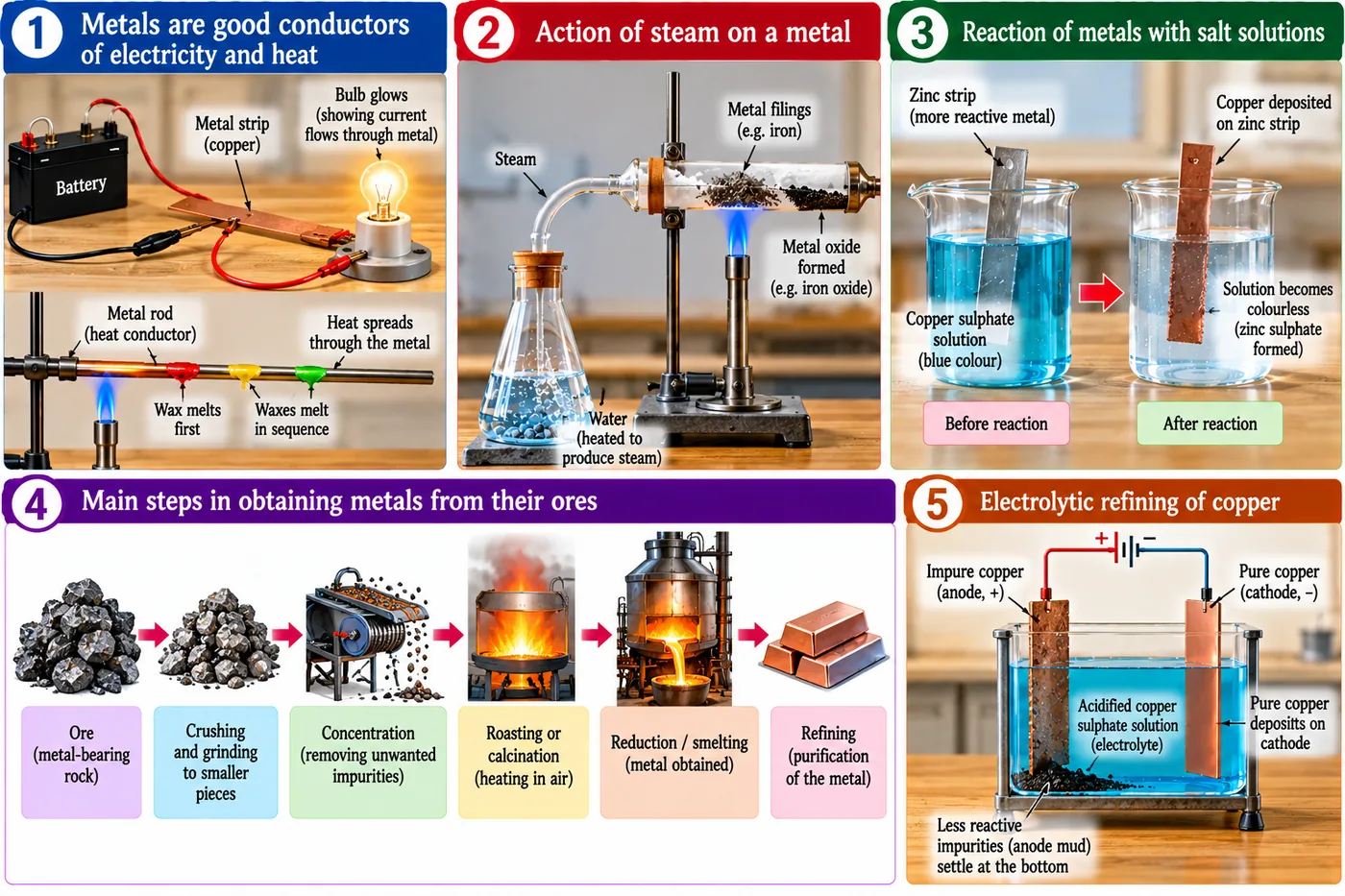
3. Chemical Properties of Metals
(a) With oxygen
Metal + oxygen → metal oxide. 2Cu + O2 → 2CuO (black); 4Al + 3O2 → 2Al2O3. Metal oxides are basic, but Al2O3 and ZnO are amphoteric — they react with both acids and bases: Al2O3 + 6HCl → 2AlCl3 + 3H2O; Al2O3 + 2NaOH → 2NaAlO2 + H2O. Soluble metal oxides form alkalis (Na2O + H2O → 2NaOH). Sodium and potassium react so vigorously that they are stored under kerosene. Mg, Al, Zn and Pb form a protective oxide layer; iron burns only as filings; copper forms black CuO on heating; silver and gold do not react with oxygen. Anodising thickens the oxide layer on aluminium to protect it.
(b) With water
Metal + water → metal oxide/hydroxide + hydrogen. Na and K react violently with cold water (the hydrogen catches fire): 2Na + 2H2O → 2NaOH + H2 + heat. Calcium reacts less violently and starts floating, as hydrogen bubbles stick to it. Magnesium reacts with hot water and also floats. Al, Fe and Zn react only with steam: 3Fe + 4H2O → Fe3O4 + 4H2. Lead, copper, silver and gold do not react with water.
(c) With dilute acids
Metal + dilute acid → salt + hydrogen (for metals above hydrogen in the reactivity series). Fe + 2HCl → FeCl2 + H2. Hydrogen is not evolved with nitric acid, which is a strong oxidising agent and oxidises H2 to water — except with Mg and Mn in very dilute HNO3. Aqua regia (“royal water”), a fresh 3 : 1 mixture of conc. HCl and conc. HNO3, dissolves gold and platinum.
(d) With solutions of other metal salts
A more reactive metal displaces a less reactive one: Fe + CuSO4 → FeSO4 + Cu. Comparing such reactions gives the reactivity series:
K > Na > Ca > Mg > Al > Zn > Fe > Pb > [H] > Cu > Hg > Ag > Au
4. How Do Metals and Non-metals React?
Noble gases have a complete outer shell (octet, or duplet for helium) and are very stable. Other atoms gain, lose or share electrons to reach this state. A sodium atom (2, 8, 1) loses one electron to become Na+ (2, 8); a chlorine atom (2, 8, 7) gains it to become Cl− (2, 8, 8). The oppositely charged ions attract each other strongly to form sodium chloride, an ionic (electrovalent) compound. Similarly Mg (2, 8, 2) gives two electrons to two Cl atoms to form MgCl2.
Properties of ionic compounds: hard solids (strong forces between ions), brittle; high melting and boiling points; generally soluble in water, insoluble in kerosene and petrol; conduct electricity in molten state or in solution (ions free to move) but not as solids.
5. Occurrence and Extraction of Metals
Elements or compounds found naturally in the earth's crust are minerals; minerals from which a metal can be extracted profitably are ores. Ores contain impurities such as soil and sand, called gangue, which are removed first (enrichment/concentration). The method of extraction depends on reactivity:
| Reactivity | Metals | Method |
|---|---|---|
| Low | Cu, Hg (Ag, Au may occur free) | Heating the sulphide ore in air: 2HgS + 3O2 → 2HgO + 2SO2; 2HgO → 2Hg + O2. 2Cu2S + 3O2 → 2Cu2O + 2SO2; 2Cu2O + Cu2S → 6Cu + SO2 |
| Middle | Zn, Fe, Pb | Convert to oxide by roasting (sulphide, in excess air: 2ZnS + 3O2 → 2ZnO + 2SO2) or calcination (carbonate, limited air: ZnCO3 → ZnO + CO2); then reduce with carbon: ZnO + C → Zn + CO |
| High | Na, Mg, Ca, Al, K | Electrolytic reduction of molten chlorides/oxides; metal deposits at the cathode, e.g. Na from molten NaCl |
Highly reactive metals such as Al can reduce oxides of less reactive metals. The thermit reaction, Fe2O3 + 2Al → 2Fe + Al2O3 + heat, produces molten iron and is used to join railway tracks and cracked machine parts.
Refining
In electrolytic refining (Cu, Zn, Sn, Ni, Ag, Au), impure metal is the anode, a thin strip of pure metal is the cathode, and a solution of a salt of the metal (acidified CuSO4 for copper) is the electrolyte. Pure metal deposits on the cathode; soluble impurities go into solution; insoluble impurities settle below the anode as anode mud.
6. Corrosion and Alloys
Silver turns black (silver sulphide), copper gets a green coating (basic copper carbonate) and iron gets a reddish-brown coating of rust. Rusting needs both air and water: a nail in boiled water covered with oil (no air) or in a tube with anhydrous CaCl2 (no moisture) does not rust. Prevention: painting, oiling, greasing, galvanising (coating with zinc — protects even if scratched), chrome plating, anodising, and making alloys.
An alloy is a homogeneous mixture of two or more metals, or a metal and a non-metal. Alloys are made by melting the main metal and dissolving the others in it.
| Alloy | Composition | Special feature / use |
|---|---|---|
| Steel | Iron + ~0.05% carbon | Hard and strong |
| Stainless steel | Iron + nickel + chromium | Does not rust; utensils |
| Brass | Copper + zinc | Lower conductivity and melting point than copper |
| Bronze | Copper + tin | Statues, medals |
| Solder | Lead + tin | Low melting point; welding wires |
| Amalgam | Mercury + another metal | Dental fillings (traditional) |
Pure (24 carat) gold is too soft; 22 carat gold has 22 parts gold and 2 parts copper or silver to make it harder. The 1600-year-old iron pillar near the Qutub Minar in Delhi shows the skill of ancient Indian metallurgists in making rust-resistant iron.
7. Master Table: Key Terms
| Term | Meaning |
|---|---|
| Amphoteric oxide | Reacts with acids and bases (Al2O3, ZnO) |
| Reactivity series | Metals arranged in decreasing reactivity |
| Ionic compound | Formed by transfer of electrons (NaCl, MgCl2) |
| Ore / gangue | Profitable mineral / earthy impurities |
| Roasting / calcination | Heating sulphide in excess air / carbonate in limited air |
| Thermit reaction | Fe2O3 + 2Al → 2Fe + Al2O3 + heat |
| Galvanisation | Coating iron with zinc |
| Alloy | Homogeneous mixture of metals or metal + non-metal |
8. Master Summary Table
| Metal | Cold water | Hot water / steam | Dilute acid |
|---|---|---|---|
| K, Na | Violent, H2 catches fire | — | Explosive |
| Ca | Less violent, floats | — | Vigorous |
| Mg | Very slow | Hot water, floats | Vigorous |
| Al, Zn, Fe | No | Steam only | Moderate |
| Pb, Cu, Ag, Au | No | No | No H2 (Pb slow) |
Chart — melting points of some metals (°C, rounded):
9. Mind Map
- Lustre, malleable, ductile
- Exceptions: Hg, Na, I, graphite
- O2, water, acids
- Displacement, reactivity series
- Electron transfer
- High m.p., conduct when molten
- Concentration, roasting/calcination
- Reduction, refining
- Rust needs air + water
- Galvanising, alloys
10. Tips and Tricks
- Reactivity series: “Please Stop Calling Me A Zebra, I Like Her Calling Me A Smart Goat” — K, Na, Ca, Mg, Al, Zn, Fe, Pb, H, Cu, Hg, Ag, Au.
- Roasting = sulphide in Rich (excess) air; Calcination = Carbonate.
- Galvanising = Grey Zinc coat.
- Writing that all metals give H2 with HNO3.
- Saying ionic compounds conduct electricity in the solid state.
- Forgetting that rusting needs both oxygen and water.
- Calling an alloy a compound — it is a mixture.
11. Important One-liners
- Mercury is the only metal that is liquid at room temperature.
- Silver and copper are the best conductors of electricity.
- Sodium and potassium are stored in kerosene.
- Al2O3 and ZnO are amphoteric oxides.
- Aqua regia is conc. HCl and conc. HNO3 in the ratio 3 : 1.
- Ionic compounds conduct electricity in molten or dissolved state.
- Calcination is used for carbonate ores, roasting for sulphide ores.
- The thermit reaction joins railway tracks.
- Anode mud forms during electrolytic refining.
- Brass = Cu + Zn; bronze = Cu + Sn; solder = Pb + Sn.
12. Exam-pattern Questions with Detailed Answers
Which metal can be cut with a knife?
- Iron
- Sodium
- Copper
- Aluminium
Show answer
Sodium (and potassium) are soft alkali metals.
Answer: (B) Sodium
Name a non-metal that is (a) a good conductor of electricity (b) lustrous (c) liquid at room temperature.
Show answer
(a) Graphite (carbon) (b) Iodine (c) Bromine.
Answer: Graphite, iodine, bromine
What is an amphoteric oxide? Give two examples.
Show answer
A metal oxide that reacts with both acids and bases to form salt and water, e.g. Al2O3, ZnO.
Answer: Reacts with acids and bases; Al2O3, ZnO
Assertion (A): Hydrogen gas is not evolved when most metals react with nitric acid. Reason (R): Nitric acid is a strong oxidising agent that oxidises the hydrogen produced to water.
- Both true; R explains A
- Both true; R does not explain A
- A true, R false
- A false, R true
Show answer
HNO3 itself is reduced to oxides of nitrogen while oxidising H2. Only Mg and Mn with very dilute HNO3 release H2.
Answer: (A)
Show the formation of MgCl2 by the transfer of electrons. (Atomic numbers: Mg = 12, Cl = 17)
Show answer
Mg (2, 8, 2) loses two electrons → Mg2+ (2, 8). Each of two Cl atoms (2, 8, 7) gains one electron → 2Cl− (2, 8, 8). The ions combine: Mg2+ + 2Cl− → MgCl2.
Answer: Mg → Mg2+ + 2e−; 2Cl + 2e− → 2Cl−
Why does calcium float when it reacts with water?
Show answer
Ca + 2H2O → Ca(OH)2 + H2. Bubbles of hydrogen stick to the surface of the calcium and make it buoyant.
Answer: Hydrogen bubbles stick to it
Differentiate between roasting and calcination with one equation each.
Show answer
Roasting: sulphide ore heated strongly in excess air, 2ZnS + 3O2 → 2ZnO + 2SO2. Calcination: carbonate ore heated strongly in limited air, ZnCO3 → ZnO + CO2.
Answer: Sulphide + excess air vs carbonate + limited air
Why is galvanised iron still protected even if the zinc coating is scratched?
Show answer
Zinc is more reactive than iron, so it reacts (corrodes) preferentially and protects the exposed iron.
Answer: Zinc, being more reactive, corrodes instead of iron
Metals A, B, C and D were added to solutions. A displaced copper from CuSO4; B did not react with FeSO4 but displaced silver from AgNO3; C reacted with FeSO4; D did not react with any salt solution given (CuSO4, FeSO4, ZnSO4, AgNO3). Which is the most and least reactive? What could B be?
Show answer
C displaces Fe, so it is above iron (most reactive among them). D displaces nothing, even silver, so it is least reactive (e.g. gold). B is below iron but above silver — it could be copper. A is above copper.
Answer: Most reactive C, least reactive D; B could be copper
Case-based: In a factory, impure copper is purified in a tank containing acidified copper sulphate. (a) Which electrode is the impure copper? (b) What collects at the cathode? (c) What is anode mud? (d) Why is acidified CuSO4 used?
Show answer
(a) Anode. (b) Pure copper deposits on the cathode. (c) Insoluble impurities (often containing silver and gold) that settle below the anode. (d) It provides Cu2+ ions; Cu2+ from the anode replaces those deposited at the cathode, and the acid increases conductivity.
Answer: Anode impure; pure Cu at cathode; insoluble residue = anode mud
Why are ionic compounds hard, with high melting points, but conductors only when molten or dissolved?
Show answer
Strong electrostatic forces between oppositely charged ions hold them in a rigid lattice, so a lot of energy is needed to break it (hard, high m.p.). In the solid, ions cannot move; when molten or dissolved, ions become free to move and carry current.
Answer: Strong ionic forces; ions mobile only when molten/dissolved
An ore on heating in air gives SO2. (a) What type of ore is it? (b) Describe how the metal (zinc) is obtained from it, with equations. (c) Why can't carbon be used to obtain sodium from its oxide?
Show answer
(a) Sulphide ore. (b) Roasting: 2ZnS + 3O2 → 2ZnO + 2SO2; reduction with carbon: ZnO + C → Zn + CO. (c) Sodium is more reactive than carbon (has greater affinity for oxygen), so carbon cannot reduce Na2O; sodium is obtained by electrolysis of molten NaCl.
Answer: Sulphide ore; roast then reduce; Na needs electrolysis
13. Quick Revision Summary
- Metals: lustrous, malleable, ductile, conductors, sonorous; know the exceptions.
- Metals form basic oxides (Al2O3, ZnO amphoteric); react with water and acids according to reactivity.
- Reactivity series: K Na Ca Mg Al Zn Fe Pb H Cu Hg Ag Au.
- Ionic compounds form by electron transfer; high m.p., conduct when molten or in solution.
- Extraction: concentration → roasting/calcination → reduction (C, Al or electrolysis) → electrolytic refining.
- Rusting needs air and water; prevent by painting, galvanising, alloying.