
1. Chapter at a Glance
Food, clothes, medicines, fuels, plastics and even our own bodies are built mainly from carbon compounds. The earth's crust has only about 0.02% carbon (as minerals) and the atmosphere about 0.03% CO2, yet the number of carbon compounds runs into millions. This chapter explains why: carbon forms covalent bonds, links with itself into long chains (catenation) and has a valency of four (tetravalency). You will learn about hydrocarbons, functional groups, homologous series, naming, important reactions, ethanol, ethanoic acid, and how soaps and detergents clean.
- Covalent bonding; electron dot structures; allotropes of carbon.
- Catenation and tetravalency; saturated and unsaturated compounds; chains, branches, rings.
- Functional groups, homologous series and IUPAC naming.
- Combustion, oxidation, addition and substitution reactions.
- Ethanol and ethanoic acid; esters; soaps, detergents and micelles.
2. Bonding in Carbon: the Covalent Bond
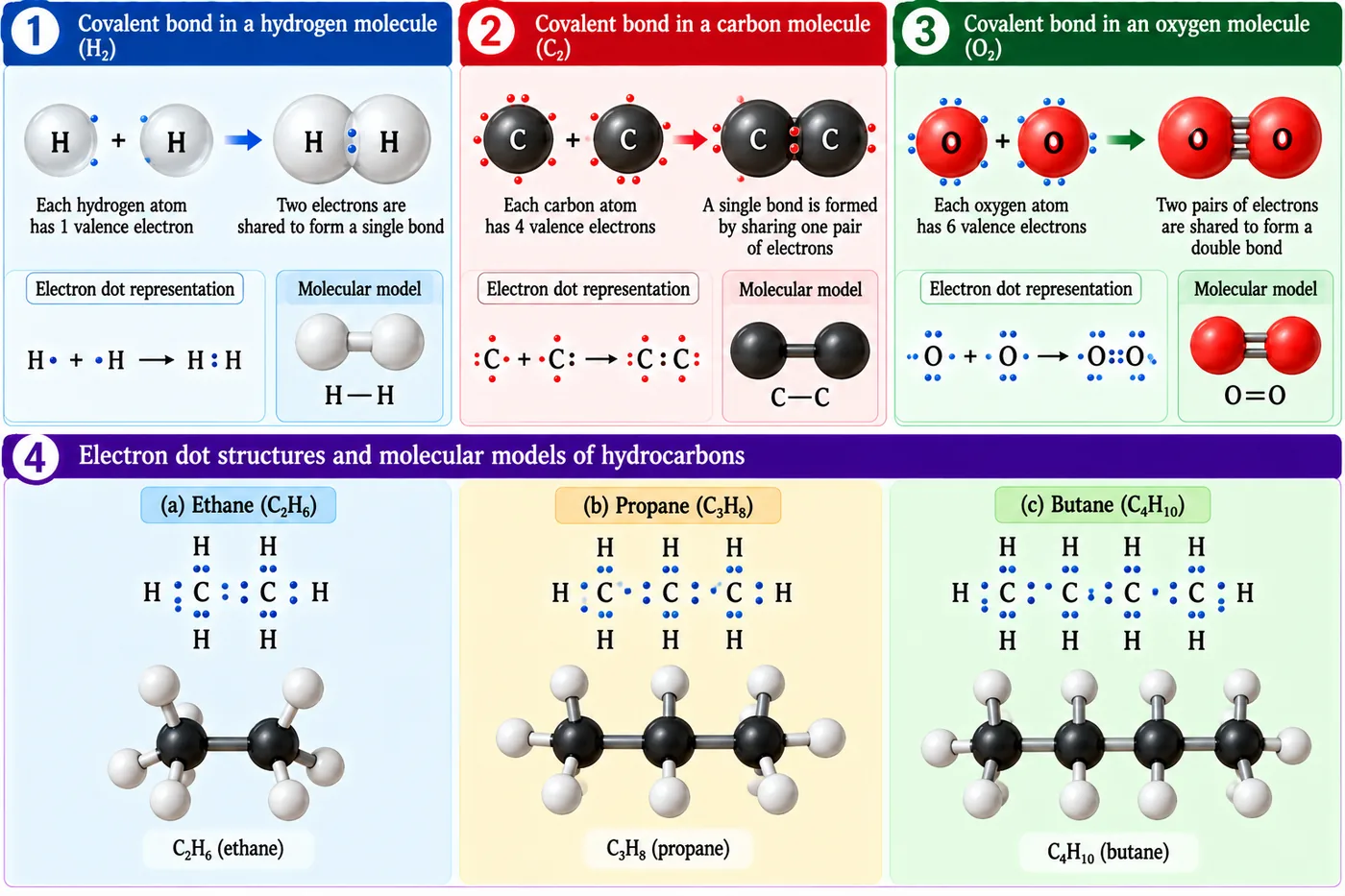
Carbon (atomic number 6, configuration 2, 4) needs four more electrons for an octet. Gaining four would give C4−, where six protons must hold ten electrons — difficult. Losing four would give C4+, which needs a lot of energy. So carbon shares its four valence electrons. A bond formed by sharing a pair of electrons is a covalent bond.
- H2: one shared pair — single bond (H–H).
- O2: two shared pairs — double bond (O=O).
- N2: three shared pairs — triple bond (N≡N).
- CH4: carbon shares one pair with each of four hydrogen atoms.
Covalent compounds have weak intermolecular forces, so they have low melting and boiling points, and they are generally poor conductors because no ions are formed.
Allotropes of carbon
| Allotrope | Structure | Properties |
|---|---|---|
| Diamond | Each C bonded to four others — rigid 3-D network | Hardest natural substance; does not conduct electricity |
| Graphite | Each C bonded to three others in hexagonal layers, layers stacked | Smooth, slippery; good conductor of electricity |
| Fullerene (C60) | 60 carbon atoms shaped like a football | Named after architect Buckminster Fuller |
3. Versatile Nature of Carbon
- Catenation: carbon forms strong bonds with other carbon atoms, giving long chains, branched chains and rings. (Silicon shows this only weakly, so its compounds are fewer and reactive.)
- Tetravalency: carbon bonds with four other atoms — carbon, hydrogen, oxygen, nitrogen, sulphur, chlorine and others. Its small size makes these bonds strong and the compounds stable.
Compounds of only carbon and hydrogen are hydrocarbons. Those with only single bonds are saturated (alkanes, CnH2n+2); those with double or triple bonds are unsaturated (alkenes CnH2n, alkynes CnH2n−2). Carbon chains may be straight (butane), branched (isobutane — butane and isobutane are structural isomers) or rings (cyclohexane C6H12; benzene C6H6).
4. Functional Groups, Homologous Series and Naming
An atom or group of atoms that gives a compound its characteristic properties is a functional group. It replaces hydrogen in a hydrocarbon.
| Functional group | Formula | Suffix/prefix | Example |
|---|---|---|---|
| Halogen | –Cl, –Br | chloro-, bromo- | Chloropropane |
| Alcohol | –OH | -ol | Propanol |
| Aldehyde | –CHO | -al | Propanal |
| Ketone | >C=O | -one | Propanone |
| Carboxylic acid | –COOH | -oic acid | Propanoic acid |
| Double / triple bond | C=C / C≡C | -ene / -yne | Propene, propyne |
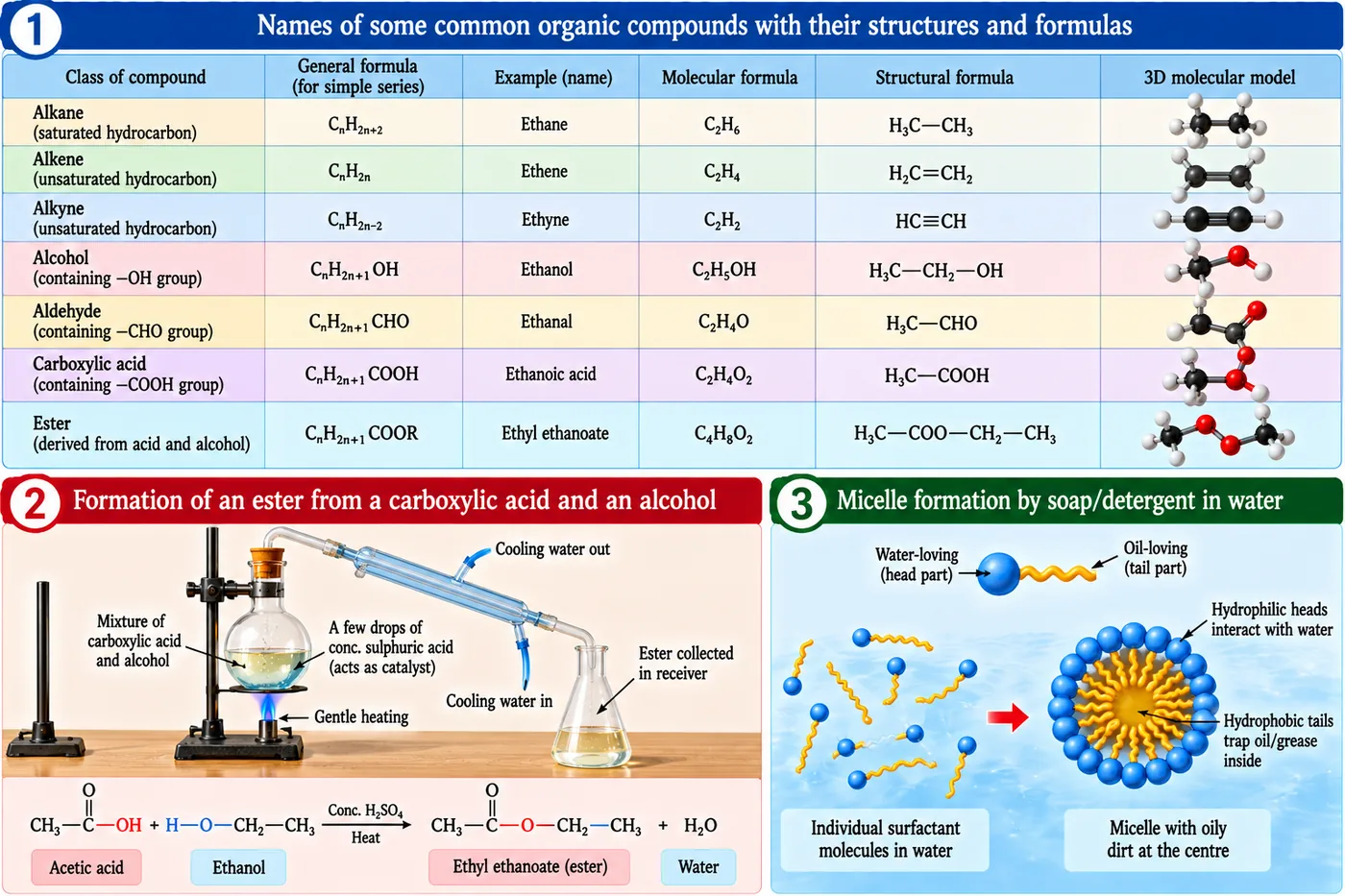
A homologous series is a family of compounds with the same functional group, in which successive members differ by a –CH2– unit (14 u). Members have similar chemical properties, while physical properties (melting point, boiling point) change gradually with molecular mass. Examples: CH3OH, C2H5OH, C3H7OH…
Naming: (1) count the carbon atoms (meth-1, eth-2, prop-3, but-4, pent-5…); (2) add the prefix or suffix for the functional group; if the suffix starts with a vowel, drop the final “e” of the alkane name (propane → propanol).
5. Chemical Properties of Carbon Compounds
- Combustion: carbon compounds burn in oxygen to give CO2, water, heat and light. CH4 + 2O2 → CO2 + 2H2O. Saturated hydrocarbons usually give a clean blue flame; unsaturated ones give a yellow, sooty flame. Limited air also gives a sooty flame (blackened cooking vessels mean air holes are blocked).
- Oxidation: alcohols are oxidised to carboxylic acids by alkaline KMnO4 or acidified K2Cr2O7 (oxidising agents): CH3CH2OH → CH3COOH.
- Addition: unsaturated hydrocarbons add hydrogen in the presence of a catalyst such as nickel — hydrogenation, used to make vanaspati ghee from vegetable oils. Animal fats are saturated and less healthy; vegetable oils with unsaturated chains are better for health.
- Substitution: in sunlight, chlorine replaces hydrogen atoms one by one in saturated hydrocarbons: CH4 + Cl2 → CH3Cl + HCl.
6. Ethanol and Ethanoic Acid
Ethanol (C2H5OH)
A liquid at room temperature, soluble in water; the active ingredient of alcoholic drinks and used in medicines (tincture iodine, cough syrups). Even small amounts cause drunkenness; intake of methanol can cause blindness and death. Industrial alcohol is made unfit to drink by adding methanol and a blue dye (denatured alcohol).
- With sodium: 2Na + 2CH3CH2OH → 2CH3CH2ONa (sodium ethoxide) + H2.
- Dehydration with hot conc. H2SO4 at 443 K: CH3CH2OH → CH2=CH2 + H2O (H2SO4 acts as a dehydrating agent).
- Ethanol is a clean fuel; mixed with petrol it is used in vehicles.
Ethanoic acid (CH3COOH)
Commonly called acetic acid. A 5–8% solution in water is vinegar. Pure ethanoic acid freezes at 290 K and often looks like ice in cold weather — hence glacial acetic acid. It is a weak acid.
- Esterification: CH3COOH + C2H5OH → CH3COOC2H5 (ethyl ethanoate) + H2O, in the presence of an acid catalyst. Esters are sweet-smelling, used in perfumes and flavouring.
- Saponification: ester + NaOH → alcohol + sodium salt of acid. CH3COOC2H5 + NaOH → C2H5OH + CH3COONa. This reaction is used to make soap.
- With a base: NaOH + CH3COOH → CH3COONa + H2O.
- With carbonates/hydrogencarbonates: 2CH3COOH + Na2CO3 → 2CH3COONa + H2O + CO2.
7. Soaps and Detergents
Soap molecules are sodium or potassium salts of long-chain carboxylic acids. Each molecule has an ionic (hydrophilic) head that dissolves in water and a long hydrocarbon (hydrophobic) tail that dissolves in oil. In water, the tails point inwards around oily dirt and the heads face outwards, forming clusters called micelles. The oily dirt is trapped in the centre and washed away with water.
In hard water (containing calcium and magnesium salts), soap forms an insoluble precipitate called scum, so more soap is wasted. Detergents are usually sodium salts of sulphonic acids or ammonium salts with chloride or bromide ions; their charged ends do not form insoluble precipitates with Ca2+ and Mg2+, so they work even in hard water — used in shampoos and laundry products.
8. Master Table: Key Terms
| Term | Meaning |
|---|---|
| Covalent bond | Bond formed by sharing electron pairs |
| Catenation | Self-linking of carbon atoms into chains/rings |
| Isomers | Same molecular formula, different structures (butane, isobutane) |
| Homologous series | Same functional group; successive members differ by CH2 (14 u) |
| Hydrogenation | Addition of H2 to unsaturated compounds with Ni catalyst |
| Esterification | Acid + alcohol → ester + water |
| Saponification | Ester + NaOH → alcohol + soap (sodium salt) |
| Micelle | Cluster of soap molecules trapping oil inside |
9. Master Summary Table
| Compound | Formula | Key reaction |
|---|---|---|
| Methane | CH4 | Combustion; substitution with Cl2 |
| Ethene | C2H4 | Addition (hydrogenation) |
| Ethanol | C2H5OH | Na → H2; dehydration → ethene; oxidation → ethanoic acid |
| Ethanoic acid | CH3COOH | Esterification; with carbonates → CO2 |
| Ethyl ethanoate | CH3COOC2H5 | Saponification |
Chart — molecular masses in the alkane series (u) — each step adds CH2 = 14 u:
10. Mind Map
- Covalent; single/double/triple
- Diamond, graphite, C60
- Catenation, tetravalency
- Chains, branches, rings
- Functional groups
- Homologous series, naming
- Combustion, oxidation
- Addition, substitution
- Ethanol, ethanoic acid, esters
- Soaps, detergents
11. Tips and Tricks
- Carbon count: “Monkeys Eat Peeled Bananas” — Meth, Eth, Prop, But.
- -ane single, -ene double, -yne triple: a, e, y in alphabetical order = 1, 2, 3 bonds.
- Saponification → “soap-making”; esterification → “sweet smell”.
- Soap heads love water (hydrophilic), tails love oil (hydrophobic).
- Writing that covalent compounds conduct electricity — they generally do not.
- Confusing addition (unsaturated) with substitution (saturated) reactions.
- Saying soap works well in hard water — it forms scum.
- Forgetting that homologues differ by 14 u, not 12 u.
12. Important One-liners
- Carbon has four valence electrons and forms covalent bonds.
- N2 has a triple bond.
- Graphite conducts electricity; diamond does not.
- Fullerene C60 looks like a football.
- Butane and isobutane are structural isomers.
- Hydrogenation of oils uses a nickel catalyst.
- Alkaline KMnO4 oxidises ethanol to ethanoic acid.
- Vinegar is 5–8% ethanoic acid.
- Esters have a sweet smell.
- Detergents work in hard water; soaps form scum.
13. Exam-pattern Questions with Detailed Answers
The number of covalent bonds in a molecule of methane is:
- 2
- 3
- 4
- 5
Show answer
Carbon forms one C–H bond with each of four hydrogen atoms.
Answer: (C) 4
Name the functional group in (a) CH3CHO (b) CH3COCH3.
Show answer
(a) Aldehyde (–CHO) — ethanal. (b) Ketone (>C=O) — propanone.
Answer: Aldehyde; ketone
Why is pure ethanoic acid called glacial acetic acid?
Show answer
Its melting point is 290 K, so in cold weather it freezes and looks like ice (glacier).
Answer: It freezes into an ice-like solid at 290 K
Assertion (A): Carbon forms covalent bonds rather than ionic bonds. Reason (R): Carbon can neither easily lose nor gain four electrons.
- Both true; R explains A
- Both true; R does not explain A
- A true, R false
- A false, R true
Show answer
Forming C4− or C4+ needs too much energy, so carbon shares electrons.
Answer: (A)
Draw the electron dot structure of ethene and of nitrogen.
Show answer
Ethene: the two carbon atoms share two electron pairs (C::C), and each carbon shares one pair with each of two hydrogen atoms. Nitrogen: the two N atoms share three pairs (N⋮⋮N) and each N keeps one lone pair.
Answer: C=C double bond in ethene; N≡N triple bond in nitrogen
Why do cooking vessels get blackened on a gas stove sometimes? What should be done?
Show answer
The air holes of the burner are blocked, so fuel burns incompletely in insufficient oxygen, giving a sooty flame. Clean the air holes so complete combustion gives a blue flame.
Answer: Incomplete combustion; clean the air holes
Write the next two members of the homologous series of CH3OH and explain how their properties change.
Show answer
C2H5OH (ethanol), C3H7OH (propanol). Chemical properties stay similar (same –OH group); melting point, boiling point and molecular mass increase gradually.
Answer: Ethanol, propanol
How would you distinguish experimentally between an alcohol and a carboxylic acid?
Show answer
Add sodium hydrogencarbonate (or sodium carbonate). The carboxylic acid gives brisk effervescence of CO2, which turns limewater milky; the alcohol gives no reaction.
Answer: NaHCO3 test — CO2 only with the acid
A compound X (C2H4O2) reacts with sodium carbonate to give CO2. It reacts with an alcohol Y in the presence of an acid to give a sweet-smelling compound Z (C4H8O2). Identify X, Y and Z and write the equations.
Show answer
X = ethanoic acid, Y = ethanol, Z = ethyl ethanoate. 2CH3COOH + Na2CO3 → 2CH3COONa + H2O + CO2; CH3COOH + C2H5OH → CH3COOC2H5 + H2O (acid catalyst).
Answer: X ethanoic acid, Y ethanol, Z ethyl ethanoate
Case-based: A student washes an oily cloth with soap in (i) distilled water and (ii) water from a hand pump. In (ii) a white curdy precipitate forms and cleaning is poor. (a) Explain how soap removes oil in (i). (b) What is the precipitate in (ii) and why does it form? (c) Suggest a better cleaning agent for (ii).
Show answer
(a) Soap molecules form micelles: hydrophobic tails dissolve in the oil and hydrophilic heads face water, so oil is pulled into the micelle centre and rinsed away. (b) Scum — insoluble calcium/magnesium salts formed by soap reacting with Ca2+ and Mg2+ ions in hard water. (c) A detergent, which does not form scum.
Answer: Micelles; scum from hard water; use a detergent
Ethanol is heated with excess conc. H2SO4 at 443 K. Name the product, write the equation and state the role of H2SO4. What happens if this product is treated with H2 in the presence of Ni?
Show answer
CH3CH2OH → CH2=CH2 + H2O; product ethene. H2SO4 is a dehydrating agent (removes water). Ethene + H2 (Ni) → ethane (addition/hydrogenation).
Answer: Ethene; dehydrating agent; hydrogenation gives ethane
Why does carbon form such a large number of compounds? Why are these compounds stable?
Show answer
Catenation lets carbon form long chains, branches and rings; tetravalency lets it bond with four atoms of carbon or other elements; multiple bonds and isomerism add more variety. Because carbon is small, its nucleus holds the shared electron pairs strongly, making the bonds strong and the compounds stable.
Answer: Catenation + tetravalency; small size gives strong bonds
14. Quick Revision Summary
- Carbon shares electrons: covalent bonds; low m.p., poor conductors.
- Allotropes: diamond (hard, non-conductor), graphite (conductor), fullerene C60.
- Catenation + tetravalency → millions of compounds; saturated vs unsaturated; isomers.
- Functional groups and homologous series (difference CH2, 14 u); naming with prefix/suffix.
- Reactions: combustion, oxidation, addition (Ni), substitution (sunlight).
- Ethanol, ethanoic acid, esters; soaps form micelles, detergents work in hard water.