
1. Chapter at a Glance
How do we know something is alive? Visible movement is not enough — a sleeping cow or a tree is alive too. Living things constantly carry out processes that maintain and repair their bodies, even when they seem inactive. These maintenance jobs are called life processes: nutrition, respiration, transportation and excretion. Single-celled organisms do them through their whole surface; large multicellular organisms need special organs and systems. This chapter studies each process in plants and in humans.
- Autotrophic nutrition (photosynthesis) and heterotrophic nutrition; human digestion.
- Aerobic and anaerobic respiration; human respiratory system.
- Blood, heart, double circulation, lymph; transport of water and food in plants.
- Human excretory system, nephron, dialysis; excretion in plants.
2. Nutrition
Autotrophic nutrition — photosynthesis
Green plants make carbohydrates from carbon dioxide and water using sunlight and chlorophyll:
6CO2 + 12H2O → (sunlight, chlorophyll) → C6H12O6 + 6O2 + 6H2O
Three events take place: (1) absorption of light energy by chlorophyll; (2) conversion of light energy to chemical energy and splitting of water into hydrogen and oxygen; (3) reduction of CO2 to carbohydrates. Extra carbohydrate is stored as starch. Desert plants take in CO2 at night, store it as an intermediate, and use it during the day.
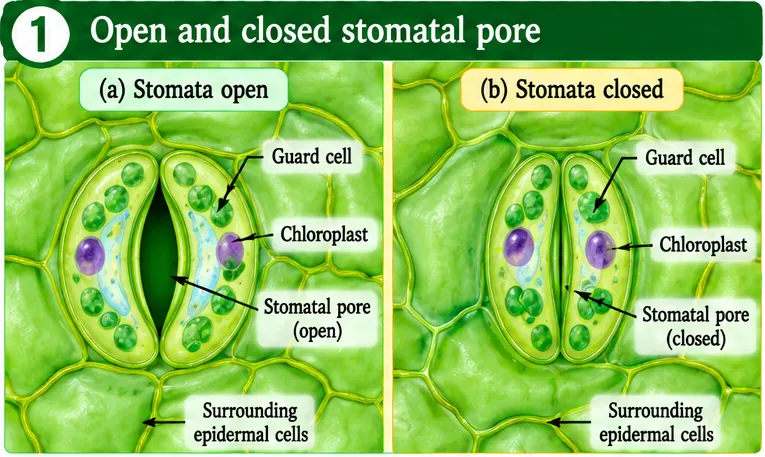
Gas exchange happens through stomata, tiny pores on leaves. Each pore is guarded by two guard cells: when they swell with water the pore opens; when they lose water it closes. Plants close stomata when they do not need CO2, to avoid losing water.
Experiments show that chlorophyll (variegated leaf turns blue-black with iodine only in green parts) and CO2 (a plant kept with KOH, which absorbs CO2, makes no starch) are essential for photosynthesis.
Heterotrophic nutrition
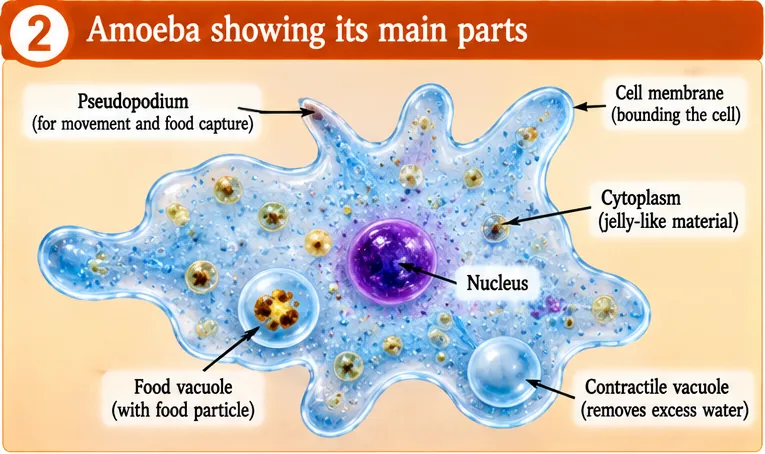
Organisms that cannot make their own food depend on others. Saprophytes (fungi such as bread moulds, yeast, mushrooms) break down food outside the body and absorb it; parasites (Cuscuta, ticks, lice, tapeworms) take food from a host without killing it; others (cow, human) take in whole food and digest it inside. Amoeba surrounds food with finger-like pseudopodia, forming a food vacuole where it is digested; Paramecium uses cilia to move food to a specific spot.
Nutrition in human beings
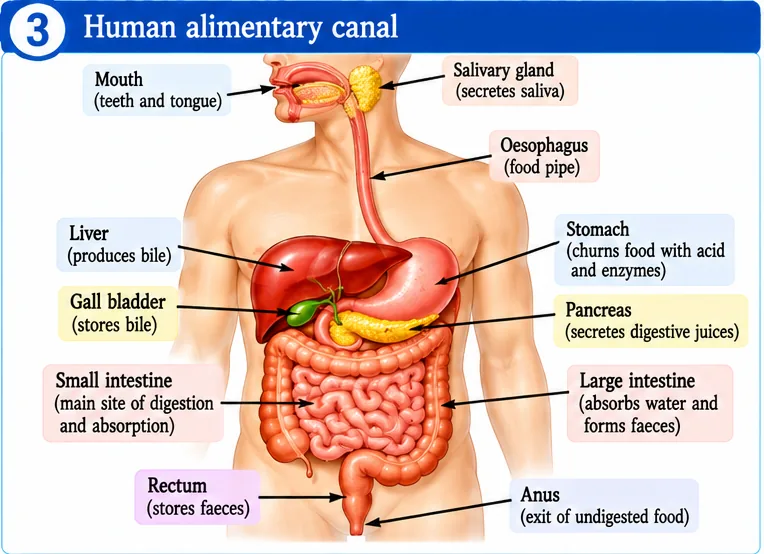
- Mouth: teeth chew food; salivary amylase breaks starch into sugar; tongue mixes food with saliva.
- Oesophagus: rhythmic contractions (peristalsis) push food along the whole gut.
- Stomach: gastric glands release HCl (makes the medium acidic for pepsin), pepsin (digests proteins) and mucus (protects the stomach lining). A sphincter releases food into the small intestine little by little.
- Small intestine (longest part; longer in herbivores, which eat cellulose): bile from the liver makes the food alkaline and breaks fats into small globules (emulsification); pancreatic juice contains trypsin (proteins) and lipase (fats); intestinal juice completes digestion — proteins to amino acids, carbohydrates to glucose, fats to fatty acids and glycerol. Finger-like villi increase the surface for absorption.
- Large intestine: absorbs water; waste is removed through the anus, controlled by the anal sphincter.
3. Respiration
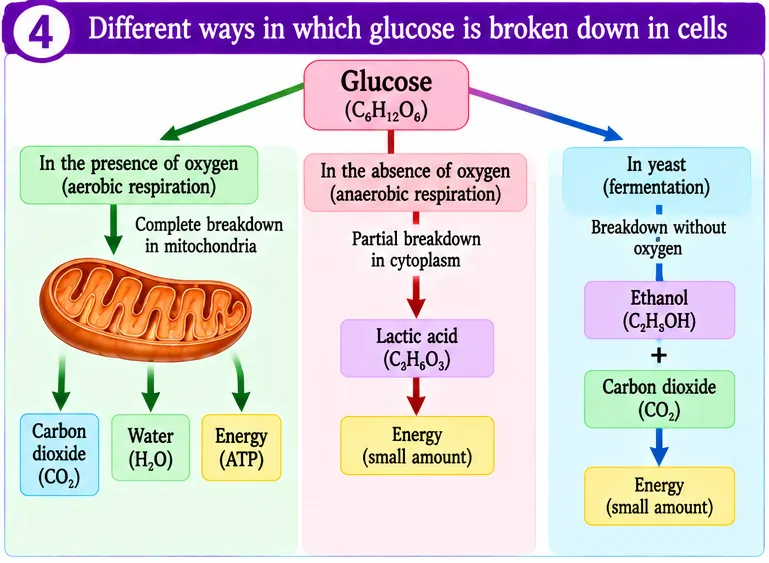
Food is broken down in cells to release energy. First, glucose (6-carbon) is broken into pyruvate (3-carbon) in the cytoplasm. Then:
- Aerobic respiration (with oxygen, in mitochondria): pyruvate → CO2 + H2O + a lot of energy.
- Anaerobic respiration in yeast (fermentation): pyruvate → ethanol + CO2 + little energy.
- Lack of oxygen in our muscles (during hard exercise): pyruvate → lactic acid + little energy; build-up of lactic acid causes cramps.
The energy released is stored as ATP (adenosine triphosphate), the energy currency of the cell. Plants exchange gases by diffusion through stomata, lenticels and root surfaces; at night they release CO2, while during the day CO2 from respiration is used for photosynthesis. Aquatic animals breathe dissolved oxygen (much less than in air), so fish breathe faster.
Human respiratory system
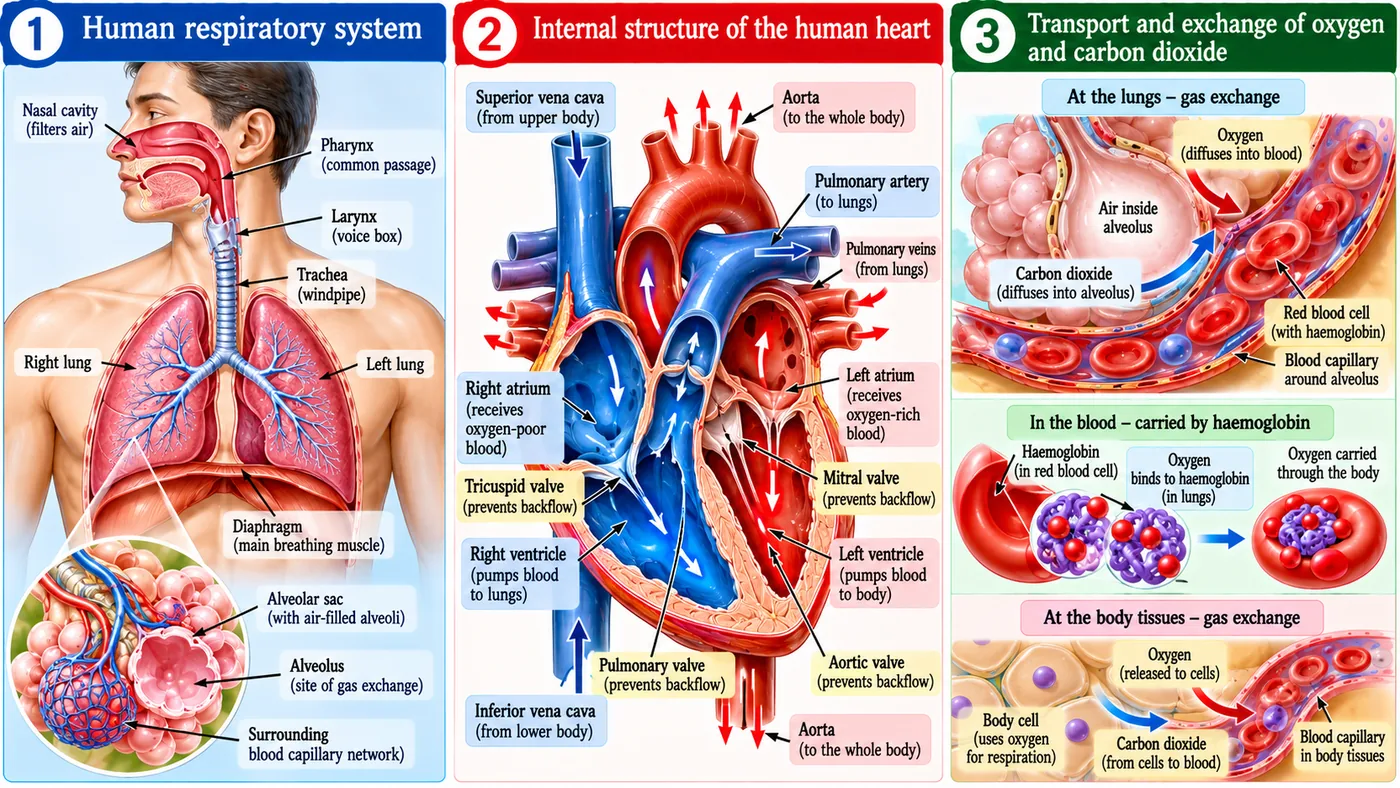
Air enters through the nostrils (fine hairs and mucus filter it), passes the pharynx, larynx and trachea (rings of cartilage stop it collapsing), then the bronchi and bronchioles, ending in balloon-like alveoli. Alveoli provide a huge surface for gas exchange with the surrounding blood capillaries. When we breathe in, the ribs lift and the diaphragm flattens, enlarging the chest cavity and sucking air in. The lungs always hold some residual air, giving time for gas exchange. Haemoglobin in red blood cells carries oxygen; CO2 is carried mainly dissolved in blood.
4. Transportation
Blood and the heart
Blood has a fluid plasma (carries food, CO2, nitrogenous wastes), red blood cells (carry oxygen) and platelets (clot blood to stop bleeding). The human heart has four chambers. Oxygen-rich blood from the lungs enters the left atrium, goes to the thick-walled left ventricle, which pumps it through the aorta to the body. Deoxygenated blood from the body enters the right atrium through the vena cavae, then the right ventricle pumps it to the lungs. Valves prevent backflow. The blood passes through the heart twice per cycle — double circulation — keeping oxygenated and deoxygenated blood separate, which supports the high energy needs of birds and mammals that maintain a constant body temperature. Fish have a two-chambered heart (single circulation); amphibians and most reptiles have three chambers.
| Vessel | Carries blood | Feature |
|---|---|---|
| Arteries | Away from the heart | Thick, elastic walls (high pressure) |
| Veins | Towards the heart | Thin walls, valves |
| Capillaries | Between arteries and veins | One-cell-thick walls for exchange |
Normal blood pressure is about 120/80 mm of Hg (systolic/diastolic), measured with a sphygmomanometer. Lymph (tissue fluid) is a colourless fluid with less protein; it carries digested fat from the intestine and drains extra fluid back into the blood.
Transport in plants
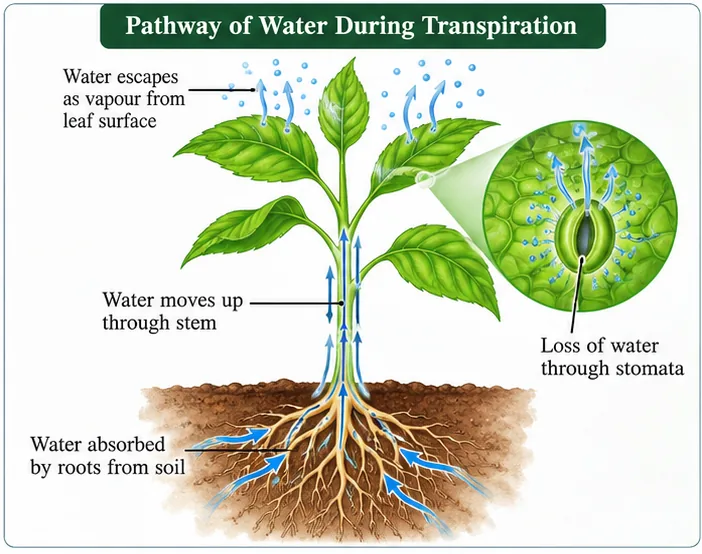
Xylem carries water and minerals from roots to leaves. Root cells take in ions, creating a concentration difference that draws water in. More important, especially in daytime, is transpiration — loss of water vapour from leaves — which creates a suction (transpiration pull) that pulls water up. Transpiration also cools the leaf. Phloem carries food (sucrose, amino acids) from leaves to other parts — translocation, which uses energy from ATP and can move in both directions.
5. Excretion
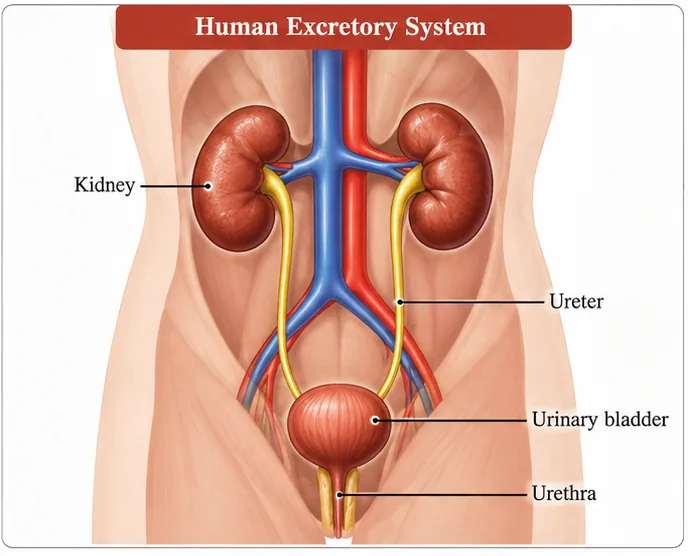
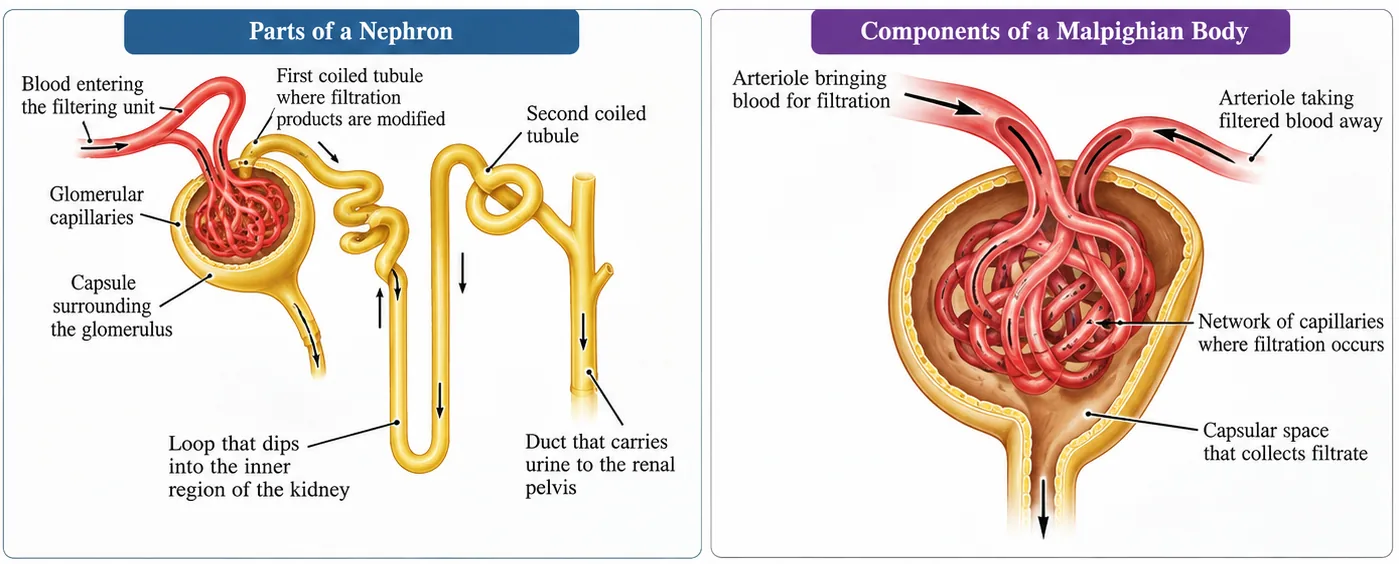
Removal of harmful nitrogenous wastes (urea, uric acid) produced in metabolism is excretion. The human excretory system has a pair of kidneys, a pair of ureters, a urinary bladder and a urethra. Each kidney contains about a million filtering units called nephrons. In each nephron, blood is filtered in a cluster of capillaries, the glomerulus, inside the cup-shaped Bowman's capsule. As the filtrate flows along the tubule, useful substances (glucose, amino acids, salts, most water) are reabsorbed. The remaining urine collects and passes through the ureter to the bladder. The amount of water reabsorbed depends on how much extra water and wastes the body has.
Artificial kidney (haemodialysis): when kidneys fail, blood is passed through long tubes in a tank of dialysing fluid; nitrogenous wastes diffuse out, and the cleaned blood returns to the body. Unlike a real kidney, there is no reabsorption.
Excretion in plants: oxygen is a by-product of photosynthesis; excess water is lost by transpiration; wastes are stored in leaves that fall off, in old xylem as resins and gums, or released into the soil.
6. Master Table: Key Terms
| Term | Meaning |
|---|---|
| Photosynthesis | 6CO2 + 12H2O → C6H12O6 + 6O2 + 6H2O |
| Emulsification | Bile breaks fat into small globules |
| Peristalsis | Wave-like contraction moving food along the gut |
| Aerobic / anaerobic | With O2 (CO2 + H2O) / without O2 (ethanol or lactic acid) |
| ATP | Energy currency of the cell |
| Double circulation | Blood passes through the heart twice per cycle |
| Transpiration | Loss of water vapour from aerial parts; creates suction |
| Translocation | Transport of food in phloem using ATP |
| Nephron | Filtering unit of kidney |
7. Master Summary Table
| Enzyme / juice | Source | Acts on |
|---|---|---|
| Salivary amylase | Salivary glands | Starch → sugar |
| Pepsin (+ HCl) | Gastric glands | Proteins |
| Bile (no enzyme) | Liver | Fats → emulsified globules; makes medium alkaline |
| Trypsin | Pancreas | Proteins |
| Lipase | Pancreas | Emulsified fats |
| Intestinal juice | Intestinal wall | Completes digestion to glucose, amino acids, fatty acids + glycerol |
Chart — energy (ATP) from one glucose molecule (commonly quoted approximate values):
8. Mind Map
- Photosynthesis, stomata
- Human digestion, villi
- Aerobic, anaerobic, ATP
- Alveoli, diaphragm
- Heart, double circulation
- Xylem, phloem
- Kidney, nephron
- Dialysis; plant wastes
9. Tips and Tricks
- Arteries carry blood Away from the heart.
- Left ventricle has the thickest wall — it pumps to the whole body.
- Xylem = water up (“X for eXport of water”); phloem = food (“Ph for Food”).
- Glucose → pyruvate always in cytoplasm; the next step decides aerobic or anaerobic.
- Saying bile contains enzymes — it emulsifies fats but has no enzyme.
- Calling pulmonary vein deoxygenated — it carries oxygenated blood to the heart.
- Thinking dialysis reabsorbs useful substances like a nephron does.
- Writing that plants respire only at night — they respire all the time.
10. Important One-liners
- Stomata open and close by guard cells.
- HCl in the stomach makes the medium acidic for pepsin.
- Villi increase the surface area for absorption.
- Muscle cramps are due to lactic acid.
- Yeast ferments sugar into ethanol and CO2.
- Alveoli are the site of gas exchange.
- The human heart has four chambers.
- Normal BP is about 120/80 mm Hg.
- Transpiration pull lifts water in tall trees.
- The nephron is the functional unit of the kidney.
11. Exam-pattern Questions with Detailed Answers
The breakdown of pyruvate to give CO2, water and energy takes place in:
- Cytoplasm
- Mitochondria
- Chloroplast
- Nucleus
Show answer
Aerobic breakdown of pyruvate occurs in mitochondria.
Answer: (B)
Name the enzyme in saliva and state its function.
Show answer
Salivary amylase — converts starch into sugar.
Answer: Salivary amylase; starch → sugar
What is the role of the rings of cartilage in the trachea?
Show answer
They keep the air passage open and prevent it from collapsing when there is less air in it.
Answer: Prevent the trachea from collapsing
Assertion (A): Separation of oxygenated and deoxygenated blood is necessary in mammals and birds. Reason (R): They need high energy to maintain constant body temperature.
- Both true; R explains A
- Both true; R does not explain A
- A true, R false
- A false, R true
Show answer
Separation allows a highly efficient supply of oxygen, which is needed for the high energy demand of warm-blooded animals.
Answer: (A)
How are the alveoli designed to maximise gas exchange?
Show answer
They are numerous and balloon-like, giving a very large surface area; their walls are very thin; they are surrounded by a dense network of capillaries; and they are moist, helping gases dissolve and diffuse.
Answer: Large area, thin walls, rich blood supply, moist
Why is the small intestine of a herbivore longer than that of a carnivore?
Show answer
Herbivores eat grass containing cellulose, which takes longer to digest, so a longer intestine gives more time and area for digestion. Meat is easier to digest, so carnivores have a shorter intestine.
Answer: Cellulose needs longer digestion
Compare transport in xylem and phloem.
Show answer
Xylem: water and minerals; from roots upwards; driven mainly by transpiration pull and root pressure; no ATP used directly. Phloem: food (sucrose, amino acids); in both directions; uses ATP (translocation).
Answer: Xylem — water, upward, physical forces; phloem — food, both ways, ATP
Describe the experiment to show that CO2 is necessary for photosynthesis.
Show answer
Destarch two potted plants by keeping them in the dark for three days. Cover each with a bell jar on a glass plate (sealed with Vaseline); keep a watch-glass of KOH (absorbs CO2) under one. Keep both in sunlight for two hours. Test a leaf from each with iodine: the leaf from the jar without KOH turns blue-black (starch made); the one with KOH does not.
Answer: No starch without CO2 (KOH jar)
Trace the path of a red blood cell from the right atrium to the left ventricle.
Show answer
Right atrium → (tricuspid valve) → right ventricle → (pulmonary valve) → pulmonary artery → lung capillaries (picks up O2) → pulmonary veins → left atrium → (mitral valve) → left ventricle.
Answer: RA → RV → pulmonary artery → lungs → pulmonary vein → LA → LV
Case-based: An athlete sprinting 400 m feels pain in the legs; it goes away after rest. (a) Which substance causes the pain? (b) Why does it form? (c) Write the pathway. (d) How is it removed?
Show answer
(a) Lactic acid. (b) During intense activity the oxygen supply to muscles falls short, so muscle cells respire anaerobically. (c) Glucose → (cytoplasm) pyruvate → (lack of O2) lactic acid + energy. (d) With rest and deep breathing, oxygen supply recovers and lactic acid is carried away and broken down.
Answer: Lactic acid from anaerobic respiration in muscles
How is the amount of urine produced regulated? Why is reabsorption important?
Show answer
The amount of water reabsorbed in the tubules depends on how much excess water the body has and how much dissolved waste must be removed. If we drink more water, less is reabsorbed and more dilute urine forms. Reabsorption saves glucose, amino acids, salts and water that would otherwise be lost in the filtrate.
Answer: Reabsorption adjusts to body water; saves useful substances
Why do fish have a higher breathing rate than terrestrial animals? Why is a two-chambered heart enough for them?
Show answer
Water holds much less dissolved oxygen than air, so fish must pass more water over their gills. Fish are cold-blooded with lower energy needs, and blood picks up oxygen in the gills and goes straight to the body (single circulation), so a two-chambered heart is sufficient.
Answer: Less O2 in water; lower energy needs
12. Quick Revision Summary
- Photosynthesis needs light, chlorophyll, CO2, water; stomata regulate gas exchange.
- Digestion: mouth (amylase) → stomach (HCl, pepsin) → small intestine (bile, trypsin, lipase, villi) → large intestine.
- Glucose → pyruvate → CO2 + H2O (aerobic) / ethanol + CO2 (yeast) / lactic acid (muscle); ATP.
- Breathing: alveoli, diaphragm, haemoglobin.
- Four-chambered heart, double circulation; arteries, veins, capillaries; lymph; xylem and phloem.
- Kidneys → nephrons (glomerulus, Bowman's capsule, tubule); dialysis; plant excretion.