
1. Chapter at a Glance
When you touch a hot pan, your hand jerks back before you even think. When a plant on a windowsill bends towards light, it is responding to its surroundings too. Every living organism must sense changes in its environment (stimuli) and respond in a controlled, coordinated way. Animals use two systems — the fast nervous system and the slower endocrine (hormonal) system. Plants have no nerves or muscles; they use plant hormones and changes in water content. This chapter explains both.
- Neurons, synapse and how messages travel.
- Reflex action and reflex arc; the human brain and its protection.
- Movement in plants: immediate responses and tropisms; plant hormones.
- Endocrine glands, hormones and feedback control.
2. The Nervous System
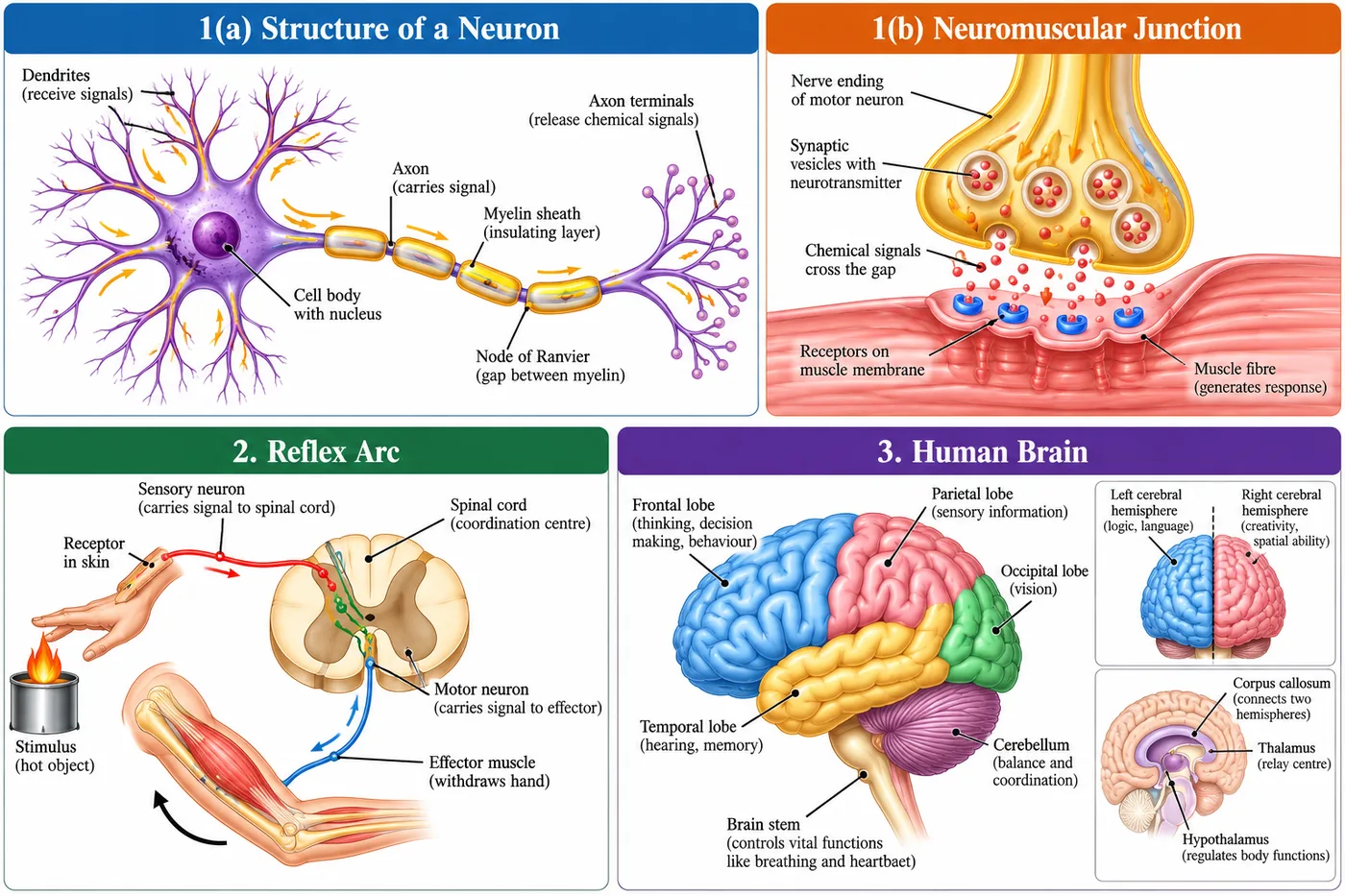
Specialised tips of nerve cells called receptors detect stimuli — for example, receptors in the inner ear (hearing, balance), nose (smell), tongue (taste) and skin (touch, heat). The information travels as an electrical impulse through a neuron:
- The dendrites receive the information and start a chemical reaction that creates an electrical impulse.
- The impulse travels from the dendrite to the cell body and then along the long axon (often covered by an insulating myelin sheath).
- At the end of the axon (nerve ending), the electrical impulse causes the release of chemicals (neurotransmitters).
- The chemicals cross a tiny gap, the synapse, and start a new impulse in the dendrite of the next neuron. A similar junction passes messages from neurons to muscle cells or glands.
Because chemicals are released only at the axon end, an impulse always travels in one direction.
3. Reflex Action and Reflex Arc
A reflex action is a sudden, automatic response to a stimulus without conscious thinking — withdrawing the hand from a flame, blinking when something comes near the eye, sneezing, coughing. Thinking takes time; in an emergency, the body needs an instant response.
The pathway is the reflex arc: receptor → sensory neuron → relay neuron in the spinal cord → motor neuron → effector (muscle/gland). Reflex arcs are formed in the spinal cord, so the response is quick; the information also travels on to the brain, which becomes aware of it later. Reflex arcs probably evolved in animals whose brains could not think quickly enough.
4. The Human Brain
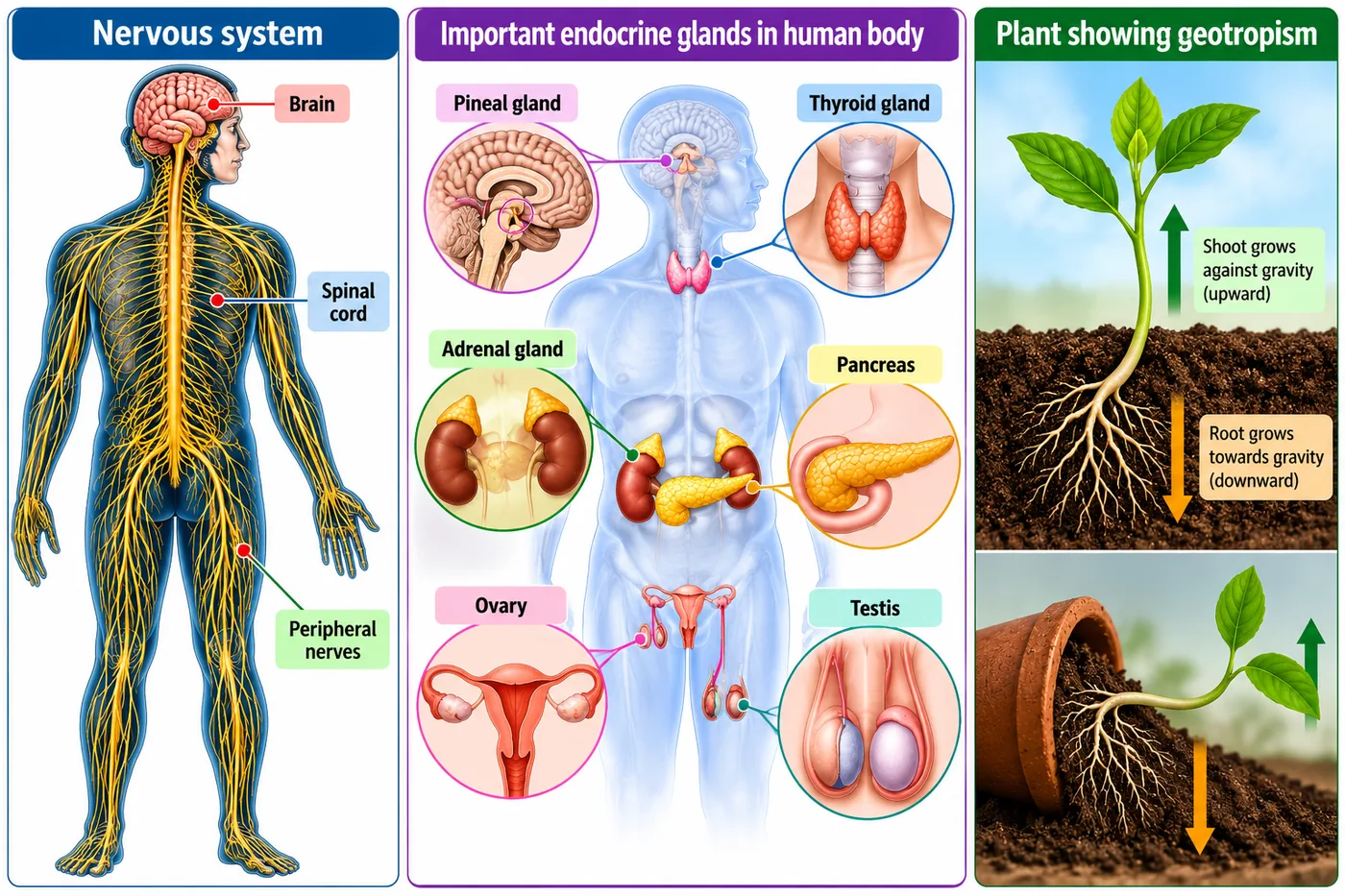
The brain and spinal cord form the central nervous system (CNS). Nerves from the brain (cranial nerves) and spinal cord (spinal nerves) form the peripheral nervous system, which connects the CNS to all parts of the body.
| Part | Region | Functions |
|---|---|---|
| Fore-brain (cerebrum) | Largest part | Thinking, memory, reasoning; separate areas for hearing, smell, sight; voluntary actions; contains the hunger centre |
| Hypothalamus | Fore-brain | Controls body temperature, hunger, thirst; controls the pituitary |
| Mid-brain | Middle | Involuntary actions such as reflex movements of head, neck and eyes |
| Pons | Hind-brain | Regulates breathing |
| Medulla | Hind-brain | Blood pressure, salivation, vomiting (involuntary) |
| Cerebellum | Hind-brain | Precision of voluntary actions, posture and balance (walking in a straight line, riding a bicycle) |
Protection: the brain sits inside the bony skull (cranium) in a fluid-filled balloon that absorbs shocks; the spinal cord is protected by the vertebral column.
How nerves make muscles move: muscle cells have special proteins that change their shape and arrangement in response to nerve impulses, so the cell shortens. Voluntary muscles (arms, legs) are under our control; involuntary muscles (heart, gut) are not.
5. Coordination in Plants
Immediate response — no growth
Leaves of the sensitive plant (touch-me-not, Mimosa pudica) fold and droop when touched. Plants have no nerves or muscles; cells use electrical-chemical signals to pass the information, and then the cells quickly change shape by changing the amount of water in them, causing the leaf to fold.
Movement due to growth — tropisms
A tropic movement is directional growth in response to a stimulus:
- Phototropism — towards light: shoots bend towards light (positive), roots away (negative).
- Geotropism — in response to gravity: roots grow downward (positive), shoots upward (negative).
- Hydrotropism — roots grow towards water.
- Chemotropism — growth of the pollen tube towards the ovule.
- Thigmotropism (touch) — tendrils of pea plants coil around a support; the part away from the support grows faster.
Plant hormones (phytohormones)
| Hormone | Main role |
|---|---|
| Auxin | Synthesised at the shoot tip; makes cells grow longer. In one-sided light it moves to the shady side, which grows more, so the shoot bends towards light. |
| Gibberellins | Growth of the stem |
| Cytokinins | Promote cell division; found in fruits and seeds |
| Abscisic acid | Inhibits growth; causes wilting of leaves (stress hormone) |
6. Hormones in Animals
Hormones are chemical messengers secreted by endocrine (ductless) glands directly into the blood. They reach all cells, but only target cells respond. Adrenaline, for example, prepares the body for emergencies (“fight or flight”): heart beats faster, more oxygen goes to muscles, blood to digestive system and skin is reduced, breathing becomes faster.
| Gland | Hormone | Function / disorder |
|---|---|---|
| Hypothalamus | Releasing hormones | Regulate secretion from the pituitary |
| Pituitary | Growth hormone | Body growth; deficiency in childhood → dwarfism, excess → gigantism |
| Thyroid | Thyroxin | Carbohydrate, protein, fat metabolism; needs iodine — deficiency → goitre (swollen neck). Hence iodised salt. |
| Adrenal | Adrenaline | Emergency response |
| Pancreas | Insulin | Lowers blood sugar; deficiency → diabetes |
| Testes | Testosterone | Male changes at puberty |
| Ovaries | Oestrogen | Female changes at puberty; menstrual cycle |
Feedback mechanism: the timing and amount of hormone release are controlled. When blood sugar rises, the pancreas detects it and releases more insulin; as sugar falls, insulin secretion decreases.
7. Master Table: Key Terms
| Term | Meaning |
|---|---|
| Stimulus | Change in the environment to which an organism responds |
| Synapse | Gap between two neurons where chemicals carry the signal |
| Reflex action | Quick automatic response; arc via spinal cord |
| Tropism | Directional growth movement in response to a stimulus |
| Auxin | Hormone causing cell elongation; phototropism |
| Endocrine gland | Ductless gland releasing hormones into blood |
| Feedback mechanism | Hormone level controlled by its own effect |
8. Master Summary Table
| Feature | Nervous control | Hormonal control |
|---|---|---|
| Signal | Electrical impulse + chemicals at synapse | Chemical (hormone) in blood |
| Speed | Very fast | Slow |
| Reach | Only cells connected by nerves | All cells; target cells respond |
| Effect | Short-lived | Long-lasting (e.g. growth) |
Chart — main parts of the hind-brain and their jobs (number of key functions listed in this chapter):
9. Mind Map
- Neuron, synapse
- Reflex arc
- Fore, mid, hind
- Skull, CSF protection
- Mimosa — water change
- Tropisms; auxin etc.
- Pituitary, thyroid, adrenal
- Insulin, feedback
10. Tips and Tricks
- Neuron path: “D-C-A” — Dendrite → Cell body → Axon.
- Plant hormones “A-G-C-A”: Auxin (elongation), Gibberellin (stem), Cytokinin (division), Abscisic acid (stop/wilt).
- Cerebellum = balance (“Balance in the Back of the head”).
- Saying reflex actions are controlled by the brain — the arc runs through the spinal cord.
- Saying Mimosa leaves fold due to growth — it is a quick water-content change.
- Confusing goitre (iodine deficiency) with diabetes (insulin deficiency).
11. Important One-liners
- The synapse passes a signal by chemicals.
- Impulses travel in one direction in a neuron.
- Reflex arcs are formed in the spinal cord.
- The cerebellum maintains posture and balance.
- The medulla controls blood pressure and vomiting.
- The brain is protected by the skull and a fluid-filled balloon.
- Roots show positive geotropism.
- Pollen tube growth is chemotropism.
- Auxin makes shoots bend towards light.
- Iodine is needed to make thyroxin.
12. Exam-pattern Questions with Detailed Answers
Which plant hormone promotes cell division?
- Auxin
- Gibberellin
- Cytokinin
- Abscisic acid
Show answer
Cytokinins promote cell division and are present in fruits and seeds.
Answer: (C)
Which part of the brain maintains posture and balance?
Show answer
The cerebellum, in the hind-brain.
Answer: Cerebellum
Why is iodised salt advised?
Show answer
Iodine is needed by the thyroid gland to make thyroxin; its deficiency causes goitre.
Answer: To prevent goitre
Assertion (A): Nerve impulses travel in only one direction in a neuron. Reason (R): Chemicals that transmit the signal are released only at the axon end.
- Both true; R explains A
- Both true; R does not explain A
- A true, R false
- A false, R true
Show answer
The next neuron receives chemicals only at its dendrite from the previous axon end.
Answer: (A)
How does the touch-me-not plant respond to touch? How is this different from the movement of a pea tendril?
Show answer
Mimosa leaves fold quickly because cells change shape by losing water; there is no growth, and it is not directional. A tendril coils around a support because the side away from the support grows faster — slow, growth-dependent and directional (thigmotropism).
Answer: Water change (no growth) vs directional growth
What is a synapse? How is the signal carried across it?
Show answer
A synapse is the small gap between the axon ending of one neuron and the dendrite of the next. The electrical impulse at the axon end releases chemicals that diffuse across the gap and start a new electrical impulse in the next neuron.
Answer: Gap between neurons; crossed by chemicals
Explain how auxin causes a shoot to bend towards light.
Show answer
Auxin made at the shoot tip diffuses towards the shaded side when light comes from one side. The higher auxin concentration on the shaded side makes those cells grow longer, so the shoot bends towards the light.
Answer: Auxin collects on the shaded side; those cells elongate
Name the endocrine gland and hormone involved: (a) fight-or-flight response (b) regulates blood sugar (c) growth of the body.
Show answer
(a) Adrenal — adrenaline. (b) Pancreas — insulin. (c) Pituitary — growth hormone.
Answer: Adrenaline, insulin, growth hormone
Why is the reflex arc formed in the spinal cord and not in the brain? Draw the flow chart of the reflex arc.
Show answer
Processing in the brain takes time; in an emergency (e.g. touching a hot object) the response must be immediate. The spinal cord relays the signal directly from sensory to motor neuron. Flow: receptor → sensory neuron → relay neuron (spinal cord) → motor neuron → effector muscle; the brain is informed afterwards.
Answer: For a faster response; receptor → sensory → spinal cord → motor → effector
Case-based: A potted plant is kept tilted on its side in a dark room for a week. (a) Which way will the shoot grow? (b) Which way will the root grow? (c) Name the movements. (d) Why was the room kept dark?
Show answer
(a) Upward (against gravity). (b) Downward (towards gravity). (c) Negative geotropism of the shoot; positive geotropism of the root. (d) To remove the effect of light (phototropism), so the response is due to gravity alone.
Answer: Shoot up, root down — geotropism; dark removes light effect
Explain feedback regulation of insulin. What happens if insulin is not produced in sufficient amounts?
Show answer
When blood sugar rises (e.g. after a meal), the pancreas detects it and secretes more insulin, which helps cells take up and store glucose; as sugar falls, insulin secretion is reduced. If insufficient insulin is produced, blood sugar stays high — diabetes — treated with insulin injections and diet control.
Answer: Sugar level controls insulin release; deficiency → diabetes
Compare nervous and hormonal control. Why do animals need both?
Show answer
Nervous signals are fast, short-lived and reach only cells connected by nerves; they stop once the chemical at the synapse is used up. Hormones travel in blood to all cells, act slowly but steadily and for longer, as needed for growth and development. Animals need quick responses (escaping danger) and sustained ones (growth, metabolism), so both systems work together.
Answer: Fast/brief vs slow/long-lasting; both needed
13. Quick Revision Summary
- Receptors detect stimuli; neurons carry impulses dendrite → cell body → axon → synapse.
- Reflex arc via the spinal cord gives quick responses.
- Brain: fore-brain (thinking), mid-brain (involuntary reflexes), hind-brain (pons, medulla, cerebellum); protected by skull and fluid.
- Plants: Mimosa folds by water change; tropisms by growth; auxin, gibberellins, cytokinins, abscisic acid.
- Endocrine glands release hormones into blood; iodine for thyroxin; insulin controlled by feedback.