
1. Chapter at a Glance
Reproduction is not necessary for an individual to stay alive, but it is essential for the survival of a species. At the heart of reproduction is the copying of DNA, the information that builds the body design. Copying is never perfectly accurate; small variations arise, which help populations survive when the environment changes. This chapter covers asexual methods (fission, fragmentation, regeneration, budding, vegetative propagation, spore formation), sexual reproduction in flowering plants, human reproduction and reproductive health.
- Why DNA copying and variation matter.
- Modes of asexual reproduction with examples.
- Parts of a flower, pollination, fertilisation, seed and fruit.
- Puberty, male and female reproductive systems, menstruation.
- Contraception, sexually transmitted diseases and healthy sex ratio.
2. Do Organisms Create Exact Copies of Themselves?
The nucleus contains DNA in chromosomes; DNA carries the information for making proteins, which shape the body. A cell copies its DNA using biochemical reactions and then divides, giving two cells. Because no reaction is fully reliable, copies show slight variations. Some variations are harmful, but others may help an individual survive a change — e.g. a bacterium that can withstand heat would survive a temperature rise in the water. Variation is the basis of evolution, and consistency of DNA copying keeps the body design stable for a species' niche.
3. Modes of Asexual Reproduction
A single parent produces offspring; no gametes are involved.
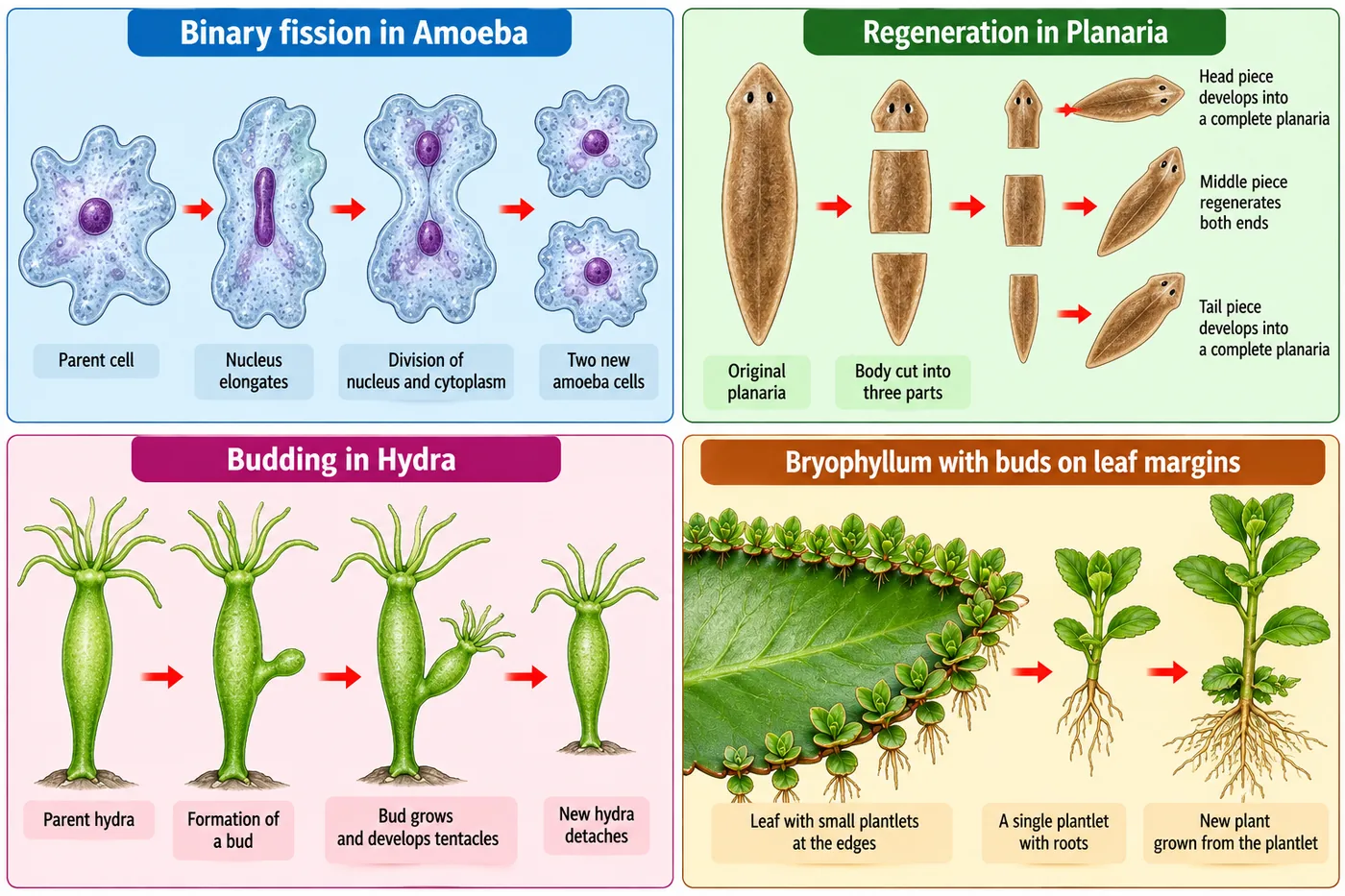
- Fission: in binary fission (Amoeba, many bacteria) the cell divides into two equal halves; in Leishmania (kala-azar) the plane of division is fixed by a whip-like structure. In multiple fission (Plasmodium, the malaria parasite), the cell divides into many daughter cells at once.
- Fragmentation: a filamentous alga such as Spirogyra breaks into pieces that each grow into new individuals.
- Regeneration: specialised cells can rebuild a whole body from a cut piece — Planaria and Hydra. (This is not common in complex organisms.)
- Budding: an outgrowth (bud) develops from repeated cell division at one site in Hydra (and yeast); it matures and detaches.
- Vegetative propagation: new plants from roots, stems or leaves — Bryophyllum buds on leaf margins, sugarcane, rose and grape by cuttings/layering/grafting, banana, orange and jasmine. Advantages: plants that have lost the capacity to produce seeds can be grown; plants bear flowers and fruits earlier; offspring are genetically similar to the parent.
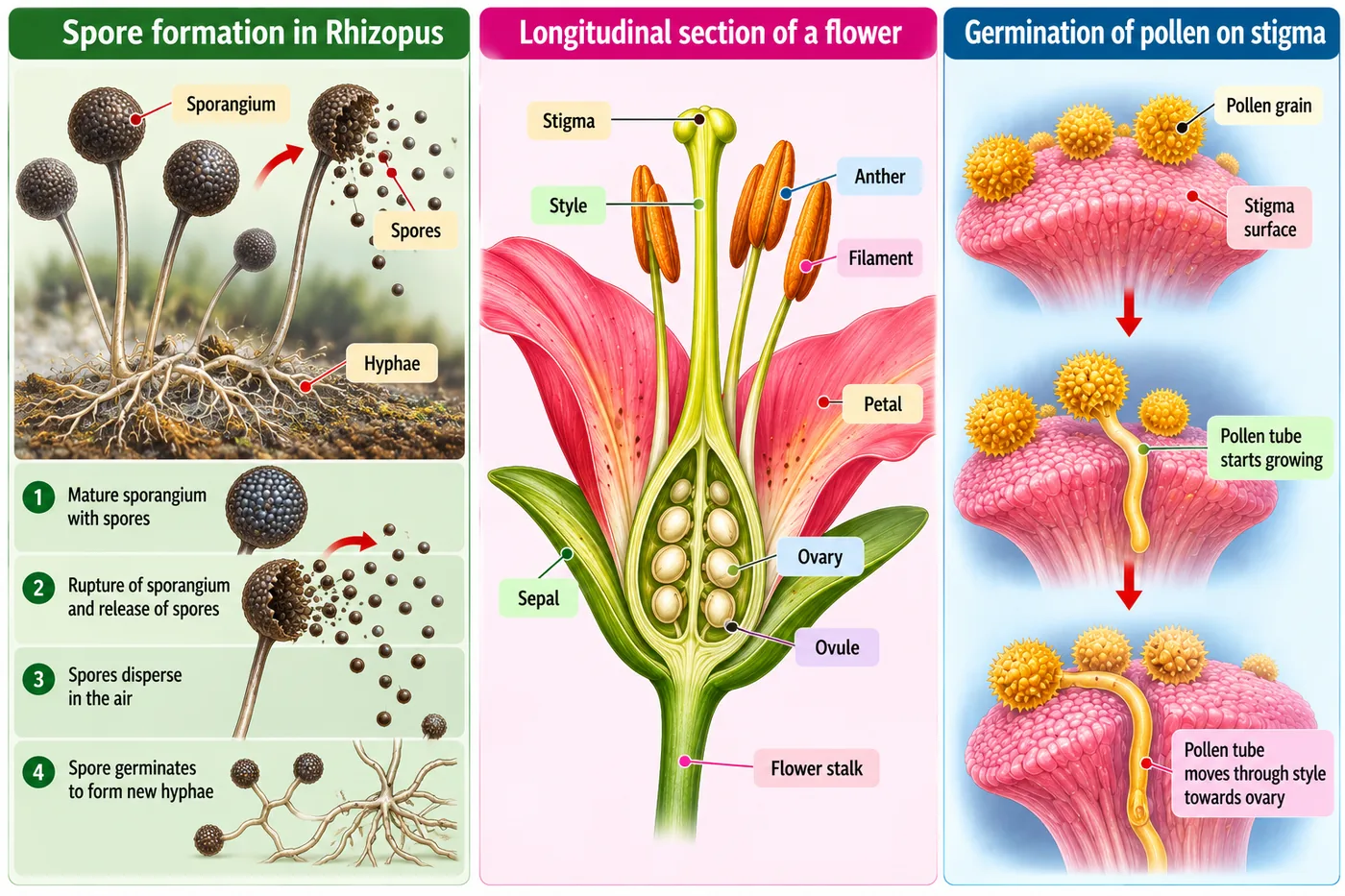
- Spore formation: bread mould Rhizopus grows thread-like hyphae and blob-like sporangia containing spores, which have thick walls that protect them until they reach moist surfaces.
4. Sexual Reproduction
Two parents contribute specialised cells (gametes). Combining DNA from two individuals produces new combinations of variations. If each gamete had the same amount of DNA as body cells, DNA would double in every generation. To prevent this, gamete-forming cells undergo a special division that halves the chromosome number; fusion of male and female gametes restores the normal number in the zygote. Gametes are specialised: the female gamete is large and has food stores, while the male gamete is smaller and motile.
5. Sexual Reproduction in Flowering Plants
The reproductive parts are in the flower. Stamens (male: anther + filament) make pollen grains. The pistil/carpel (female) has a sticky stigma, a long style, and a swollen ovary containing ovules, each with an egg cell. A flower with only stamens or only a pistil is unisexual (papaya, watermelon); one with both is bisexual (hibiscus, mustard).
- Pollination: transfer of pollen from anther to stigma — within the same flower (self-pollination) or to another flower (cross-pollination, by wind, water or animals).
- A pollen tube grows out of the pollen grain, through the style, to the ovule.
- Fertilisation: the male germ cell fuses with the female gamete in the ovule to form a zygote.
- The zygote divides to form an embryo; the ovule develops a tough coat and becomes a seed; the ovary grows and ripens into a fruit. Petals, sepals, stamens, style and stigma may shrivel and fall off.
- The seed contains the future plant (embryo) which germinates under suitable conditions.
6. Reproduction in Human Beings
Changes during adolescence that mark sexual maturation are called puberty: in both sexes, growth of hair in armpits and genital area, oily skin and pimples; in boys, facial hair, cracking voice; in girls, breast development and the start of menstruation. Sexual maturity takes time because the body must grow first.
Male reproductive system
The testes make sperms and the hormone testosterone. They lie outside the abdominal cavity in the scrotum because sperm formation needs a temperature lower than normal body temperature. Sperms travel through the vas deferens, which joins a tube from the bladder; the urethra is a common passage for sperms and urine. The seminal vesicles and prostate gland add secretions that make transport easier and nourish the sperms. A sperm has a long tail to swim towards the egg.
Female reproductive system
The two ovaries contain thousands of immature eggs from birth; at puberty, one egg is released each month from one ovary. It travels through the thin oviduct (fallopian tube), where fertilisation may occur. The two oviducts open into the elastic, bag-like uterus, which opens into the vagina through the cervix. The fertilised egg (zygote) implants in the thick uterine lining. The embryo gets nutrition from the mother's blood through the placenta, a disc with villi that provide a large surface for exchange of glucose, oxygen and wastes. Development takes about nine months.
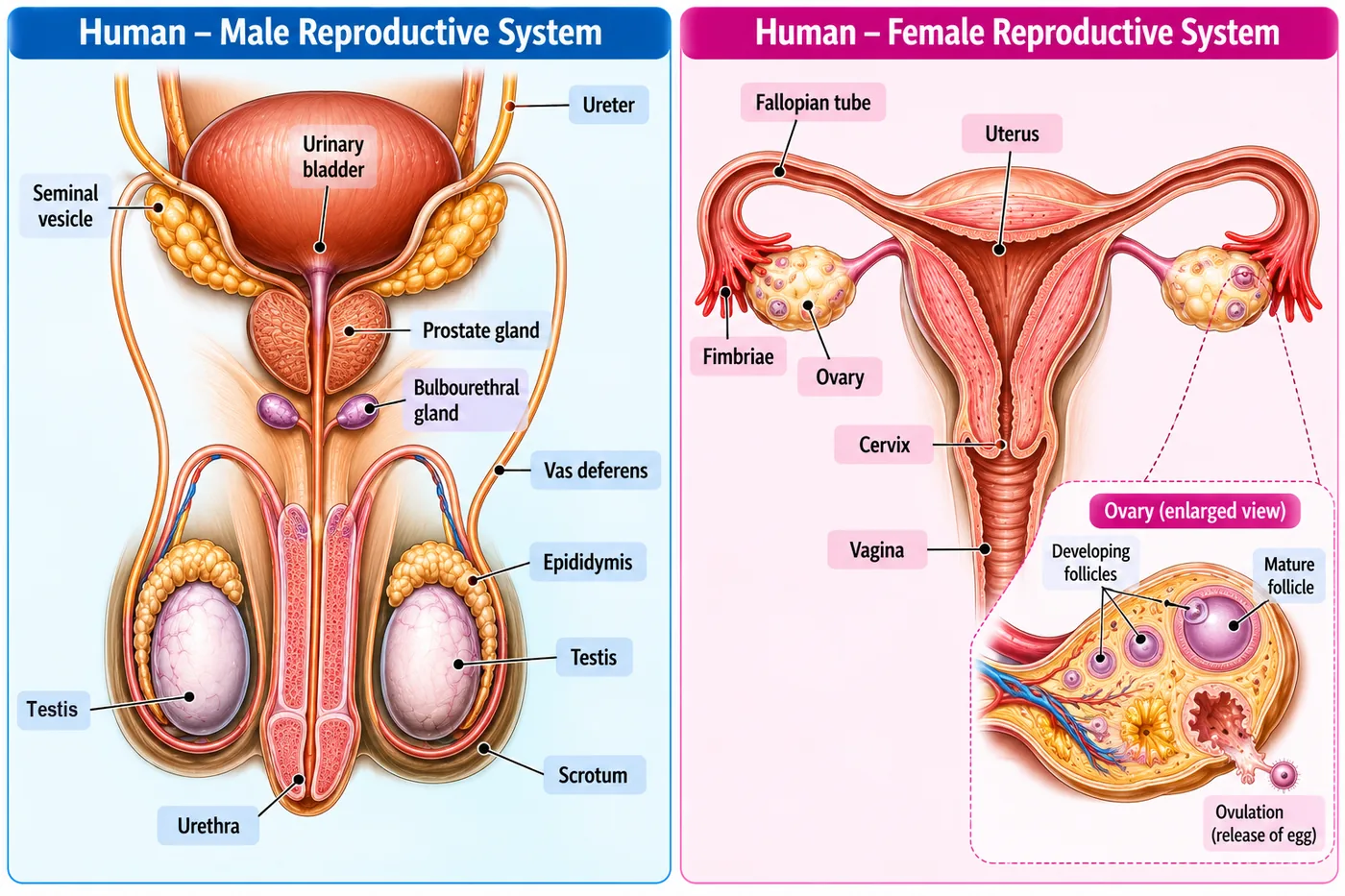
Menstruation: every month the uterus prepares a thick, blood-rich lining to receive a zygote. If the egg is not fertilised, the lining breaks down and comes out as blood and mucus through the vagina. This cycle takes roughly one month and lasts about two to eight days.
7. Reproductive Health
- Sexually transmitted diseases (STDs): bacterial — gonorrhoea, syphilis; viral — warts, HIV-AIDS. Using a condom helps prevent their spread.
- Contraception (preventing pregnancy): mechanical barriers (condoms); oral pills that change hormonal balance; devices such as the loop or copper-T placed in the uterus; surgical methods — vasectomy (vas deferens blocked) and tubectomy (fallopian tube blocked).
- Female foeticide — sex-selective abortion — is illegal in India and is reducing the female–male sex ratio sharply in some areas. Prenatal sex determination is prohibited by law. A healthy society needs a healthy sex ratio.
8. Master Table: Key Terms
| Term | Meaning |
|---|---|
| Binary / multiple fission | Division into two / many daughter cells |
| Regeneration | Whole organism from body pieces (Planaria) |
| Vegetative propagation | New plants from root, stem or leaf |
| Pollination | Transfer of pollen from anther to stigma |
| Fertilisation | Fusion of male and female gametes → zygote |
| Puberty | Period of sexual maturation in adolescence |
| Placenta | Tissue connecting embryo to the mother's blood supply |
| Contraception | Methods to prevent pregnancy |
9. Master Summary Table
| Mode | Example | Key feature |
|---|---|---|
| Binary fission | Amoeba, Leishmania | Two equal daughters |
| Multiple fission | Plasmodium | Many daughters at once |
| Fragmentation | Spirogyra | Breaks into pieces |
| Regeneration | Planaria, Hydra | Specialised cells rebuild the body |
| Budding | Hydra, yeast | Outgrowth detaches |
| Vegetative propagation | Bryophyllum, rose, banana | From vegetative parts |
| Spore formation | Rhizopus | Sporangia release spores |
Chart — number of daughter cells formed in one division (illustrative comparison):
10. Mind Map
- Variation
- Stability of body design
- Fission, budding, fragmentation
- Regeneration, spores, vegetative
- Pollination, pollen tube
- Seed, fruit
- Puberty, testes, ovaries
- Placenta, menstruation
- STDs, contraception
- Sex ratio
11. Tips and Tricks
- Plasmodium = Plenty (multiple fission); Leishmania = Line of division fixed.
- After fertilisation: Ovule → Seed, Ovary → Fruit (“OS-OF”).
- Vasectomy = male (vas deferens); tubectomy = female (tube).
- Writing that the ovule becomes the fruit — the ovary does.
- Saying regeneration is the same as reproduction in all animals — it is limited to a few simple animals.
- Thinking testes are outside the body for protection — it is for a lower temperature.
12. Important One-liners
- DNA copying always produces some variation.
- Plasmodium reproduces by multiple fission.
- Spirogyra reproduces by fragmentation.
- Planaria shows regeneration.
- Bryophyllum produces buds on leaf margins.
- Rhizopus forms spores in sporangia.
- The ovary develops into fruit after fertilisation.
- Sperms need a lower temperature, so testes lie in the scrotum.
- Fertilisation in humans occurs in the oviduct.
- The placenta supplies nutrition to the embryo.
13. Exam-pattern Questions with Detailed Answers
Asexual reproduction by budding takes place in:
- Amoeba
- Yeast
- Plasmodium
- Leishmania
Show answer
Yeast (and Hydra) reproduce by budding; the others reproduce by fission.
Answer: (B)
Name the parts of the pistil.
Show answer
Stigma, style and ovary.
Answer: Stigma, style, ovary
What is the function of the placenta?
Show answer
It provides a large surface for glucose and oxygen to pass from mother's blood to the embryo and for wastes to pass from the embryo to the mother's blood.
Answer: Exchange of nutrients and wastes between mother and embryo
Assertion (A): Gametes have half the number of chromosomes of body cells. Reason (R): This keeps the chromosome number constant from generation to generation after fertilisation.
- Both true; R explains A
- Both true; R does not explain A
- A true, R false
- A false, R true
Show answer
Two half-sets combine in the zygote to give the full normal number.
Answer: (A)
Why is variation useful for the survival of a species but not necessarily for the individual?
Show answer
If the environment changes drastically (e.g. temperature rises), most individuals may die, but a few with a suitable variation survive and reproduce, so the species continues. For a single individual, a variation may be harmful or neutral.
Answer: Some variants survive environmental change
Give two advantages of vegetative propagation.
Show answer
Plants that do not produce viable seeds (banana, orange, rose, jasmine) can be grown; plants bear flowers and fruits earlier; all offspring are genetically similar to the parent, preserving desirable traits.
Answer: Seedless plants grown; earlier fruiting; parent-like traits
How does the uterus prepare for a zygote each month? What happens if fertilisation does not occur?
Show answer
The uterine lining becomes thick and spongy with a rich blood supply to nourish an embryo. If the egg is not fertilised, the lining breaks down and is shed as blood and mucus through the vagina — menstruation.
Answer: Thick blood-rich lining; shed as menstruation if no fertilisation
List the roles of the seminal vesicles and prostate gland.
Show answer
They add their secretions so that sperms are in a fluid; this makes their transport easier and also provides nutrition.
Answer: Fluid medium for transport and nutrition of sperms
Explain how Rhizopus spreads quickly on moist bread. Why are its spores well adapted for survival?
Show answer
Thread-like hyphae spread over bread; vertical hyphae end in sporangia containing many spores. When sporangia burst, spores are dispersed by air; on landing on a moist food surface, each germinates into new hyphae. Spores have thick walls that protect them from drying and other harsh conditions until they reach a suitable surface.
Answer: Large numbers of thick-walled spores dispersed by air
Case-based: A gardener wants many plants of a rose variety with a special colour. (a) Which method should he use? (b) Why not seeds? (c) Name two other plants grown this way.
Show answer
(a) Vegetative propagation — stem cuttings, layering or grafting. (b) Seeds come from sexual reproduction, which mixes DNA from two parents, so the special colour may not be retained; vegetative propagation gives offspring nearly identical to the parent. (c) Sugarcane, grapes, banana, jasmine.
Answer: Cuttings/grafting keep the parent's traits
Trace the path of a sperm from its formation to the site of fertilisation.
Show answer
Testis (formation) → vas deferens → urethra (with secretions of seminal vesicles and prostate) → vagina → cervix → uterus → oviduct (fallopian tube), where it may meet the egg.
Answer: Testis → vas deferens → urethra → vagina → uterus → oviduct
What are the different methods of contraception? Which also prevents STDs? Why is prenatal sex determination banned?
Show answer
Barrier methods (condoms), hormonal oral pills, intrauterine devices (loop, copper-T) and surgical methods (vasectomy, tubectomy). Condoms also reduce transmission of STDs. Prenatal sex determination is banned to stop female foeticide, which is lowering the female–male sex ratio.
Answer: Condoms protect against STDs; ban protects the sex ratio
14. Quick Revision Summary
- Reproduction copies DNA; variations aid species survival.
- Asexual: fission, fragmentation, regeneration, budding, vegetative propagation, spores.
- Gametes have half the chromosomes; fusion restores the number.
- Flower: stamen + pistil; pollination → pollen tube → fertilisation → seed and fruit.
- Human: testes in scrotum, sperms via vas deferens; egg in oviduct, embryo in uterus, placenta.
- Reproductive health: condoms, pills, copper-T, surgery; STDs; no sex-selective abortion.