
1. Chapter at a Glance
Electricity runs our homes, schools, hospitals and industries. What makes charges flow in a wire? How much current flows, and what controls it? This chapter introduces electric current, potential difference, Ohm's law, resistance and the factors it depends on, combinations of resistors in series and parallel, the heating effect of current and electric power. It is one of the most numerical chapters of Class 10 — practise the formulas well.
- Charge, current (I = Q/t) and potential difference (V = W/Q).
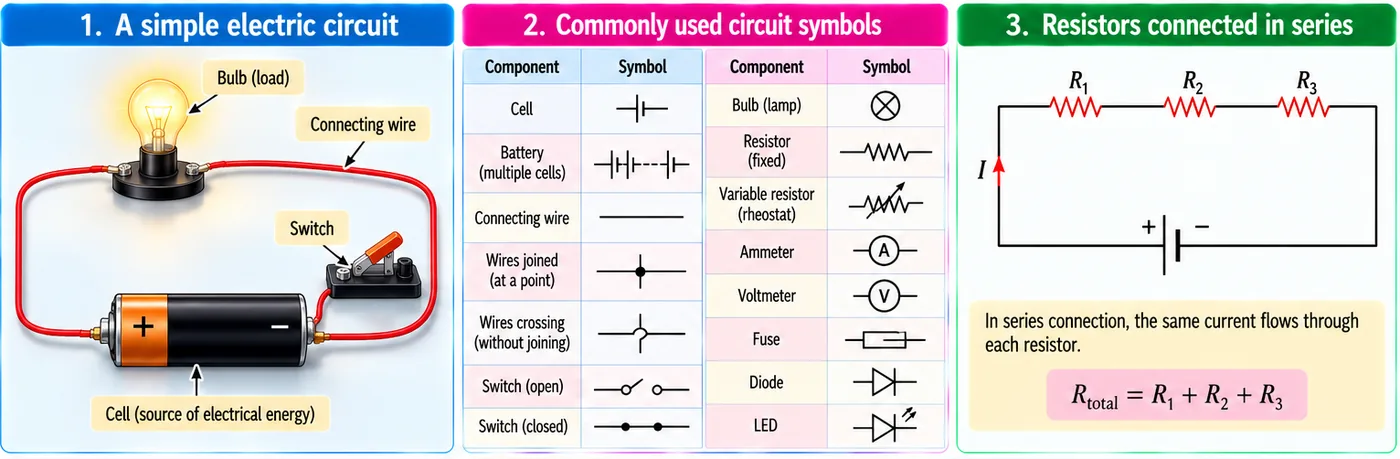
- Circuit diagrams and symbols; ammeter and voltmeter.
- Ohm's law; resistance and resistivity (R = ρl/A).
- Series and parallel combinations of resistors.
- Joule's law of heating (H = I²Rt), electric power and energy (kWh).
2. Electric Current and Circuit
Electric current is the rate of flow of electric charge: I = Q/t. Its SI unit is the ampere (A); 1 A = 1 C/s. Small currents are measured in mA (10−3 A) and μA (10−6 A). The charge of an electron is 1.6 × 10⁻¹⁹ C, so 1 C is the charge of about 6 × 10¹⁸ electrons. By convention, current flows opposite to the flow of electrons (from + to − outside the cell). A continuous, closed path for current is an electric circuit. Current is measured by an ammeter, always connected in series.
Potential difference
Charges flow only if there is a difference of electric pressure — potential difference — between two points, maintained by a cell or battery through chemical action. Potential difference is the work done to move a unit charge from one point to the other: V = W/Q. Its SI unit is the volt (V); 1 V = 1 J/C. It is measured by a voltmeter, always connected in parallel.
3. Ohm's Law and Resistance
Georg Simon Ohm found that the current through a metallic wire is directly proportional to the potential difference across its ends, provided its temperature remains the same: V ∝ I or V = IR. The constant R is the resistance of the conductor; its SI unit is the ohm (Ω); 1 Ω = 1 V/A. The V–I graph for a metallic conductor is a straight line through the origin. A rheostat (variable resistance) is used to regulate current. Good conductors have low resistance; insulators have very high resistance.
Factors affecting resistance
The resistance of a uniform conductor is directly proportional to its length and inversely proportional to its area of cross-section, and depends on the material: R = ρl/A. The constant ρ (rho) is the resistivity of the material; its SI unit is the ohm metre (Ω m). Resistivity does not depend on length or thickness, but changes with temperature.
- Metals and alloys have very low resistivity (10−8 to 10−6 Ω m) — good conductors. Insulators like rubber and glass have 1012 to 1017 Ω m.
- Copper and aluminium are used for transmission lines (low resistivity).
- Alloys (nichrome, manganin, constantan) have higher resistivity and do not oxidise (burn) readily at high temperature, so they are used in heaters, irons and toasters.
4. Resistors in Series and in Parallel
Series: resistors joined end to end. The same current flows through each; the total potential difference equals the sum of the potential differences across each: V = V1 + V2 + V3. Equivalent resistance: Rs = R1 + R2 + R3 — greater than the largest individual resistance.
Parallel: resistors connected between the same two points. The potential difference across each is the same; the total current equals the sum of the currents: I = I1 + I2 + I3. Equivalent resistance: 1/Rp = 1/R1 + 1/R2 + 1/R3 — smaller than the smallest individual resistance.
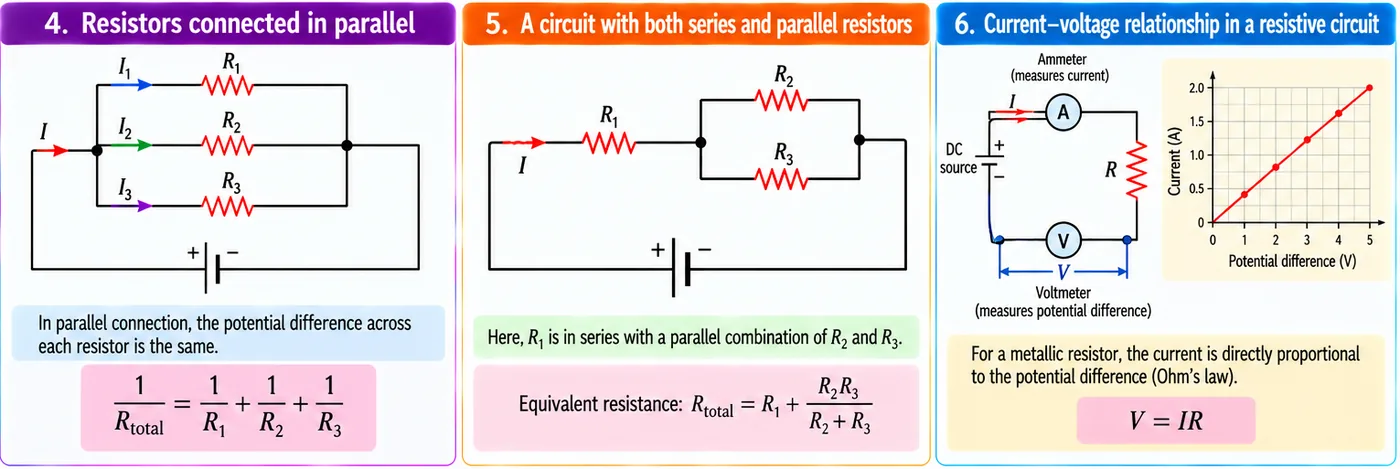
Why household appliances are connected in parallel: in series, if one appliance fails the whole circuit breaks; all appliances would also share the voltage and the total resistance would be large, so current would be small. In parallel, each appliance gets the full supply voltage, can be switched on or off independently, and draws the current it needs.
5. Heating Effect of Electric Current
If a current I flows through a resistor R for time t, the work done by the source is converted into heat: H = VIt = I2Rt — Joule's law of heating. Heat produced is directly proportional to the square of the current, to the resistance and to the time.
- Electric bulb: the filament (tungsten, melting point 3380 °C) gets so hot that it glows; bulbs are filled with inert nitrogen and argon to prolong filament life.
- Electric fuse: a wire of a metal or alloy of suitable (fairly low) melting point — e.g. aluminium, copper, iron or lead — connected in series with the device; if a large current flows, the wire melts and breaks the circuit, protecting appliances. Fuses for home use are rated 1 A, 2 A, 3 A, 5 A, 10 A and so on.
- Electric iron, toaster, oven, kettle and room heater work on this effect. The heating is unwanted in computers and motors.
6. Electric Power and Energy
Power is the rate of consumption of electrical energy: P = VI = I2R = V2/R. SI unit: watt (W); 1 W = 1 V × 1 A. Electrical energy consumed = power × time. The commercial unit is the kilowatt hour (kWh), commonly called a “unit”: 1 kWh = 1000 W × 3600 s = 3.6 × 10⁶ J.
Worked example: an electric iron of 1000 W is used for 2 hours daily for 30 days. Energy = 1 kW × 2 h × 30 = 60 kWh. At ₹5 per unit (illustrative rate), the cost would be ₹300.
7. Master Table: Formulas
| Quantity | Formula | SI unit |
|---|---|---|
| Current | I = Q/t | ampere (A) |
| Potential difference | V = W/Q | volt (V) |
| Ohm's law | V = IR | ohm (Ω) |
| Resistance | R = ρl/A | ρ in Ω m |
| Series | Rs = R1 + R2 + R3 | Ω |
| Parallel | 1/Rp = 1/R1 + 1/R2 + 1/R3 | Ω |
| Heat | H = I2Rt = VIt | joule (J) |
| Power | P = VI = I2R = V2/R | watt (W) |
| Energy | E = Pt; 1 kWh = 3.6 × 10⁶ J | J or kWh |
8. Master Summary Table
| Feature | Series | Parallel |
|---|---|---|
| Current | Same in all | Divides among branches |
| Potential difference | Divides | Same across all |
| Equivalent resistance | Larger than the largest | Smaller than the smallest |
| If one device fails | Whole circuit stops | Others keep working |
| Use | Fuse with appliance; decorative lights | House wiring |
Chart — electrical resistivity of some metals at 20 °C (× 10−8 Ω m, NCERT values):
9. Mind Map
- I = Q/t; V = W/Q
- Ammeter series, voltmeter parallel
- V = IR
- R = ρl/A
- Series: add R
- Parallel: add 1/R
- H = I²Rt
- Bulb, fuse, heater
- P = VI = I²R = V²/R
- 1 kWh = 3.6 MJ
10. Tips and Tricks
- Ohm's triangle: V on top, I × R below — cover the quantity you need.
- Two equal resistors R in parallel give R/2; n equal resistors give R/n.
- If a wire is stretched to double length, its area halves, so R becomes 4 times.
- For appliances on the same voltage, use P = V2/R: higher power means lower resistance.
- Connecting a voltmeter in series or an ammeter in parallel.
- Forgetting to take the reciprocal at the end of a parallel calculation.
- Using hours in J calculations or seconds in kWh calculations.
- Thinking resistivity changes with length.
11. Important One-liners
- 1 ampere = 1 coulomb per second.
- Charge on an electron is 1.6 × 10⁻¹⁹ C.
- 1 volt = 1 joule per coulomb.
- Ohm's law holds at constant temperature.
- Resistivity depends on material and temperature only.
- Alloys are used in heating elements.
- Domestic appliances are connected in parallel.
- Bulb filaments are made of tungsten.
- A fuse is connected in series.
- 1 kWh = 3.6 × 10⁶ J.
12. Exam-pattern Questions with Detailed Answers
A current of 0.5 A flows through a bulb for 10 minutes. The charge that flows is:
- 5 C
- 50 C
- 300 C
- 600 C
Show answer
Q = It = 0.5 × 600 = 300 C.
Answer: (C)
How much work is done in moving a charge of 2 C across two points having a potential difference of 12 V?
Show answer
W = VQ = 12 × 2 = 24 J.
Answer: 24 J
Why is tungsten used for bulb filaments?
Show answer
It has a very high melting point (3380 °C), so it can glow at high temperature without melting.
Answer: Very high melting point
Assertion (A): Alloys are used in electric heating devices. Reason (R): Alloys have high resistivity and do not oxidise readily at high temperatures.
- Both true; R explains A
- Both true; R does not explain A
- A true, R false
- A false, R true
Show answer
High resistivity gives more heat; resistance to oxidation gives long life.
Answer: (A)
Three resistors of 2 Ω, 3 Ω and 6 Ω are connected (a) in series (b) in parallel. Find the equivalent resistance in each case.
Show answer
(a) 2 + 3 + 6 = 11 Ω. (b) 1/R = 1/2 + 1/3 + 1/6 = (3 + 2 + 1)/6 = 1 → R = 1 Ω.
Answer: 11 Ω; 1 Ω
A wire of resistance 20 Ω is stretched to double its length. What is its new resistance?
Show answer
Volume stays constant: length doubles, area halves. R = ρl/A → new R = ρ(2l)/(A/2) = 4R = 80 Ω.
Answer: 80 Ω
An electric heater draws 4 A from a 220 V line. Find its power and the heat produced in 1 minute.
Show answer
P = VI = 220 × 4 = 880 W. H = Pt = 880 × 60 = 52 800 J.
Answer: 880 W; 5.28 × 10⁴ J
Two bulbs of 100 W and 60 W are rated for 220 V. Which has higher resistance?
Show answer
R = V2/P. 100 W: 48400/100 = 484 Ω; 60 W: 48400/60 ≈ 807 Ω. The 60 W bulb has higher resistance.
Answer: 60 W bulb (≈ 807 Ω)
In a circuit, R1 = 5 Ω is in series with a parallel combination of R2 = 10 Ω and R3 = 10 Ω, connected to a 20 V battery. Find (a) total resistance (b) total current (c) current through R2 (d) p.d. across R1.
Show answer
(a) Parallel part = 10 × 10/(10 + 10) = 5 Ω; total = 5 + 5 = 10 Ω. (b) I = 20/10 = 2 A. (c) Equal branches share equally: 1 A. (d) V1 = IR1 = 2 × 5 = 10 V.
Answer: 10 Ω; 2 A; 1 A; 10 V
Case-based: A house has 4 tube lights of 40 W each used 5 h daily, a 1 kW geyser used 1 h daily, and a 400 W refrigerator running 10 h daily. (a) Daily energy in kWh? (b) Energy in a 30-day month? (c) Why are these appliances connected in parallel?
Show answer
(a) Tube lights: 4 × 40 × 5 = 800 Wh = 0.8 kWh; geyser: 1 × 1 = 1 kWh; refrigerator: 0.4 × 10 = 4 kWh; total = 5.8 kWh. (b) 5.8 × 30 = 174 kWh (units). (c) Each gets the full 220 V, works independently, and a fault in one does not stop the others.
Answer: 5.8 kWh/day; 174 kWh/month
How many 176 Ω resistors (in parallel) are needed to carry 5 A on a 220 V line?
Show answer
Required R = V/I = 220/5 = 44 Ω. n equal resistors in parallel give R/n: 176/n = 44 → n = 4.
Answer: 4
The current through a resistor is doubled. By what factor does the heat produced in the same time change? An electric fuse rated 5 A is used with a 2 kW heater on 220 V. Will it work? Explain.
Show answer
H ∝ I2, so heat becomes 4 times. Heater current I = P/V = 2000/220 ≈ 9.1 A, which is more than 5 A, so the fuse will melt and break the circuit; a 10 A fuse is needed.
Answer: 4 times; no — current ≈ 9.1 A exceeds 5 A
13. Quick Revision Summary
- I = Q/t (ampere); V = W/Q (volt); ammeter in series, voltmeter in parallel.
- Ohm's law V = IR at constant temperature; R = ρl/A.
- Series: Rs = ΣR, same current; parallel: 1/Rp = Σ1/R, same voltage — used in houses.
- Joule heating H = I2Rt: bulbs, heaters, fuses.
- P = VI = I2R = V2/R; 1 kWh = 3.6 × 10⁶ J.