
1. Chapter at a Glance
The human eye is a natural optical instrument that uses a convex lens to form images on a light-sensitive screen. This chapter explains how the eye works, how it focuses on near and far objects (accommodation), what goes wrong in common defects of vision and how lenses correct them. It then applies refraction to natural phenomena: dispersion of white light by a prism, formation of the rainbow, atmospheric refraction (twinkling stars, early sunrise) and scattering of light (blue sky, red sunset).
- Structure and working of the eye; power of accommodation; near and far points.
- Myopia, hypermetropia and presbyopia; their correction; numericals.
- Refraction through a prism; dispersion; recombination; rainbow.
- Atmospheric refraction and scattering of light with everyday examples.
2. The Human Eye
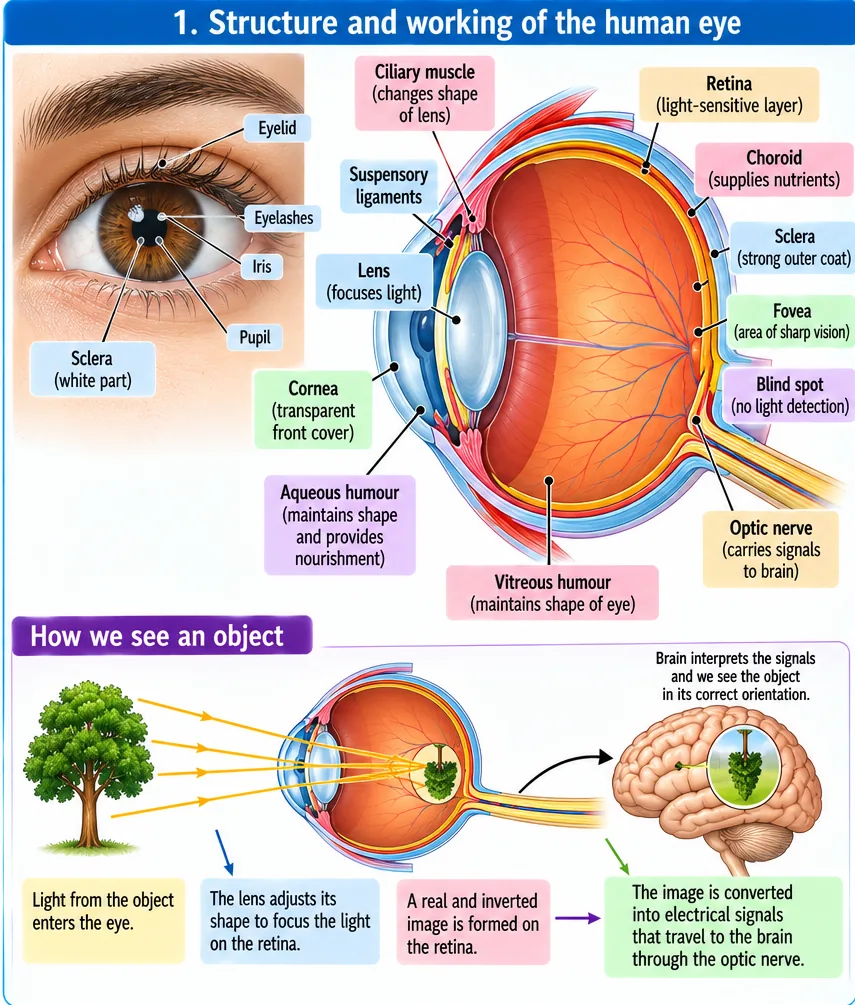
| Part | Function |
|---|---|
| Cornea | Thin transparent front bulge; most refraction of light happens here |
| Iris | Dark muscular diaphragm; controls the size of the pupil |
| Pupil | Opening that regulates the light entering; becomes small in bright light, large in dim light |
| Eye lens | Transparent, flexible convex lens; fine-adjusts focal length |
| Ciliary muscles | Change the curvature (and focal length) of the lens |
| Retina | Light-sensitive screen with rods and cones; forms a real, inverted image |
| Optic nerve | Carries electrical signals to the brain, which interprets them as upright images |
When we enter a dark room from bright light, we cannot see clearly for a while because the pupil takes time to widen.
Power of accommodation
The ability of the eye lens to adjust its focal length is its power of accommodation. For distant objects, the ciliary muscles relax, the lens becomes thin and its focal length increases. For nearby objects, the muscles contract, the lens becomes thicker and its focal length decreases. The focal length cannot be reduced below a limit, so we cannot see objects held very close clearly.
- Near point (least distance of distinct vision): about 25 cm for a normal young adult.
- Far point: infinity for a normal eye.
- A normal eye sees clearly between 25 cm and infinity.
In old age, the lens may become milky and cloudy — cataract — causing partial or complete loss of vision; it can be restored by surgery.
3. Defects of Vision and Their Correction
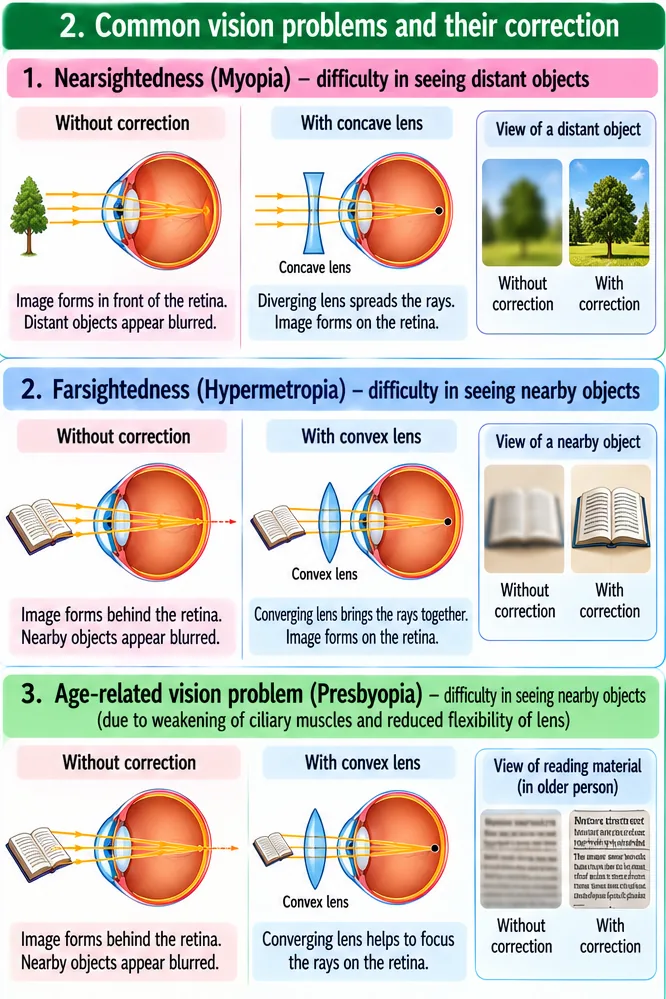
| Defect | Problem | Causes | Correction |
|---|---|---|---|
| Myopia (near-sightedness) | Cannot see distant objects; far point is nearer than infinity; image forms in front of retina | Excessive curvature of the lens; elongated eyeball | Concave lens of suitable power |
| Hypermetropia (far-sightedness) | Cannot see nearby objects; near point is farther than 25 cm; image forms behind retina | Focal length of lens too long; eyeball too small | Convex lens of suitable power |
| Presbyopia | Difficulty in seeing nearby objects in old age | Weakening of ciliary muscles and reduced flexibility of the lens | Convex lens; bifocal lens if both near and far vision are affected (upper part concave, lower part convex) |
Today, refractive defects can also be corrected by contact lenses or surgery.
Worked example (myopia): far point of a person is 80 cm. A lens must form the image of a distant object (u = −∞) at the far point (v = −80 cm). 1/f = 1/v − 1/u = −1/80 → f = −80 cm = −0.8 m. P = 1/f = −1.25 D (concave).
Worked example (hypermetropia): near point is 1 m. To read at 25 cm, the lens must form the image of an object at u = −25 cm at v = −100 cm. 1/f = 1/v − 1/u = −1/100 + 1/25 = 3/100 → f = 33.3 cm. P = +3 D (convex).
4. Refraction through a Prism and Dispersion
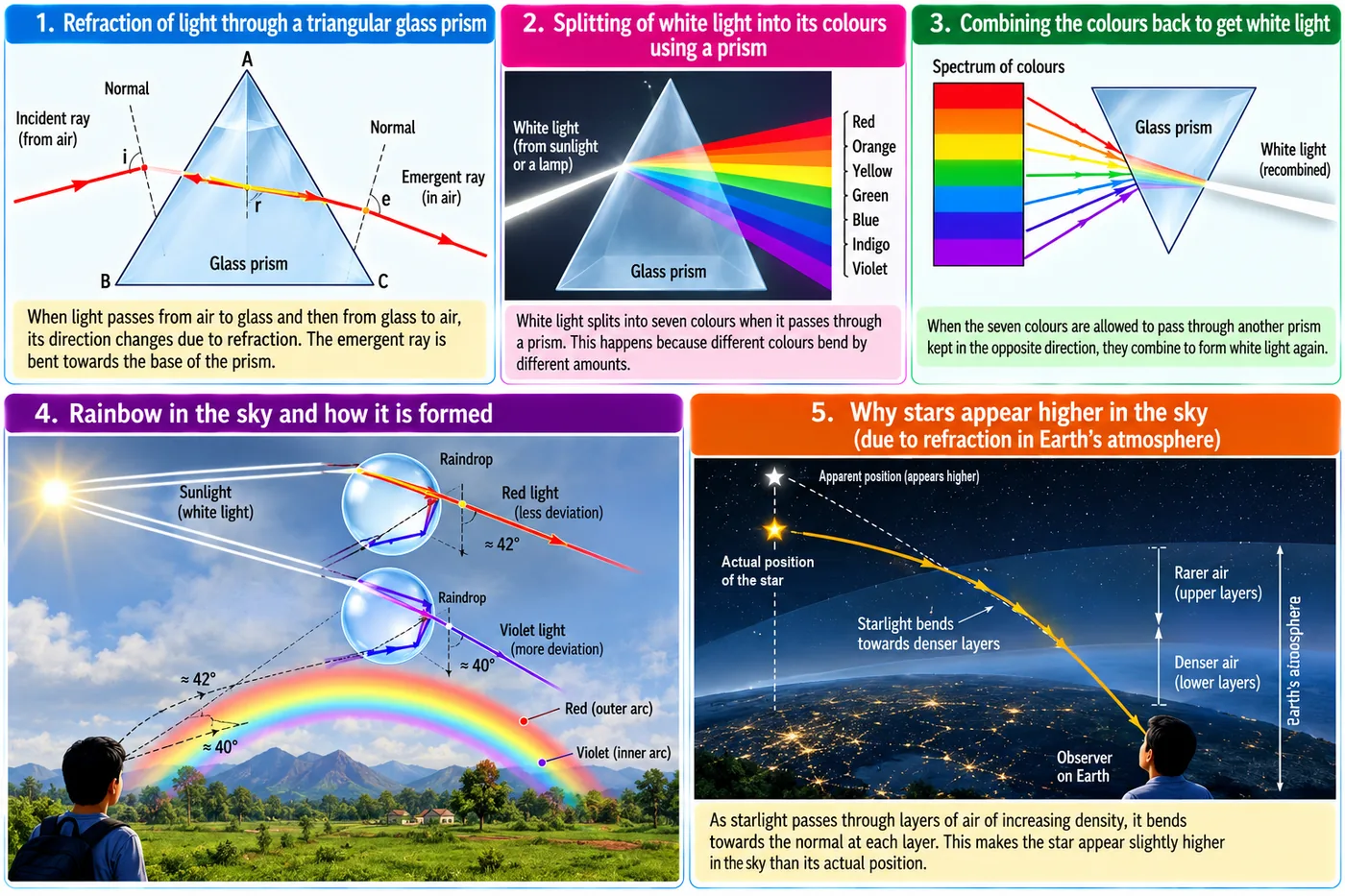
A glass prism has two triangular bases and three rectangular faces; the angle between two refracting faces is the angle of prism. Light bends towards the base on entering and again on leaving. The angle between the incident ray and the emergent ray is the angle of deviation.
When white light passes through a prism, it splits into seven colours — VIBGYOR (violet, indigo, blue, green, yellow, orange, red). This splitting is dispersion, and the band of colours is the spectrum. Different colours bend by different amounts: red bends the least, violet the most. Isaac Newton showed that a second, inverted prism recombines the colours into white light, proving that sunlight is made of seven colours.
Rainbow
A rainbow is a natural spectrum seen after rain. Water droplets act like tiny prisms: sunlight is refracted and dispersed on entering, internally reflected inside, and refracted again on leaving. A rainbow is always seen in the direction opposite to the Sun — with the Sun behind the observer.
5. Atmospheric Refraction
Air layers at different temperatures and densities have slightly different refractive indices. Hot air just above a fire is less dense, so objects seen through it appear to flicker.
- Twinkling of stars: starlight bends continuously on entering the atmosphere of changing density. Stars are point sources, so the slightly changing path makes their brightness and position flicker. Planets do not twinkle — they are much closer and act as extended sources (many point sources whose flickering averages out).
- Stars appear higher than their actual position, because light bends towards the normal as it moves into denser lower air.
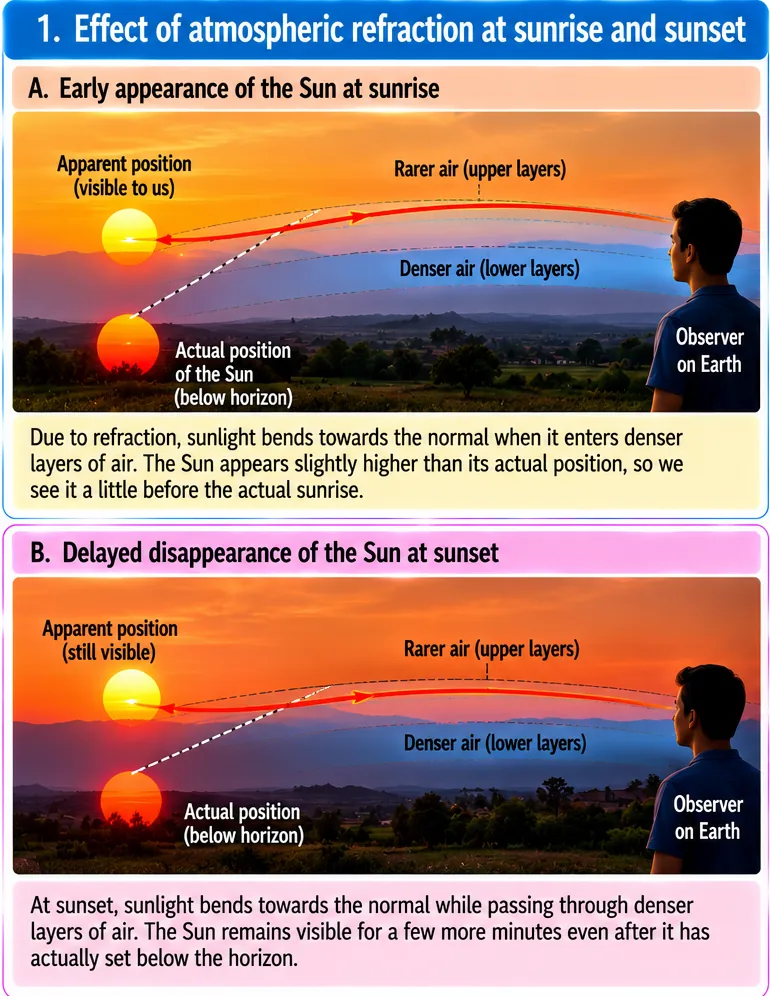
- Advance sunrise and delayed sunset: we see the Sun about 2 minutes before it actually rises above the horizon and about 2 minutes after it actually sets, so the day is about 4 minutes longer. The Sun also looks slightly flattened at sunrise and sunset.
6. Scattering of Light
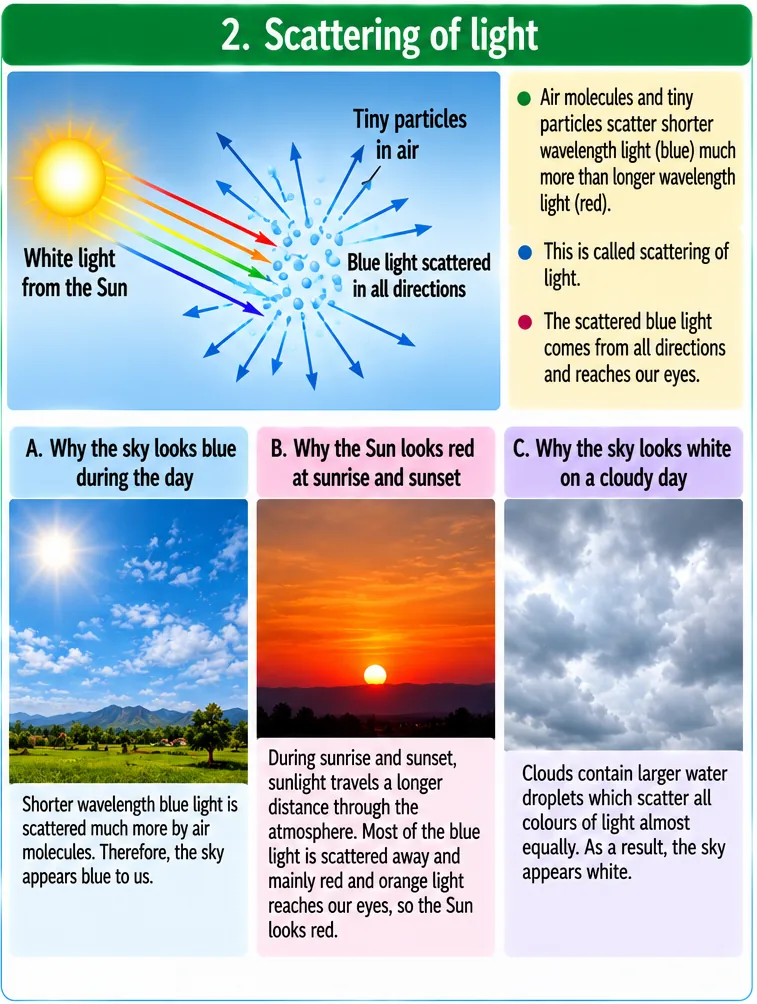
When a beam of light passes through a colloid or air with fine particles, its path becomes visible because the particles scatter light — the Tyndall effect (e.g. sunbeams through a dense forest canopy, a beam entering a smoky room).
- The colour of scattered light depends on particle size: very fine particles scatter mainly blue (shorter wavelength); larger particles scatter longer wavelengths; very large particles make light appear white (clouds).
- Why the sky is blue: air molecules are smaller than the wavelength of visible light, so they scatter blue light much more than red. To astronauts in space (no atmosphere), the sky looks dark.
- Why danger signals are red: red light is scattered the least by fog and smoke, so it can be seen from a distance.
- Why the Sun looks reddish at sunrise and sunset: sunlight travels a longer path through the atmosphere near the horizon, so most blue light is scattered away; the remaining light reaching us is mainly red and orange. At noon the path is short, and the Sun looks white.
7. Master Table: Key Facts
| Quantity / term | Value / meaning |
|---|---|
| Near point (normal eye) | 25 cm |
| Far point (normal eye) | Infinity |
| Myopia correction | Concave lens, f = −(far point) |
| Hypermetropia correction | Convex lens; image of object at 25 cm formed at defective near point |
| Lens formula | 1/v − 1/u = 1/f; P = 1/f (m) |
| Spectrum | VIBGYOR; red least, violet most deviation |
| Sunrise advance | About 2 min early, 2 min late sunset |
8. Master Summary Table
| Phenomenon | Cause |
|---|---|
| Rainbow | Dispersion + refraction + internal reflection in raindrops |
| Twinkling of stars | Atmospheric refraction of point-source light |
| Early sunrise, late sunset | Atmospheric refraction |
| Blue sky | Scattering of blue light by air molecules |
| Red Sun at sunrise/sunset | Blue scattered away over a long path |
| White clouds | Large droplets scatter all colours nearly equally |
Chart — approximate wavelength of colours of light (nm):
9. Mind Map
- Cornea, iris, lens, retina
- Accommodation; 25 cm to ∞
- Myopia — concave
- Hypermetropia, presbyopia — convex/bifocal
- Deviation, dispersion
- Rainbow
- Twinkling, early sunrise
- Blue sky, red sunset
10. Tips and Tricks
- Myopia → Minus lens (concave). Hypermetropia → convex (“Help to read”).
- Spectrum from top: “ROY G BIV” — red at top (least bent).
- Shorter wavelength → more scattering → blue sky.
- Rainbow: Sun at your back.
- Saying the eye lens does most of the refraction — the cornea does.
- Saying planets twinkle.
- Mixing up the causes: rainbow is dispersion; blue sky is scattering.
- Forgetting to convert focal length to metres in power questions.
11. Important One-liners
- The image on the retina is real and inverted.
- The iris controls the size of the pupil.
- Near point of a normal eye is 25 cm.
- Cataract is clouding of the eye lens.
- Myopia is corrected by a concave lens.
- Bifocal lenses correct presbyopia with both defects.
- Violet light deviates the most in a prism.
- A rainbow is formed opposite to the Sun.
- Stars twinkle due to atmospheric refraction.
- Danger signals are red because red scatters least.
12. Exam-pattern Questions with Detailed Answers
The change in focal length of the eye lens is caused by the action of the:
- Pupil
- Retina
- Ciliary muscles
- Iris
Show answer
Ciliary muscles change the curvature of the lens.
Answer: (C)
Why does the sky appear dark to an astronaut in space?
Show answer
There is no atmosphere in space to scatter sunlight, so no scattered light reaches the eye.
Answer: No scattering without atmosphere
What is the near point and far point of a normal human eye?
Show answer
Near point: 25 cm; far point: infinity.
Answer: 25 cm and infinity
Assertion (A): The Sun appears reddish at sunrise. Reason (R): Light from the Sun travels a longer distance through the atmosphere at sunrise, and blue light is scattered away.
- Both true; R explains A
- Both true; R does not explain A
- A true, R false
- A false, R true
Show answer
Shorter wavelengths are removed over the long path; red and orange reach us.
Answer: (A)
Why do stars twinkle but planets do not?
Show answer
Stars are very far and act as point sources; small changes in the path of their light due to changing atmospheric refraction make their brightness flicker. Planets are closer and appear as extended sources — a collection of many point sources whose variations average out to zero.
Answer: Point source vs extended source
A student cannot see the blackboard clearly from the last row. Name the defect, two causes and the correction.
Show answer
Myopia. Causes: excessive curvature of the eye lens; elongation of the eyeball. Correction: concave lens of suitable power.
Answer: Myopia; concave lens
Why does a prism split white light while a glass slab does not?
Show answer
In a prism the two refracting faces are inclined, so the colours deviated by different amounts at the first face are deviated further at the second face and spread out. In a slab the faces are parallel; the colours separated at the first face are brought back parallel at the second face and overlap, so white light emerges.
Answer: Inclined faces add deviations; parallel faces cancel them
Why are danger signals red?
Show answer
Red has the longest wavelength in the visible spectrum and is scattered the least by fog and smoke, so it travels farthest and is seen clearly from a distance.
Answer: Red is least scattered
A myopic person has a far point of 1.2 m. Find the nature, focal length and power of the corrective lens.
Show answer
u = −∞, v = −1.2 m. 1/f = 1/v − 1/u = −1/1.2 → f = −1.2 m. P = 1/f ≈ −0.83 D. Concave lens.
Answer: Concave lens, f = −1.2 m, P ≈ −0.83 D
The near point of a hypermetropic eye is 1 m. What is the power of the lens needed to read at 25 cm?
Show answer
u = −25 cm, v = −100 cm. 1/f = 1/v − 1/u = −1/100 + 1/25 = 3/100 → f = 100/3 cm ≈ 0.33 m. P = +3 D (convex).
Answer: +3 D, convex lens
Case-based: After a rain shower in the evening, a boy sees a rainbow. (a) In which direction is the Sun? (b) Which colour is on the outer edge? (c) Name the three processes in the raindrop. (d) Why can't a rainbow be seen at noon in the tropics usually?
Show answer
(a) Behind him (west in the evening; rainbow in the east). (b) Red. (c) Refraction with dispersion, internal reflection, refraction. (d) The rainbow appears at about 40–42° from the anti-solar point; when the Sun is very high, this arc lies below the horizon.
Answer: Sun behind; red outside; refraction–reflection–refraction
Explain why the Sun is visible about two minutes before actual sunrise. What would happen if Earth had no atmosphere?
Show answer
Near the horizon, sunlight passes from rarer to denser layers of air and bends towards the normal, so the Sun appears higher than its actual position; we see it before it actually crosses the horizon (and after it sets). Without an atmosphere there would be no refraction or scattering: the Sun would be seen only when it actually rises, the sky would look dark, and days would be slightly shorter.
Answer: Atmospheric refraction lifts the Sun's image; no atmosphere → no early sunrise, dark sky
13. Quick Revision Summary
- Eye: cornea refracts most; ciliary muscles change lens focal length (accommodation); near point 25 cm, far point ∞.
- Myopia — concave lens; hypermetropia — convex lens; presbyopia — convex/bifocal; cataract — surgery.
- Prism disperses white light into VIBGYOR; red bends least; Newton recombined colours.
- Rainbow: refraction, dispersion, internal reflection; seen opposite the Sun.
- Atmospheric refraction: twinkling stars, early sunrise, late sunset.
- Scattering: Tyndall effect, blue sky, red sunrise/sunset, red danger signals, white clouds.