
1. Chapter at a Glance
Children resemble their parents, yet no two siblings (except identical twins) are exactly alike. Heredity is the passing of traits from parents to offspring; the rules that govern it are the rules of inheritance. Every round of reproduction adds a little variation; sexual reproduction mixes the variations of two parents and so produces much greater diversity. This chapter explains how Gregor Johann Mendel discovered the basic rules, how genes on chromosomes control traits, and how sex is determined in human beings.
- Accumulation of variation; inherited traits.
- Mendel's monohybrid and dihybrid crosses; dominant and recessive traits.
- Genotype and phenotype ratios; independent inheritance.
- How genes express traits through proteins; genes on chromosomes.
- Sex determination in humans and other animals.
2. Accumulation of Variation
In asexual reproduction, offspring differ from each other only slightly, due to small errors in DNA copying. In sexual reproduction, offspring receive DNA from two parents, so variation is much greater. Variations are inherited and pass to the next generation; in a population, some variations become common over many generations because they help survival (by natural selection), while others disappear.
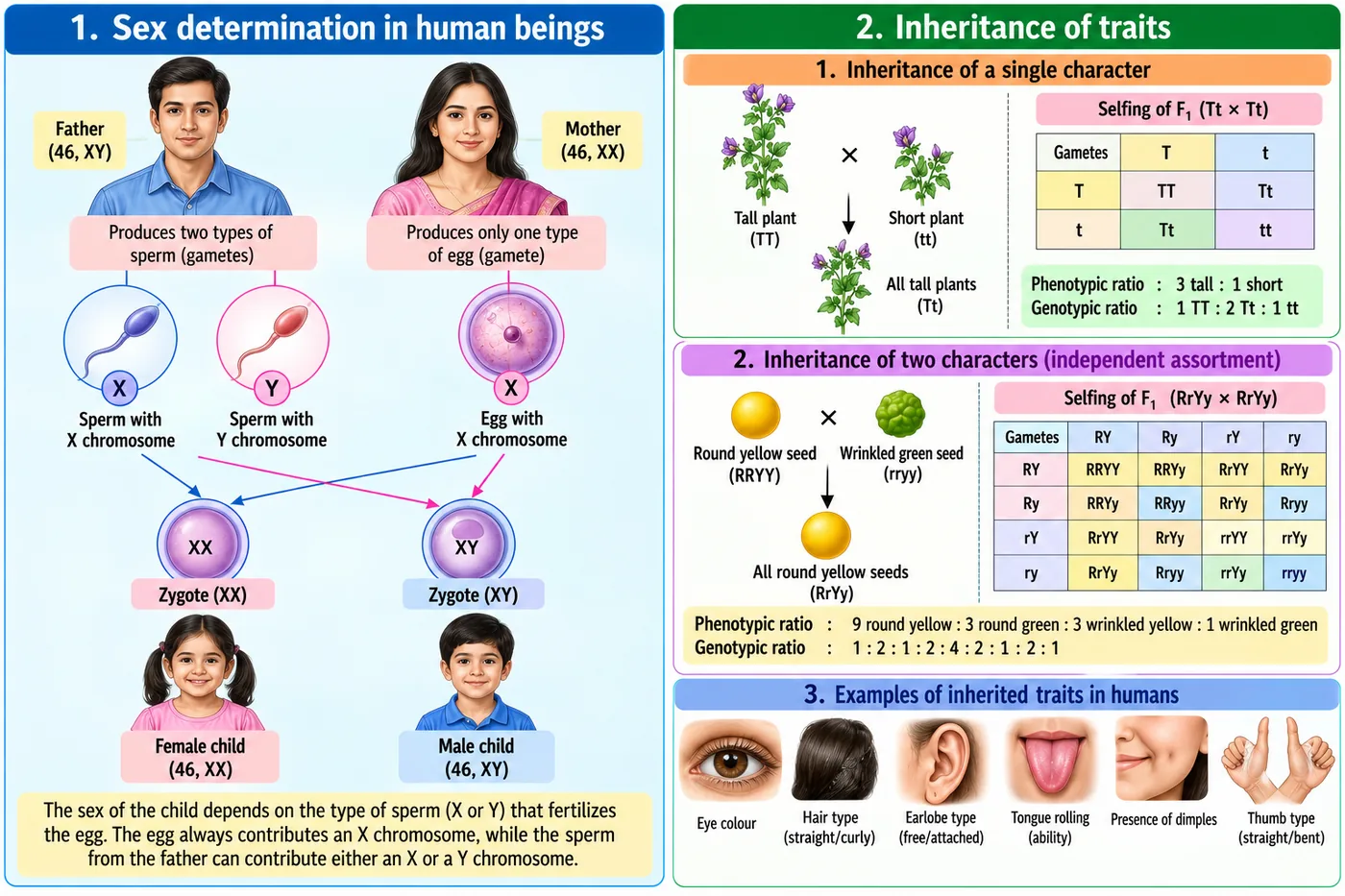
Inherited traits: basic body design is the same for a species (a human child has the basic features of a human), but details vary — e.g. free or attached earlobes, tongue rolling, dimples, eye colour, hair type.
3. Rules for the Inheritance of Traits — Mendel's Contributions
Both parents contribute practically equal amounts of genetic material to the child, so each trait is influenced by both paternal and maternal DNA: each child has two versions (copies) of the information for each trait. Mendel (1822–1884), working with garden peas (Pisum sativum), chose seven pairs of contrasting characters — tall/short plant, round/wrinkled seed, yellow/green seed, violet/white flower, and others. Peas were ideal: many visible contrasting traits, short life cycle, both self- and cross-pollination possible, and many seeds per generation.
Monohybrid cross (one character)
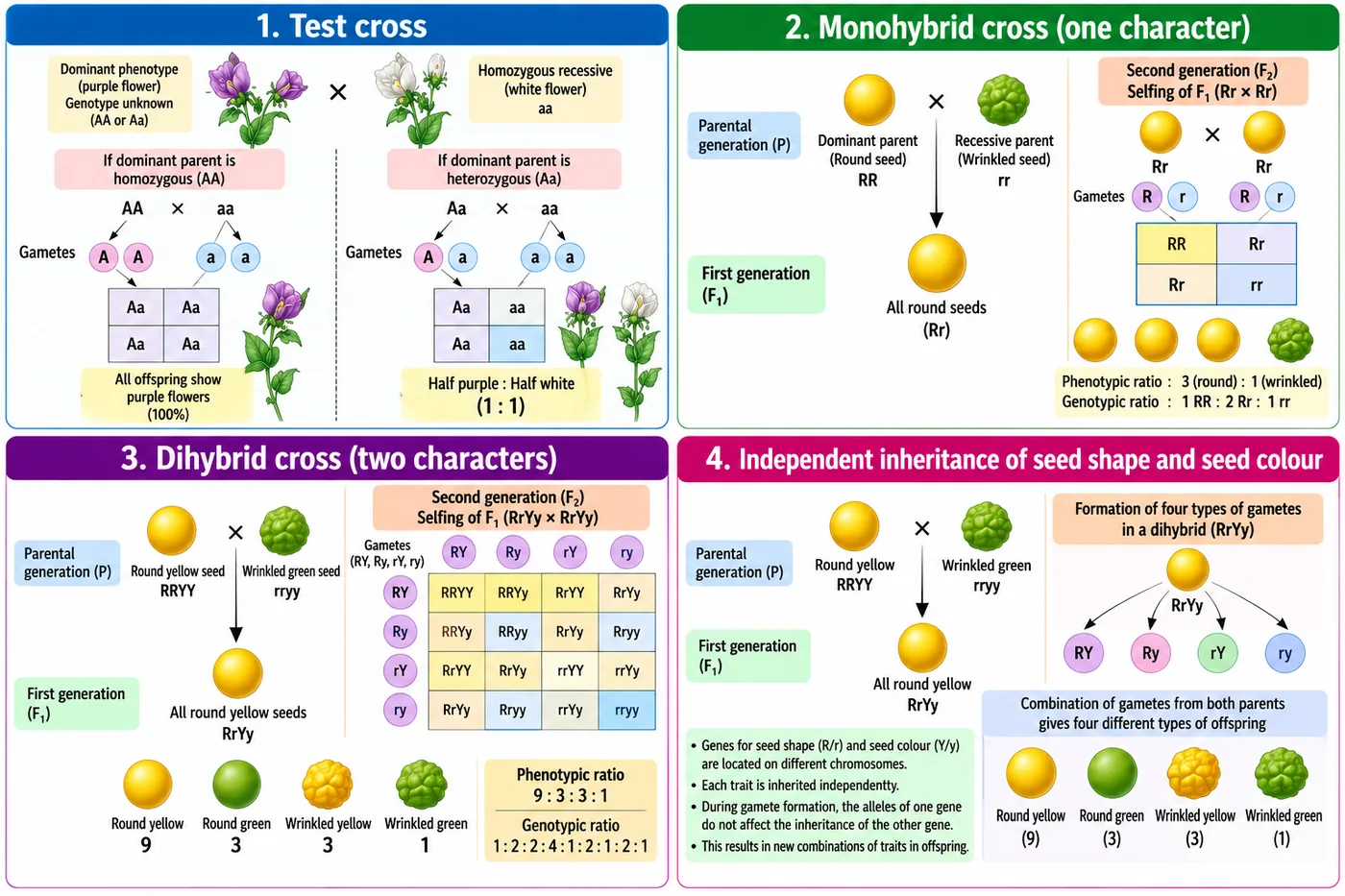
Mendel crossed a pure tall plant (TT) with a pure short plant (tt). All plants of the first generation (F1) were tall (Tt) — no medium-height plants. On self-pollinating F1, the second generation (F2) had tall and short plants in the ratio 3 : 1. The short trait had not been lost; it was hidden in F1.
- The trait seen in F1 is dominant (tallness, T); the hidden one is recessive (shortness, t).
- A plant is tall if it has even one T (TT or Tt); it is short only if it has tt.
- Phenotype = visible trait (tall/short); genotype = genetic make-up (TT, Tt, tt).
- F2 phenotypic ratio 3 tall : 1 short; genotypic ratio 1 TT : 2 Tt : 1 tt.
Dihybrid cross (two characters)
Mendel crossed plants with round yellow seeds (RRYY) with plants having wrinkled green seeds (rryy). All F1 seeds were round and yellow (RrYy) — round and yellow are dominant. In F2, four kinds of seeds appeared: round yellow 9 : round green 3 : wrinkled yellow 3 : wrinkled green 1. Two of these are new combinations (round green, wrinkled yellow). This shows that seed shape and seed colour are inherited independently — the F1 plant makes four kinds of gametes (RY, Ry, rY, ry) in equal numbers.
4. How Do Traits Get Expressed?
Cellular DNA is the information source for making proteins. A section of DNA that provides information for one protein is a gene. Consider plant height: plants have a hormone that triggers growth; its amount depends on the efficiency of an enzyme (a protein). If the gene for this enzyme works efficiently, more hormone is made and the plant is tall; if the gene has an alteration that makes the enzyme less efficient, less hormone is made and the plant is short. Thus genes control characteristics (traits).
How do two copies combine? Each gene set is present not as one long thread but as separate pieces called chromosomes. Each cell has two copies of each chromosome, one from each parent. Each germ cell takes one chromosome from each pair, which may be of maternal or paternal origin. When two germ cells combine, the normal number of chromosomes is restored, and this explains independent inheritance as well as the stability of species' DNA.
5. Sex Determination
Different species use different strategies. In some reptiles, the temperature at which fertilised eggs are kept decides the sex of the offspring. In some animals like snails, individuals can change sex. In human beings, sex is determined genetically.
- Humans have 23 pairs of chromosomes; 22 pairs are autosomes; one pair is the sex chromosomes.
- Women have a perfect pair, XX; men have a mismatched pair, XY (the Y is shorter).
- All eggs carry an X chromosome. Half the sperms carry X and half carry Y.
- Sperm with X + egg → XX (girl); sperm with Y + egg → XY (boy).
So the sex of the child depends on which sperm fertilises the egg — it is inherited from the father, and the mother cannot be held responsible for the sex of the child. The chance of a boy or a girl is equal (50 : 50) in each pregnancy.
6. Master Table: Key Terms
| Term | Meaning |
|---|---|
| Gene | Section of DNA coding for one protein; unit of inheritance |
| Dominant / recessive | Trait expressed in F1 / trait hidden in F1 |
| Genotype / phenotype | Genetic make-up (Tt) / visible trait (tall) |
| Monohybrid ratio | F2 phenotype 3 : 1; genotype 1 : 2 : 1 |
| Dihybrid ratio | F2 phenotype 9 : 3 : 3 : 1 |
| Autosomes / sex chromosomes | 22 pairs / 1 pair (XX or XY) in humans |
7. Master Summary Table
| Cross | F1 | F2 phenotypes | Conclusion |
|---|---|---|---|
| TT × tt | All tall (Tt) | 3 tall : 1 short | Dominance; recessive trait reappears |
| RRYY × rryy | All round yellow (RrYy) | 9 : 3 : 3 : 1 | Independent inheritance |
| XY × XX | — | 1 boy : 1 girl (on average) | Sex decided by sperm (X or Y) |
Chart — F2 of a dihybrid cross (out of 16 combinations):
8. Mind Map
- DNA copying errors
- Greater in sexual reproduction
- Pea, 7 contrasting traits
- 3 : 1 and 9 : 3 : 3 : 1
- DNA → protein → trait
- On chromosomes
- XX / XY
- Father's sperm decides
9. Tips and Tricks
- Capital letter = dominant (T), small letter = recessive (t).
- Monohybrid: “3-1 phenotype, 1-2-1 genotype”.
- Dihybrid: “9-3-3-1” — sum is always 16.
- A recessive trait shows only when both copies are recessive.
- Saying F1 plants were medium height — they were all tall.
- Blaming the mother for the sex of the child — the father's sperm decides.
- Confusing genotype ratio (1 : 2 : 1) with phenotype ratio (3 : 1).
10. Important One-liners
- Mendel is called the father of genetics.
- Mendel used the garden pea, Pisum sativum.
- In F1, only the dominant trait appears.
- F2 monohybrid phenotypic ratio is 3 : 1.
- F2 dihybrid phenotypic ratio is 9 : 3 : 3 : 1.
- A gene is a segment of DNA coding for a protein.
- Humans have 23 pairs of chromosomes.
- Men have XY; women have XX sex chromosomes.
- In some reptiles, temperature determines sex.
- Snails can change sex.
11. Exam-pattern Questions with Detailed Answers
A cross between a tall pea plant (TT) and a short pea plant (tt) gives F1 plants that are:
- All short
- All tall
- Half tall, half short
- All medium height
Show answer
F1 are all Tt; T is dominant, so all are tall.
Answer: (B)
Who determines the sex of a child in humans?
Show answer
The father, because his sperm may carry X or Y; the mother's egg always carries X.
Answer: The father's sperm
Define genotype and phenotype with an example.
Show answer
Genotype is the genetic make-up (e.g. Tt); phenotype is the observable trait (tall).
Answer: Tt (genotype) → tall (phenotype)
Assertion (A): A recessive trait may skip a generation. Reason (R): A recessive trait is expressed only when an individual has two copies of the recessive gene.
- Both true; R explains A
- Both true; R does not explain A
- A true, R false
- A false, R true
Show answer
In F1 (Tt) the recessive gene is hidden; it shows up again in F2 (tt).
Answer: (A)
A plant with violet flowers (VV) is crossed with one with white flowers (vv). What will be the flower colour in F1 and the ratio in F2?
Show answer
F1: all violet (Vv). F2 (Vv × Vv): VV, Vv, Vv, vv → 3 violet : 1 white.
Answer: All violet; 3 violet : 1 white
How do genes control the height of a plant?
Show answer
A gene codes for an enzyme needed to make a growth hormone. An efficient enzyme gives more hormone → tall plant; an altered, less efficient enzyme gives less hormone → short plant.
Answer: Gene → enzyme → amount of growth hormone → height
Why did Mendel choose the garden pea?
Show answer
Many easily seen contrasting traits; short life cycle; both self- and cross-pollination could be controlled; large number of seeds per generation for counting.
Answer: Contrasting traits, short cycle, controlled pollination, many seeds
What types of gametes does a plant with genotype RrYy produce? In what proportion?
Show answer
Each gamete gets one gene for shape and one for colour, independently: RY, Ry, rY, ry in equal proportions (1 : 1 : 1 : 1).
Answer: RY, Ry, rY, ry — equal numbers
In a dihybrid cross, out of 1600 F2 seeds, how many would be expected to be (a) round green (b) wrinkled green?
Show answer
Ratio 9 : 3 : 3 : 1, total 16 parts; each part = 1600 ÷ 16 = 100. (a) Round green = 3 × 100 = 300. (b) Wrinkled green = 1 × 100 = 100.
Answer: (a) 300 (b) 100
Case-based: A tall pea plant of unknown genotype is crossed with a short plant. Half the offspring are tall and half short. (a) What was the genotype of the tall parent? (b) Show the cross. (c) What would the result be if the tall parent were TT?
Show answer
(a) Tt. (b) Tt × tt → gametes T, t and t → Tt, tt → 1 tall : 1 short. (c) TT × tt → all Tt, all tall.
Answer: Tt; 1 : 1 ratio; TT would give all tall
How does Mendel's dihybrid experiment show that traits are inherited independently?
Show answer
F2 contained new combinations — round green and wrinkled yellow — not present in either parent. Shape and colour genes therefore separated and recombined independently during gamete formation, giving 9 : 3 : 3 : 1.
Answer: New combinations (round green, wrinkled yellow) appear
Explain with a flow chart why the probability of a male or female child is 50 : 50.
Show answer
Father (XY) → sperms: 50% X, 50% Y. Mother (XX) → eggs: 100% X. X sperm + X egg → XX (girl); Y sperm + X egg → XY (boy). Since X and Y sperms are equally likely to fertilise, each child has an equal chance of being a boy or a girl.
Answer: Equal numbers of X and Y sperms → 1 : 1
12. Quick Revision Summary
- Sexual reproduction creates more variation; variations are inherited.
- Each trait has two gene copies, one from each parent.
- Monohybrid: F1 all dominant; F2 3 : 1 (genotype 1 : 2 : 1).
- Dihybrid: F2 9 : 3 : 3 : 1 → independent inheritance.
- Genes code for proteins (enzymes) that control traits; genes lie on chromosomes.
- Humans: XX female, XY male; sperm decides the sex; some reptiles use temperature.