
1. Chapter at a Glance
We see objects because light from them enters our eyes. Light travels in straight lines (very small objects can bend it, but for everyday optics we use straight-line rays). When light falls on a polished surface it reflects; when it passes from one transparent medium into another it refracts (bends). This chapter studies images formed by spherical mirrors and spherical lenses using ray diagrams, the New Cartesian sign convention, the mirror and lens formulae, magnification, refractive index and the power of a lens — a numerical-heavy chapter for board exams.
- Laws of reflection; terms for spherical mirrors; f = R/2.
- Ray diagrams and image tables for concave and convex mirrors; uses.
- Sign convention, mirror formula and magnification.
- Refraction through a glass slab; laws of refraction; refractive index.
- Convex and concave lenses, lens formula, magnification and power.
2. Reflection of Light
Laws of reflection: (i) the angle of incidence equals the angle of reflection; (ii) the incident ray, the normal at the point of incidence and the reflected ray lie in the same plane. These laws apply to all reflecting surfaces, including curved ones. A plane mirror forms a virtual, erect image of the same size, as far behind the mirror as the object is in front, and laterally inverted.
Spherical mirrors — terms
- Concave mirror: reflecting surface curved inwards (faces the centre of the sphere). Convex mirror: reflecting surface curved outwards.
- Pole (P): centre of the reflecting surface. Centre of curvature (C): centre of the sphere of which the mirror is a part (in front for concave, behind for convex). Radius of curvature (R): distance PC.
- Principal axis: line through P and C. Principal focus (F): point where rays parallel to the axis meet after reflection (concave) or appear to diverge from (convex). Focal length f = PF.
- For mirrors of small aperture: R = 2f.
Rules for ray diagrams (any two are enough)
- A ray parallel to the principal axis passes through (or appears to come from) F after reflection.
- A ray through F (or directed towards F) becomes parallel to the axis.
- A ray through C (or directed towards C) retraces its path.
- A ray incident obliquely at P is reflected obliquely, making equal angles with the axis.
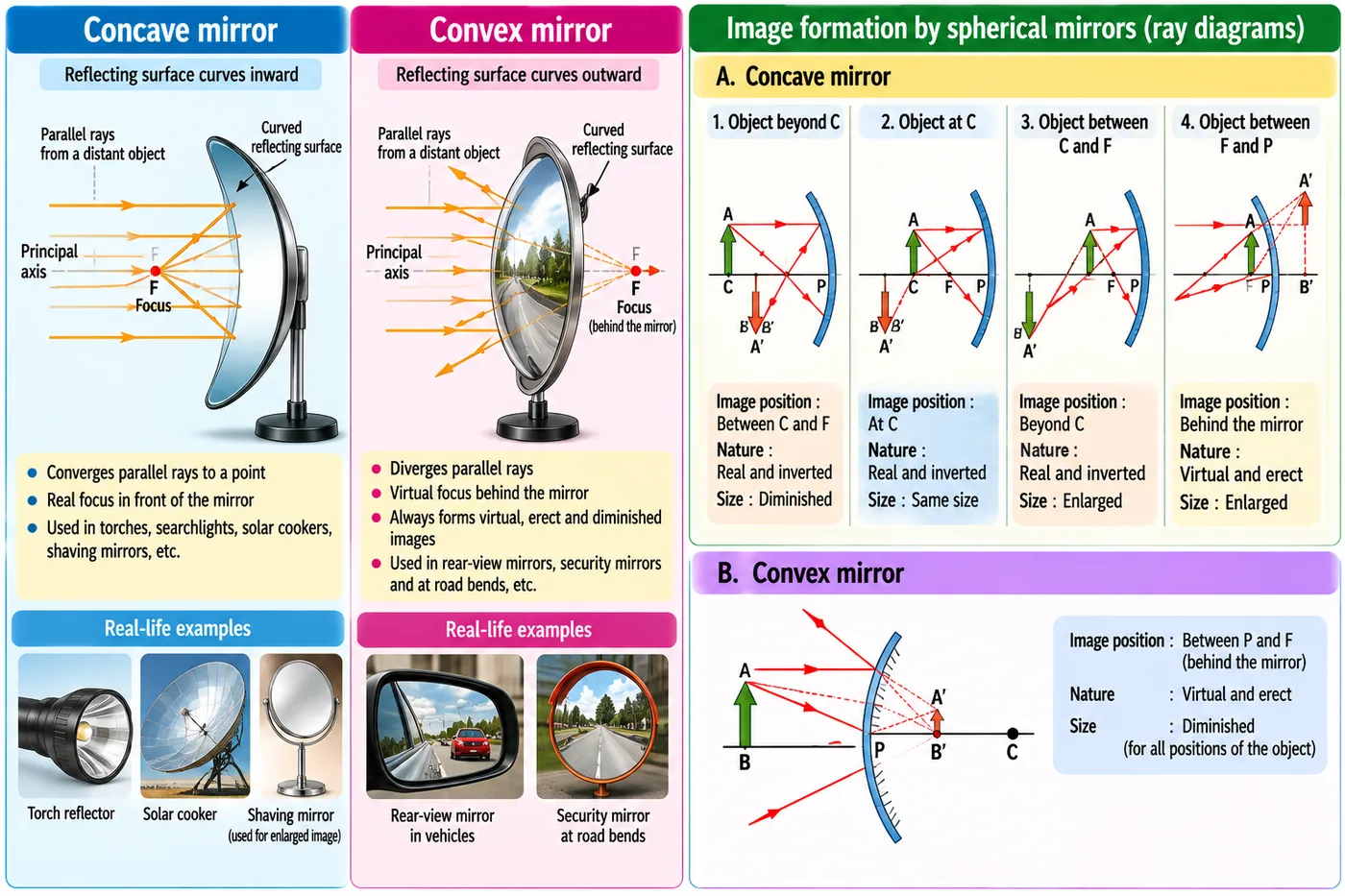
| Object position (concave mirror) | Image position | Size | Nature |
|---|---|---|---|
| At infinity | At F | Highly diminished, point-sized | Real, inverted |
| Beyond C | Between F and C | Diminished | Real, inverted |
| At C | At C | Same size | Real, inverted |
| Between C and F | Beyond C | Enlarged | Real, inverted |
| At F | At infinity | Highly enlarged | Real, inverted |
| Between P and F | Behind the mirror | Enlarged | Virtual, erect |
Convex mirror: object at infinity → image at F behind the mirror, point-sized; object anywhere between infinity and P → image between P and F behind the mirror, diminished, virtual and erect.
Uses: concave — torches, searchlights and vehicle headlights (parallel beam), shaving and dentists' mirrors (enlarged image), solar furnaces. Convex — rear-view mirrors of vehicles, because they always give an erect image and have a wider field of view.
3. Sign Convention, Mirror Formula and Magnification
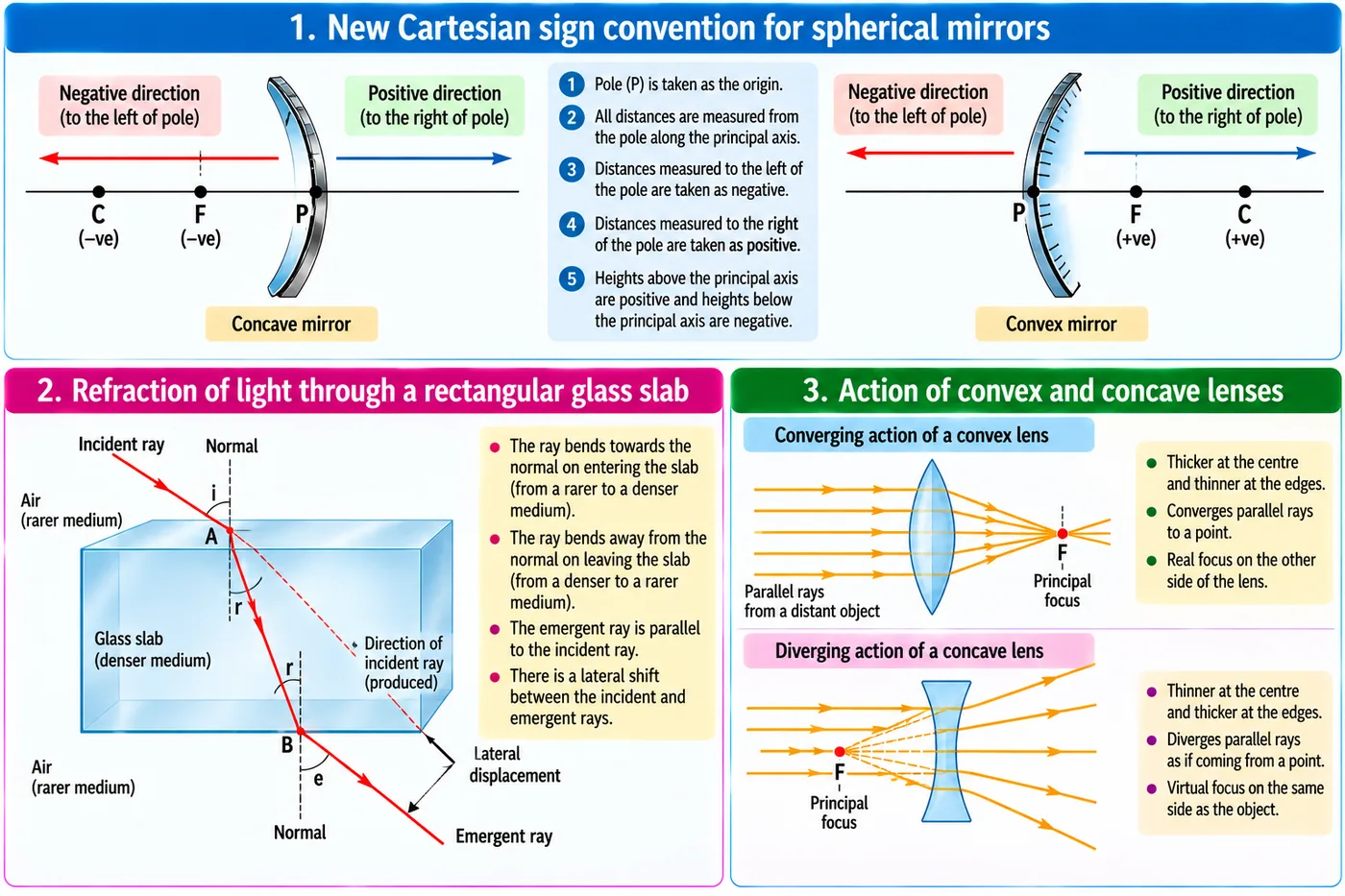
New Cartesian sign convention: the pole is the origin and the principal axis is the x-axis; the object is placed to the left; distances measured along the incident light (to the right) are positive, against it (to the left) negative; heights above the axis are positive, below negative. So for a concave mirror f is negative; for a convex mirror f is positive; object distance u is always negative.
1/v + 1/u = 1/f m = h′/h = −v/u
Negative m → real, inverted image; positive m → virtual, erect image. |m| > 1 enlarged, < 1 diminished.
Worked example: an object is 10 cm in front of a concave mirror of focal length 15 cm. u = −10 cm, f = −15 cm. 1/v = 1/f − 1/u = −1/15 + 1/10 = 1/30 → v = +30 cm (behind the mirror, virtual). m = −v/u = −30/(−10) = +3 → erect and three times enlarged.
4. Refraction of Light
A pencil partly in water looks bent; a coin in a bucket appears raised. Light changes speed when it passes obliquely from one medium into another, so it bends. In a rectangular glass slab, light bends towards the normal on entering glass (rarer → denser) and away from the normal on leaving it. The emergent ray is parallel to the incident ray but shifted sideways — lateral displacement. A ray falling along the normal goes straight without bending.
Laws of refraction: (i) the incident ray, refracted ray and normal lie in the same plane; (ii) Snell's law — for a given colour and pair of media, sin i / sin r = constant (the refractive index of the second medium with respect to the first).
Refractive index: n21 = v1/v2 (speed of light in medium 1 / in medium 2). The absolute refractive index nm = c/v, where c = 3 × 10⁸ m/s is the speed of light in vacuum. A medium with larger n is optically denser (light is slower in it). Optical density is not the same as mass density — kerosene (n = 1.44) is optically denser than water (n = 1.33) but lighter.
5. Refraction by Spherical Lenses
A convex (converging) lens is thicker at the middle; a concave (diverging) lens is thicker at the edges. A lens has two centres of curvature (C1, C2), an optical centre (O) through which rays pass undeviated, and two principal foci F1, F2 on either side. Ray rules: a ray parallel to the axis passes through (convex) or appears to come from (concave) the focus; a ray through the focus emerges parallel; a ray through O goes straight.
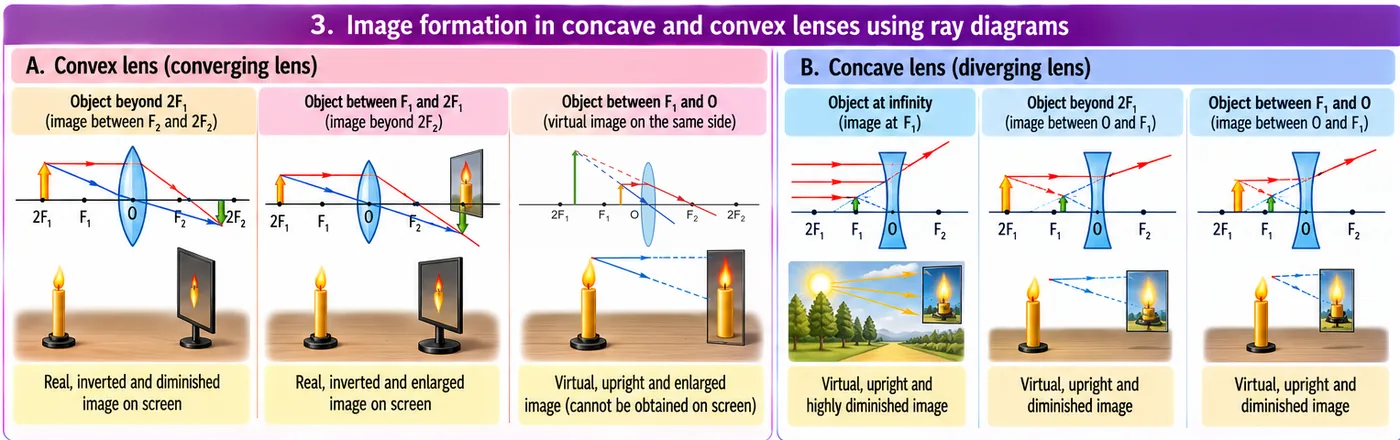
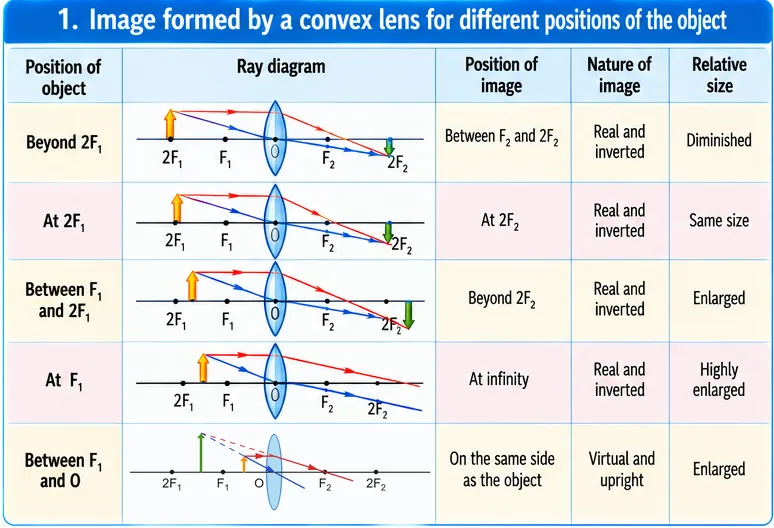
| Object position (convex lens) | Image position | Size | Nature |
|---|---|---|---|
| At infinity | At F2 | Point-sized | Real, inverted |
| Beyond 2F1 | Between F2 and 2F2 | Diminished | Real, inverted |
| At 2F1 | At 2F2 | Same size | Real, inverted |
| Between F1 and 2F1 | Beyond 2F2 | Enlarged | Real, inverted |
| At F1 | At infinity | Highly enlarged | Real, inverted |
| Between F1 and O | Same side as object | Enlarged | Virtual, erect (magnifying glass) |
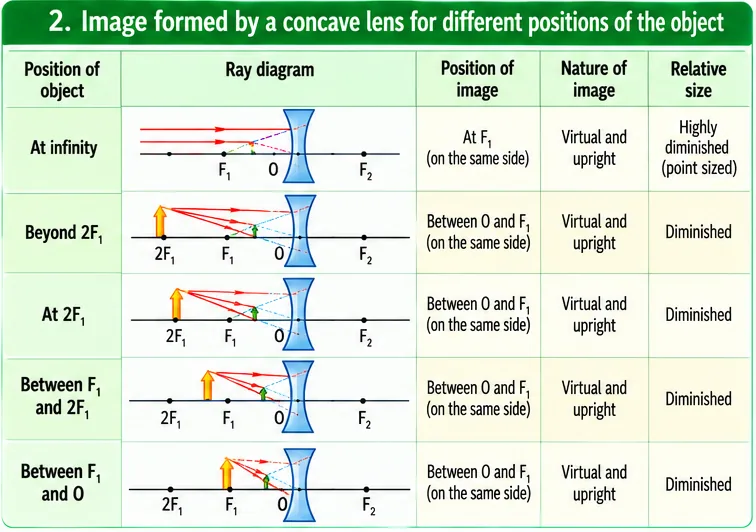
Concave lens: object at infinity → image at F1, point-sized; any other position → between F1 and O, diminished, virtual and erect.
1/v − 1/u = 1/f m = h′/h = v/u P = 1/f (f in metres)
SI unit of power: dioptre (D); 1 D = 1 m−1. Convex lens: f and P positive; concave: negative. For lenses in contact, P = P1 + P2 + P3 + …
Worked example: a concave lens of focal length 15 cm forms an image 10 cm from the lens. Find u. v = −10 cm, f = −15 cm. 1/u = 1/v − 1/f = −1/10 + 1/15 = −1/30 → u = −30 cm. m = v/u = −10/−30 = +1/3 (virtual, erect, one-third size). Power of this lens P = 1/(−0.15) ≈ −6.7 D.
6. Master Table: Formulas
| Quantity | Formula |
|---|---|
| Focal length and radius | f = R/2 |
| Mirror formula | 1/v + 1/u = 1/f |
| Magnification (mirror) | m = h′/h = −v/u |
| Snell's law | sin i / sin r = n21 |
| Refractive index | n21 = v1/v2; n = c/v |
| Lens formula | 1/v − 1/u = 1/f |
| Magnification (lens) | m = h′/h = v/u |
| Power | P = 1/f (m); unit dioptre |
7. Master Summary Table
| Device | f sign | Can form real image? | Virtual image is |
|---|---|---|---|
| Concave mirror | Negative | Yes | Enlarged (object between P and F) |
| Convex mirror | Positive | No | Always diminished |
| Convex lens | Positive | Yes | Enlarged (object between F1 and O) |
| Concave lens | Negative | No | Always diminished |
Chart — absolute refractive indices of some media (NCERT values):
8. Mind Map
- Laws; plane mirror
- Concave, convex; R = 2f
- Sign convention
- 1/v + 1/u = 1/f; m = −v/u
- Glass slab, Snell's law
- n = c/v
- 1/v − 1/u = 1/f; m = v/u
- P = 1/f (D)
9. Tips and Tricks
- Mirror formula has + (1/v + 1/u); lens formula has − (1/v − 1/u).
- Mirror m has a minus (−v/u); lens m has none (v/u).
- “Concave Converges, conVEX diVErges” for mirrors; for lenses it is the opposite: convex converges.
- Always convert f to metres before finding power.
- Real images are always inverted; virtual images are always erect.
- Forgetting the negative sign of u.
- Using cm in P = 1/f.
- Saying a convex mirror can form a real image.
- Assuming optically denser means heavier.
10. Important One-liners
- Angle of incidence equals angle of reflection.
- For small-aperture mirrors, R = 2f.
- Convex mirrors are used as rear-view mirrors.
- Concave mirrors are used in torches and as shaving mirrors.
- Light bends towards the normal entering a denser medium.
- Emergent ray from a glass slab is parallel to the incident ray.
- Speed of light in vacuum is 3 × 10⁸ m/s.
- Diamond has refractive index 2.42.
- A convex lens used as a magnifier has the object between F and O.
- 1 dioptre is the power of a lens of focal length 1 m.
11. Exam-pattern Questions with Detailed Answers
The focal length of a concave mirror is 20 cm. Its radius of curvature is:
- 10 cm
- 20 cm
- 40 cm
- 80 cm
Show answer
R = 2f = 40 cm.
Answer: (C)
Which mirror gives a wider field of view? Where is it used?
Show answer
Convex mirror — rear-view mirrors of vehicles and security mirrors at road bends.
Answer: Convex mirror; rear-view mirrors
Find the power of a convex lens of focal length 50 cm.
Show answer
f = +0.5 m; P = 1/0.5 = +2 D.
Answer: +2 D
Assertion (A): A ray of light passing through the optical centre of a lens goes undeviated. Reason (R): Near the optical centre the two faces of the lens are almost parallel, like a thin glass slab.
- Both true; R explains A
- Both true; R does not explain A
- A true, R false
- A false, R true
Show answer
A thin parallel slab gives negligible lateral shift, so the ray continues straight.
Answer: (A)
An object 4 cm high is placed 25 cm in front of a concave mirror of focal length 15 cm. Find the position, nature and size of the image.
Show answer
u = −25, f = −15. 1/v = 1/f − 1/u = −1/15 + 1/25 = (−5 + 3)/75 = −2/75 → v = −37.5 cm (in front, real). m = −v/u = −(−37.5)/(−25) = −1.5; h′ = −1.5 × 4 = −6 cm.
Answer: 37.5 cm in front; real, inverted, 6 cm tall (enlarged)
The refractive index of diamond is 2.42. What does this mean? Find the speed of light in diamond.
Show answer
Light travels 2.42 times slower in diamond than in vacuum. v = c/n = 3 × 10⁸ / 2.42 ≈ 1.24 × 10⁸ m/s.
Answer: ≈ 1.24 × 10⁸ m/s
An object is placed 20 cm from a convex lens of focal length 10 cm. Where is the image and what is its nature?
Show answer
u = −20 = 2F1. 1/v = 1/f + 1/u = 1/10 − 1/20 = 1/20 → v = +20 cm. m = v/u = −1.
Answer: At 2F2 (20 cm on the other side); real, inverted, same size
Two lenses of power +3.5 D and −2.5 D are placed in contact. Find the power and focal length of the combination. Is it converging or diverging?
Show answer
P = 3.5 − 2.5 = +1 D; f = 1/P = 1 m = 100 cm; positive, so converging.
Answer: +1 D, f = 100 cm, converging
A convex lens forms a real image three times magnified at 60 cm from the lens. Find the object distance and the focal length.
Show answer
Real image → m = −3, v = +60 cm. m = v/u → u = 60/(−3) = −20 cm. 1/f = 1/v − 1/u = 1/60 + 1/20 = 4/60 → f = 15 cm.
Answer: u = −20 cm; f = +15 cm
Case-based: A student focuses the image of a distant tree on a screen using a lens and finds the screen 25 cm from the lens. (a) Which lens is it? (b) What is its focal length and power? (c) Where should she place a candle to get a same-size image on the screen? (d) Where should the candle be to use this lens as a magnifier?
Show answer
(a) Convex lens (real image on a screen). (b) Distant object → image at F, so f = +25 cm; P = 1/0.25 = +4 D. (c) At 2F, i.e. 50 cm from the lens (image also at 50 cm on the other side). (d) Closer than 25 cm (between F and O).
Answer: Convex; 25 cm, +4 D; candle at 50 cm; within 25 cm for magnifier
Light enters from air into glass of refractive index 1.5. If the speed of light in air is 3 × 10⁸ m/s, find its speed in glass. What is the refractive index of glass with respect to water (n = 1.33)?
Show answer
v = c/n = 3 × 10⁸/1.5 = 2 × 10⁸ m/s. nglass,water = nglass/nwater = 1.5/1.33 ≈ 1.13.
Answer: 2 × 10⁸ m/s; ≈ 1.13
A convex mirror used on a car has a radius of curvature of 3.00 m. A bus is 5.00 m from the mirror. Find the position, nature and size of the image.
Show answer
R = +3.00 m → f = +1.50 m; u = −5.00 m. 1/v = 1/f − 1/u = 1/1.5 + 1/5 = (10 + 3)/15 = 13/15 → v ≈ +1.15 m (behind the mirror). m = −v/u = −1.15/(−5) ≈ +0.23.
Answer: 1.15 m behind; virtual, erect, about 0.23 times the size
12. Quick Revision Summary
- Laws of reflection; R = 2f; ray rules through P, F, C.
- Concave mirror: real images except when object is between P and F; convex mirror: always virtual, erect, diminished.
- Mirror: 1/v + 1/u = 1/f, m = −v/u; sign convention from the pole.
- Refraction: towards the normal into a denser medium; Snell's law; n = c/v.
- Lens: 1/v − 1/u = 1/f, m = v/u; P = 1/f (m) in dioptres; P adds for lenses in contact.