
1. Chapter at a Glance
Three-fourths of the Earth is water, but only about 2.5% of it is fresh water, and most of that is locked in ice sheets, glaciers and deep groundwater. Fresh water is a renewable resource, renewed through the hydrological cycle, yet it is scarce in many places. India receives about 4% of the world's precipitation but supports about 18% of the world's people. This chapter looks at water scarcity, multipurpose river projects and the debates around them, and India's long tradition of rainwater harvesting.
2. Water Scarcity and the Need for Conservation
Scarcity does not mean only a lack of rain. It can come from:
- Large and growing population — more water for domestic use and more food to grow.
- Irrigation — farming uses most of India's water; dry-season farming and water-hungry crops over-draw groundwater, especially through private wells and tube-wells in Punjab, Haryana, western Uttar Pradesh and parts of the south.
- Industrialisation and urbanisation — industries need water and power (hydroelectricity); cities draw groundwater heavily, and housing societies have their own borewells.
- Poor quality — water may be plentiful but polluted by domestic and industrial waste, chemicals, pesticides and fertilisers, making it unfit for use.
- Unequal access among regions and social groups.
To safeguard ourselves from health hazards, ensure food security, continue livelihoods and productive activities, and prevent the degradation of natural ecosystems. Over-exploitation and mismanagement impoverish this resource.
3. India's Ancient Water Engineering
| Period / place | Structure |
|---|---|
| 1st century BCE, Sringaverapura near Prayagraj | Sophisticated system channelling the flood water of the Ganga |
| Chandragupta Maurya's time | Dams, lakes and irrigation systems built extensively |
| Kalinga (Odisha), Nagarjunakonda (Andhra Pradesh), Bennur (Karnataka), Kolhapur (Maharashtra) | Evidence of sophisticated irrigation works |
| 11th century, Bhopal | Bhopal Lake — one of the largest artificial lakes of its time |
| 14th century, Delhi | Tank at Hauz Khas supplying water to the Siri Fort area |
4. Dams and Multipurpose River Projects
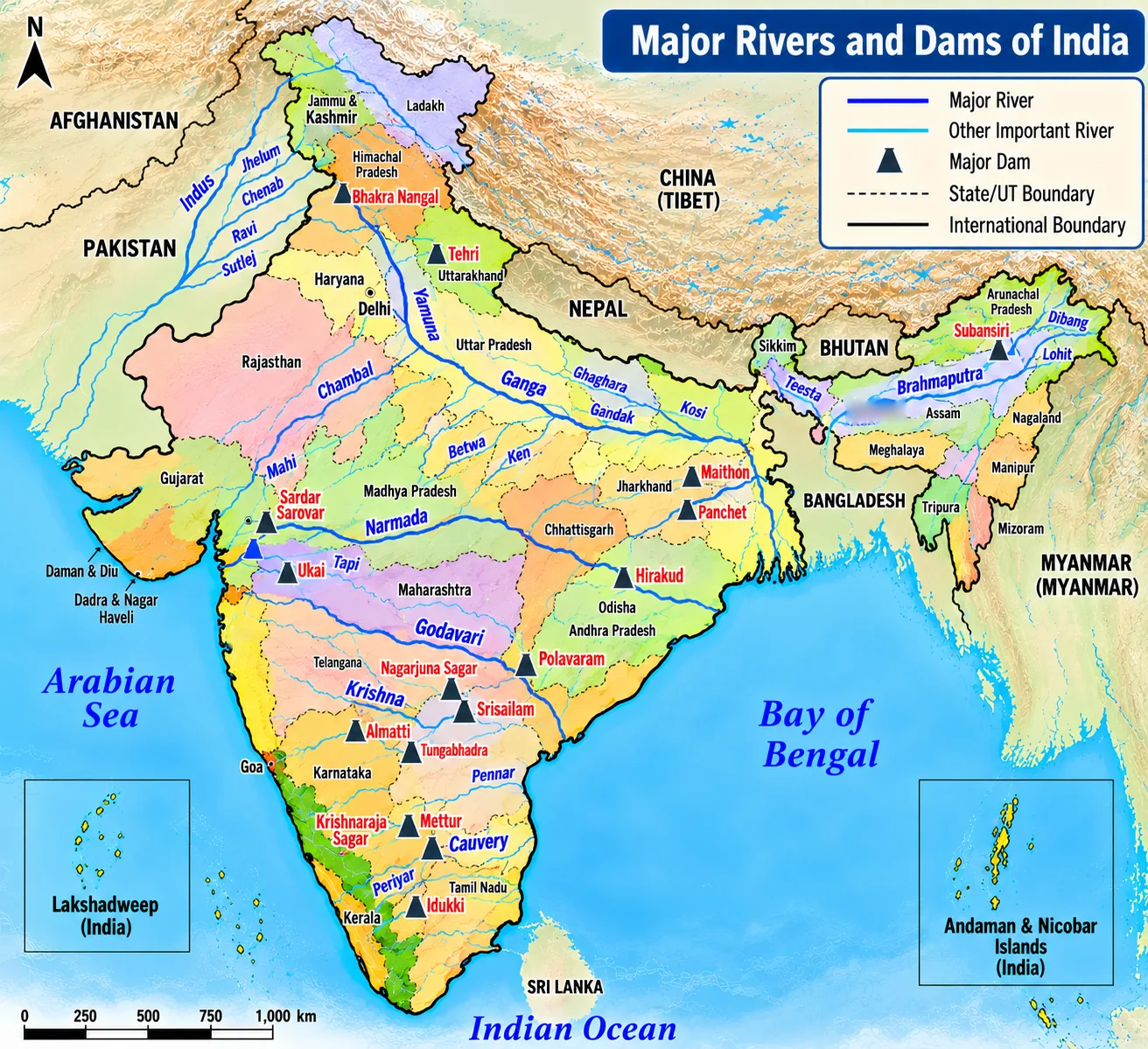
A dam is a barrier across flowing water that obstructs, directs or retards the flow, often creating a reservoir, lake or impoundment. Dams can be classified by structure (timber, embankment, masonry) and height (large/major, low/medium/minor). Multipurpose projects serve several uses together.
| Use | Example |
|---|---|
| Irrigation and hydroelectricity | Bhakra Nangal (Sutlej) — both irrigation and power |
| Flood control + power + irrigation | Hirakud (Mahanadi) — conservation of water and flood control |
| Water supply, irrigation, power | Sardar Sarovar (Narmada) — drought-prone Gujarat and Rajasthan |
| Others | Inland navigation, fish breeding, recreation, domestic and industrial supply |
Jawaharlal Nehru called dams the "temples of modern India", believing they would integrate agriculture and the village economy with rapid industrialisation and urban growth.
Why multipurpose projects are opposed
- Regulating river flow causes excessive sedimentation at the reservoir bottom, making the riverbed rockier and degrading aquatic habitats.
- Dams fragment rivers, making it hard for aquatic fauna to migrate and spawn.
- Reservoirs submerge vegetation and soil, which decompose over time.
- Large-scale displacement of local communities, who often lose land, livelihood and access to resources without fair rehabilitation — this triggered the Narmada Bachao Andolan (against Sardar Sarovar) and the Tehri Dam Andolan.
- Irrigation changed cropping patterns towards water-intensive and commercial crops, leading to salinisation of soils; social gaps widened between landowners and the landless.
- Dams meant to control floods have sometimes triggered floods due to sedimentation or sudden releases (e.g., Maharashtra and Gujarat in 2006); floods without fertile silt deposits; they have also been linked to earthquakes, water-borne diseases, pests and pollution from excessive water use.
- Inter-state water disputes: Krishna–Godavari (Maharashtra, Karnataka, Andhra Pradesh) and Kaveri (Karnataka, Tamil Nadu).
An NGO-led movement (from the 1980s) that mobilised tribal people, farmers, environmentalists and human-rights activists against the Sardar Sarovar Dam. It began with environmental issues of submergence of trees and later focused on fair rehabilitation of displaced people.
5. Rainwater Harvesting
Many saw multipurpose projects as having failed to meet their goals and looked to traditional, decentralised methods suited to local ecology.
| Region | Technique |
|---|---|
| Hilly and mountainous areas (western Himalaya) | Guls or kuls — diversion channels for irrigation |
| Rajasthan (drinking water) | Rooftop rainwater harvesting; underground tanks called tankas in Bikaner, Phalodi and Barmer |
| Floodplains of Bengal | Inundation channels to irrigate fields |
| Arid and semi-arid Rajasthan (Jaisalmer) | Khadins and johads — rain-fed storage structures that keep soil moist for farming |
| Meghalaya | Bamboo drip irrigation — about 200 years old |
- Tankas were part of houses and courtyards, connected to sloping roofs. Rainwater (palar pani, "pure water") stored in them was the main drinking source and stayed cool, keeping rooms cool too. Many houses built underground rooms next to them for summer.
- In Meghalaya, water from streams and springs is carried down slopes through bamboo pipes; by the time it reaches the plant, the 18–20 litres per minute entering the system drops to about 20–80 drops per minute — irrigation for betel leaf and black pepper.
- Today rooftop harvesting is popular in Gujarat, Karnataka and elsewhere. In Gendathur, a remote village in Mysuru district, Karnataka, about 200 households have installed rooftop systems (as described in the textbook).
- Tamil Nadu was the first State to make rooftop rainwater harvesting compulsory for all houses across the State; legal action can be taken against defaulters.
- Shillong (Meghalaya), despite being near Cherrapunjee and Mawsynram (among the world's wettest places), faces water shortage, so nearly every household has rooftop harvesting.
6. Master Table: Key Terms
| Term | Meaning |
|---|---|
| Hydrological cycle | Continuous circulation of water — evaporation, condensation, precipitation |
| Water scarcity | Shortage in quantity or quality relative to need |
| Dam | Barrier that stores or regulates river flow |
| Multipurpose project | Dam serving irrigation, power, flood control, etc. |
| Sedimentation | Settling of silt behind a dam |
| Guls / kuls | Himalayan diversion channels |
| Tanka | Underground rainwater tank in Rajasthan |
| Palar pani | Rainwater, considered the purest form |
| Khadin / johad | Rain-fed storage areas in arid Rajasthan |
| Inundation channel | Flood channel irrigating Bengal fields |
| Bamboo drip irrigation | Meghalaya's bamboo pipe system |
7. Master Summary Table
| Project | River | State(s) | Main purpose |
|---|---|---|---|
| Bhakra Nangal | Sutlej | Himachal Pradesh / Punjab | Irrigation, hydro-power |
| Hirakud | Mahanadi | Odisha | Flood control, irrigation, power |
| Sardar Sarovar | Narmada | Gujarat | Water supply, irrigation, power |
| Tehri | Bhagirathi | Uttarakhand | Power, water supply |
| Nagarjuna Sagar | Krishna | Telangana / Andhra Pradesh | Irrigation, power |
| Tungabhadra | Tungabhadra | Karnataka | Irrigation, power |
Chart — where Earth's water is (approx. %):
8. Mind Map
- Population, irrigation
- Industry, pollution
- Sringaverapura
- Bhopal Lake
- Bhakra, Hirakud
- Sardar Sarovar
- Displacement, silt
- NBA, disputes
- Tankas, kuls, khadins
- Bamboo drip, rooftop
9. Tips and Tricks
- Bhakra – Sutlej (BS); Hirakud – Mahanadi (HM); Sardar Sarovar – Narmada (both S's, one river N).
- Rajasthan = Tankas + Khadins + Johads ("TKJ").
- Tamil Nadu = The first to make rooftop harvesting compulsory.
- Water scarcity can occur even where rain is high (Shillong) — due to poor storage and quality.
- Guls/kuls are in the western Himalaya, not Rajasthan.
- Hirakud is on the Mahanadi, not the Narmada.
10. Important One-liners
- India gets about 4% of the world's precipitation.
- Nehru called dams "temples of modern India".
- Bhakra Nangal is on the Sutlej.
- Hirakud dam is on the Mahanadi in Odisha.
- Sardar Sarovar is on the Narmada.
- Narmada Bachao Andolan opposed Sardar Sarovar.
- Tankas are underground tanks in Rajasthan.
- Bamboo drip irrigation is practised in Meghalaya.
- Tamil Nadu made rooftop harvesting compulsory.
- Sringaverapura had a flood-water system in the 1st century BCE.
- Kaveri dispute involves Karnataka and Tamil Nadu.
11. Previous-Year-Pattern Questions with Detailed Answers
Hirakud dam is built on the river:
- Narmada
- Sutlej
- Mahanadi
- Krishna
Show answer
Hirakud is on the Mahanadi in Odisha. Sardar Sarovar is on the Narmada, Bhakra Nangal on the Sutlej, Nagarjuna Sagar on the Krishna.
Answer: (C)
Which State first made rooftop rainwater harvesting compulsory?
- Rajasthan
- Tamil Nadu
- Meghalaya
- Karnataka
Show answer
Tamil Nadu made it compulsory for all houses. Rajasthan has traditional tankas; Meghalaya has bamboo drip and Shillong's household systems; Karnataka's Gendathur is a village example.
Answer: (B)
What are guls or kuls?
Show answer
Diversion channels built in the hilly regions of the western Himalaya to carry stream water to fields for irrigation.
Answer: Himalayan diversion channels
"Water scarcity may be due to quality, not just quantity." Explain.
Show answer
Even where water is plentiful, it may be polluted by domestic sewage, industrial effluents, chemicals, pesticides and fertilisers, making it unsafe for drinking or irrigation. So people face scarcity of usable water despite its physical presence.
Answer: Polluted water is effectively unavailable
Why did Nehru call dams "temples of modern India"?
Show answer
He saw them as engines of national development: providing irrigation for food, electricity for industry, flood control and water supply — integrating agriculture and the village economy with rapid industrialisation and urban growth.
Answer: Seen as the base of modern development
Describe rooftop rainwater harvesting in Rajasthan.
Show answer
In Bikaner, Phalodi and Barmer, houses have underground tanks (tankas) connected to sloping roofs by pipes. Rain from the roof is stored in the tanka; the first spell is usually let go to clean the roof. This palar pani is the main drinking water in dry months and keeps nearby rooms cool.
Answer: Roof runoff stored in underground tankas
Explain bamboo drip irrigation in Meghalaya.
Show answer
Stream and spring water is tapped on hilltops and carried down slopes through bamboo pipes, with smaller channels and diversion units near the plants. The flow falls from about 18–20 litres per minute to about 20–80 drops per minute at the plant roots — a 200-year-old system for betel leaf and black pepper.
Answer: Gravity-fed bamboo pipes delivering drops to plants
Why are multipurpose river projects opposed? Give five reasons.
Show answer
(1) Sedimentation and rocky riverbeds harm aquatic life. (2) Fragmented rivers block fish migration. (3) Submergence of forests and farmland. (4) Displacement of local people without fair rehabilitation (Narmada Bachao, Tehri Andolan). (5) Changed cropping patterns and salinisation; sometimes floods triggered by sudden releases; inter-state disputes over sharing water.
Answer: Ecological, social and political costs
Why does Shillong face water shortage despite heavy rain nearby?
Show answer
Rainwater runs off quickly down steep slopes; there is little storage; growing population increases demand; and supply systems are inadequate. So households rely on rooftop rainwater harvesting — showing that rainfall alone does not ensure water availability; storage and management do.
Answer: Runoff, poor storage and rising demand
Compare large dams and traditional rainwater harvesting.
Show answer
Large dams store huge volumes for irrigation, power and cities but are costly, displace people and harm ecology. Traditional harvesting is decentralised, cheap, community-run, suited to local terrain and recharges groundwater, but cannot meet large industrial or urban needs alone. A combination, with emphasis on local harvesting and efficient use, is most sustainable.
Answer: Scale and power vs local, low-cost sustainability
How did irrigation from dams increase social inequality?
Show answer
Big landowners with access to canal water switched to water-intensive commercial crops and gained most; the landless and those displaced lost land and livelihoods; downstream and tail-end farmers got less water. So benefits concentrated among the better-off while costs fell on the poor.
Answer: Unequal distribution of benefits and costs
12. Quick Revision Summary
- Fresh water ~2.5%; India gets ~4% of world precipitation.
- Scarcity: population, irrigation, industry, cities, pollution, unequal access.
- Ancient works: Sringaverapura, Mauryan dams, Bhopal Lake, Hauz Khas.
- Multipurpose projects: Bhakra Nangal, Hirakud, Sardar Sarovar — "temples of modern India".
- Opposition: sediment, fragmentation, submergence, displacement, salinisation, disputes; NBA.
- Harvesting: guls/kuls, tankas, khadins/johads, inundation channels, bamboo drip; TN law; Gendathur; Shillong.