
1. Chapter at a Glance
India is an agriculturally important country: about two-thirds of its people depend on farming directly or indirectly, and agriculture provides food, raw materials for industry (cotton, jute, sugarcane, oilseeds) and exports (tea, coffee, spices, rice). This chapter covers the types of farming, cropping seasons, the major crops with their conditions and regions, and the technological and institutional reforms that have shaped Indian agriculture.
2. Types of Farming
| Type | Features | Where |
|---|---|---|
| Primitive subsistence | Small patches; old tools (hoe, dao, digging sticks); family labour; depends on monsoon and natural soil fertility. Includes slash-and-burn (shifting) cultivation — clear forest, grow crops, move on when soil loses fertility | Hilly and forested tribal areas |
| Intensive subsistence | High use of biochemical inputs and irrigation on small holdings to get maximum output; pressure of population on land; holdings keep shrinking through inheritance | Densely populated areas |
| Commercial | Heavy use of modern inputs — HYV seeds, fertilisers, insecticides, pesticides; crops grown for sale. Degree of commercialisation varies: rice is commercial in Punjab and Haryana but subsistence in Odisha | Punjab, Haryana etc. |
| Plantation (a commercial type) | A single crop on a large area; capital-intensive, large migrant labour; produce used as industrial raw material; developed network of transport, processing and markets | Tea (Assam, north Bengal), coffee (Karnataka), rubber, sugarcane, banana |
India: jhumming (Assam, Meghalaya, Mizoram, Nagaland), Pamlou (Manipur), Dipa (Bastar, Chhattisgarh), Bewar/Dahiya (Madhya Pradesh), Podu/Penda (Andhra Pradesh), Pama Dabi/Koman/Bringa (Odisha), Kumari (Western Ghats), Valre/Waltre (south-east Rajasthan), Khil (Himalayan belt), Kuruwa (Jharkhand). World: Milpa (Mexico, Central America), Conuco (Venezuela), Roca (Brazil), Masole (Central Africa), Ladang (Indonesia), Ray (Vietnam).
3. Cropping Seasons
| Season | Sown / harvested | Main crops | Notes |
|---|---|---|---|
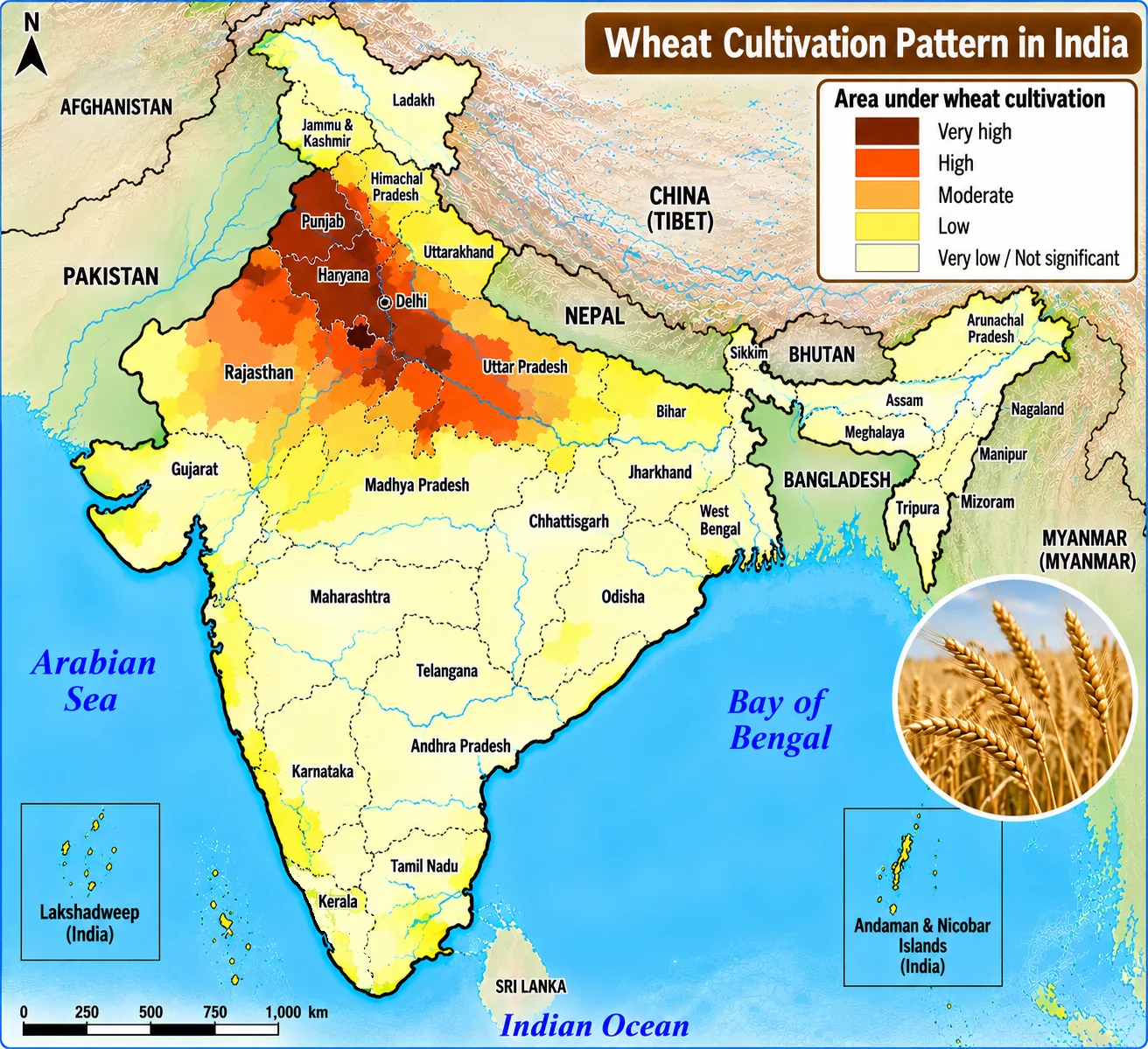
| Rabi | Sown October–December; harvested April–June | Wheat, barley, peas, gram, mustard | Grown in Punjab, Haryana, Himachal Pradesh, J&K, Uttarakhand, Uttar Pradesh; winter rain from western temperate cyclones helps; Green Revolution success in Punjab, Haryana, western UP and parts of Rajasthan |
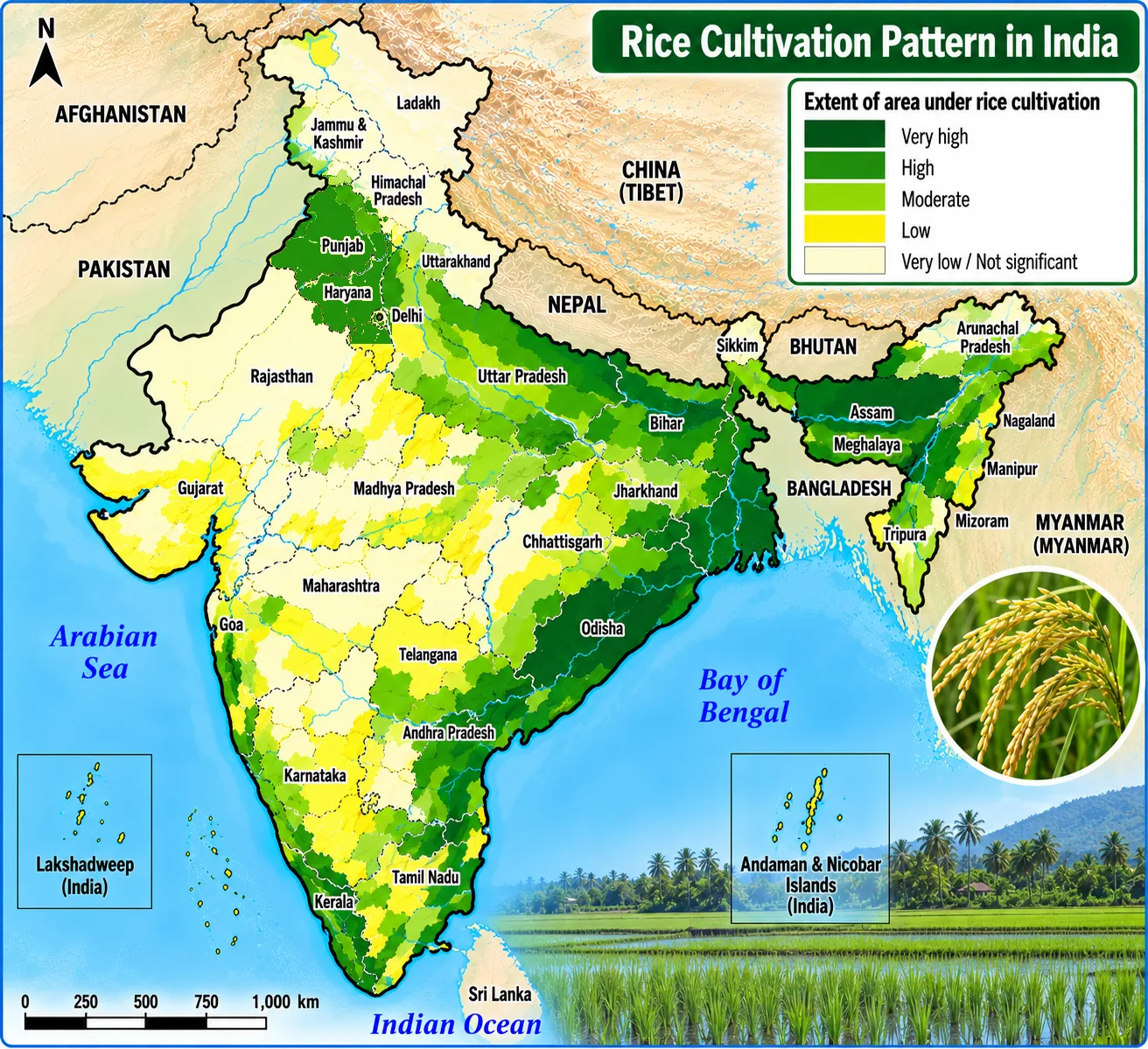
| Kharif | Sown with the onset of monsoon; harvested September–October | Paddy, maize, jowar, bajra, tur (arhar), moong, urad, cotton, jute, groundnut, soybean | Paddy: Assam, West Bengal, coastal Odisha, AP, Telangana, TN, Kerala, Maharashtra (Konkan), UP, Bihar, and also Punjab and Haryana. In Assam, West Bengal and Odisha three paddy crops a year: Aus, Aman and Boro |
| Zaid | Short summer season between rabi and kharif | Watermelon, muskmelon, cucumber, vegetables, fodder crops | Sugarcane takes almost a year to grow |
4. Major Crops
| Crop | Conditions | Major areas | Notes |
|---|---|---|---|
| Rice | Kharif; above 25°C, high humidity, over 100 cm rain; irrigation in low-rain areas | Plains of north and north-east India, coastal areas, deltas; canals and tube-wells in Punjab, Haryana, western UP, parts of Rajasthan | Staple of most Indians; India is one of the two largest producers (with China) and the largest exporter |
| Wheat | Rabi; cool growing season, bright sunshine at ripening; 50–75 cm rain spread over the season | Ganga–Satluj plains of the north-west and black-soil Deccan; Punjab, Haryana, UP, MP, Bihar, Rajasthan | Main food crop of the north and north-west |
| Jowar, bajra, ragi (millets) | Coarse grains with high nutrition; grow in dry conditions | Jowar — Maharashtra (largest), Karnataka, AP, MP; bajra — Rajasthan (largest), UP, Maharashtra, Gujarat, Haryana (sandy and shallow black soil); ragi — Karnataka (largest), TN, Himachal, Uttarakhand, Sikkim, Jharkhand, Arunachal | Ragi is rich in iron, calcium and roughage; 2023 was the International Year of Millets |
| Maize | 21–27°C; old alluvial soil; kharif (rabi in Bihar) | Karnataka, MP, UP, Bihar, AP, Telangana | Food and fodder |
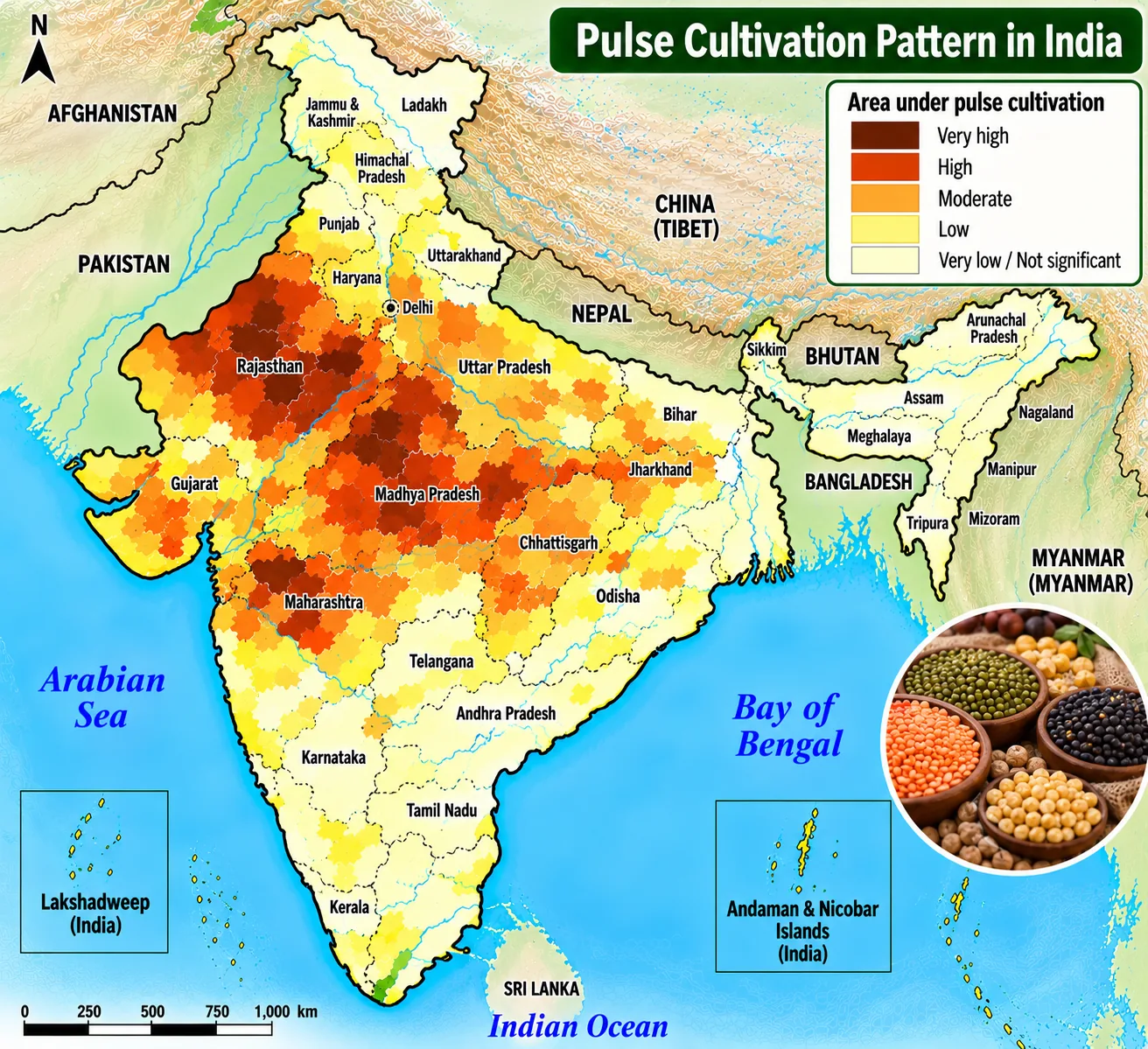
| Pulses | Need less moisture; leguminous crops (except arhar) fix nitrogen and restore soil fertility, so are rotated with other crops | MP, Rajasthan, Maharashtra, UP, Karnataka | India is the largest producer and consumer; tur, urad, moong, masur, peas, gram |
| Sugarcane | Tropical/sub-tropical; 21–27°C; 75–100 cm rain; grows on many soils; needs manual labour | UP, Maharashtra, Karnataka, TN, AP, Telangana, Bihar, Punjab, Haryana | India is the second-largest producer (after Brazil); source of sugar, gur, khandsari, molasses |
| Oilseeds | Groundnut — kharif (Gujarat largest); mustard — rabi; sesamum — kharif in north, rabi in south; castor — both; linseed, soybean, sunflower, cotton seeds | Varies | About 12% of cropped area; edible oils and raw material for soaps, cosmetics, ointments |
| Tea | Plantation; warm, moist, frost-free; frequent showers; deep fertile, well-drained soil rich in humus and organic matter; cheap skilled labour | Assam, Darjeeling and Jalpaiguri hills (West Bengal), TN, Kerala; also HP, Uttarakhand, Meghalaya, AP, Tripura | Introduced by the British; India is a leading producer and exporter |
| Coffee | Plantation; hills | Nilgiris in Karnataka, Kerala and TN | Arabica variety, originally from Yemen, has high world demand |
| Rubber | Equatorial crop; moist, humid climate, over 200 cm rain, over 25°C | Kerala, TN, Karnataka, Andaman and Nicobar, Garo hills of Meghalaya | Industrial raw material |
| Cotton | Drier parts of black-soil Deccan; high temperature, light rain, 210 frost-free days, bright sunshine; kharif, 6–8 months to mature | Maharashtra, Gujarat, MP, Karnataka, AP, Telangana, TN, Punjab, Haryana, UP | India is believed to be the original home of cotton; a major producer |
| Jute ("golden fibre") | Well-drained fertile floodplain soils renewed every year; high temperature | West Bengal, Bihar, Assam, Odisha, Meghalaya | Gunny bags, mats, ropes, carpets; losing market to synthetic fibres |
5. Technological and Institutional Reforms
- Agriculture has been practised for thousands of years, but sustained use of land without matching technology and institutions slowed progress. Many farmers still depend on the monsoon and natural fertility.
- Institutional reforms after independence: collectivisation, consolidation of holdings, cooperation and abolition of zamindari were priorities in the First Five Year Plan.
- Green Revolution (1960s): high-yielding variety seeds, fertilisers, irrigation — big gains in wheat and later rice, especially in Punjab and Haryana. White Revolution (Operation Flood): dairy development.
- Comprehensive land development in the 1980s and 1990s: crop insurance against drought, flood, cyclone, fire and disease; Grameen banks, cooperative societies and banks for loans at lower interest.
- Kisan Credit Card (KCC) and Personal Accident Insurance Scheme (PAIS); weather bulletins and agricultural programmes on radio and TV; Minimum Support Price (MSP) announced for important crops to check exploitation by middlemen. PM-KISAN (2019) gives eligible farmer families ₹6,000 a year in instalments.
- Bhoodan–Gramdan: Vinoba Bhave, a follower of Gandhi, began the Bhoodan ("gift of land") movement at Pochampalli (now in Telangana) in 1951, when landowners donated land to the landless. Some zamindars gave whole villages — Gramdan. It is called the "blood-less revolution".
Small and shrinking holdings, dependence on monsoon, falling groundwater, soil degradation from overuse of chemicals, rising input costs, price fluctuations and competition from global markets. Solutions include crop diversification (e.g., from food grains to fruits, vegetables, medicinal plants, flowers), efficient irrigation like drip and sprinklers, better storage and markets, and organic and natural farming.
6. Master Table: Key Terms
| Term | Meaning |
|---|---|
| Subsistence farming | Growing mainly for the family's own needs |
| Commercial farming | Growing crops mainly for sale |
| Plantation | Single crop on large estate, industry-linked |
| Jhumming | Slash-and-burn farming in the north-east |
| Rabi / Kharif / Zaid | Winter / monsoon / summer crop seasons |
| Aus, Aman, Boro | Three paddy crops in Assam, Bengal, Odisha |
| HYV seeds | High-yielding variety seeds |
| MSP | Minimum Support Price announced by government |
| KCC | Kisan Credit Card for easy farm loans |
| Bhoodan | Voluntary gift of land to the landless |
| Golden fibre | Jute |
7. Master Summary Table
| Crop | Season | Leading State(s) |
|---|---|---|
| Rice | Kharif | West Bengal, UP, Punjab |
| Wheat | Rabi | UP, MP, Punjab, Haryana |
| Jowar / Bajra / Ragi | Mostly kharif | Maharashtra / Rajasthan / Karnataka |
| Pulses | Both | MP, Rajasthan, Maharashtra |
| Sugarcane | ~1 year | UP, Maharashtra, Karnataka |
| Groundnut | Kharif | Gujarat |
| Tea / Coffee / Rubber | Plantation | Assam / Karnataka / Kerala |
| Cotton / Jute | Kharif | Gujarat, Maharashtra / West Bengal |
Chart — rainfall needs of crops (cm, approx.):
8. Mind Map
- Primitive, intensive
- Commercial, plantation
- Rabi, kharif, zaid
- Aus, Aman, Boro
- Rice, wheat, millets
- Maize, pulses
- Sugarcane, oilseeds
- Tea, coffee, cotton, jute
- Green Revolution, KCC
- MSP, Bhoodan
9. Tips and Tricks
- Rabi = Return of winter (Oct–Dec sowing); Kharif = Kloud/monsoon.
- Millet leaders: Jowar – Maharashtra, Bajra – Rajasthan, Ragi – Karnataka ("JM, BR, RK").
- Paddy trio A-A-B: Aus, Aman, Boro.
- Arhar (tur) is the pulse that does not fix nitrogen like other legumes.
- Rice is commercial in Punjab but subsistence in Odisha.
- Rubber is an equatorial crop, not a temperate one.
10. Important One-liners
- About two-thirds of Indians depend on agriculture.
- Jhumming is slash-and-burn farming in the north-east.
- Rabi crops are sown in winter and harvested in summer.
- Rice needs more than 100 cm of rain.
- Rajasthan is the largest producer of bajra.
- Karnataka is the largest producer of ragi.
- Gujarat is the largest producer of groundnut.
- India is the largest producer and consumer of pulses.
- Jute is called the golden fibre.
- Vinoba Bhave started the Bhoodan movement.
- Rubber needs over 200 cm of rain.
11. Previous-Year-Pattern Questions with Detailed Answers
Which of these is a rabi crop?
- Rice
- Cotton
- Gram
- Jute
Show answer
Gram is sown in winter and harvested in spring/summer. Rice, cotton and jute are kharif crops grown with the monsoon.
Answer: (C)
"Pamlou" is the name of shifting cultivation in:
- Manipur
- Mizoram
- Odisha
- Jharkhand
Show answer
Pamlou is Manipur's term. Mizoram calls it jhum; Odisha uses Koman/Bringa; Jharkhand uses Kuruwa.
Answer: (A)
Name the three paddy crops of Assam, West Bengal and Odisha.
Show answer
Aus, Aman and Boro — grown in different seasons of the same year.
Answer: Aus, Aman, Boro
Describe the geographical conditions required for rice.
Show answer
High temperature (above 25°C), high humidity and annual rainfall above 100 cm; in less rainy areas it grows with irrigation. It grows in the plains of north and north-east India, coastal areas and deltas; canal and tube-well irrigation has made it possible in Punjab, Haryana, western UP and parts of Rajasthan.
Answer: Hot, humid, >100 cm rain or irrigation
Distinguish between intensive subsistence and commercial farming.
Show answer
Intensive subsistence: small holdings, high labour and inputs to maximise output, mainly for family needs, in densely populated areas. Commercial: modern inputs like HYV seeds, fertilisers and pesticides used to grow crops for sale; degree varies by region (rice commercial in Punjab, subsistence in Odisha).
Answer: Production for family vs for market
Why are pulses important in Indian farming?
Show answer
They are the main source of protein in a mainly vegetarian diet; need less moisture and survive dry conditions; being leguminous (except arhar), they fix atmospheric nitrogen and restore soil fertility, so they are rotated with other crops. India is the largest producer and consumer.
Answer: Protein, drought-hardiness, soil fertility
State the conditions for growing tea.
Show answer
Tropical/sub-tropical climate; deep, fertile, well-drained soil rich in humus and organic matter; warm, moist, frost-free weather all year; frequent showers spread through the year for continuous growth of tender leaves; and abundant cheap skilled labour. Main areas: Assam, Darjeeling, Jalpaiguri, Tamil Nadu, Kerala.
Answer: Warm, moist, frost-free, humus-rich, labour
Explain the technological and institutional reforms introduced to improve Indian agriculture.
Show answer
Institutional: zamindari abolition, consolidation of holdings, cooperatives; Bhoodan–Gramdan. Technological: Green Revolution with HYV seeds, fertilisers and irrigation; White Revolution in dairying. Support: crop insurance, Grameen and cooperative banks, KCC, PAIS, MSP, weather bulletins on radio and TV, PM-KISAN income support.
Answer: Land reforms + modern inputs + credit, insurance and price support
Why is the jute industry losing its market, and what can revive it?
Show answer
Cheaper and durable synthetic fibres and plastic packaging have replaced jute in many uses, and the industry faces high costs. Revival: growing demand for eco-friendly biodegradable packaging, government mandates for jute bags for food grains, product diversification (fashion, geo-textiles) and modernisation.
Answer: Competition from synthetics; revive through eco-friendly demand
Why is slash-and-burn agriculture considered unsustainable today?
Show answer
It works only when fallow periods are long enough for forests to regrow. With rising population and less land, fallow periods shrink, so soils lose fertility, forests and biodiversity decline, erosion increases and yields fall. Settled farming with soil conservation, agroforestry and secure land rights offers better alternatives.
Answer: Shorter fallow cycles degrade forests and soil
Why are millets called nutri-cereals, and why does their promotion matter?
Show answer
Jowar, bajra and ragi are rich in protein, fibre, iron and calcium (ragi especially). They grow on poor, dry soils with little water and are climate-resilient. Promoting them (2023, International Year of Millets) improves nutrition, saves water compared with rice and wheat, and supports dryland farmers.
Answer: Nutritious, water-saving, climate-resilient
12. Quick Revision Summary
- Types: primitive subsistence (slash-and-burn, many local names), intensive subsistence, commercial, plantation.
- Seasons: rabi (wheat, gram), kharif (rice, cotton, jute), zaid (melons); Aus–Aman–Boro.
- Crops and conditions: rice >100 cm, wheat 50–75 cm, millets dry, sugarcane 75–100 cm, rubber >200 cm, tea frost-free, cotton black soil, jute floodplains.
- Leaders: bajra Rajasthan, ragi Karnataka, jowar Maharashtra, groundnut Gujarat; pulses MP, Rajasthan, Maharashtra.
- Reforms: land reforms, Green/White Revolution, insurance, KCC, MSP, PM-KISAN, Bhoodan–Gramdan.