
1. Chapter at a Glance
Have you noticed that you are growing taller quickly, that your voice or face is changing, or that you feel happy one moment and upset the next? These are normal signs of adolescence — the period of life between childhood and adulthood. This chapter explains the physical, emotional and behavioural changes of adolescence, why they happen, and how to stay healthy, safe and confident during this stage.
- Adolescence and puberty — the teenage years.
- Physical changes in boys and girls that show the body is becoming capable of reproduction.
- Role of hormones.
- Emotional and behavioural changes.
- Nutrition, hygiene, exercise and saying no to harmful substances.
2. Growing with Age — The Teenage Years
Adolescence is the period of growth and change between childhood and adulthood, roughly from 10–11 years to 18–19 years of age. Since these years end in “teen” (thirteen to nineteen), adolescents are also called teenagers. During adolescence, the body undergoes changes that lead to reproductive maturity; this phase of physical change is called puberty.
The timing differs from person to person. Girls often begin these changes a year or two earlier than boys. There is no “right” age — every individual grows at their own pace.
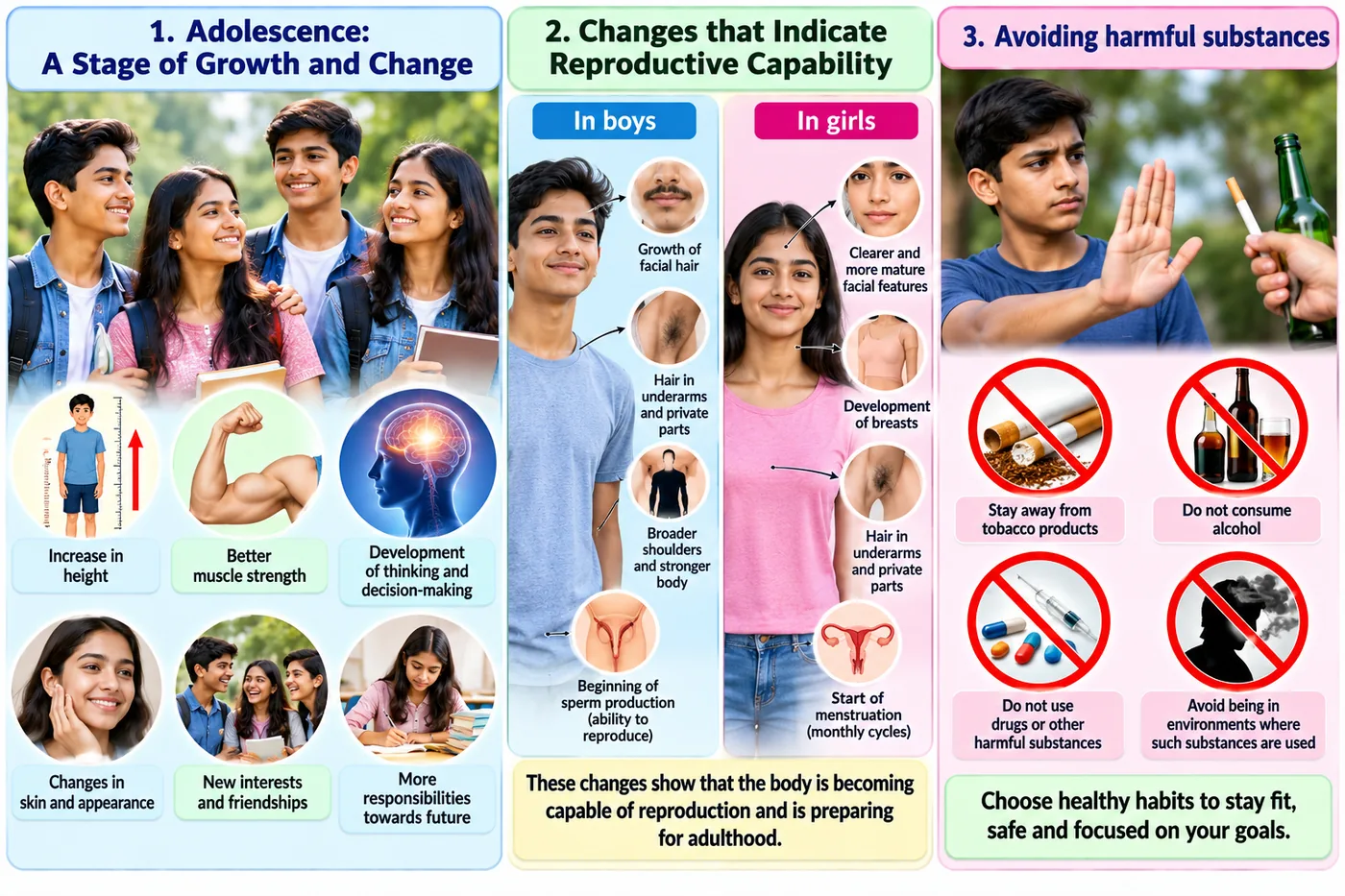
3. Physical Changes
Changes in both boys and girls
- Increase in height — a sudden growth spurt as long bones of arms and legs grow.
- Increased strength and change in body shape.
- Hair growth in the underarms and the pubic region.
- More active sweat and oil glands — many teenagers get pimples (acne) and body odour.
- Development of thinking and decision-making abilities.
Changes that indicate reproductive capability
| Boys | Girls |
|---|---|
| Growth of facial hair (moustache, beard) | Development of breasts |
| Voice becomes deeper; the voice box (larynx) grows and may show as the Adam’s apple | Voice becomes higher and more mature |
| Shoulders broaden; muscles become stronger | Region below the waist (hips) widens |
| Testes begin producing sperm | Ovaries begin releasing eggs; menstruation (monthly cycle) begins |
Menstruation is a natural process. Its first occurrence is called menarche. Menstrual cycles help prepare the body for reproduction in adulthood. Clean sanitary pads or cloth, changing them regularly, and proper disposal keep girls healthy.
4. Why Do These Changes Happen? — Hormones
These changes are controlled by hormones — chemical messengers released into the blood by special glands. At puberty, hormones from the pituitary gland (at the base of the brain) signal the testes in boys to produce testosterone and the ovaries in girls to produce oestrogen. These hormones cause the changes described above.
5. Emotional and Behavioural Changes
- Mood swings — feeling happy, irritated or sad quickly.
- Wanting more independence and privacy.
- Becoming conscious of looks and of what friends think (peer pressure).
- New interests, deeper friendships and curiosity about one’s body.
- Greater ability to think, question and take responsibility.
These feelings are normal. Talking to parents, teachers, elder siblings or a school counsellor helps. Reliable information protects against myths and wrong beliefs.
6. Making Adolescence a Joyful Experience
| Area | Healthy habits |
|---|---|
| Nutrition | Balanced diet with proteins (pulses, milk, eggs), iron (green leafy vegetables, jaggery), calcium (milk, ragi) and fruits; avoid junk food. Iron is especially important for adolescent girls to prevent anaemia. |
| Hygiene | Bathe daily, wash face to prevent pimples, wear clean clothes, maintain menstrual hygiene. |
| Exercise and sleep | Daily physical activity or sports; 8–9 hours of sleep. |
| Mental health | Share feelings; pursue hobbies; avoid comparing yourself with others. |
| Safety | Say no to tobacco, alcohol and drugs; avoid places where they are used; be careful online. |
Tobacco, alcohol and drugs harm the brain, lungs, liver and heart and can cause addiction. Peer pressure is not a reason to try them. If anyone offers them, refuse firmly and inform a trusted adult.
7. The “Why” Question for Adolescence
Why does the body change? These changes prepare the body for adulthood, including the ability to reproduce, which allows life to continue from one generation to the next. Understanding them scientifically removes fear and embarrassment and helps us respect each other.
8. Master Table: Key Terms
| Term | Meaning |
|---|---|
| Adolescence | Period between childhood and adulthood (about 10–19 years) |
| Puberty | Phase of physical changes leading to reproductive maturity |
| Hormones | Chemical messengers released into blood by glands |
| Testosterone | Male hormone produced by testes |
| Oestrogen | Female hormone produced by ovaries |
| Menstruation / Menarche | Monthly cycle in girls / its first occurrence |
| Adam’s apple | Bulge of the growing voice box in the throat of boys |
9. Master Summary Table
| Change | Boys | Girls | Both |
|---|---|---|---|
| Height | Growth spurt | Growth spurt (often earlier) | ✔ |
| Voice | Deeper | Higher, mature | Changes |
| Body hair | Facial, underarm, pubic | Underarm, pubic | ✔ |
| Body shape | Broad shoulders | Wider hips, breasts | — |
| Reproductive | Sperm production | Menstruation begins | — |
| Skin | Active oil and sweat glands — acne | ✔ | |
10. Mind Map
- Height, hair, voice
- Reproductive maturity
- Pituitary
- Testosterone, oestrogen
- Mood swings
- Independence, peer pressure
- Diet, hygiene, exercise
- No tobacco, alcohol, drugs
11. Tips and Tricks
- Testosterone — Testes; Oestrogen — Ovaries.
- In answers about diet, mention iron (anaemia) and calcium (bones) for teenagers.
- For emotional changes, always add a positive coping method (talk to a trusted adult).
- Thinking changes must start at the same age for everyone.
- Believing myths (for example, that girls should not exercise or bathe during periods).
- Saying only boys grow taller — both boys and girls have growth spurts.
12. Important One-liners
- Adolescence spans roughly 10–19 years of age.
- Puberty brings reproductive maturity.
- Hormones are chemical messengers carried by blood.
- Testes produce testosterone; ovaries produce oestrogen.
- The voice box grows in boys, forming the Adam’s apple.
- Menstruation is a natural monthly cycle in girls.
- Pimples appear due to active oil glands in the skin.
- Adolescents need a protein-, iron- and calcium-rich diet.
- Saying no to tobacco, alcohol and drugs protects health.
13. Exam-pattern Questions with Detailed Answers
The hormone produced by the testes is:
- Oestrogen
- Testosterone
- Insulin
- Thyroxine
Show answer
Testes produce testosterone; oestrogen comes from ovaries; insulin and thyroxine come from other glands.
Answer: (B) Testosterone
What is puberty?
Show answer
The phase of adolescence during which the body undergoes changes leading to reproductive maturity.
Answer: Changes leading to reproductive maturity
Why do many teenagers get pimples?
Show answer
Oil and sweat glands in the skin become more active during adolescence, which can block pores and cause pimples.
Answer: Increased activity of oil glands
List two changes during adolescence seen only in boys and two only in girls.
Show answer
Boys: facial hair, deeper voice, broader shoulders. Girls: development of breasts, start of menstruation, widening of hips.
Answer: Facial hair, deep voice; breasts, menstruation
Why is iron important in the diet of adolescent girls?
Show answer
Iron is needed to make blood. Girls lose some blood during menstruation and are at risk of anaemia, so iron-rich foods like green leafy vegetables, jaggery and pulses are important.
Answer: To prevent anaemia
What are hormones? Name the gland that controls the release of sex hormones.
Show answer
Hormones are chemical messengers released by glands into the blood. The pituitary gland signals the testes and ovaries to produce sex hormones.
Answer: Chemical messengers; pituitary gland
Suggest three ways to handle mood swings during adolescence.
Show answer
Talk to parents, teachers or friends; take part in sports, music or hobbies; get enough sleep and exercise; write a diary; seek a counsellor’s help if needed.
Answer: Talk, stay active, rest well
Why should adolescents avoid junk food?
Show answer
The body is growing fast and needs proteins, vitamins and minerals. Junk food is high in fat, sugar and salt but low in nutrients, leading to weakness, obesity and poor growth.
Answer: Low nutrition, high fat/sugar — harms growth
Two classmates of the same age differ a lot in height. One feels worried. What would you tell him?
Show answer
The age at which the growth spurt begins differs from person to person due to hormones, heredity and nutrition. Both are normal. Eating well, exercising and sleeping enough support healthy growth; there is no need to compare.
Answer: Growth timing varies; it is normal
A friend offers you a cigarette saying “everyone tries it”. How should you respond and why?
Show answer
Refuse firmly and walk away; tell a trusted adult if pressure continues. Tobacco contains nicotine, which is addictive and damages the lungs and heart and causes cancer. Peer pressure is not a good reason to harm your health.
Answer: Say no — tobacco is addictive and harmful
Why is personal hygiene especially important during adolescence?
Show answer
Increased sweating and oil secretion can cause body odour, pimples and infections. Daily bathing, clean clothes and menstrual hygiene prevent these problems and build confidence.
Answer: Active glands — hygiene prevents odour, acne, infections
14. Quick Revision Summary
- Adolescence: about 10–19 years; puberty brings reproductive maturity.
- Changes: height, body hair, voice, shape; sperm production in boys, menstruation in girls.
- Hormones from testes (testosterone) and ovaries (oestrogen), controlled by the pituitary.
- Emotional changes are normal — talk to trusted adults.
- Balanced diet, hygiene, exercise, sleep; say no to tobacco, alcohol and drugs.