
1. Chapter at a Glance
Ice melts, milk turns into curd, paper is torn, wood burns, an iron gate rusts and huge rocks slowly crumble into soil. Changes are happening all around us. Some changes only alter the shape, size or state of a substance; others form completely new substances. This chapter teaches how to tell physical changes from chemical changes, and looks at combustion, rusting, crystallisation and slow natural changes such as weathering and erosion.
- Physical change — no new substance; often reversible.
- Chemical change — new substance formed; signs of a chemical change.
- Examples: rusting, combustion, curdling of milk, burning of a candle.
- Reversible and irreversible, desirable and undesirable changes.
- Crystallisation; slow natural changes — weathering and erosion.
2. Physical Changes
In a physical change, the shape, size, colour or state of a substance changes, but no new substance is formed. Many physical changes can be reversed.
- Melting of ice and freezing of water.
- Dissolving sugar or salt in water (the salt can be recovered by evaporation).
- Tearing or folding paper, cutting vegetables, breaking glass.
- Heating a metal wire until it glows — it becomes the same wire again on cooling.
- Stretching a rubber band; boiling water into steam.
3. Chemical Changes
In a chemical change, one or more new substances with different properties are formed. Chemical changes are usually irreversible. A chemical change is also called a chemical reaction.
- Heat, light or sound is given out or absorbed.
- A gas is produced (bubbles, fizz).
- Colour changes.
- A new smell appears.
- A solid (precipitate) forms.
| Example | What happens | New substance |
|---|---|---|
| Burning magnesium ribbon | Dazzling white light, white ash | Magnesium oxide |
| Vinegar + baking soda | Fizzing; gas turns lime water milky | Carbon dioxide (and others) |
| Iron in moist air | Reddish-brown flakes | Rust |
| Milk → curd | Taste and texture change | Curd (bacteria act on milk) |
| Cooking food, ripening fruit | Taste, colour and smell change | New substances |
| Cut apple turning brown | Colour change in air | New brown substances |
Carbon dioxide + Lime water → milky (white solid forms) — test for carbon dioxide
4. Combustion
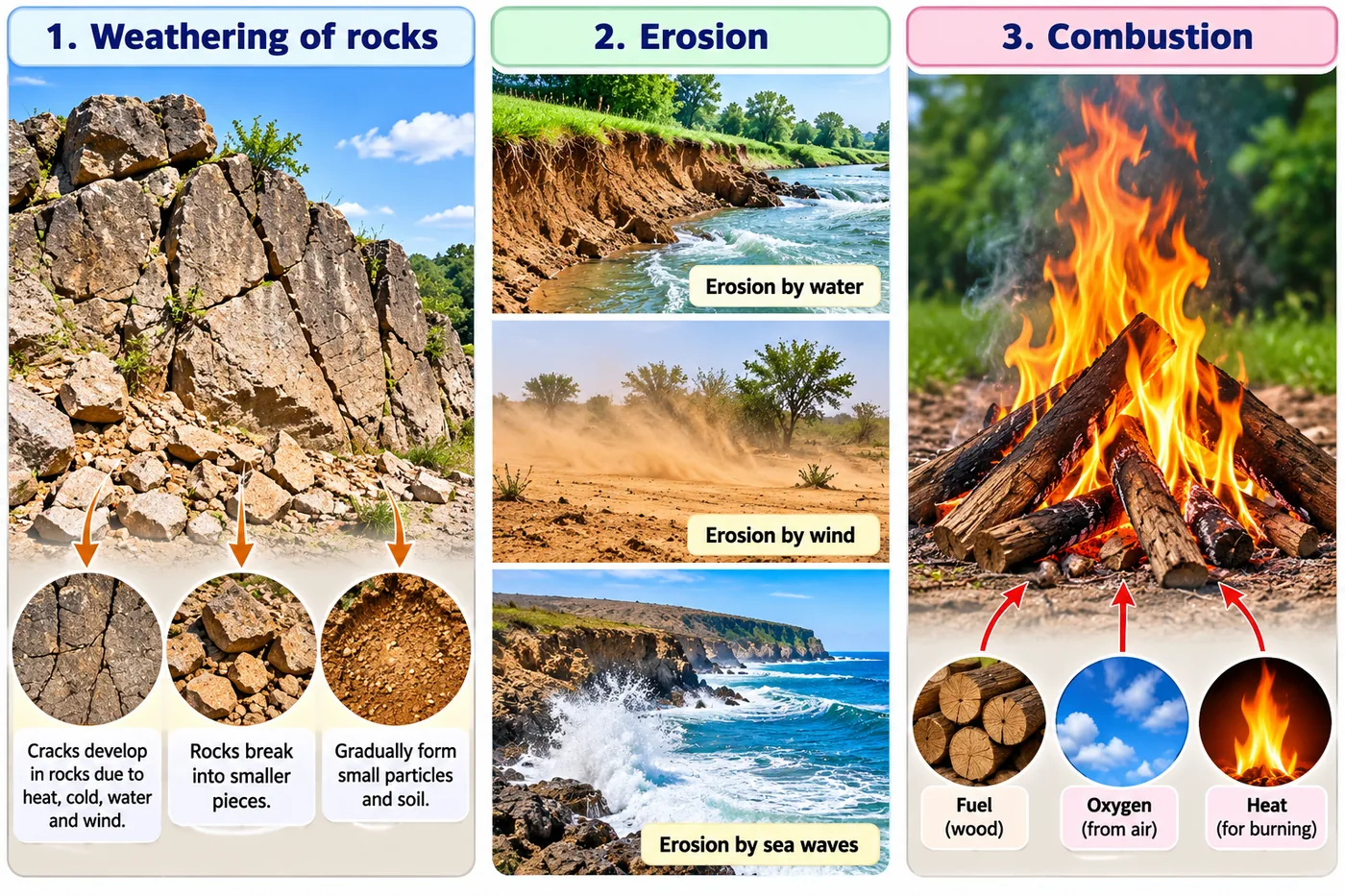
Combustion (burning) is a chemical change in which a substance reacts with oxygen and gives out heat and light. For combustion three things are needed — the fire triangle:
- Fuel — a substance that burns (wood, LPG, kerosene, coal).
- Oxygen — from air (supporter of combustion).
- Heat — to raise the fuel to its ignition temperature (the lowest temperature at which it catches fire).
Removing any one stops the fire: water cools the fuel below ignition temperature; a blanket or sand cuts off oxygen; removing fuel (fire lines in forests) stops spreading. Fires involving electricity or oil are not put out with water — fire extinguishers using carbon dioxide are used.
5. Physical and Chemical Changes in One Process
A burning candle shows both. Wax melts and then solidifies again (physical change), while the wax vapour near the flame burns to form carbon dioxide and water vapour with heat and light (chemical change). Similarly, when food is cooked, chopping is physical but cooking is chemical.
6. Crystallisation
Large, pure crystals of a substance can be obtained from its solution. Dissolve copper sulphate in hot water (with a few drops of dilute sulphuric acid, by the teacher) until no more dissolves, filter and let it cool slowly. Beautiful blue crystals form. This is crystallisation — a physical change, since the same substance is recovered. Salt obtained by simple evaporation of seawater has small crystals and impurities; crystallisation gives purer, bigger crystals.
7. Classifying Changes
| Type | Meaning | Examples |
|---|---|---|
| Reversible | Can be undone | Melting of wax, dissolving salt, folding paper |
| Irreversible | Cannot be undone | Burning paper, cooking rice, curd from milk |
| Desirable | Useful to us | Ripening of fruit, digestion, cooking, making curd |
| Undesirable | Harmful or unwanted | Rusting, spoiling of food, forest fires |
| Slow | Takes a long time | Rusting, weathering of rocks, growth of a tree |
| Fast | Happens quickly | Burning of a matchstick, bursting of a cracker |
8. Some Slow Natural Changes
Weathering is the slow breaking down of rocks into smaller pieces and finally soil by heat, cold, water, wind and living things. Day–night heating and cooling make rocks expand and contract, forming cracks; water freezing in cracks widens them; plant roots also split rocks.
Erosion is the carrying away of the broken pieces and soil from one place to another by flowing water, wind, sea waves and glaciers. Trees and grass hold soil and reduce erosion.
9. Master Table: Key Terms
| Term | Meaning |
|---|---|
| Physical change | No new substance; shape, size, state change |
| Chemical change | New substance formed; usually irreversible |
| Combustion | Fuel + oxygen → heat + light (+ new substances) |
| Ignition temperature | Lowest temperature at which a substance catches fire |
| Fire triangle | Fuel + oxygen + heat |
| Rusting | Iron + oxygen + water → rust |
| Crystallisation | Getting pure crystals from a solution |
| Weathering / Erosion | Breaking of rocks / carrying away of soil and rock pieces |
10. Master Summary Table
| Feature | Physical change | Chemical change |
|---|---|---|
| New substance | No | Yes |
| Reversible? | Usually | Usually not |
| Energy change | Small | Often heat/light given out |
| Examples | Melting, dissolving, tearing | Burning, rusting, curdling |
11. Mind Map
- No new substance
- Melting, dissolving
- New substance
- Gas, colour, heat, light
- Combustion, rusting
- Candle — both
- Weathering, erosion
- Crystallisation
12. Tips and Tricks
- Ask one question: “Is a new substance formed?” Yes → chemical; No → physical.
- Fire triangle: “F-O-H” — Fuel, Oxygen, Heat.
- Lime water turning milky = carbon dioxide present.
- Calling dissolving of sugar a chemical change — sugar can be recovered.
- Saying a burning candle shows only a chemical change — it shows both.
- Calling all irreversible changes chemical — breaking glass is irreversible but physical.
13. Important One-liners
- In a physical change no new substance is formed.
- In a chemical change new substances are formed.
- Burning of magnesium gives white magnesium oxide.
- Carbon dioxide turns lime water milky.
- Rusting needs oxygen and water.
- Combustion needs fuel, oxygen and heat.
- Crystallisation gives large pure crystals.
- Weathering breaks rocks; erosion carries them away.
- Curdling of milk is a chemical change.
14. Exam-pattern Questions with Detailed Answers
Which is a chemical change?
- Melting of ice
- Tearing of paper
- Burning of wood
- Dissolving salt
Show answer
Burning forms new substances (ash, gases) with heat and light. The others are physical changes.
Answer: (C) Burning of wood
Which gas turns lime water milky?
Show answer
Carbon dioxide reacts with lime water to form a white solid, making it milky.
Answer: Carbon dioxide
Name the three things needed for combustion.
Show answer
Fuel, oxygen (air) and heat (to reach ignition temperature).
Answer: Fuel, oxygen, heat
Explain why burning of a candle shows both physical and chemical changes.
Show answer
Melting of wax and its solidifying again is a physical change. Burning of wax vapour forms carbon dioxide and water with heat and light — a chemical change.
Answer: Melting (physical) + burning (chemical)
Why is water used to put out a wood fire?
Show answer
Water cools the burning wood below its ignition temperature, and steam formed also cuts off air. So the fire stops.
Answer: Cools below ignition temperature
Classify as desirable or undesirable: ripening of fruit, rusting of a gate, digestion, spoiling of milk.
Show answer
Desirable: ripening of fruit, digestion. Undesirable: rusting of a gate, spoiling of milk.
Answer: Ripening, digestion — desirable; rusting, spoiling — undesirable
What is weathering? Name two agents that cause it.
Show answer
Weathering is the slow breaking of rocks into smaller pieces and soil. Agents: changes in temperature (heating and cooling), water freezing in cracks, wind, plant roots.
Answer: Breakdown of rocks; temperature changes, water, roots
Is crystallisation a physical or chemical change? Why?
Show answer
Physical — the same substance (e.g. copper sulphate) is obtained as crystals; no new substance forms.
Answer: Physical change
When vinegar is added to baking soda, it fizzes. How will you prove that a new substance is formed?
Show answer
Pass the gas produced into lime water through a delivery tube. The lime water turns milky, showing carbon dioxide — a new gas — has formed. So it is a chemical change.
Answer: Gas turns lime water milky → CO₂ formed
Why should water not be used on a fire caused by electricity or petrol?
Show answer
Water conducts electricity and can give shocks. Petrol and oil are lighter than water and float on it, so the burning oil spreads. Such fires are put out with carbon dioxide or sand that cut off oxygen.
Answer: Shock risk; burning oil floats and spreads
A cut apple turns brown in air. Is this a physical or chemical change? Suggest a way to slow it.
Show answer
Chemical change — substances in the apple react with oxygen to form new brown substances. Applying lemon juice or keeping slices in water reduces contact with air and slows browning.
Answer: Chemical; lemon juice or water reduces air contact
15. Quick Revision Summary
- Physical change: no new substance, often reversible (melting, dissolving).
- Chemical change: new substance with signs like gas, colour, heat, light (burning, rusting, curdling).
- Combustion needs fuel, oxygen and heat; remove one to stop fire.
- Candle shows both changes; crystallisation is physical.
- Weathering breaks rocks; erosion by water, wind and waves carries them away.