
1. Chapter at a Glance
A steel spoon in hot tea becomes hot at its handle. Water heated at the bottom of a pan gets hot all over. We feel the warmth of the Sun even though space is empty. In each case heat travels — from a hotter object to a colder one. This chapter explains the three ways of heat transfer — conduction, convection and radiation — and how they create sea and land breezes, drive the water cycle and even affect water stored under the ground.
- Heat always flows from a hotter to a colder body.
- Conduction; good and poor conductors of heat.
- Convection in liquids and gases; sea breeze and land breeze.
- Radiation; dark and light coloured surfaces.
- The water cycle, infiltration, groundwater and aquifers.
2. Conduction
Heat one end of a metal rod with wax drops (or pins stuck with wax) along it. The wax nearest the flame melts first, then the next, and so on. Heat moves along the rod from the hot end to the cold end, from particle to particle, without the particles moving from their places. This is conduction. It mainly happens in solids.
- Good conductors let heat pass easily — metals like copper, aluminium, iron, silver.
- Poor conductors (insulators) do not — wood, plastic, rubber, cloth, air, glass.
So cooking pots are made of metals while their handles are plastic or wood. Woollen clothes keep us warm because air trapped between fibres is a poor conductor. In winter, a metal chair feels colder than a wooden one at the same temperature because metal conducts heat away from our hand faster.
3. Convection
Put a few crystals of potassium permanganate at the bottom of a beaker of water and heat it gently from below. Coloured streaks rise up from the heated part and come down along the sides. Water near the heat becomes warm, lighter and rises; cooler, heavier water from above sinks to take its place. This circulation, in which the heated particles themselves move and carry heat, is convection. It happens in liquids and gases.
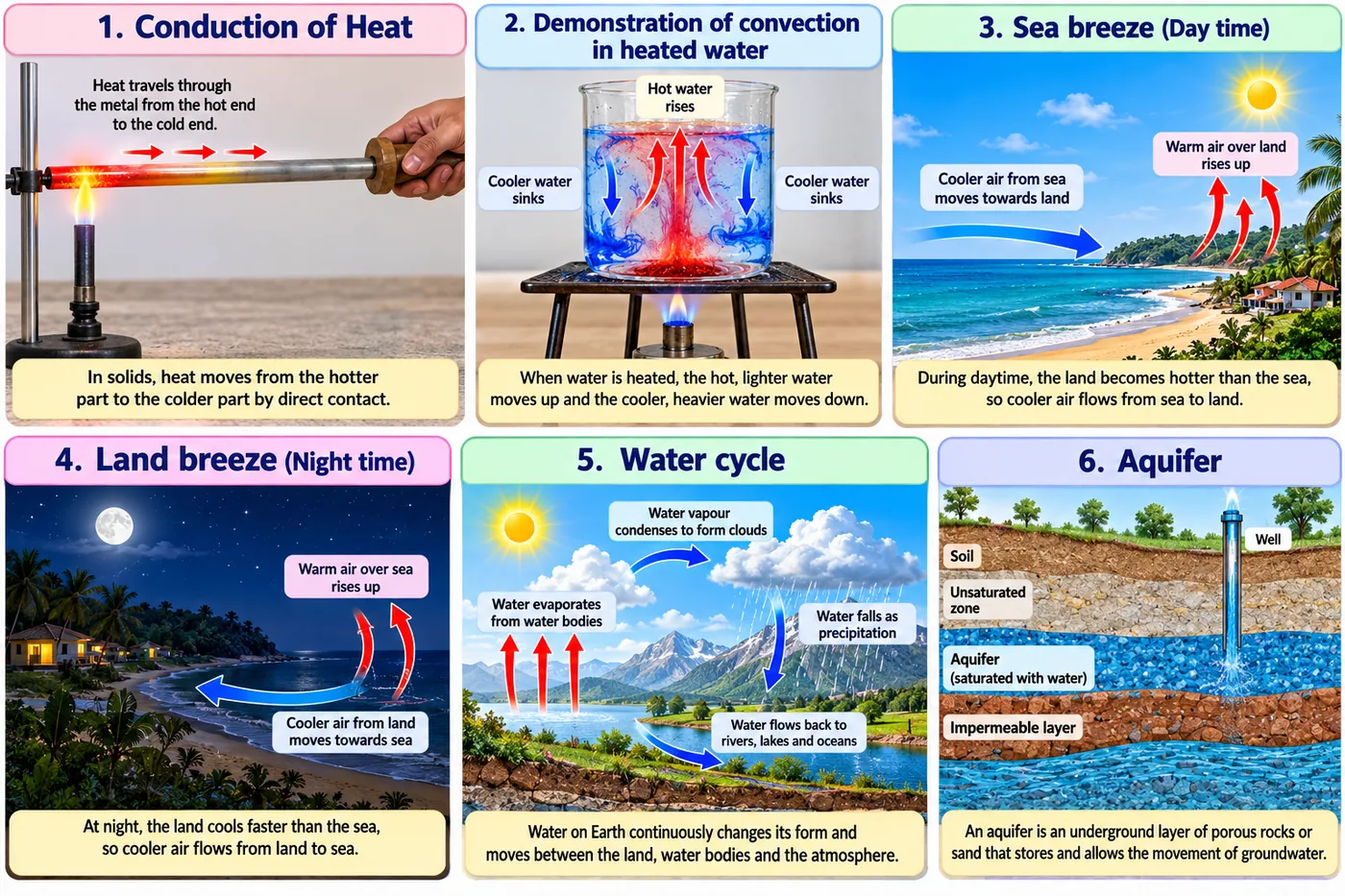
Sea breeze and land breeze
| Breeze | When | What happens | Direction |
|---|---|---|---|
| Sea breeze | Day | Land heats faster than sea; warm air over land rises; cooler air from the sea moves in | Sea → land |
| Land breeze | Night | Land cools faster than sea; warm air over sea rises; cooler air from land moves out | Land → sea |
Ventilators near the ceiling let warm, light air escape and cool air enter from windows below — another use of convection.
4. Radiation
Heat from the Sun reaches the Earth through empty space, where there are no particles to conduct or carry it. This transfer of heat without any medium is radiation. We also feel radiation when sitting near a fire or a heater.
- All hot objects give out heat by radiation.
- Dark-coloured surfaces absorb more heat; light-coloured surfaces reflect more. So we prefer light-coloured clothes in summer and dark ones in winter.
- Solar water heaters and solar cookers are painted black inside to absorb more heat.
| Mode | Medium needed? | Particles move? | Example |
|---|---|---|---|
| Conduction | Yes (mainly solids) | No — vibrate in place | Hot spoon handle |
| Convection | Yes (liquids, gases) | Yes — carry heat | Boiling water, sea breeze |
| Radiation | No | No medium | Sun’s heat, heat from a fire |
5. Heat and the Water Cycle
The Sun’s heat drives the water cycle. Water from oceans, rivers, lakes and plants evaporates; the warm moist air rises (convection), cools high above and the vapour condenses into clouds; water falls back as precipitation — rain, snow or hail — and flows back to water bodies.
6. Seepage of Water Beneath the Earth
Part of the rainwater soaks into the ground through soil and cracks in rocks. This process is called infiltration. The water collects below the surface as groundwater. The level up to which the ground is filled with water is the water table. A layer of porous rock or sand that holds groundwater and lets it flow is an aquifer; wells and hand pumps draw water from aquifers. A hard, impermeable layer below stops the water from going deeper.
Groundwater is being used faster than rain can refill it in many places. Rainwater harvesting, recharge pits and protecting ponds and forests help keep the water table from falling.
7. Master Table: Key Terms
| Term | Meaning |
|---|---|
| Conduction | Heat transfer from particle to particle without their movement (solids) |
| Convection | Heat carried by moving particles of liquids/gases |
| Radiation | Heat transfer without a medium |
| Good conductor / insulator | Passes heat easily / poorly |
| Sea breeze / Land breeze | Day: sea → land / Night: land → sea |
| Infiltration | Seeping of water into the ground |
| Water table | Upper level of groundwater |
| Aquifer | Underground porous layer holding usable water |
8. Master Summary Table
| Observation | Mode of heat transfer |
|---|---|
| Handle of a metal pan gets hot | Conduction |
| Smoke rises above a fire | Convection |
| Feeling warm in sunlight | Radiation |
| Cool breeze at the beach in the afternoon | Convection (sea breeze) |
| Black solar cooker heats up | Radiation (absorbed) |
Chart — how well materials conduct heat (compared with copper = 100):
Approximate comparison: metals conduct heat hundreds of times better than glass, wood or air.
9. Mind Map
- Solids
- Metals good; wood poor
- Liquids, gases
- Sea and land breeze
- No medium
- Dark absorbs more
- Water cycle
- Infiltration, aquifer
10. Tips and Tricks
- “Sea by Sun, Land by Moon” — sea breeze by day, land breeze by night.
- Conduction = Contact; Convection = Currents; Radiation = Rays (no medium).
- Land heats and cools faster than water — use this in every breeze question.
- Saying cold flows from ice to hand — heat flows from hand to ice.
- Writing that sea breeze blows at night.
- Saying radiation needs air — it travels even through vacuum.
11. Important One-liners
- Heat flows from a hotter object to a colder one.
- In solids heat travels mainly by conduction.
- Metals are good conductors of heat.
- In liquids and gases heat travels by convection.
- Heat from the Sun reaches us by radiation.
- Dark surfaces absorb more heat than light ones.
- Sea breeze blows during the day; land breeze at night.
- Infiltration recharges groundwater.
- An aquifer is a layer of rock or sand holding groundwater.
12. Exam-pattern Questions with Detailed Answers
Heat from the Sun reaches the Earth by:
- Conduction
- Convection
- Radiation
- All of these
Show answer
Space has almost no particles, so heat cannot be conducted or convected; it travels by radiation.
Answer: (C) Radiation
Name two good and two poor conductors of heat.
Show answer
Good: copper, aluminium. Poor: wood, plastic.
Answer: Copper, aluminium; wood, plastic
When does a land breeze blow?
Show answer
At night, when land cools faster than the sea, cool air moves from land to sea.
Answer: At night
Why do we wear light-coloured clothes in summer?
Show answer
Light colours reflect most of the Sun’s heat and absorb less, keeping us cooler. Dark colours absorb more heat.
Answer: They reflect more heat
Explain how a sea breeze is formed.
Show answer
During the day, land heats faster than water. Air above land becomes warm, light and rises. Cooler air from over the sea moves in to take its place, producing a breeze from sea to land.
Answer: Land heats faster → air rises → cool sea air flows in
Why are two thin blankets warmer than one thick blanket of the same total thickness?
Show answer
A layer of air is trapped between the two blankets. Air is a poor conductor of heat, so it reduces heat loss from the body.
Answer: Trapped air layer insulates
What is an aquifer? How do we get water from it?
Show answer
An aquifer is an underground layer of porous rock or sand that stores groundwater and lets it move. Wells, tube wells and hand pumps reach the aquifer to draw water.
Answer: Water-holding porous layer; tapped by wells
Why is a ventilator fixed near the ceiling of a room?
Show answer
Warm air from breathing and lamps is lighter and rises. A ventilator near the ceiling lets it escape while fresh, cooler air enters through windows — convection keeps the room airy.
Answer: Hot air rises and escapes (convection)
A steel tumbler and a plastic tumbler with the same hot milk are held. Which feels hotter to hold and why?
Show answer
The steel tumbler, because steel is a good conductor and quickly passes heat from the milk to the hand. Plastic is a poor conductor, so less heat reaches the hand.
Answer: Steel — good conductor
Explain why the water table in many cities is falling. Suggest two remedies.
Show answer
More groundwater is pumped out for homes, industries and farms than is refilled. Concrete roads and buildings reduce infiltration, and ponds and forests are lost. Remedies: rainwater harvesting with recharge pits; reducing wastage; protecting ponds and green spaces.
Answer: Over-use + less infiltration; harvest rain, save water
In the potassium permanganate experiment, the coloured water rises at the centre and falls along the sides. Explain.
Show answer
The flame heats the water at the centre of the bottom. This water expands, becomes lighter and rises, carrying colour upward. Cooler, denser water near the sides sinks to replace it, forming a convection current.
Answer: Heated water rises, cooler water sinks — convection current
13. Quick Revision Summary
- Heat flows from hot to cold.
- Conduction (solids, metals good), convection (liquids, gases, moving particles), radiation (no medium).
- Sea breeze by day, land breeze by night — land heats and cools faster than water.
- Dark surfaces absorb more heat; light ones reflect.
- Water cycle is driven by the Sun; infiltration fills aquifers; save groundwater.