
1. Chapter at a Glance
Cooking pots, electric wires, bridges, jewellery and coins are made of metals. Pencil lead, the oxygen we breathe and the sulphur in matchsticks are non-metals. Metals and non-metals behave very differently — in how they look, sound, bend, conduct heat and electricity, and react with air and water. Knowing these properties helps us choose the right material for each job.
- Physical properties: lustre, hardness, malleability, ductility, sonority, conduction of heat and electricity.
- Comparing metals and non-metals and exceptions to the rules.
- Reaction of metals and non-metals with oxygen; nature of their oxides.
- Effect of air and water on iron — rusting and its prevention.
- Uses of metals and non-metals.
2. Physical Properties
| Property | Meaning | Metals | Non-metals |
|---|---|---|---|
| Lustre | Shine | Lustrous (shiny when fresh) | Dull (iodine and graphite are exceptions with shine) |
| Hardness | Resistance to scratching | Generally hard (sodium, potassium are soft) | Generally soft or brittle solids; many are gases |
| Malleability | Can be beaten into thin sheets | Malleable — aluminium foil, silver varq | Not malleable; brittle (break into pieces) |
| Ductility | Can be drawn into wires | Ductile — copper and aluminium wires | Not ductile |
| Sonority | Produces a ringing sound when struck | Sonorous — school bells, temple bells | Not sonorous |
| Heat conduction | Allows heat to pass | Good conductors — cooking pots | Poor conductors |
| Electrical conduction | Allows current to pass | Good conductors — wires | Poor conductors (graphite is an exception) |
| State at room temperature | — | Solids (mercury is a liquid) | Solid, liquid (bromine) or gas (oxygen, nitrogen) |
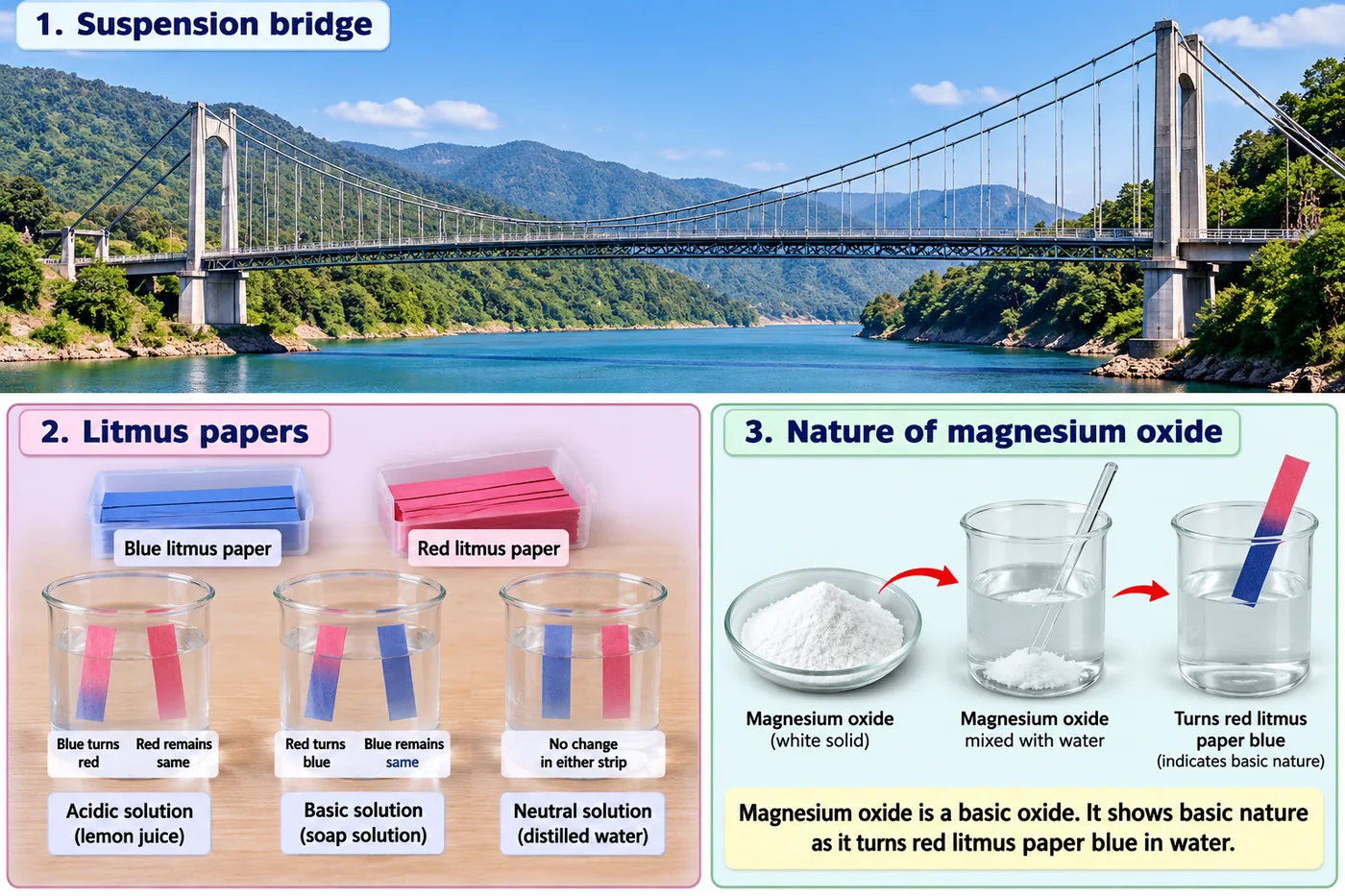
Because metals are strong, malleable and ductile, steel is used for buildings, rails and bridges. A suspension bridge hangs on thick steel cables — made possible by the strength and ductility of metal.
3. Reaction with Oxygen — Nature of Oxides
Burn a magnesium ribbon in air: it burns with a dazzling white flame and forms a white powder, magnesium oxide. Dissolve it in water and test with litmus: it turns red litmus blue. So the oxide of this metal is basic.
Magnesium + Oxygen → Magnesium oxide (basic)
Burn a little sulphur (in a deflagrating spoon, by the teacher) and collect the gas in a jar with some water. The solution turns blue litmus red. The oxide of this non-metal is acidic.
Sulphur + Oxygen → Sulphur dioxide (acidic)
Oxides of metals are generally basic; oxides of non-metals are generally acidic.
4. Effect of Air and Water on Iron — Rusting
An iron nail left in moist air gets a reddish-brown coating called rust. Experiments with three test tubes show the conditions needed:
| Test tube | Air | Water | Rust? |
|---|---|---|---|
| Nail in tap water, open | Yes | Yes | Yes |
| Nail in boiled water with oil layer (no air) | No | Yes | No |
| Nail with dry calcium chloride (no moisture) | Yes | No | No |
So rusting needs both oxygen (air) and water (moisture). It is faster in coastal areas because salty, humid air speeds it up. Rust is a new substance, so rusting is a chemical change; it weakens iron objects.
Prevention: painting, oiling or greasing, galvanisation (coating iron with zinc), and making alloys like stainless steel (iron with chromium and nickel).
Gold and silver are less reactive — they do not rust and keep their shine, which is why they are used for jewellery. Silver slowly turns black and copper turns green in air, but they do not rust like iron.
5. Uses of Metals and Non-metals
| Substance | Type | Use | Property used |
|---|---|---|---|
| Copper | Metal | Electric wires | Ductile, good electrical conductor |
| Aluminium | Metal | Foil, utensils, aircraft | Malleable, light, conducts heat |
| Iron / steel | Metal | Bridges, machines, rails | Strong, hard |
| Gold, silver | Metals | Jewellery | Lustrous, does not corrode easily |
| Oxygen | Non-metal | Breathing, burning, hospitals | Supports life and combustion |
| Carbon | Non-metal | Fuel (coal), pencil lead (graphite) | Burns; graphite is soft and conducts |
| Nitrogen, phosphorus | Non-metals | Fertilisers | Plant nutrients |
| Chlorine | Non-metal | Purifying water | Kills germs |
| Sulphur | Non-metal | Matchsticks, medicines | Burns easily |
6. Master Table: Key Terms
| Term | Meaning |
|---|---|
| Malleability | Can be hammered into thin sheets |
| Ductility | Can be drawn into thin wires |
| Sonority | Gives a ringing sound when struck |
| Lustre | Shiny surface |
| Brittle | Breaks into pieces when hammered |
| Metal oxide | Generally basic (turns red litmus blue) |
| Non-metal oxide | Generally acidic (turns blue litmus red) |
| Rusting | Iron + oxygen + water → rust (reddish-brown) |
| Galvanisation | Coating iron with zinc to prevent rusting |
7. Master Summary Table
| Rule | Exception |
|---|---|
| Metals are solids | Mercury is liquid |
| Metals are hard | Sodium, potassium can be cut with a knife |
| Non-metals do not conduct electricity | Graphite conducts |
| Non-metals are dull | Iodine and graphite are shiny |
| Non-metals are soft | Diamond (carbon) is the hardest natural substance |
8. Mind Map
- Lustrous, malleable, ductile
- Sonorous, good conductors
- Dull, brittle
- Poor conductors
- Metal oxide: basic
- Non-metal oxide: acidic
- Air + water
- Paint, oil, galvanise
9. Tips and Tricks
- “Metal oxide = Makes red litmus blue (basic).”
- Ductile → Draw wires; Malleable → Make sheets.
- Rust needs “Air + Water” — AW, remove either and rust stops.
- Saying all metals are solids — mercury is liquid.
- Saying no non-metal conducts electricity — graphite does.
- Calling rusting a physical change — rust is a new substance.
10. Important One-liners
- Metals are lustrous, malleable, ductile and sonorous.
- Copper and aluminium are used for electric wires.
- Mercury is a metal that is liquid at room temperature.
- Graphite is a non-metal that conducts electricity.
- Magnesium burns with a dazzling white flame.
- Magnesium oxide is basic; sulphur dioxide is acidic.
- Rusting needs both air and moisture.
- Galvanisation is coating iron with zinc.
- Gold does not rust, so it is used for jewellery.
11. Exam-pattern Questions with Detailed Answers
The property of metals by which they can be drawn into wires is:
- Malleability
- Ductility
- Sonority
- Lustre
Show answer
Ductility = drawing into wires. Malleability is beating into sheets; sonority is ringing sound; lustre is shine.
Answer: (B) Ductility
Name a metal that is liquid at room temperature.
Show answer
Mercury is a liquid metal at room temperature.
Answer: Mercury
Why are school bells made of metals?
Show answer
Metals are sonorous — they produce a ringing sound when struck.
Answer: Sonority
Magnesium oxide dissolved in water turns red litmus blue. What does this show?
Show answer
The solution is basic, so magnesium oxide is a basic oxide. Metal oxides are generally basic.
Answer: Metal oxides are basic
Why are cooking utensils made of metals but their handles of plastic or wood?
Show answer
Metals conduct heat well, so food cooks quickly. Plastic and wood are poor conductors, so handles stay cool and safe to hold.
Answer: Metal conducts heat; handle insulates
State the conditions necessary for rusting. How can it be prevented?
Show answer
Both oxygen (air) and water (moisture) are needed. Prevent by painting, oiling or greasing, galvanising with zinc, or using stainless steel.
Answer: Air + water; paint, oil, galvanise
Why does iron rust faster in coastal areas?
Show answer
Air near the sea is humid and contains salt. More moisture and salt speed up rusting.
Answer: Humid, salty air
Give two exceptions to the general properties of non-metals.
Show answer
Graphite conducts electricity; iodine is lustrous; diamond is extremely hard; bromine is a liquid.
Answer: e.g. graphite conducts, iodine is shiny
Three iron nails are kept in (A) tap water in an open tube, (B) boiled water covered with oil, (C) dry air with calcium chloride. Which rusts and why?
Show answer
Only A rusts — it has both air and water. In B, boiling removes dissolved air and oil stops new air entering. In C, calcium chloride absorbs moisture, so there is no water.
Answer: A only — both air and water present
Two unlabelled solutions are made: one by dissolving the white ash of burnt magnesium in water, the other by dissolving the gas from burnt sulphur in water. How will you identify which solution came from a metal?
Show answer
Test both solutions with litmus. The one turning red litmus blue is basic — from magnesium (a metal). The one turning blue litmus red is acidic — from sulphur (a non-metal).
Answer: Basic solution → metal oxide
Suggest a material for each and give the property: (a) wire for a house, (b) foil for wrapping food, (c) frame of a bridge, (d) a sweet decoration.
Show answer
(a) Copper — ductile, conducts electricity. (b) Aluminium — malleable, light, non-toxic. (c) Steel — strong, hard. (d) Silver varq — highly malleable, non-toxic in tiny amounts.
Answer: Copper, aluminium, steel, silver
12. Quick Revision Summary
- Metals: lustrous, hard, malleable, ductile, sonorous, good conductors; mercury is liquid.
- Non-metals: dull, brittle, poor conductors; graphite, iodine, diamond are exceptions.
- Metal oxides are basic; non-metal oxides are acidic.
- Rusting needs air and water; prevent by paint, oil, galvanisation, alloys.
- Choose materials by their properties — copper for wires, aluminium for foil, steel for bridges.