
1. Chapter at a Glance
Switch on a torch and it lights up; switch it off and it goes dark. What happens inside? A torch is a simple electric circuit — a closed path through which electric current flows from a source (cells) through a device (lamp) and back. This chapter explains the parts of a circuit, how to draw circuits with symbols, how switches work, and which materials allow current to pass.
- Parts of a torch and an electric cell; battery of cells.
- Incandescent lamp and LED, their terminals and polarity.
- Simple, closed and open circuits; the role of a switch.
- Circuit symbols and circuit diagrams.
- Conductors and insulators; safety with electricity.
2. The Electric Cell and Battery
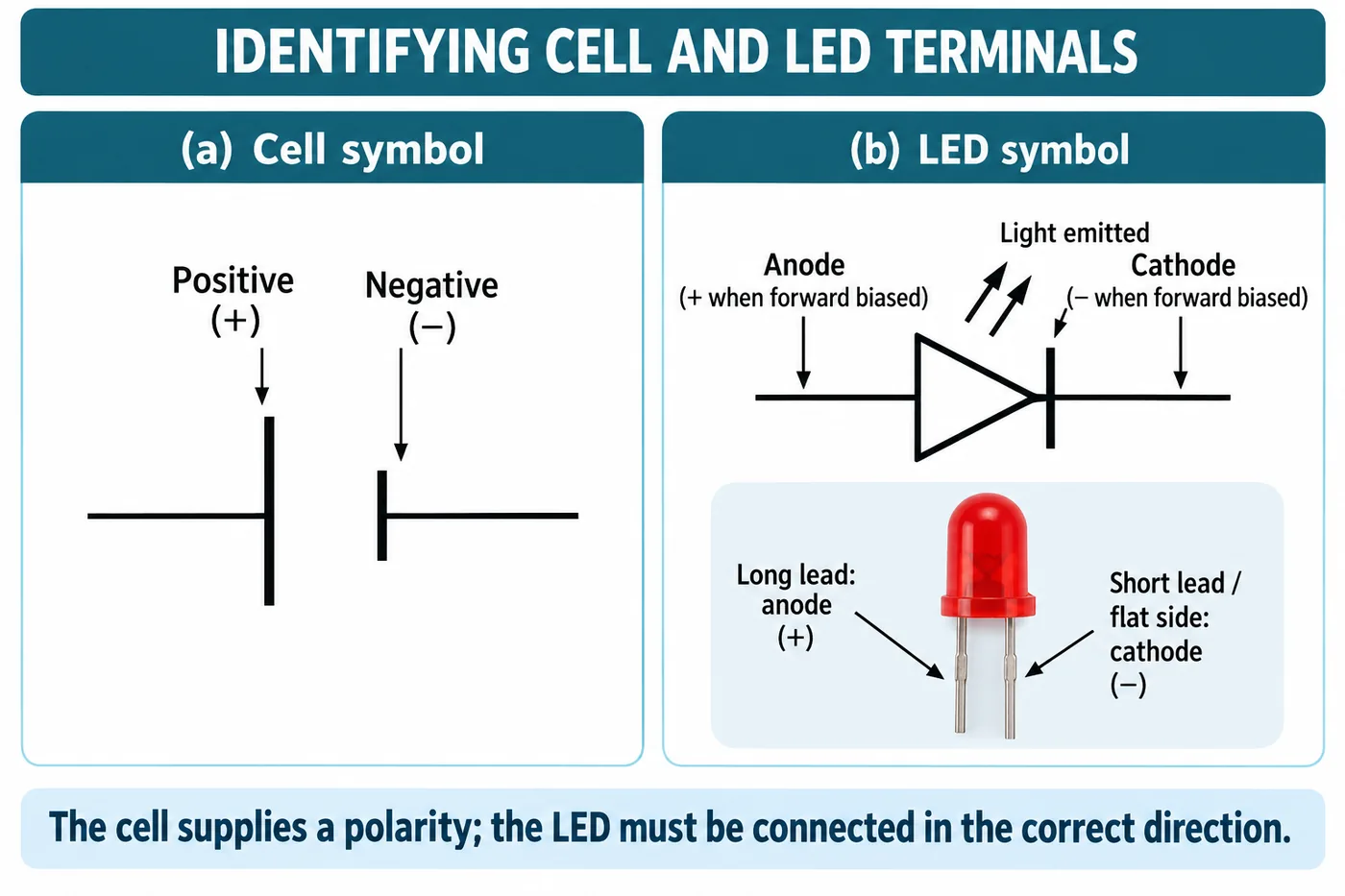
An electric cell is a source of electricity. It has two terminals: a positive terminal (+), the metal cap, and a negative terminal (−), the flat metal base. A cell produces electricity from chemicals stored inside it; when the chemicals are used up, the cell stops working and must be replaced (or recharged, if rechargeable).
Two or more cells joined together form a battery. In a torch, cells are placed one after another so that the positive terminal of one touches the negative terminal of the next. A battery gives more electrical push than a single cell, so the lamp glows brighter.
3. Electric Lamp and LED
| Feature | Incandescent lamp (bulb) | LED (light emitting diode) |
|---|---|---|
| How it gives light | A thin coiled wire (filament) gets very hot and glows | A special material glows when current passes |
| Terminals | Two; can be connected either way | Two leads: longer = positive (anode), shorter = negative (cathode) |
| Direction | Glows in either direction | Glows only when connected the right way |
| Energy use | Wastes much energy as heat | Uses much less electricity; lasts longer |
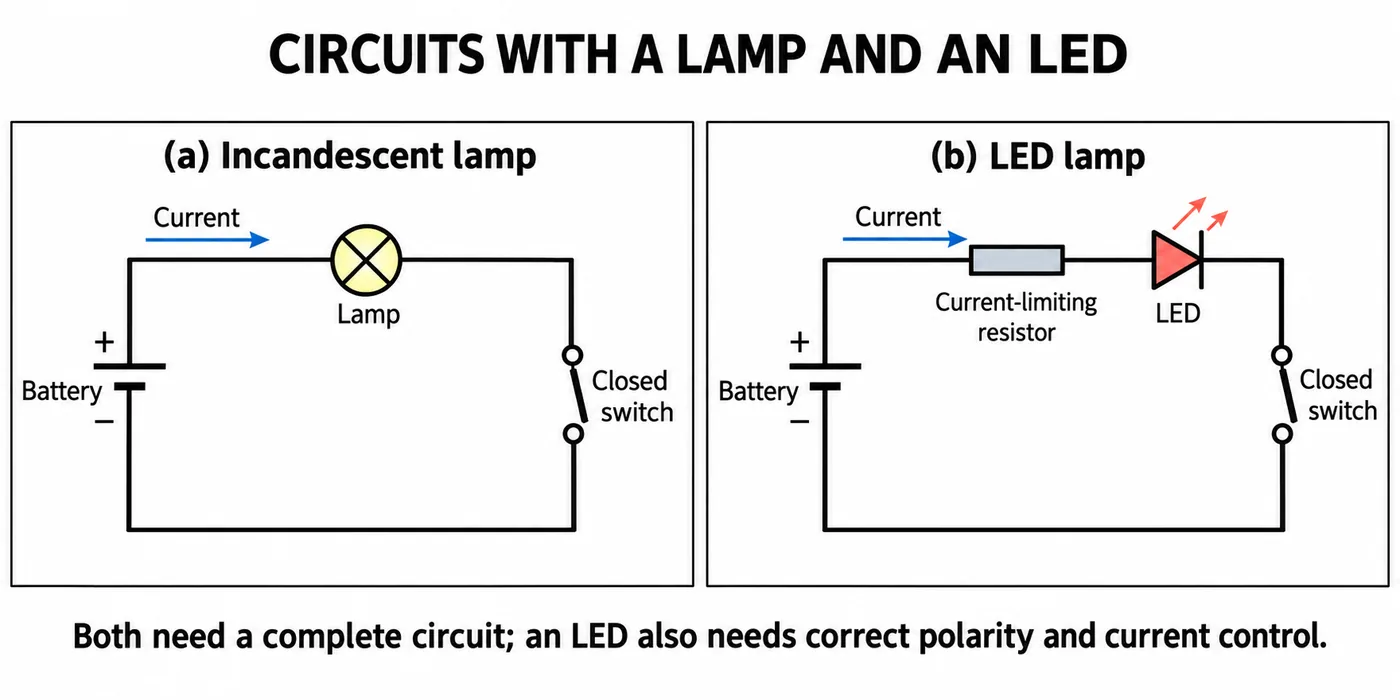
When the filament of a bulb breaks, the bulb is said to be fused; current can no longer pass through it. An LED is usually used with a small resistor in the circuit so that too much current does not damage it.
4. Simple Circuit — Closed and Open
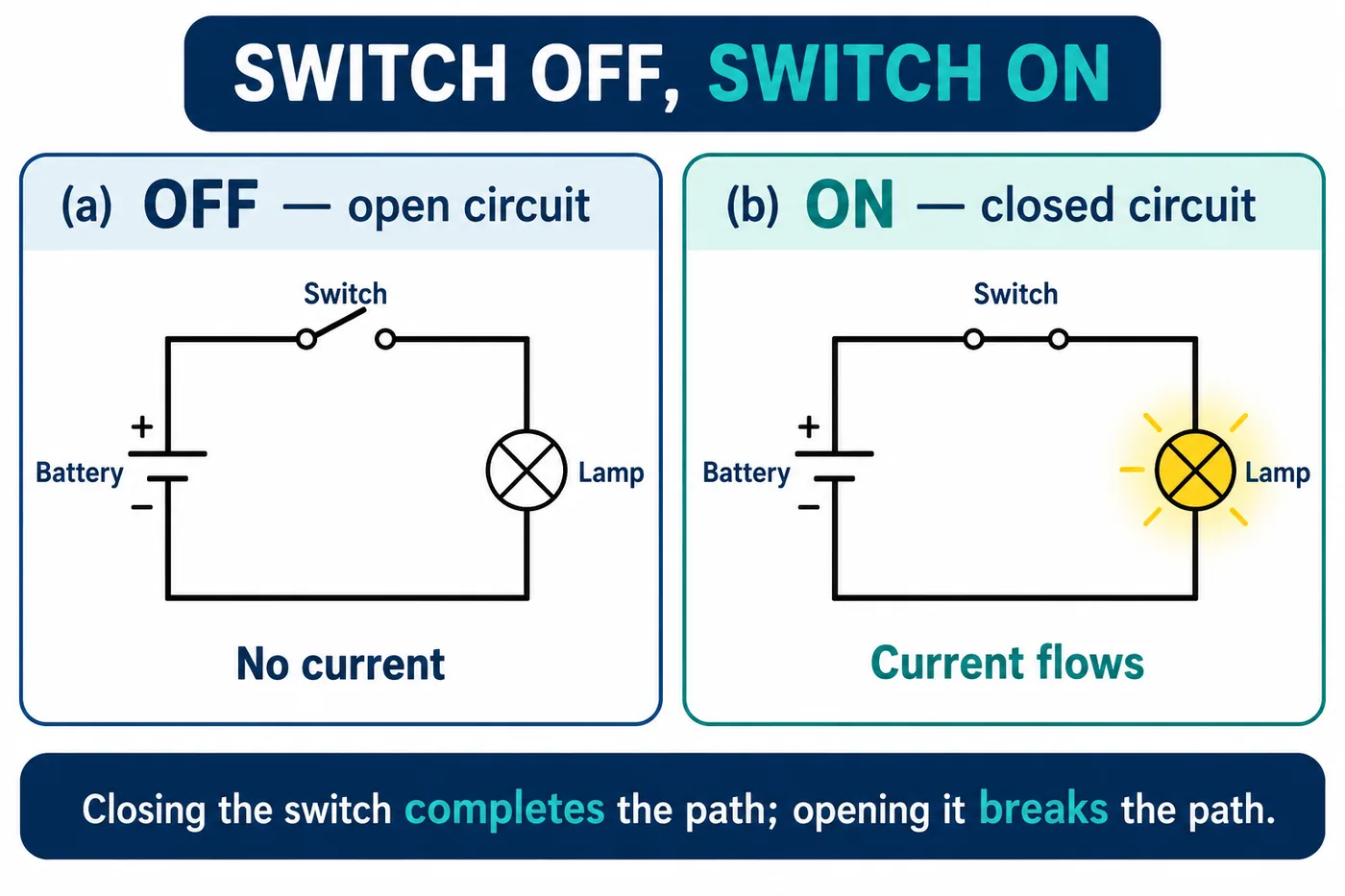
For a lamp to glow, there must be a complete path from the positive terminal of the cell, through the lamp, back to the negative terminal. This complete path is a closed circuit. If the path is broken anywhere — a loose wire, a fused bulb or an open switch — it is an open circuit and no current flows.
A switch is a device that makes or breaks the circuit. When it is ON (closed), the path is complete and current flows. When it is OFF (open), there is a gap and current stops.
5. Circuit Symbols and Diagrams
Drawing real objects takes time, so we use standard symbols to draw a circuit diagram.
| Component | Symbol description |
|---|---|
| Electric cell | A long thin line (+) and a short thick line (−) |
| Battery | Two or more cell symbols joined in a row |
| Lamp (bulb) | A circle with a cross inside |
| LED | A triangle pointing to a bar, with two small arrows for light |
| Switch (open / OFF) | A line with a gap between two dots |
| Switch (closed / ON) | A line joining the two dots |
| Connecting wire | A straight line |
6. Conductors and Insulators
Insert different objects into a gap in a working circuit. If the lamp glows, current passes through the object.
- Conductors allow electric current to pass — metals like copper, aluminium, iron; graphite (pencil lead); our body and impure water also conduct.
- Insulators do not allow current to pass easily — plastic, rubber, wood (dry), glass, cotton thread, paper.
Wires are made of copper or aluminium (conductors) and covered with plastic or rubber (insulators) so that current flows only through the metal and people are protected from shocks. Switch boards, plugs and handles of electricians’ tools are made of insulating materials.
- Never touch switches with wet hands — water conducts electricity.
- Never play with mains sockets or open wiring; mains electricity can be fatal.
- Use only cells for experiments in school.
- Do not join the two terminals of a cell directly with a wire (short circuit) — the cell gets hot and drains quickly.
7. Inside a Torch
A torch has cells (battery), a lamp or LED, a reflector, a switch and metal strips that connect them. Sliding the switch joins the metal strips, completing the circuit, so the lamp glows. The shiny reflector sends the light forward in a beam.
8. Master Table: Key Terms
| Term | Meaning |
|---|---|
| Electric cell | Source of electricity with + and − terminals |
| Battery | Two or more cells joined + to − |
| Filament | Thin wire in a bulb that glows when hot |
| LED | Light emitting diode; glows only when connected correctly |
| Closed circuit | Complete path; current flows |
| Open circuit | Broken path; no current |
| Switch | Device to open or close a circuit |
| Conductor / Insulator | Allows / does not allow current to pass |
9. Master Summary Table
| Situation | Lamp glows? | Reason |
|---|---|---|
| Switch ON, all connections good | Yes | Closed circuit |
| Switch OFF | No | Gap in circuit |
| Bulb fused | No | Broken filament |
| LED connected in reverse | No | Wrong polarity |
| Steel spoon in gap | Yes | Conductor |
| Plastic scale in gap | No | Insulator |
10. Mind Map
- Cell: + and −
- Battery of cells
- Lamp: filament
- LED: polarity
- Closed / open
- Switch, symbols
- Conductors: metals
- Insulators: plastic, rubber
11. Tips and Tricks
- Cell symbol: “long line = plus” (long and positive both mean more).
- LED: “long leg, plus peg” — the long lead goes to the positive terminal.
- When a lamp does not glow, check in order: switch → connections → cell → bulb.
- Drawing the cell symbol with the short line as positive.
- Thinking “switch ON” means the circuit is open — ON means closed.
- Calling water a perfect insulator — tap water conducts electricity.
12. Important One-liners
- An electric cell has a positive and a negative terminal.
- A battery is a combination of two or more cells.
- A bulb glows because its filament gets very hot.
- An LED glows only when connected with correct polarity.
- Current flows only in a closed circuit.
- A switch makes or breaks a circuit.
- Metals are good conductors of electricity.
- Plastic and rubber are insulators.
- LEDs use less electricity than incandescent bulbs.
13. Exam-pattern Questions with Detailed Answers
Which of these is a conductor of electricity?
- Rubber band
- Plastic comb
- Iron nail
- Wooden stick
Show answer
Iron is a metal and conducts electricity; rubber, plastic and dry wood are insulators.
Answer: (C) Iron nail
In the symbol of a cell, which line represents the positive terminal?
Show answer
The longer, thinner line is positive; the shorter, thicker line is negative.
Answer: The longer line
What is a battery?
Show answer
A combination of two or more electric cells connected together, positive to negative.
Answer: Two or more cells joined together
An LED does not glow when connected, but glows when its leads are interchanged. Explain.
Show answer
An LED allows current in one direction only. Its long lead must be joined to the positive terminal. At first it was connected in reverse; interchanging the leads gave the correct polarity.
Answer: LED works only with correct polarity
Why are electric wires covered with plastic?
Show answer
Plastic is an insulator. It keeps current inside the metal wire and protects us from electric shocks and short circuits when wires touch each other.
Answer: Plastic insulates and protects
Give two reasons why a torch may not light up even when switched on.
Show answer
Cells may be dead or placed wrongly; the bulb may be fused; a connection may be loose or rusted. Any of these breaks the circuit.
Answer: Dead/wrongly placed cells, fused bulb, loose contact
Distinguish between an open and a closed circuit.
Show answer
Closed circuit: complete path from + to − terminal; current flows; lamp glows. Open circuit: path broken somewhere; no current; lamp does not glow.
Answer: Complete path vs broken path
Why should we not touch switches with wet hands?
Show answer
Water containing dissolved impurities conducts electricity. Current can pass through wet hands into the body and cause a dangerous shock.
Answer: Water conducts; risk of shock
Draw (describe) a circuit diagram with two cells, an LED, a resistor and a switch, and state why the resistor is used.
Show answer
Two cell symbols joined long line to short line; from the + end, a wire to a resistor (rectangle), then to the LED (triangle pointing in the direction of current, from + side), then to a switch, and back to the − end. The resistor limits the current so the LED is not damaged.
Answer: Series loop; resistor protects LED from excess current
Paheli placed a pencil lead (graphite) in the gap of a circuit and the bulb glowed dimly. What can you conclude?
Show answer
Graphite allows current to pass, so it is a conductor, though not as good as copper (the bulb glows dimly). Not all conductors are metals.
Answer: Graphite is a (weaker) conductor
Why are LEDs replacing incandescent bulbs in homes?
Show answer
An incandescent bulb wastes most electricity as heat. LEDs give the same light using much less electricity, last many times longer and stay cool. This saves money and reduces the need to produce electricity from fossil fuels.
Answer: Energy-efficient, long-lasting, less heat
14. Quick Revision Summary
- Cell: + (cap, long line) and − (base, short line); battery = cells joined + to −.
- Bulb glows by a hot filament; LED glows only with correct polarity (long lead to +).
- Current flows only in a closed circuit; a switch opens or closes it.
- Circuit diagrams use standard symbols.
- Metals and graphite conduct; plastic, rubber, wood, glass insulate. Stay safe with electricity.