
1. Chapter at a Glance
How did people know the time before clocks? How do we decide who ran fastest in a race? To describe motion we need to measure two things — distance and time. This chapter traces how humans measured time, from shadows and sand to pendulums and quartz clocks, and then uses time to find speed and to tell uniform motion from non-uniform motion.
- Ancient and modern time-measuring devices.
- The simple pendulum: oscillation and time period.
- The SI unit of time and other units.
- Slow and fast — speed = distance ÷ time; units of speed.
- Uniform and non-uniform linear motion; average speed.
2. Measuring Time — From Sundials to Clocks
Any event that repeats itself at regular intervals can be used to measure time. Sunrise to sunrise gives a day; one new moon to the next gives a month; one revolution of the Earth around the Sun gives a year.
| Device | How it works | Limitation |
|---|---|---|
| Sundial (shadow clock) | Position of the shadow of a stick changes as the Sun moves; Jantar Mantar in Jaipur has a huge sundial (Samrat Yantra) | Works only in sunlight |
| Water clock (ghaṭikā yantra) | A bowl with a small hole sinks in water in a fixed time | Needs constant attention |
| Sand clock (hourglass) | Sand flows from upper to lower bulb in a fixed time | Measures only fixed intervals |
| Pendulum clock | Regular swings of a pendulum | Must be kept still and level |
| Quartz clock / digital stopwatch | Regular vibrations of a quartz crystal driven by a cell | Very accurate |
In ancient India, a ghaṭī (about 24 minutes) was a common unit of time measured with water clocks.
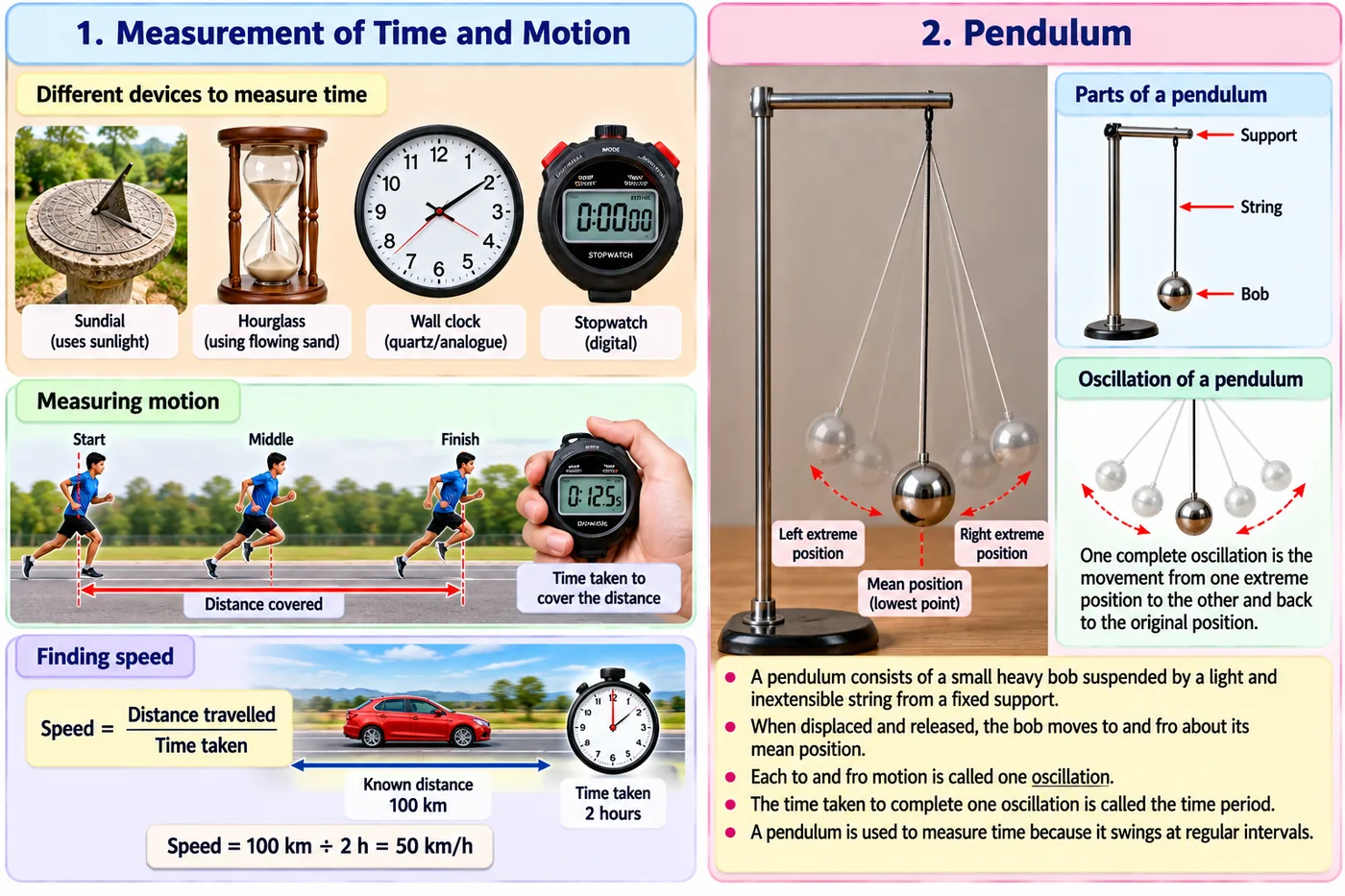
3. The Simple Pendulum
A simple pendulum is a small heavy metal ball, called the bob, hung by a light, inextensible string from a fixed support. When the bob is pulled to one side and released, it moves to and fro about its rest position (the mean position). This is oscillatory motion.
- One oscillation = the bob goes from one extreme to the other and back to the first extreme (or from the mean position to one extreme, to the other extreme and back to the mean).
- Time period = time taken for one complete oscillation.
- For a given length of string, the time period stays the same at a place — this is why pendulums can keep time.
- A longer string gives a longer time period; the mass of the bob does not change it (for small swings).
A pendulum makes 20 oscillations in 32 s. Time period = 32 ÷ 20 = 1.6 s.
Galileo noticed that a swinging lamp in a church took the same time for each swing, which led to the idea of pendulum clocks; Christiaan Huygens built the first practical pendulum clock.
4. Units of Time
The SI unit of time is the second (s). Larger units: 60 s = 1 minute (min); 60 min = 1 hour (h); 24 h = 1 day. Very short times are measured in milliseconds (1 ms = 1/1000 s) by stopwatches and timers in sports.
5. Slow or Fast — Speed
To compare how fast objects move, we find the distance each covers in the same time. Speed is the distance covered by an object in unit time.
Speed = Distance covered ÷ Time taken
The SI unit of speed is metre per second (m/s). Vehicles use kilometre per hour (km/h). The speedometer of a vehicle shows its speed; the odometer shows distance covered.
A car covers 100 km in 2 h. Speed = 100 ÷ 2 = 50 km/h.
(a) A cyclist moves at 5 m/s for 60 s: distance = speed × time = 5 × 60 = 300 m. (b) A train at 80 km/h covers 240 km: time = 240 ÷ 80 = 3 h.
36 km/h = 36 × 1000 m ÷ 3600 s = 10 m/s. (Shortcut: km/h × 5/18 = m/s.)
6. Uniform and Non-uniform Motion
- Uniform linear motion — an object moving in a straight line covers equal distances in equal intervals of time; its speed is constant.
- Non-uniform linear motion — covers unequal distances in equal intervals; speed keeps changing (a bus in city traffic, a falling stone).
For non-uniform motion we use average speed = total distance ÷ total time.
| Time (s) | Object A distance (m) | Object B distance (m) |
|---|---|---|
| 0 | 0 | 0 |
| 1 | 10 | 5 |
| 2 | 20 | 15 |
| 3 | 30 | 22 |
| 4 | 40 | 40 |
A covers 10 m every second — uniform. B covers 5, 10, 7, 18 m — non-uniform. Both cover 40 m in 4 s, so both have an average speed of 10 m/s.
7. Master Table: Formulas and Units
| Quantity | Formula / value |
|---|---|
| Speed | Distance ÷ Time |
| Distance | Speed × Time |
| Time | Distance ÷ Speed |
| Average speed | Total distance ÷ Total time |
| Time period of pendulum | Total time ÷ Number of oscillations |
| SI unit of time | second (s) |
| SI unit of speed | m/s; also km/h |
| km/h to m/s | multiply by 5/18 |
8. Master Summary Table
| Concept | Key point | Typical question |
|---|---|---|
| Periodic events | Used to measure time | Name a device using shadows |
| Pendulum | Constant time period for fixed length | Find time period |
| Speed | Distance per unit time | Numericals with km/h, m/s |
| Uniform motion | Equal distances in equal times | Identify from a table/graph |
| Average speed | For changing speed | Total distance ÷ total time |
9. Mind Map
- Sundial, water clock, hourglass
- Pendulum, quartz
- Bob, string, support
- Oscillation, time period
- Distance ÷ time
- m/s, km/h
- Uniform, non-uniform
- Average speed
10. Tips and Tricks
- Use the DST triangle: D on top, S and T below — cover the one you want.
- Always convert to the same units before calculating (km with h, m with s).
- For time period, measure 20 oscillations and divide — more accurate than timing one swing.
- Counting half a swing (one extreme to the other) as one full oscillation.
- Thinking a heavier bob changes the time period.
- Dividing time by distance instead of distance by time.
11. Important One-liners
- Periodic events are used to measure time.
- The SI unit of time is the second.
- A sundial measures time using shadows.
- Time period is the time for one complete oscillation.
- Time period of a pendulum depends on its length.
- Speed = distance ÷ time.
- The SI unit of speed is m/s.
- Uniform motion: equal distances in equal time intervals.
- Speedometer shows speed; odometer shows distance.
12. Exam-pattern Questions with Detailed Answers
The SI unit of speed is:
- km/h
- m/min
- m/s
- km/min
Show answer
SI units of distance and time are metre and second, so speed is in m/s.
Answer: (C) m/s
A bus travels 180 km in 3 h. Find its average speed.
Show answer
180 ÷ 3 = 60 km/h.
Answer: 60 km/h
Define the time period of a simple pendulum.
Show answer
The time taken by the pendulum to complete one oscillation.
Answer: Time for one complete oscillation
A pendulum completes 25 oscillations in 50 s. What is its time period?
Show answer
50 ÷ 25 = 2 s.
Answer: 2 s
Convert 54 km/h into m/s.
Show answer
54 × 5/18 = 15 m/s.
Answer: 15 m/s
How long will a train moving at 72 km/h take to cover 288 km?
Show answer
Time = distance ÷ speed = 288 ÷ 72 = 4 h.
Answer: 4 h
Distinguish between uniform and non-uniform motion with one example each.
Show answer
Uniform: equal distances in equal time intervals — a train on a straight track at constant speed. Non-uniform: unequal distances in equal intervals — a car in city traffic.
Answer: Constant vs changing speed
Why can’t a sundial be used at night or on a cloudy day?
Show answer
A sundial depends on the shadow cast by sunlight. Without sunlight, there is no shadow to read.
Answer: No sunlight, no shadow
Rahul walks 2 km to school in 30 min and returns in 20 min by the same route. Find his average speed for the whole trip in km/h.
Show answer
Total distance = 4 km. Total time = 50 min = 50/60 h = 5/6 h. Average speed = 4 ÷ 5/6 = 4.8 km/h.
Answer: 4.8 km/h
Two pendulums have the same length but bobs of 100 g and 200 g. Compare their time periods. What would change the time period?
Show answer
Their time periods are (almost) equal because the time period does not depend on the mass of the bob. Changing the length of the string changes the time period — a longer string gives a longer time period.
Answer: Same; only length changes it
From the data — 0 s: 0 m; 2 s: 8 m; 4 s: 16 m; 6 s: 24 m — state the type of motion and the speed.
Show answer
The object covers 8 m in every 2 s — equal distances in equal intervals, so the motion is uniform. Speed = 8 ÷ 2 = 4 m/s.
Answer: Uniform, 4 m/s
13. Quick Revision Summary
- Periodic events measure time: sundial, water clock, hourglass, pendulum, quartz clock.
- Pendulum: bob, string, support; time period = time for one oscillation; depends on length.
- SI unit of time: second.
- Speed = distance ÷ time; SI unit m/s; km/h × 5/18 = m/s.
- Uniform motion: equal distances in equal times; average speed = total distance ÷ total time.