
1. Chapter at a Glance
Every animal needs energy to move, grow and stay alive. It gets this energy from food, but food must first be broken down (digested), and the energy in it must be released using oxygen (respiration). The digested food and oxygen are then carried to all parts of the body by blood. This chapter explores nutrition and respiration in humans and other animals, and gives a first look at how the circulatory system links them.
- Steps of nutrition: ingestion, digestion, absorption, assimilation, egestion.
- The human digestive system and the role of each organ.
- Digestion in birds and in ruminants such as cows.
- Breathing and respiration in humans; inhaled vs exhaled air.
- Breathing in fish, insects and earthworms; blood as the carrier.
2. Why Do Animals Digest and Respire?
Food such as rice, dal and roti is made of large, complex substances that the body cannot use directly. Digestion breaks them into simple, soluble substances (like glucose) that can pass into the blood. Cells then use oxygen to break glucose and release energy — this is respiration. Blood, pumped by the heart, carries digested food and oxygen to every cell and takes away wastes like carbon dioxide. Digestion, respiration and circulation therefore work as a team.
3. Steps of Nutrition in Animals
- Ingestion — taking food into the body (through the mouth).
- Digestion — breaking complex food into simple, soluble substances.
- Absorption — digested food passes through the wall of the small intestine into blood.
- Assimilation — absorbed food is used by cells for energy, growth and repair.
- Egestion — undigested food is removed from the body as faeces through the anus.
4. The Human Digestive System
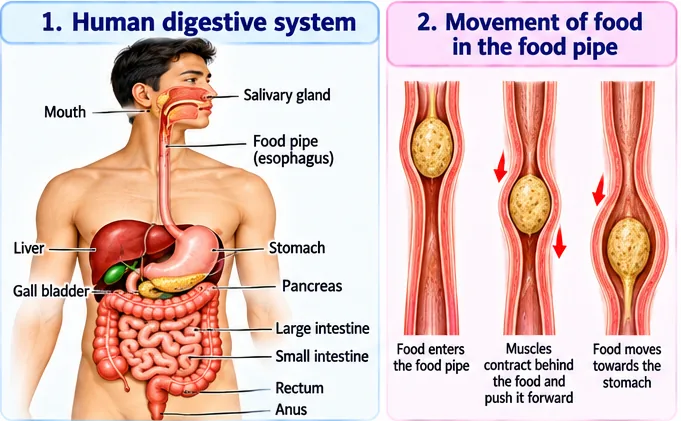
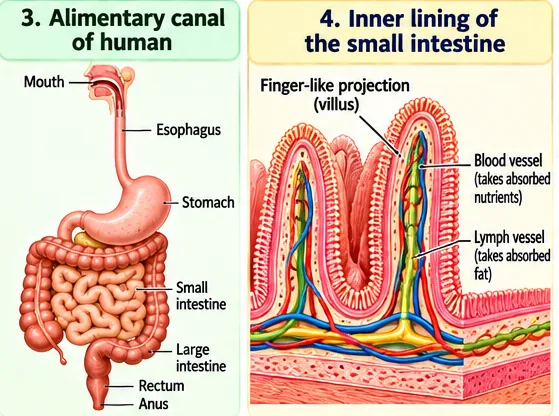
The alimentary canal is a long tube from the mouth to the anus: mouth (buccal cavity) → food pipe (oesophagus) → stomach → small intestine → large intestine → rectum → anus. Digestive glands — salivary glands, liver and pancreas — release juices into it.
| Part | What happens |
|---|---|
| Mouth | Teeth chew and grind food; saliva moistens it and begins digesting starch into sugar; the tongue mixes food and helps swallowing; taste buds sense taste. |
| Food pipe (oesophagus) | Carries food to the stomach by wave-like contractions of its muscular walls (food moves even if we lie down). |
| Stomach | Thick, muscular bag; churns food; hydrochloric acid kills bacteria and makes the medium acidic; digestive juices begin protein digestion; mucus protects the stomach lining. |
| Liver | Largest gland; makes bile (stored in the gall bladder) that helps digest fats. |
| Pancreas | Releases pancreatic juice that acts on carbohydrates, fats and proteins. |
| Small intestine | About 6–7 m long and coiled; digestion is completed here; digested food is absorbed through millions of finger-like villi which increase the surface area. |
| Large intestine | Shorter but wider (about 1.5 m); absorbs water and some salts from undigested food. |
| Rectum and anus | Store faeces and remove them (egestion). |
Take two test tubes with boiled rice. Add saliva to one and water to the other. After 30 minutes, add iodine. The tube with water turns blue-black (starch present); the tube with saliva does not turn blue-black (or only faintly), showing that saliva has broken down starch into sugar.
5. Digestion in Other Animals
Birds
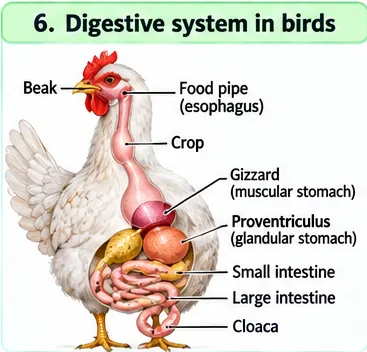
Birds have no teeth. Food passes from the beak through the food pipe to the crop, where it is stored and softened. It then reaches the proventriculus (glandular stomach), which adds digestive juices, and then the gizzard (muscular stomach), whose strong walls — often with small stones swallowed by the bird — grind the food. Wastes leave through the cloaca.
Ruminants — grass eaters like cows
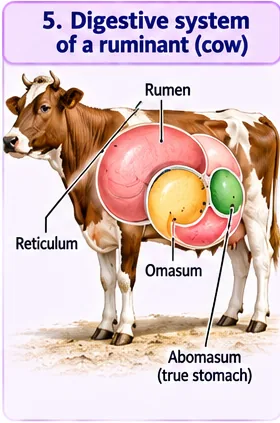
Grass is rich in cellulose, which humans cannot digest. Cows, buffaloes, goats and deer are ruminants. They swallow grass quickly; it goes into the first part of the stomach, the rumen, where it is partly digested by microorganisms into cud. Later the cud is brought back to the mouth and chewed slowly — this is rumination (chewing the cud). Their stomach has four chambers: rumen, reticulum, omasum and abomasum (the true stomach).
Other examples: Amoeba engulfs food with finger-like projections (pseudopodia) and digests it in a food vacuole; snakes swallow prey whole; mosquitoes and butterflies suck liquid food.
6. Respiration in Humans
Air enters through the nostrils into the nasal cavity, where hair and mucus trap dust. It passes through the pharynx and larynx into the windpipe (trachea), which divides into two bronchi leading to the two lungs. In the lungs, bronchi branch into fine bronchioles ending in tiny air sacs called alveoli. The lungs sit in the chest cavity, protected by the ribs, with a dome-shaped muscle sheet, the diaphragm, below.
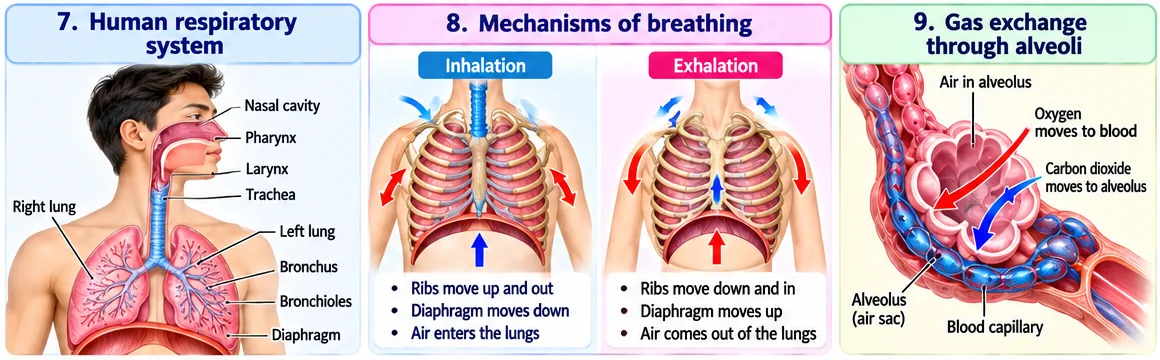
| Step | Ribs | Diaphragm | Chest cavity | Air |
|---|---|---|---|---|
| Inhalation (breathing in) | Move up and out | Moves down (flattens) | Becomes larger | Rushes into lungs |
| Exhalation (breathing out) | Move down and in | Moves up (dome shape) | Becomes smaller | Pushed out of lungs |
In the alveoli, oxygen passes from air into the blood in the thin capillaries around them, and carbon dioxide passes from blood into the alveoli to be breathed out. Blood carries oxygen to all cells, where food is broken down to release energy:
Glucose + Oxygen → Carbon dioxide + Water + Energy
An adult at rest breathes about 15–18 times per minute; the rate increases during exercise because the body needs more energy.
Inhaled and exhaled air
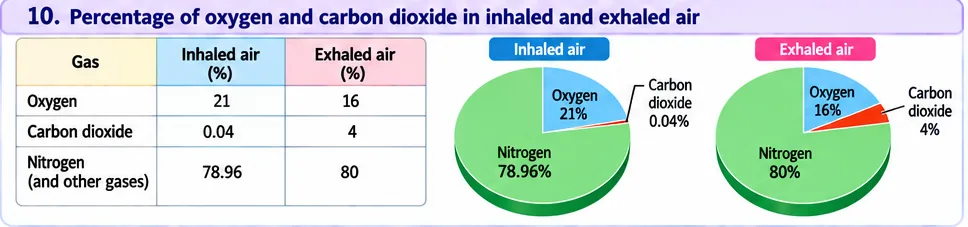
Blowing exhaled air into lime water turns it milky faster than ordinary air, showing exhaled air contains more carbon dioxide.
7. Breathing in Other Animals
| Animal | Breathing organ | How |
|---|---|---|
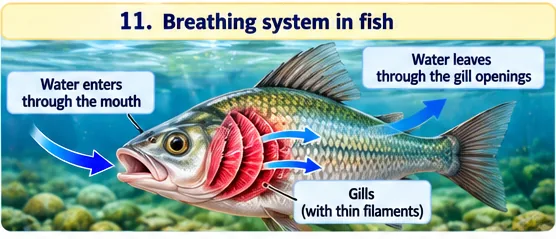
| Fish | Gills | Water enters through the mouth, flows over gills (rich in blood vessels) that take dissolved oxygen, and leaves through gill openings |
| Earthworm | Moist skin | Gases pass through the thin, moist skin |
| Frog | Lungs and moist skin | Breathes through skin in water, lungs on land |
| Insects (cockroach) | Spiracles and tracheae | Small holes on the body sides lead to air tubes |
| Whale, dolphin | Lungs | Come to the surface to breathe air through a blowhole |
8. Blood — The Carrier
The heart pumps blood through tubes called blood vessels. Blood picks up oxygen in the lungs and digested food from the small intestine and delivers them to all cells; it carries carbon dioxide back to the lungs. You will learn more about the heart and blood vessels in higher classes.
9. Master Table: Key Terms
| Term | Meaning |
|---|---|
| Ingestion / Egestion | Taking in food / removing undigested food |
| Digestion | Breaking complex food into simple soluble substances |
| Absorption / Assimilation | Food into blood / food used by cells |
| Villi | Finger-like projections of the small intestine that absorb food |
| Bile | Liver juice, stored in gall bladder; helps digest fats |
| Rumination | Chewing the cud by ruminants |
| Alveoli | Air sacs in lungs where gases are exchanged |
| Respiration | Glucose + oxygen → carbon dioxide + water + energy |
| Gills | Breathing organs of fish |
10. Master Summary Table
| Organ | Main job | Exam note |
|---|---|---|
| Mouth (saliva) | Starch → sugar | Iodine test activity |
| Stomach | Acid, protein digestion | Mucus protects lining |
| Small intestine | Complete digestion, absorption | Longest part; villi |
| Large intestine | Absorbs water | Shorter, wider |
| Lungs | Gas exchange | Alveoli |
| Diaphragm | Breathing movements | Down in inhalation |
11. Mind Map
- 5 steps
- Mouth → anus
- Birds: crop, gizzard
- Cow: 4-chambered stomach
- Lungs, alveoli
- Ribs, diaphragm
- Fish: gills
- Earthworm: skin; insects: spiracles
12. Tips and Tricks
- Steps of nutrition in order — “I Do Always Assist Everyone”: Ingestion, Digestion, Absorption, Assimilation, Egestion.
- Ruminant stomach order: “Really Rich Old Aunty” — Rumen, Reticulum, Omasum, Abomasum.
- Inhalation: diaphragm goes down, air comes in.
- Saying digestion is completed in the stomach — it is completed in the small intestine.
- Calling breathing and respiration the same — breathing moves air; respiration releases energy in cells.
- Saying exhaled air has no oxygen — it still has about 16%.
13. Important One-liners
- Saliva begins digestion of starch in the mouth.
- The liver is the largest gland; it makes bile.
- Digestion is completed in the small intestine.
- Villi increase the surface area for absorption.
- The large intestine absorbs water.
- Ruminants have a four-chambered stomach.
- Birds grind food in the gizzard.
- Gas exchange in lungs takes place in the alveoli.
- Fish breathe through gills; earthworms through skin.
- Exhaled air has about 4% carbon dioxide.
14. Exam-pattern Questions with Detailed Answers
Absorption of digested food mainly takes place in the:
- Stomach
- Small intestine
- Large intestine
- Food pipe
Show answer
The villi of the small intestine absorb digested food into blood. The large intestine absorbs mainly water.
Answer: (B) Small intestine
Name the breathing organ of a fish.
Show answer
Fish breathe using gills.
Answer: Gills
What is rumination?
Show answer
Bringing partly digested food (cud) from the rumen back to the mouth and chewing it again, as cows do.
Answer: Chewing the cud
Why does a piece of chapati taste sweet if chewed for a long time?
Show answer
Saliva breaks down the starch in chapati into sugar, which tastes sweet.
Answer: Saliva converts starch into sugar
Describe what happens to the ribs and diaphragm during inhalation.
Show answer
Ribs move up and outward and the diaphragm moves down. The chest cavity enlarges, and air rushes into the lungs.
Answer: Ribs up/out, diaphragm down, chest expands
Why do we breathe faster after running?
Show answer
Muscles need more energy while running, so cells respire faster and need more oxygen. Breathing rate increases to supply more oxygen and remove extra carbon dioxide.
Answer: More oxygen needed for extra energy
How are villi suited to their function?
Show answer
Millions of finger-like villi greatly increase the inner surface area of the small intestine. Each villus has thin walls and a rich supply of blood vessels, so digested food is absorbed quickly into blood.
Answer: Large surface area, thin walls, blood supply
Why can cows digest grass but humans cannot?
Show answer
Grass contains cellulose. The rumen of cows has microorganisms that break down cellulose. Humans lack such microorganisms in large numbers in their digestive system, so cannot digest cellulose (it acts as roughage).
Answer: Microbes in the rumen digest cellulose
Compare the percentages of oxygen and carbon dioxide in inhaled and exhaled air and explain the difference.
Show answer
Inhaled: O₂ ≈ 21%, CO₂ ≈ 0.04%. Exhaled: O₂ ≈ 16%, CO₂ ≈ 4%. Oxygen is taken into the blood in the alveoli and used by cells for respiration, which produces carbon dioxide; this CO₂ is breathed out.
Answer: O₂ used and CO₂ produced in respiration
Birds have no teeth. How do they manage to digest hard grains?
Show answer
Grains are stored and softened in the crop. The muscular gizzard grinds them with its strong walls, aided by small stones the bird swallows. This grinding does the work that teeth do in humans.
Answer: Crop softens; gizzard grinds
Why do fish die soon after being taken out of water?
Show answer
Gills take oxygen dissolved in water. In air the delicate gill filaments collapse and dry, so they cannot absorb oxygen; the fish suffocates.
Answer: Gills cannot work in air
Explain how digestion, respiration and circulation work together to give energy to a muscle cell.
Show answer
Digestion breaks food into glucose, absorbed into blood in the small intestine. Breathing brings oxygen into the lungs, where it enters blood. The heart pumps blood carrying glucose and oxygen to the muscle cell. There, respiration breaks glucose using oxygen to release energy; carbon dioxide is carried back by blood to the lungs.
Answer: Food + oxygen delivered by blood → respiration releases energy
15. Quick Revision Summary
- Nutrition steps: ingestion, digestion, absorption, assimilation, egestion.
- Mouth (saliva on starch) → oesophagus → stomach (acid, mucus) → small intestine (digestion completed; villi absorb) → large intestine (water) → rectum → anus; liver (bile) and pancreas help.
- Birds: crop and gizzard; ruminants: rumen, reticulum, omasum, abomasum; rumination.
- Breathing: ribs and diaphragm; gas exchange in alveoli; exhaled air has more CO₂.
- Fish — gills; earthworm — skin; insects — spiracles; blood carries food and oxygen.