
1. Chapter at a Glance
A tiny seed can grow into a huge banyan tree. Where does all that material come from? Plants cannot walk to find food, yet they feed themselves and also feed almost every other living thing on Earth. This chapter explains how plants grow, how their green leaves make food by photosynthesis, how water and minerals travel from roots to leaves, and how plants respire just like animals.
- How plants grow and what they need.
- Leaves as food factories — chlorophyll, sunlight, carbon dioxide and water.
- Testing a leaf for starch; role of chlorophyll, light and air.
- Stomata, transport of water and minerals (xylem) and food (phloem); transpiration.
- Respiration in plants — day and night.
2. How Do Plants Grow and Get Food?
Plants need water, minerals, air (carbon dioxide), sunlight and a suitable temperature to grow. Unlike animals, green plants make their own food — they are autotrophs (self-feeders). Animals, which depend on plants or other animals for food, are heterotrophs.
About 400 years ago, the scientist Jan van Helmont grew a willow tree in a weighed pot of soil and gave it only water for five years. The tree gained a lot of mass, but the soil lost very little. This showed that plants do not take their food mass mainly from soil — later scientists found that it comes largely from air (carbon dioxide) and water, using sunlight.
3. Leaves — The Food Factories
Photosynthesis is the process by which green plants make their own food (glucose) from carbon dioxide and water using the energy of sunlight, in the presence of the green pigment chlorophyll. Oxygen is released.
Carbon dioxide + Water —(sunlight, chlorophyll)→ Glucose + Oxygen
- Chlorophyll in leaves traps sunlight.
- Water comes from the soil through roots.
- Carbon dioxide enters from air through tiny pores called stomata.
- The glucose made is stored mostly as starch.
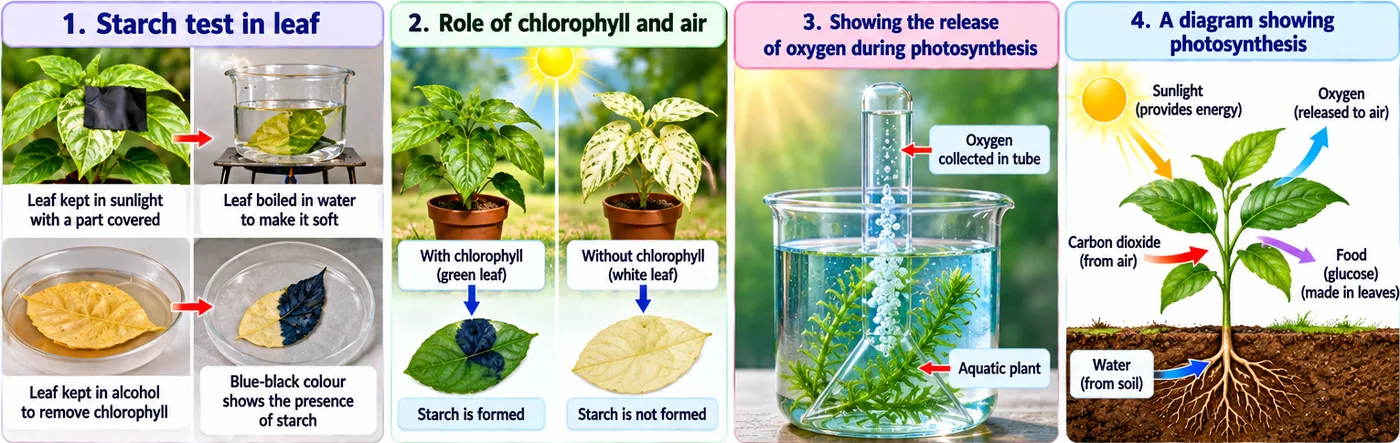
4. Experiments on Photosynthesis
(a) Testing a leaf for starch
- Boil the leaf in water for a few minutes to soften it.
- Place it in alcohol in a test tube kept in hot water (never on a direct flame) to remove chlorophyll; the leaf becomes pale.
- Wash it in warm water and spread it on a dish.
- Add dilute iodine. A blue-black colour shows starch is present.
| Experiment | Result | Conclusion |
|---|---|---|
| Part of a leaf covered with black paper for 2–3 days in sunlight | Covered part shows no blue-black; uncovered part turns blue-black | Sunlight is needed |
| Variegated leaf (green and white patches, e.g. croton) | Only green parts turn blue-black | Chlorophyll is needed |
| Plant kept in a closed jar with a substance that absorbs carbon dioxide | Leaves do not form starch | Carbon dioxide (air) is needed |
| Water plant (Hydrilla) in sunlight under an inverted test tube | Gas bubbles collect; a glowing splinter rekindles | Oxygen is released |
Alcohol catches fire easily. Heat it only in a water bath, under the teacher’s supervision.
5. Transport in Plants
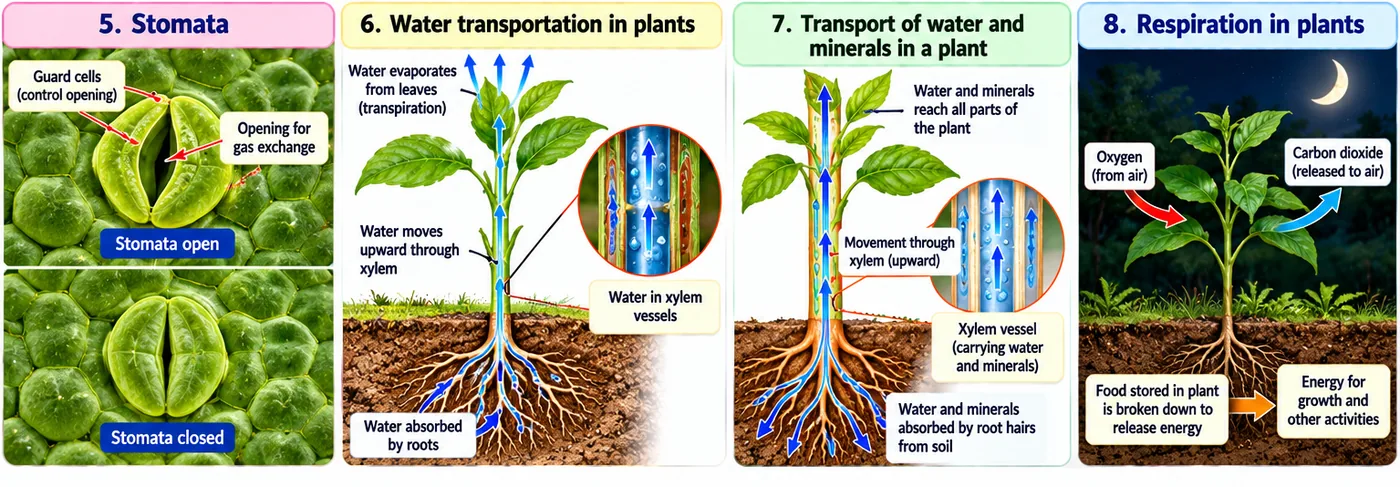
Roots absorb water and dissolved minerals from the soil through tiny root hairs. This water travels up through narrow tubes called xylem in the root, stem and leaves. Food made in the leaves is carried to all parts of the plant by another set of tubes called phloem.
Put a white flower or a celery/balsam stem in coloured water. After some hours the petals and veins take the colour — showing that water moves up through the stem.
Stomata are tiny pores mostly on the lower surface of leaves, each surrounded by two guard cells that open and close it. Through stomata, carbon dioxide enters and oxygen and water vapour leave. Loss of water as vapour from leaves is called transpiration. It cools the plant and creates a pull that helps draw water up from the roots.
6. Do Plants Respire?
Yes. Like animals, plants need energy for growth and other activities. Every living cell of a plant respires all the time — day and night — taking in oxygen and releasing carbon dioxide:
Glucose + Oxygen → Carbon dioxide + Water + Energy
Roots take oxygen from air spaces in the soil (that is why over-watering, which fills these spaces, can harm plants). Leaves exchange gases through stomata, and stems through small openings (lenticels).
| Feature | Photosynthesis | Respiration |
|---|---|---|
| Where | Green parts (leaves) only | All living cells |
| When | Only in light | Day and night |
| Gas taken in | Carbon dioxide | Oxygen |
| Gas given out | Oxygen | Carbon dioxide |
| Food | Made | Broken down |
| Energy | Stored (from sunlight) | Released |
During the day, photosynthesis is much faster than respiration, so plants give out more oxygen than they use. At night only respiration occurs.
7. Master Table: Key Terms and Equations
| Term | Meaning / equation |
|---|---|
| Photosynthesis | CO₂ + water —sunlight, chlorophyll→ glucose + O₂ |
| Respiration | Glucose + O₂ → CO₂ + water + energy |
| Chlorophyll | Green pigment that traps sunlight |
| Stomata | Pores in leaves for gas exchange, controlled by guard cells |
| Xylem / Phloem | Carry water and minerals up / carry food to all parts |
| Transpiration | Loss of water vapour from leaves |
| Autotroph / Heterotroph | Makes own food / depends on others for food |
| Starch test | Iodine → blue-black |
8. Master Summary Table
| Need for photosynthesis | Comes from | Proved by |
|---|---|---|
| Sunlight | Sun | Covered leaf has no starch |
| Chlorophyll | Green leaves | Variegated leaf test |
| Carbon dioxide | Air via stomata | CO₂-free jar experiment |
| Water | Soil via roots and xylem | Coloured water activity |
| Product: oxygen | Released into air/water | Hydrilla bubbles |
9. Mind Map
- CO₂ + water + light
- Glucose + oxygen
- Starch test
- Light, chlorophyll, CO₂
- Xylem up, phloem food
- Stomata, transpiration
- All cells, day and night
- O₂ in, CO₂ out
10. Tips and Tricks
- Photosynthesis and respiration are “mirror reactions” — reactants of one are products of the other.
- Xylem = X-tra water up; Phloem = Food flow.
- In starch-test questions, always mention removing chlorophyll with alcohol first.
- Saying plants do not respire during the day — they respire all the time.
- Saying plants get food from the soil — they get water and minerals; food is made in leaves.
- Heating alcohol directly on a flame — always use a water bath.
11. Important One-liners
- Green plants are autotrophs.
- Leaves are the food factories of plants.
- Chlorophyll traps the energy of sunlight.
- Oxygen is a by-product of photosynthesis.
- Food is stored in plants as starch.
- Iodine turns starch blue-black.
- Stomata are surrounded by guard cells.
- Xylem carries water; phloem carries food.
- Transpiration is loss of water vapour from leaves.
- Plants respire day and night.
12. Exam-pattern Questions with Detailed Answers
The gas released during photosynthesis is:
- Carbon dioxide
- Nitrogen
- Oxygen
- Hydrogen
Show answer
Plants take in carbon dioxide and release oxygen during photosynthesis.
Answer: (C) Oxygen
Name the tiny pores on leaves through which gases are exchanged.
Show answer
Stomata, controlled by guard cells.
Answer: Stomata
Which tissue carries water from roots to leaves?
Show answer
Xylem carries water and minerals upward.
Answer: Xylem
Why is a leaf boiled in alcohol before testing it for starch?
Show answer
Alcohol removes the green chlorophyll. Otherwise the green colour would hide the blue-black colour of the iodine test.
Answer: To remove chlorophyll so the colour is visible
A variegated leaf turns blue-black with iodine only in the green parts. What does this show?
Show answer
Starch (food) is made only where chlorophyll is present, so chlorophyll is necessary for photosynthesis.
Answer: Chlorophyll is needed
Write two differences between photosynthesis and respiration.
Show answer
Photosynthesis occurs only in green parts and only in light; respiration occurs in all cells day and night. Photosynthesis takes in CO₂ and releases O₂; respiration takes in O₂ and releases CO₂.
Answer: Place/time and gases exchanged differ
How can you show that water moves up through the stem?
Show answer
Place a white flower or a balsam stem in water with red ink. After a few hours the veins and petals turn red, and a cut stem shows coloured strands — water travels up through xylem.
Answer: Coloured water activity
What is transpiration? Give one use.
Show answer
Loss of water as vapour from leaves through stomata. It cools the plant and helps pull water up from the roots.
Answer: Water vapour loss; cooling and upward pull
A potted plant is over-watered daily and starts wilting. Explain why.
Show answer
Roots need oxygen from air spaces in the soil for respiration. Excess water fills these spaces, so roots cannot respire properly, get damaged and cannot absorb water — the plant wilts.
Answer: Roots lack oxygen for respiration
How would you prove that oxygen is released during photosynthesis?
Show answer
Put a water plant (Hydrilla) under an inverted funnel in a beaker of water, with a water-filled test tube over the funnel. Keep it in sunlight. Gas bubbles collect in the tube. Bring a glowing splinter near — it bursts into flame, showing oxygen.
Answer: Hydrilla experiment + glowing splinter test
Why is it said that plants are the base of all food on Earth?
Show answer
Only green plants (and some other producers) can convert sunlight into chemical energy in food. Herbivores eat plants, and carnivores eat herbivores, so all food energy ultimately comes from photosynthesis. Plants also release the oxygen animals breathe.
Answer: They make food from sunlight that all others depend on
13. Quick Revision Summary
- Plants are autotrophs; leaves make food by photosynthesis: CO₂ + water + sunlight + chlorophyll → glucose + O₂.
- Starch test: boil, alcohol (water bath), iodine → blue-black.
- Experiments show the need for light, chlorophyll and CO₂, and the release of O₂.
- Root hairs absorb water; xylem carries it up; phloem carries food; stomata exchange gases; transpiration cools and pulls water.
- All plant cells respire day and night: glucose + O₂ → CO₂ + water + energy.