
1. Chapter at a Glance
Of all the planets we know, only the Earth is home to life — from bacteria in hot springs to whales in the ocean. What makes our planet so special? This chapter compares the Earth with other planets, and explains how its position, size, magnetic field, atmosphere, water and soil allow life to exist. It also shows how living things keep life going through reproduction, and what threatens life on Earth today.
- Planets of the Solar System; why Earth is unique.
- Earth’s position in the habitable zone, its size and its magnetic field.
- Atmosphere, greenhouse effect and ozone layer; water, soil and geodiversity.
- Continuity of life — reproduction in plants and animals.
- Threats to life — pollution, climate change, biodiversity loss — and how to protect Earth.
2. Why Is Earth a Unique Planet?
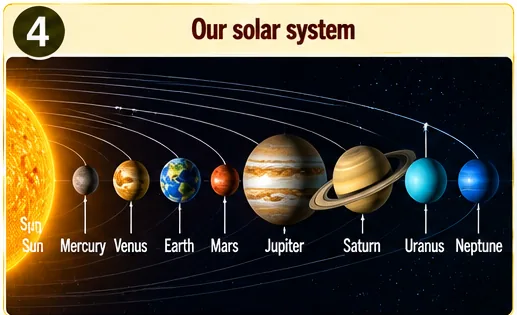
Our Solar System has eight planets. The four inner planets (Mercury, Venus, Earth, Mars) are small and rocky; the four outer planets (Jupiter, Saturn, Uranus, Neptune) are giant planets made mostly of gases and ice. Mercury is scorched and airless; Venus is covered by thick carbon dioxide clouds and is hotter than Mercury; Mars is cold with a thin atmosphere; the giant planets have no solid surface. Only Earth has liquid water on its surface, a breathable atmosphere and a moderate temperature.
3. Position, Size and Magnetic Field
- Position: Earth lies in the habitable zone around the Sun — not too near (water would boil away) and not too far (water would freeze). Liquid water, essential for life, can exist.
- Size: Earth is large enough for its gravity to hold an atmosphere. A much smaller planet (like Mercury, or our Moon) loses its gases to space.
- Magnetic field: Earth behaves like a giant magnet (because of its molten iron outer core). Its magnetic field acts as a shield, deflecting harmful charged particles from the Sun (solar wind) and cosmic rays. Near the poles these particles create beautiful auroras.
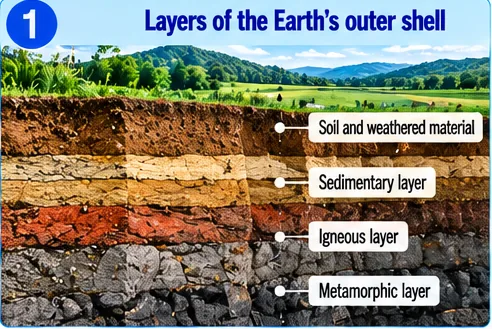
Life exists in a thin zone — on and near the surface, in water and in the lower atmosphere — called the biosphere. The Earth’s outer rocky shell, the crust, is thin compared with the whole planet and has layers of soil, sedimentary, igneous and metamorphic rocks.
4. What Allows Life to Be Sustained on Earth?
(a) Atmosphere
The atmosphere provides oxygen for respiration and carbon dioxide for photosynthesis, protects us from meteors (they burn up), and keeps the planet warm.
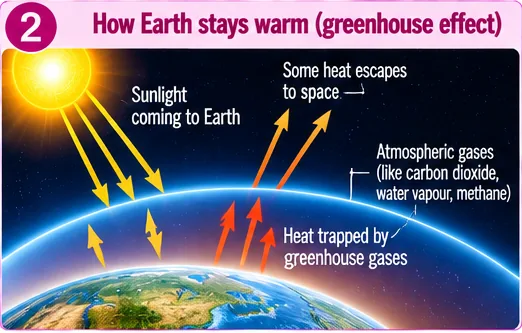
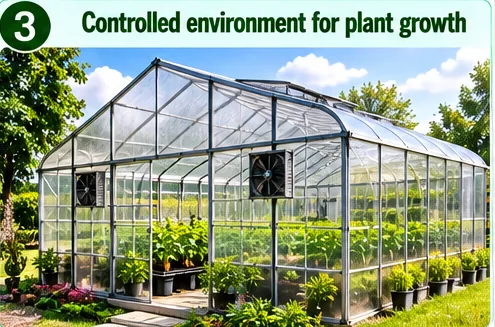
Greenhouse effect: sunlight passes through the atmosphere and warms the Earth’s surface. The warm surface gives out heat; gases such as carbon dioxide, water vapour and methane trap some of this heat, keeping the Earth’s average temperature at about 15 °C. Without them, the Earth would be about −18 °C — frozen. A greenhouse (glass house) used to grow plants works in a similar way, trapping heat inside.
The ozone layer high in the atmosphere absorbs most of the Sun’s harmful ultraviolet (UV) rays, which can cause skin cancer and harm plants and animals. Certain chemicals (CFCs) used in old refrigerators and sprays damaged it; their use has been banned under international agreements, and the layer is slowly recovering.
(b) Water
About 71% of the Earth’s surface is covered by water, mostly in oceans. Water dissolves nutrients, regulates temperature, is a habitat for countless organisms and is needed by every cell. Only a small fraction is fresh water available for use.
(c) Soil and geodiversity
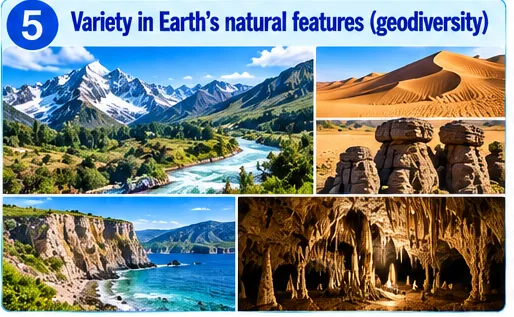
Soil, formed by weathering of rocks over thousands of years, supports plants and is home to many organisms. The variety of landforms, rocks, minerals and soils — mountains, deserts, coasts, caves — is called geodiversity; it creates many different habitats and supports biodiversity.
5. What Keeps Life from Disappearing? — Reproduction
Every organism has a limited life span. Life continues because living things reproduce — produce new individuals of their own kind. Reproduction also passes on features and brings variation, helping species adapt to changing environments.
Reproduction in plants
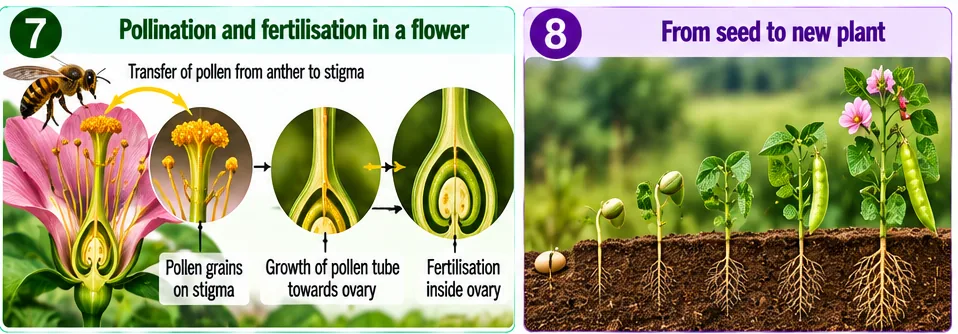
- Sexual reproduction — flowers have male parts (stamens with anthers producing pollen) and female parts (pistil with stigma, style and ovary containing ovules). Transfer of pollen from anther to stigma is pollination (by insects, wind, water). A pollen tube grows down to the ovule, where the male and female cells fuse — fertilisation. The ovule becomes the seed and the ovary becomes the fruit. Seeds germinate into new plants.
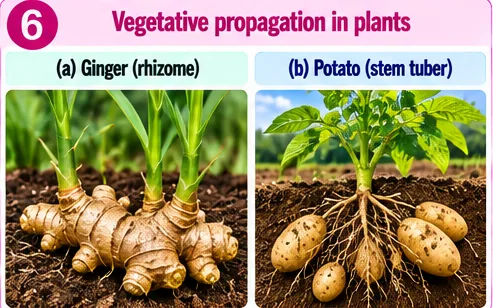
- Vegetative propagation — new plants grow from parts like stems, roots or leaves: potato (stem tuber with “eyes”), ginger (rhizome), rose (stem cuttings), Bryophyllum (leaf buds). It is faster and gives plants identical to the parent.
Reproduction in animals
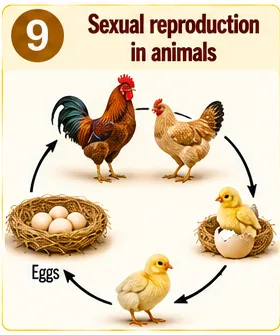
Most animals reproduce sexually: a male sperm fuses with a female egg (fertilisation) to form a zygote, which develops into a new individual. In hens and other birds, the young develop inside eggs laid outside the body (oviparous); in humans, cows and dogs, the young develop inside the mother’s body (viviparous).
6. Threats to Life on Earth and Protection
| Threat | Cause | Effect |
|---|---|---|
| Climate change (enhanced greenhouse effect) | Burning fossil fuels, deforestation add CO₂ | Global warming, melting glaciers, rising seas, extreme weather |
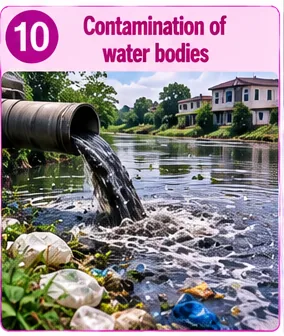
| Water pollution | Sewage, factory waste, plastics, pesticides | Diseases, death of fish, algal blooms |
| Air pollution | Vehicles, factories, stubble burning | Breathing problems, acid rain |
| Biodiversity loss | Habitat destruction, poaching, invasive species | Extinction, broken food webs |
| Ozone depletion | CFCs | More UV radiation |
- Save electricity and fuel; use public transport, cycles and renewable energy (solar, wind).
- Plant and protect trees; conserve forests and wetlands.
- Reduce, reuse, recycle; avoid single-use plastics.
- Treat sewage and industrial waste before release; save water.
- Protect wildlife through sanctuaries, national parks and laws.
7. Master Table: Key Terms
| Term | Meaning |
|---|---|
| Habitable zone | Region around a star where liquid water can exist |
| Magnetic field of Earth | Shield against solar wind and cosmic rays |
| Greenhouse effect | Trapping of heat by CO₂, water vapour, methane |
| Ozone layer | Absorbs harmful UV rays |
| Geodiversity | Variety of Earth’s rocks, landforms and soils |
| Pollination | Transfer of pollen from anther to stigma |
| Fertilisation | Fusion of male and female gametes |
| Vegetative propagation | New plants from stems, roots or leaves |
| Oviparous / Viviparous | Lay eggs / give birth to young |
8. Master Summary Table
| Earth’s feature | Why it matters for life |
|---|---|
| Habitable zone position | Liquid water, moderate temperature |
| Right size (gravity) | Holds the atmosphere |
| Magnetic field | Protects from solar particles |
| Atmosphere | Oxygen, CO₂, warmth, protection from meteors |
| Ozone layer | Blocks UV rays |
| Water and soil | Habitats, nutrients, food production |
Chart — approximate average surface temperatures:
| Planet | Average temperature | Why |
|---|---|---|
| Venus | about 465 °C | Very thick CO₂ atmosphere — runaway greenhouse effect |
| Earth | about 15 °C | Moderate natural greenhouse effect |
| Earth without greenhouse gases | about −18 °C | Heat would escape to space |
| Mars | about −60 °C | Thin atmosphere, farther from the Sun |
9. Mind Map
- Habitable zone, size
- Magnetic field
- Atmosphere, ozone
- Water, soil, geodiversity
- Pollination, fertilisation
- Vegetative propagation
- Climate change, pollution
- Biodiversity loss
10. Tips and Tricks
- Earth’s life-support kit: “PSMAW” — Position, Size, Magnetic field, Atmosphere, Water.
- Greenhouse gases: “CWM” — Carbon dioxide, Water vapour, Methane.
- Pollination is transfer; fertilisation is fusion.
- Thinking the greenhouse effect is always harmful — the natural effect keeps Earth warm; the enhanced effect causes global warming.
- Confusing ozone depletion with global warming — they are different problems.
- Calling potato a root — it is a stem tuber.
11. Important One-liners
- Earth is the only known planet with life.
- Earth lies in the Sun’s habitable zone.
- Earth’s gravity holds its atmosphere.
- Earth’s magnetic field shields it from solar particles.
- Natural greenhouse effect keeps Earth’s average temperature near 15 °C.
- The ozone layer absorbs harmful UV rays.
- About 71% of Earth’s surface is covered by water.
- Reproduction ensures continuity of life.
- Potato and ginger reproduce by vegetative propagation.
- Burning fossil fuels increases CO₂ and causes global warming.
12. Exam-pattern Questions with Detailed Answers
Which layer of the atmosphere protects us from harmful UV rays?
- Carbon dioxide layer
- Ozone layer
- Nitrogen layer
- Water vapour layer
Show answer
The ozone layer absorbs most of the Sun’s ultraviolet radiation.
Answer: (B) Ozone layer
Name two greenhouse gases.
Show answer
Carbon dioxide and methane (also water vapour).
Answer: CO₂, methane
What is pollination?
Show answer
Transfer of pollen grains from the anther to the stigma of a flower.
Answer: Pollen transfer from anther to stigma
Why is the Earth’s position in the Solar System important for life?
Show answer
It lies in the habitable zone at a moderate distance from the Sun, so temperatures allow water to stay liquid — neither boiling away nor freezing — which is essential for life.
Answer: Allows liquid water and moderate temperature
How does the Earth’s magnetic field help life?
Show answer
It deflects harmful charged particles from the Sun and cosmic rays, which could otherwise strip away the atmosphere and harm living things.
Answer: Shields from solar wind and cosmic rays
What would happen if there were no greenhouse gases in the atmosphere?
Show answer
Heat given out by the Earth would escape to space and the average temperature would drop to about −18 °C. Water would freeze and most life could not survive.
Answer: Earth would be frozen (~−18 °C)
Give two advantages of vegetative propagation.
Show answer
It is quicker than growing from seed, and the new plants are identical to the parent, keeping desired qualities. It also works for plants that produce few or no seeds (banana).
Answer: Faster; identical offspring
Distinguish between oviparous and viviparous animals with examples.
Show answer
Oviparous animals lay eggs that develop outside (hen, frog, snake). Viviparous animals give birth to young that develop inside the mother (human, cow, dog).
Answer: Lay eggs vs give birth
Why can’t the Moon hold an atmosphere like the Earth?
Show answer
The Moon is much smaller, so its gravity is weak (about one-sixth of Earth’s). Gas particles can escape into space easily. The Earth’s stronger gravity keeps its atmosphere in place.
Answer: Weak gravity due to small size
Explain how burning fossil fuels leads to rising sea levels.
Show answer
Burning fossil fuels releases carbon dioxide, increasing the greenhouse effect and trapping more heat. Global temperatures rise, glaciers and polar ice melt, and sea water expands on warming — together these raise sea levels, threatening coastal areas.
Answer: More CO₂ → warming → melting ice and expansion of water
Describe the journey from pollination to the formation of a seed.
Show answer
Pollen lands on the stigma (pollination). It grows a pollen tube down the style into the ovary to reach an ovule. The male cell fuses with the egg cell in the ovule (fertilisation), forming a zygote. The ovule develops into a seed containing the embryo, and the ovary develops into the fruit.
Answer: Pollination → pollen tube → fertilisation → ovule becomes seed
13. Quick Revision Summary
- Earth is unique: habitable zone, right size, magnetic field, atmosphere, liquid water, soil.
- Natural greenhouse effect keeps Earth warm (~15 °C); ozone layer blocks UV.
- Geodiversity creates varied habitats.
- Reproduction continues life: pollination and fertilisation in flowers; vegetative propagation; oviparous and viviparous animals.
- Threats: climate change, pollution, biodiversity loss — protect Earth with clean energy, trees, 3 Rs and conservation.