
1. Chapter at a Glance
Sit quietly near a pond or in a park and you will notice a busy, connected world: frogs catching insects, birds eating seeds, mushrooms growing on a dead log, plants turning towards sunlight. No organism lives alone. This chapter explores how living things share habitats, interact with each other and with non-living surroundings, pass food and energy along food chains, recycle wastes, and how all these links keep nature in balance.
- Habitat, population, community and ecosystem; biotic and abiotic components.
- Natural ecosystems (forest, pond, mangrove) and human-made ones (crop field).
- Interactions: competition, predation, mutualism, parasitism, commensalism.
- Producers, consumers, decomposers; food chains, food webs and energy flow.
- Recycling of wastes; chain effects of change; maintaining balance.
2. Who Lives Together in Nature?
A habitat is the natural home of an organism, providing food, water, shelter and suitable conditions. A pond, a forest, a desert and a grassland are habitats.
| Level | Meaning | Example |
|---|---|---|
| Population | All members of one species in an area | All deer in a forest |
| Community | All populations of different species living together | Deer, tigers, trees, insects, birds of the forest |
| Ecosystem | Community + non-living surroundings interacting | The forest with its soil, water, air and sunlight |
An ecosystem has two kinds of components:
- Biotic (living) — plants, animals, microbes.
- Abiotic (non-living) — sunlight, air, water, soil, temperature, minerals.
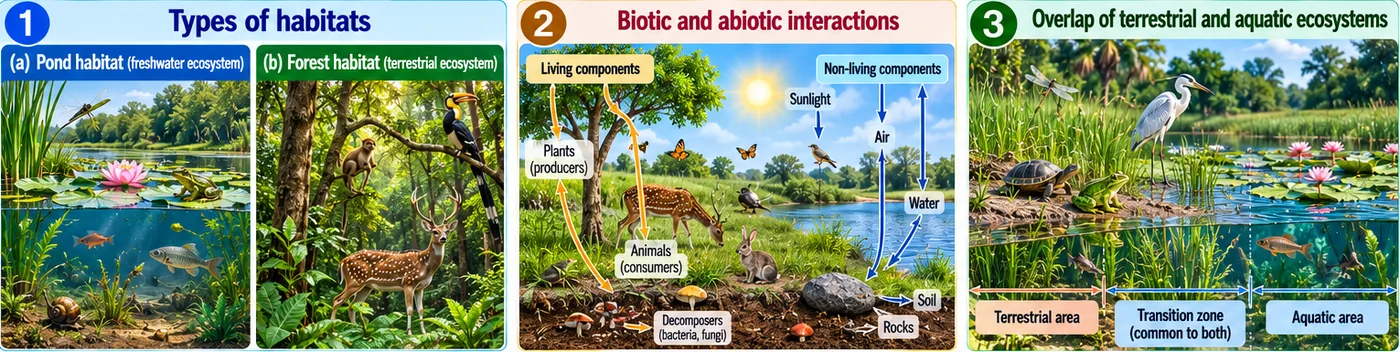
Ecosystems can be natural (forests, ponds, rivers, seas, mangroves, grasslands) or human-made (crop fields, gardens, aquariums). The edge of a pond, where land and water meet, is shared by animals of both ecosystems — frogs, herons and turtles. The Sundarbans, the largest mangrove forest in the world, is home to the Royal Bengal tiger and protects coasts from storms.
3. Does Every Organism in a Community Matter?
Every species has a role. Bees and butterflies pollinate flowers; earthworms loosen soil; vultures and decomposers clean up dead bodies; predators keep prey numbers in check. Losing even one species can upset others. Large animals like elephants and tigers whose protection also protects many other species are called umbrella or keystone species.
4. Types of Interactions
| Interaction | Effect | Example |
|---|---|---|
| Competition | Both compete for limited food, space, light or mates | Deer fighting for mates; plants competing for sunlight |
| Predation | Predator gains, prey loses | Tiger hunts deer; frog eats insects |
| Mutualism | Both benefit | Bees and flowers; Rhizobium in legume roots; lichens (alga + fungus) |
| Parasitism | Parasite gains, host is harmed | Lice on humans; Cuscuta (amarbel) on plants; tapeworm |
| Commensalism | One gains, the other is unaffected | Orchids growing on tree branches; cattle egret with grazing cattle |
5. Who Eats Whom? — Food Chains and Webs
- Producers — green plants make food by photosynthesis using sunlight.
- Consumers — eat other organisms: herbivores (primary consumers), carnivores (secondary and tertiary consumers), omnivores.
- Decomposers — bacteria and fungi that break down dead remains and wastes.
A food chain shows who eats whom in a single line: Grass → Grasshopper → Frog → Snake → Hawk. Each step is a trophic level. In nature, many food chains interconnect to form a food web, giving animals alternative food sources and making the ecosystem more stable.
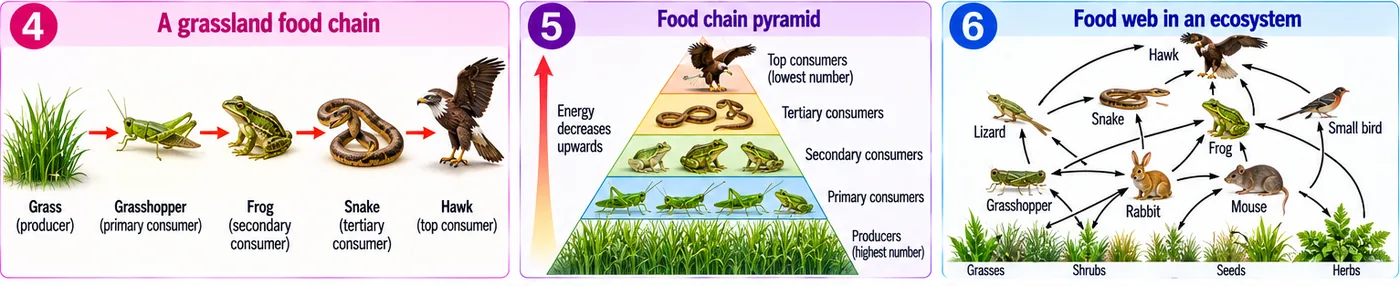
Energy flow: the Sun is the source of energy. Producers capture it; only a small part (about 10%) passes to each next level, as most is used for life activities or lost as heat. So there are many producers, fewer herbivores and very few top predators — an energy pyramid.
Chart — energy available at each level (starting with 10,000 units in producers):
Using the approximate 10% rule.
6. What Happens to Waste in Nature?
Fallen leaves, dead animals and animal droppings do not pile up forever. Decomposers (bacteria and fungi) and scavengers (vultures, crows, earthworms) break them down, returning nutrients like nitrogen and phosphorus to the soil, which plants use again. Thus, in nature there is no waste — matter is recycled. Compost pits copy this natural process. Plastics, however, are not broken down by decomposers and remain for hundreds of years.
7. How Does One Change Lead to Another?
Because organisms are linked, a change in one affects others — a chain effect.
- If frogs are killed in large numbers, insects (their food) increase and damage crops, while snakes (which eat frogs) decline.
- When vultures declined in India (due to a painkiller drug given to cattle), dead animals lay uncleared and stray dogs and diseases increased.
- Overuse of pesticides kills useful insects and builds up in food chains, harming birds.
- Cutting forests removes habitats, reduces rainfall and increases soil erosion.
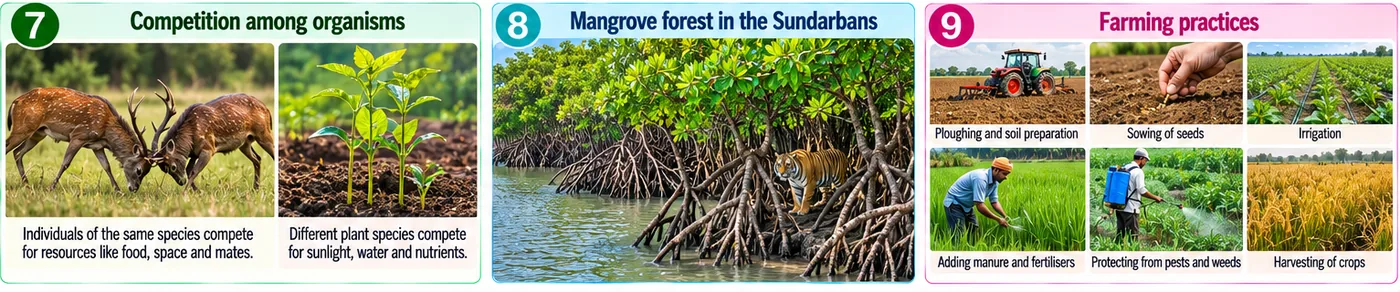
Crop fields are human-made ecosystems. Ploughing, sowing, irrigation, manures and fertilisers, weeding and pest control, and harvesting are farming practices. Using organic manure, crop rotation, mixed cropping and natural pest control keeps these ecosystems healthier.
8. How Do Interactions Maintain Balance?
Predators keep prey numbers in check; prey numbers limit predators; decomposers recycle nutrients; plants replace oxygen and food. These checks and links keep population sizes fairly steady — ecological balance. Human activities like deforestation, pollution, overhunting and introducing foreign species can break this balance. Protecting habitats, wildlife sanctuaries, sacred groves and sustainable farming help restore it.
9. Master Table: Key Terms
| Term | Meaning |
|---|---|
| Habitat | Natural home of an organism |
| Population / Community | One species / all species in an area |
| Ecosystem | Community + abiotic environment interacting |
| Biotic / Abiotic | Living / non-living components |
| Producer / Consumer / Decomposer | Makes food / eats others / breaks down dead matter |
| Food chain / Food web | Single feeding path / interconnected chains |
| Trophic level | Feeding level in a food chain |
| 10% law | About 10% energy passes to the next level |
| Mutualism / Parasitism / Commensalism | +/+ ; +/− ; +/0 |
10. Master Summary Table
| Component | Role | Example |
|---|---|---|
| Sunlight | Energy source | Used in photosynthesis |
| Producers | Make food | Grass, trees, algae |
| Herbivores | Primary consumers | Grasshopper, deer |
| Carnivores | Higher consumers | Frog, snake, hawk, tiger |
| Decomposers | Recycle nutrients | Bacteria, fungi |
11. Mind Map
- Population, community
- Ecosystem: biotic + abiotic
- Competition, predation
- Mutualism, parasitism, commensalism
- Food chain, web
- 10% energy rule
- Decomposers recycle
- Chain effects of change
12. Tips and Tricks
- Food chain arrows point to the eater (direction of energy flow).
- Interactions sign code: mutualism + +, parasitism + −, commensalism + 0, competition − −.
- Every food chain starts with a producer.
- Drawing arrows from the eater to the food.
- Calling a community an ecosystem — an ecosystem includes non-living parts too.
- Thinking top predators are most numerous — they are fewest.
13. Important One-liners
- An ecosystem has biotic and abiotic components.
- Green plants are producers.
- Decomposers recycle nutrients to the soil.
- A food web is a network of food chains.
- Only about 10% of energy passes to the next trophic level.
- Bees and flowers show mutualism.
- Cuscuta is a plant parasite.
- The Sundarbans is the largest mangrove forest.
- Removing one species can cause chain effects in an ecosystem.
14. Exam-pattern Questions with Detailed Answers
Which of these is an abiotic component?
- Grass
- Fungi
- Sunlight
- Frog
Show answer
Sunlight is non-living; the others are living (biotic).
Answer: (C) Sunlight
What are decomposers? Give two examples.
Show answer
Organisms that break down dead plants and animals into simple substances, returning nutrients to the soil — bacteria and fungi.
Answer: Bacteria, fungi
Write a food chain with four organisms.
Show answer
Grass → grasshopper → frog → snake.
Answer: Grass → grasshopper → frog → snake
Distinguish between population and community.
Show answer
A population is all individuals of one species in an area (all frogs in a pond). A community is all populations of different species living together (frogs, fish, plants, insects of the pond).
Answer: One species vs many species
Identify the interaction: (a) bee and flower, (b) lice on a dog, (c) orchid on a mango tree.
Show answer
(a) Mutualism — both benefit. (b) Parasitism — lice gain, dog harmed. (c) Commensalism — orchid gains support, tree unaffected.
Answer: Mutualism, parasitism, commensalism
Why are food webs more stable than single food chains?
Show answer
In a food web, animals have several food options. If one prey decreases, predators can eat others, so the system does not collapse easily.
Answer: Alternative food sources
If producers have 20,000 units of energy, how much reaches the secondary consumers?
Show answer
Primary consumers get 10% = 2,000; secondary consumers get 10% of that = 200 units.
Answer: 200 units
Why is it said that “there is no waste in nature”?
Show answer
Dead remains and wastes are broken down by decomposers and scavengers; their nutrients return to the soil and are used again by plants. Everything is recycled.
Answer: Decomposers recycle all natural wastes
Predict what may happen to a grassland if all snakes are removed.
Show answer
Frogs and rats (eaten by snakes) would increase. More frogs would reduce grasshoppers; more rats would damage grasses and crops and spread diseases. Hawks that eat snakes may lose food. The balance of the ecosystem would be disturbed.
Answer: Prey explode, crops damaged, predators of snakes suffer
Why are there fewer tigers than deer in a forest?
Show answer
Energy decreases at each trophic level (about 10% passes on). Tigers are top carnivores and receive very little energy, so the forest can support only a few of them compared with the many deer below.
Answer: Less energy at higher trophic levels
How is a crop field different from a natural forest ecosystem? Suggest one way to make farming more eco-friendly.
Show answer
A crop field is human-made, usually with one main crop, managed by ploughing, irrigation, fertilisers and pest control; it has low diversity. A forest is natural, highly diverse and self-sustaining. Eco-friendly ways: use compost/organic manure, crop rotation with legumes, mixed cropping and natural pest control.
Answer: Low vs high diversity; use organic and rotation methods
15. Quick Revision Summary
- Habitat → population → community → ecosystem (biotic + abiotic).
- Interactions: competition, predation, mutualism, parasitism, commensalism.
- Producers → consumers → decomposers; food chains form food webs; ~10% energy passes on.
- Decomposers recycle nutrients — no waste in nature (except things like plastic).
- One change causes chain effects; protecting habitats maintains ecological balance.