
1. Chapter at a Glance
A drop of pond water looks clear, yet under a microscope it is crowded with tiny living things. Our bodies, too, are made of trillions of units too small to see. This chapter opens the invisible world: cells, the building blocks of all life, and microorganisms (microbes), the tiny living beings found almost everywhere — in soil, water, air, food and inside us. You will see how cells differ, how life is organised, and how microbes help and sometimes harm us.
- The microscope and the discovery of cells; the cell as the basic unit of life.
- Parts of plant and animal cells; differences between them.
- Variety in the shape and size of cells; levels of organisation.
- Groups of microorganisms: bacteria, fungi, protozoa, algae and viruses.
- Microbes in soil, water, food, medicine and industry; harmful microbes.
2. What Is a Cell?
In 1665, Robert Hooke looked at a thin slice of cork under his microscope and saw tiny box-like compartments, which he called cells. Later, Antonie van Leeuwenhoek, using his own powerful lenses, saw living single-celled organisms in pond water. Scientists then concluded that all living things are made of cells, and new cells come from existing cells.
The cell is the basic structural and functional unit of life. Some organisms have just one cell (unicellular — amoeba, paramecium, bacteria); most plants and animals have many cells (multicellular).
Parts of a cell
- Cell membrane (plasma membrane) — thin outer boundary; controls what enters and leaves.
- Cytoplasm — jelly-like substance inside the membrane where most activities happen.
- Nucleus — controls the cell’s activities; contains genetic material; has a nucleolus inside.
- Cell organelles — mitochondria (release energy), endoplasmic reticulum, Golgi apparatus, ribosomes, vacuoles.
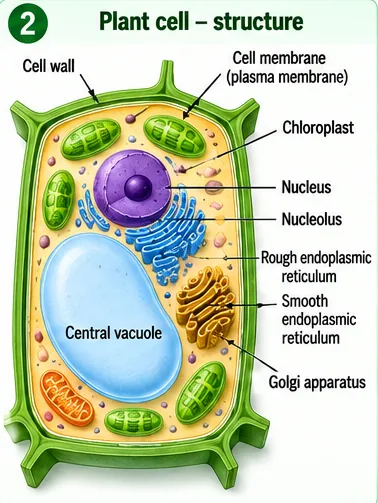
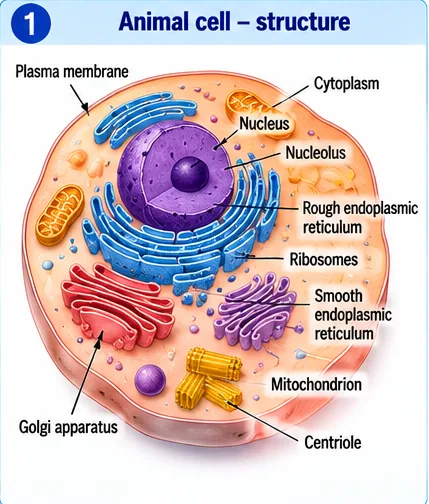
| Feature | Plant cell | Animal cell |
|---|---|---|
| Cell wall | Present (outside the membrane; gives shape and strength) | Absent |
| Chloroplasts | Present (contain chlorophyll for photosynthesis) | Absent |
| Vacuole | One large central vacuole | Small or absent |
| Shape | Usually fixed, rectangular | Usually irregular or round |
| Centrioles | Absent (in most) | Present |
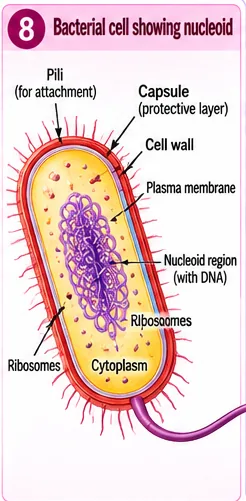
Bacterial cells are simpler. They have a cell wall, membrane, cytoplasm and ribosomes, but no well-defined nucleus: their genetic material lies in a region called the nucleoid. Many have a protective capsule, hair-like pili and a whip-like flagellum for movement.
3. Variety in Cells and Levels of Organisation
Cells vary in shape and size according to their work. Nerve cells are long and branched to carry messages; red blood cells are disc-shaped to carry oxygen; muscle cells are spindle-shaped to contract; egg cells are large and round with stored food.
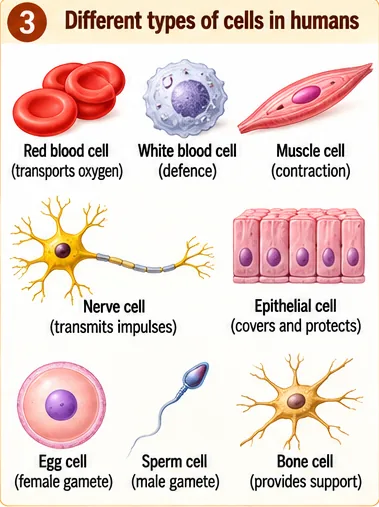
| Cell | Shape | Function |
|---|---|---|
| Red blood cell | Disc-shaped, no nucleus in humans | Carries oxygen |
| White blood cell | Irregular, changes shape | Fights germs |
| Nerve cell (neuron) | Long with branches | Carries messages |
| Muscle cell | Spindle-shaped | Contracts and relaxes for movement |
| Egg / sperm | Large round / tailed | Reproduction |
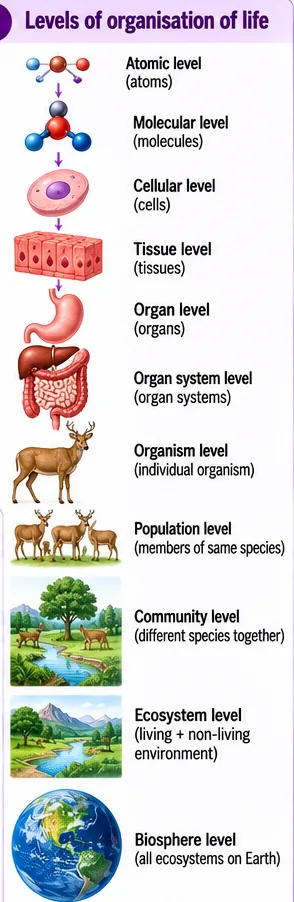
Cells are organised into higher levels: cells → tissues → organs → organ systems → organism. Beyond the organism come population, community, ecosystem and biosphere.
4. What Are Microorganisms?
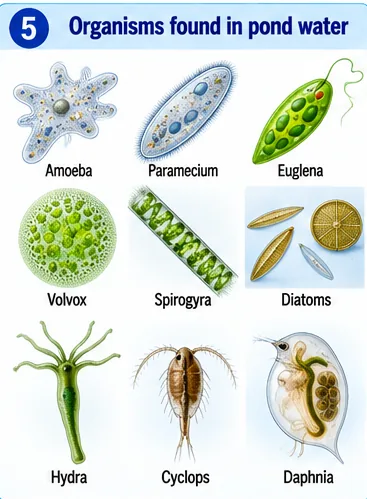
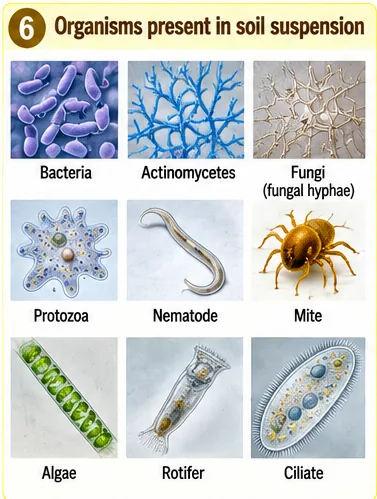
Microorganisms are living beings too small to be seen without a microscope. They are found in soil, water, air, on our skin and inside our bodies, even in hot springs and icy regions.
| Group | Features | Examples |
|---|---|---|
| Bacteria | Single-celled; no nucleus; very small | Lactobacillus (curd), Rhizobium (root nodules) |
| Fungi | Many are thread-like (hyphae); some single-celled | Yeast, bread mould, mushroom |
| Protozoa | Single-celled, animal-like | Amoeba, Paramecium, Plasmodium |
| Algae | Plant-like, contain chlorophyll | Spirogyra, Chlamydomonas, Volvox, diatoms |
| Viruses | Not cells; reproduce only inside living host cells | Viruses causing flu, measles, chickenpox |
5. How Are We Connected to Microbes?
Useful microbes
- Food: Lactobacillus turns milk into curd; yeast makes dough rise (releases carbon dioxide) and is used in idli and dosa batters and in bread — this is fermentation.
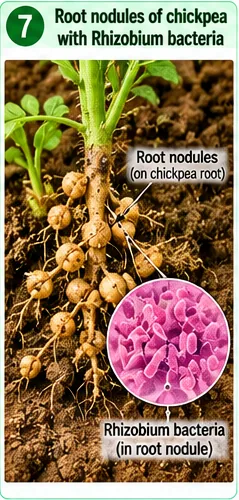
- Soil fertility: Rhizobium bacteria in the root nodules of legumes (gram, peas, beans) fix nitrogen from the air into forms plants can use. Microbes also decompose dead plants and animals into manure (compost), recycling nutrients.
- Medicine: antibiotics like penicillin (discovered by Alexander Fleming from a mould) kill bacteria; vaccines made from weakened or killed microbes protect us from diseases.
- Environment: microbes clean sewage in treatment plants and break down wastes.
- Industry: making vinegar, alcohol, enzymes and biogas.
Harmful microbes
- Pathogens cause diseases in humans (tuberculosis, cholera, typhoid by bacteria; malaria by protozoa; flu, measles by viruses), animals (foot-and-mouth disease) and plants (rust of wheat).
- Some microbes spoil food — bread becomes mouldy, milk turns sour; a few produce toxins causing food poisoning.
Food preservation prevents microbial growth: refrigeration, boiling, drying, salting, sugar (jams), oil and vinegar (pickles), pasteurisation of milk and airtight packing.
6. Why Is the Cell the Basic Unit of Life?
All life processes — taking in food, releasing energy, removing wastes, growing and reproducing — take place in cells. A single cell (like an amoeba) can carry out all these alone. In multicellular organisms, cells specialise and work together. So the cell is both the structural and the functional unit of life.
7. Master Table: Key Terms
| Term | Meaning |
|---|---|
| Cell | Basic structural and functional unit of life |
| Unicellular / Multicellular | One cell / many cells |
| Nucleus | Control centre with genetic material |
| Nucleoid | Region with genetic material in bacteria (no membrane) |
| Chloroplast | Organelle with chlorophyll; only in plant cells |
| Microorganism | Living being seen only with a microscope |
| Fermentation | Change of sugar into alcohol/acid and gas by microbes |
| Nitrogen fixation | Conversion of atmospheric nitrogen into usable compounds |
| Pathogen | Disease-causing microbe |
8. Master Summary Table
| Microbe | Useful role | Harmful role |
|---|---|---|
| Bacteria | Curd, nitrogen fixation, decomposition | Cholera, typhoid, TB |
| Fungi | Yeast in bread, penicillin | Mould on bread, plant rust |
| Protozoa | Part of food chains | Malaria, amoebic dysentery |
| Algae | Make food and oxygen in water | Algal blooms |
| Viruses | Used in some vaccines and research | Flu, measles, chickenpox |
9. Mind Map
- Membrane, cytoplasm, nucleus
- Plant vs animal vs bacteria
- Cell → tissue → organ
- → system → organism
- Bacteria, fungi, protozoa
- Algae, viruses
- Curd, yeast, Rhizobium
- Pathogens, spoilage
10. Tips and Tricks
- Plant cell extras: “WCV” — Wall, Chloroplast, big Vacuole.
- Five microbe groups: “Big Friendly Panda Ate Vegetables” — Bacteria, Fungi, Protozoa, Algae, Viruses.
- Rhizobium → Root nodules → nitrogen.
- Saying viruses are cells — they are not; they need a host cell to multiply.
- Saying bacteria have a nucleus — they have a nucleoid without a membrane.
- Thinking all microbes are harmful — most are useful or harmless.
11. Important One-liners
- Robert Hooke first described cells (1665) in cork.
- The cell is the basic unit of life.
- Plant cells have a cell wall, chloroplasts and a large vacuole.
- Bacteria have a nucleoid instead of a true nucleus.
- Nerve cells are long and branched.
- Lactobacillus converts milk into curd.
- Yeast is used in baking; it releases carbon dioxide.
- Rhizobium fixes nitrogen in root nodules of legumes.
- Penicillin was discovered by Alexander Fleming.
- Viruses reproduce only inside host cells.
12. Exam-pattern Questions with Detailed Answers
Which structure is present in a plant cell but absent in an animal cell?
- Nucleus
- Cell membrane
- Cell wall
- Cytoplasm
Show answer
Only plant cells have a cell wall (and chloroplasts). Nucleus, membrane and cytoplasm are common to both.
Answer: (C) Cell wall
Name the bacterium that helps in making curd.
Show answer
Lactobacillus converts milk sugar into lactic acid, setting milk into curd.
Answer: Lactobacillus
Who first observed and named cells?
Show answer
Robert Hooke, while studying cork under a microscope in 1665.
Answer: Robert Hooke
Why does the dough rise when yeast is added?
Show answer
Yeast feeds on sugar and releases carbon dioxide gas (fermentation). Gas bubbles get trapped in the dough, making it rise and become soft and spongy.
Answer: CO₂ released by yeast
How do leguminous plants increase soil fertility?
Show answer
Rhizobium bacteria living in their root nodules fix atmospheric nitrogen into nitrogen compounds that enrich the soil. That is why farmers grow legumes between cereal crops.
Answer: Rhizobium fixes nitrogen in root nodules
Explain why the shape of a nerve cell suits its function.
Show answer
A nerve cell is long with many branches. Its length carries messages over long distances, and branches connect with many other cells to receive and pass on signals.
Answer: Long and branched for carrying messages
Arrange in increasing order of organisation: organ, cell, organism, tissue, organ system.
Show answer
Cell → tissue → organ → organ system → organism.
Answer: Cell, tissue, organ, organ system, organism
Give two methods of food preservation and explain how they work.
Show answer
Refrigeration — low temperature slows microbial growth. Salting/sugaring — remove water from food and microbes, preventing their growth. (Others: boiling, pasteurisation, drying, airtight packing.)
Answer: Cold slows microbes; salt/sugar removes water
Why are viruses considered to be at the boundary of living and non-living?
Show answer
Outside a living cell a virus shows no life activities — it does not feed, respire or grow, and can even be crystallised. Inside a host cell it multiplies, a feature of living things. So it behaves as non-living outside and living inside a host.
Answer: Reproduce only inside host cells; inert outside
A cell has a cell wall and ribosomes but no nucleus enclosed by a membrane. Identify it and justify.
Show answer
It is a bacterial cell. Bacteria have a cell wall and ribosomes, but their genetic material lies in a nucleoid without a nuclear membrane.
Answer: Bacterium
What would happen to the Earth if there were no decomposer microbes?
Show answer
Dead plants and animals and wastes would pile up; nutrients locked in them would not return to the soil; plants would lack nutrients and food chains would collapse. Decomposers recycle matter and keep ecosystems working.
Answer: Wastes pile up; nutrients not recycled
13. Quick Revision Summary
- Cells (Hooke, 1665) are the basic units of life; unicellular and multicellular organisms.
- Plant cells: wall, chloroplasts, large vacuole; animal cells lack these; bacteria have a nucleoid.
- Cells vary in shape for their work; cell → tissue → organ → system → organism.
- Microbes: bacteria, fungi, protozoa, algae, viruses.
- Useful: curd, baking, nitrogen fixation, antibiotics, vaccines, decomposition; harmful: diseases, food spoilage — preserve food.