
1. Chapter at a Glance
When wood burns it seems to lose mass; when iron rusts it seems to gain mass. Do substances disappear or appear from nowhere in chemical reactions? Careful measurements in the 18th century gave clear answers, leading to the laws of chemical combination. These laws were explained by Dalton’s atomic theory. This chapter then shows how atoms combine — by transferring electrons to form ions (ionic bonding) or by sharing electrons (covalent bonding) — and how to write chemical formulae using valency.
- Law of conservation of mass and law of constant proportions.
- Dalton’s atomic theory — postulates and limitations.
- Atoms, molecules and atomicity; ions — cations and anions.
- Ionic and covalent bonds; why ionic solutions conduct electricity.
- Writing chemical formulae; molecular and formula unit mass.
2. Law of Conservation of Mass
Antoine Lavoisier showed by careful weighing in closed vessels that mass can neither be created nor destroyed in a chemical reaction. The total mass of reactants equals the total mass of products.
Take a solution of barium chloride in a conical flask and a small test tube of sodium sulphate solution hanging inside it. Weigh the closed set-up, tilt to mix (a white precipitate of barium sulphate forms) and weigh again — the mass does not change.
In a reaction, 5.3 g of sodium carbonate reacts with 6.0 g of ethanoic acid to give 2.2 g of carbon dioxide, 0.9 g of water and 8.2 g of sodium ethanoate. Reactants = 5.3 + 6.0 = 11.3 g; products = 2.2 + 0.9 + 8.2 = 11.3 g. Mass is conserved.
Wood seems to lose mass on burning only because gases (carbon dioxide, water vapour) escape; iron gains mass on rusting because it combines with oxygen and water from air. In a closed system the total stays the same.
3. Law of Constant Proportions
Joseph Proust stated: in a chemical substance, the elements are always present in definite proportions by mass, whatever its source or method of preparation. Pure water from a river, a well or made in the laboratory always has hydrogen and oxygen in the mass ratio 1 : 8. In ammonia, nitrogen and hydrogen are always in the ratio 14 : 3.
Hydrogen and oxygen combine in the ratio 1 : 8 by mass. How much oxygen is needed to react completely with 3 g of hydrogen? Oxygen = 3 × 8 = 24 g, forming 27 g of water.
4. Dalton’s Atomic Theory (1808)
- All matter is made of very tiny particles called atoms.
- Atoms are indivisible and cannot be created or destroyed in a chemical reaction (explains conservation of mass).
- Atoms of a given element are identical in mass and chemical properties.
- Atoms of different elements have different masses and properties.
- Atoms combine in the ratio of small whole numbers to form compounds (explains constant proportions).
- The relative number and kinds of atoms are constant in a given compound.
Limitations (known today): atoms are divisible into electrons, protons and neutrons; atoms of the same element can have different masses (isotopes); atoms of different elements can have the same mass number (isobars).
5. Atoms, Molecules and Ions
- A molecule is the smallest particle of an element or compound that can exist independently and shows all its properties. It is made of two or more atoms chemically bonded.
- Atomicity — number of atoms in a molecule: monoatomic (He, Ne, Ar), diatomic (H₂, O₂, N₂, Cl₂), triatomic (O₃), polyatomic (P₄, S₈).
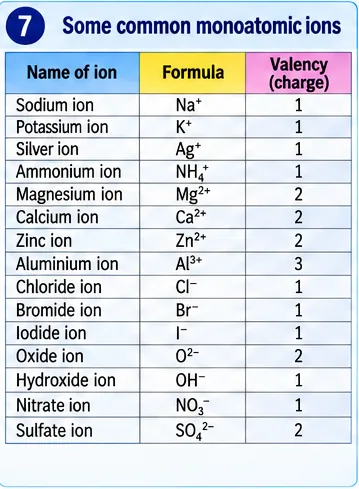
- An ion is a charged particle formed when an atom (or group of atoms) loses or gains electrons. A positively charged ion is a cation (Na⁺, Mg²⁺); a negatively charged ion is an anion (Cl⁻, O²⁻). A charged group of atoms is a polyatomic ion (NH₄⁺, OH⁻, NO₃⁻, SO₄²⁻, CO₃²⁻).
6. How Atoms Combine
Atoms combine to attain a stable electron arrangement — a complete outer shell (octet, or duplet for hydrogen/helium) like the noble gases.
(a) Ionic bonding — transfer of electrons
Metals with few valence electrons lose them to form cations; non-metals with 5–7 valence electrons gain electrons to form anions. The oppositely charged ions attract strongly, forming an ionic (electrovalent) bond.
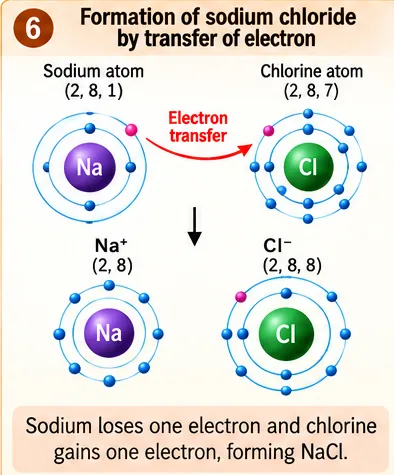
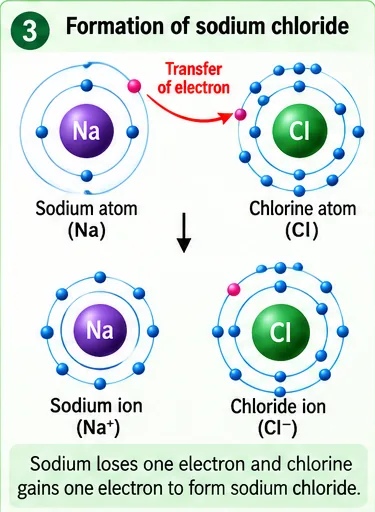
Na (2,8,1) → Na⁺ (2,8) + e⁻ ; Cl (2,8,7) + e⁻ → Cl⁻ (2,8,8) ; Na⁺ + Cl⁻ → NaCl
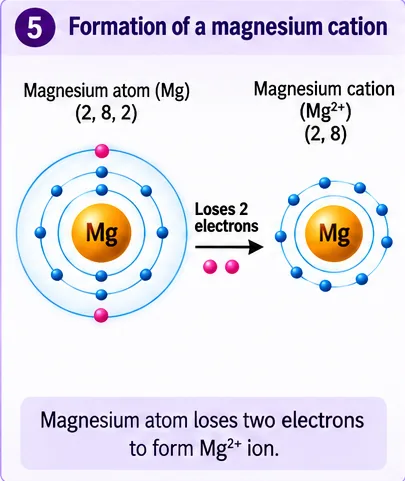
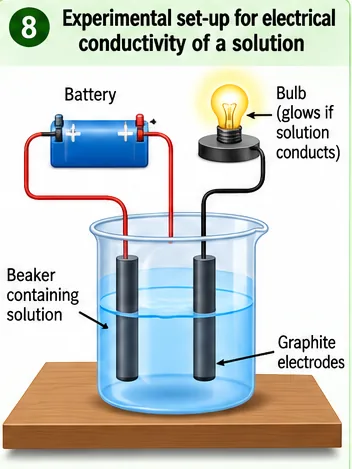
Similarly, Mg (2,8,2) gives 2 electrons to O (2,6) to form Mg²⁺ and O²⁻ → MgO. Ionic compounds are usually hard crystalline solids with high melting points; they conduct electricity when molten or dissolved in water, because their ions become free to move.
(b) Covalent bonding — sharing of electrons
Non-metal atoms often share electron pairs so that each attains a stable configuration. A shared pair forms a covalent bond.
- H₂ — each H shares its one electron: a single bond (H–H).
- O₂ — each O (2,6) shares two electrons: a double bond (O=O).
- N₂ — triple bond (N≡N).
- H₂O — oxygen shares one pair with each of two hydrogen atoms.
- CH₄ — carbon shares four pairs with four hydrogen atoms.
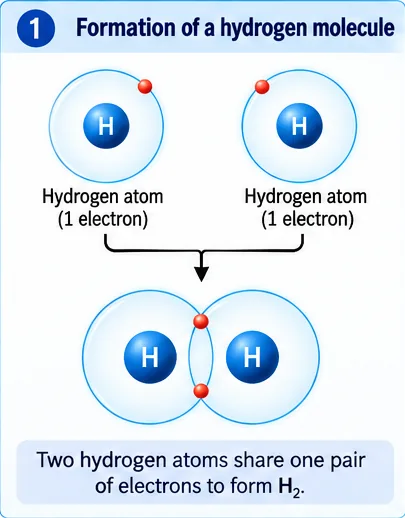
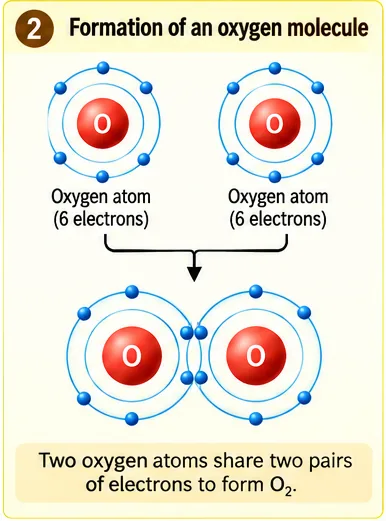
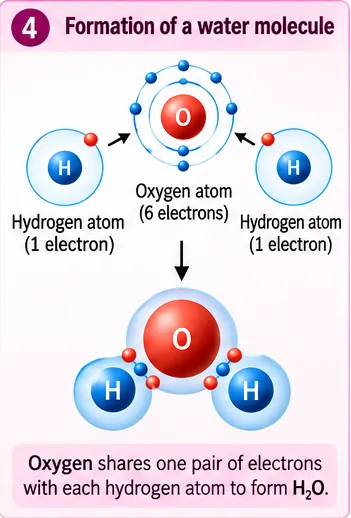
Covalent compounds usually have low melting and boiling points and do not conduct electricity (no free ions).
| Property | Ionic compounds | Covalent compounds |
|---|---|---|
| Formed by | Transfer of electrons (metal + non-metal) | Sharing of electrons (non-metals) |
| State | Hard solids | Often gases, liquids or soft solids |
| Melting/boiling points | High | Low |
| Conductivity | Conduct in molten state or solution | Generally do not conduct |
| Examples | NaCl, MgO, CaCl₂ | H₂, O₂, H₂O, CH₄, CO₂ |
7. Writing Chemical Formulae
A chemical formula shows the symbols of elements and the number of atoms (or ions) of each in a compound. Rules: write the cation (metal) first and the anion second; criss-cross the valencies; reduce to the simplest ratio; put polyatomic ions in brackets when more than one is needed.
| Compound | Ions (valency) | Formula |
|---|---|---|
| Sodium chloride | Na⁺ (1), Cl⁻ (1) | NaCl |
| Magnesium oxide | Mg²⁺ (2), O²⁻ (2) | MgO (2:2 → 1:1) |
| Calcium chloride | Ca²⁺ (2), Cl⁻ (1) | CaCl₂ |
| Aluminium oxide | Al³⁺ (3), O²⁻ (2) | Al₂O₃ |
| Calcium hydroxide | Ca²⁺ (2), OH⁻ (1) | Ca(OH)₂ |
| Ammonium sulphate | NH₄⁺ (1), SO₄²⁻ (2) | (NH₄)₂SO₄ |
| Sodium carbonate | Na⁺ (1), CO₃²⁻ (2) | Na₂CO₃ |
Molecular mass and formula unit mass
Molecular mass = sum of atomic masses of all atoms in a molecule. For ionic compounds we use formula unit mass. (Atomic masses: H = 1 u, C = 12 u, N = 14 u, O = 16 u, Na = 23 u, Cl = 35.5 u, Ca = 40 u.)
- H₂O = 2 × 1 + 16 = 18 u.
- CO₂ = 12 + 2 × 16 = 44 u.
- NaCl = 23 + 35.5 = 58.5 u.
- CaCO₃ = 40 + 12 + 3 × 16 = 100 u.
8. Master Table: Laws and Key Terms
| Term | Meaning |
|---|---|
| Conservation of mass (Lavoisier) | Mass of reactants = mass of products |
| Constant proportions (Proust) | Fixed mass ratio of elements in a compound (H : O = 1 : 8 in water) |
| Atomicity | Number of atoms in a molecule |
| Cation / Anion | Positive ion (lost e⁻) / negative ion (gained e⁻) |
| Ionic bond | Electrostatic attraction after electron transfer |
| Covalent bond | Shared pair of electrons |
| Criss-cross | Exchange valencies to get subscripts |
| Molecular mass | Sum of atomic masses in a molecule |
9. Master Summary Table
| Molecule / compound | Bond type | Electrons involved |
|---|---|---|
| H₂ | Covalent (single) | 1 shared pair |
| O₂ | Covalent (double) | 2 shared pairs |
| N₂ | Covalent (triple) | 3 shared pairs |
| H₂O | Covalent | 2 shared pairs (O–H each) |
| NaCl | Ionic | 1 electron transferred |
| MgO | Ionic | 2 electrons transferred |
10. Mind Map
- Conservation of mass
- Constant proportions
- Postulates
- Limitations
- Ionic: transfer
- Covalent: sharing
- Criss-cross valency
- Molecular mass
11. Tips and Tricks
- Metals → lose e⁻ (cations); non-metals → gain e⁻ (anions). “Cations are pawsitive.”
- After criss-cross, always simplify (Mg₂O₂ → MgO).
- Bracket polyatomic ions when the subscript is more than 1: Ca(OH)₂, not CaOH₂.
- Saying mass is lost when wood burns — gases escaped; total mass is conserved.
- Writing NaCl₂ — both ions have valency 1.
- Calling NH₄⁺ or SO₄²⁻ monoatomic — they are polyatomic ions.
12. Important One-liners
- Lavoisier: mass is neither created nor destroyed in a reaction.
- Proust: elements combine in a fixed ratio by mass in a compound.
- Hydrogen and oxygen are in the ratio 1 : 8 by mass in water.
- Dalton’s theory explained both laws of chemical combination.
- Cations are positive ions; anions are negative ions.
- Ionic bonds form by transfer; covalent bonds by sharing of electrons.
- Ionic compounds conduct electricity in solution or molten state.
- O₂ has a double bond; N₂ has a triple bond.
- Formula of aluminium oxide is Al₂O₃.
- Molecular mass of H₂O is 18 u.
13. Exam-pattern Questions with Detailed Answers
The law of constant proportions was given by:
- Lavoisier
- Dalton
- Proust
- Rutherford
Show answer
Proust; Lavoisier gave conservation of mass; Dalton the atomic theory.
Answer: (C) Proust
Write the formula of calcium chloride.
Show answer
Ca²⁺ and Cl⁻ → criss-cross → CaCl₂.
Answer: CaCl₂
Calculate the molecular mass of CO₂ (C = 12 u, O = 16 u).
Show answer
12 + 2 × 16 = 44 u.
Answer: 44 u
Assertion (A): Sodium chloride solution conducts electricity. Reason (R): It contains free-moving ions.
- Both true; R explains A
- Both true; R does not explain A
- A true, R false
- A false, R true
Show answer
In water, NaCl separates into Na⁺ and Cl⁻ ions that move and carry current.
Answer: (A)
When 3 g of carbon burns in 8 g of oxygen, 11 g of carbon dioxide forms. What mass of CO₂ forms when 3 g of carbon burns in 50 g of oxygen? Which law is involved?
Show answer
Carbon and oxygen combine in a fixed ratio 3 : 8, so only 8 g of oxygen reacts; 42 g remains unused. CO₂ formed = 11 g. Law of constant proportions (and conservation of mass).
Answer: 11 g; law of constant proportions
Show the formation of MgO by transfer of electrons.
Show answer
Mg (2,8,2) → Mg²⁺ (2,8) + 2e⁻. O (2,6) + 2e⁻ → O²⁻ (2,8). Mg²⁺ + O²⁻ → MgO (ionic bond).
Answer: Mg loses 2e⁻ to O; Mg²⁺O²⁻
Write the formulae of: aluminium sulphate, ammonium chloride, sodium hydroxide.
Show answer
Al³⁺ + SO₄²⁻ → Al₂(SO₄)₃; NH₄⁺ + Cl⁻ → NH₄Cl; Na⁺ + OH⁻ → NaOH.
Answer: Al₂(SO₄)₃, NH₄Cl, NaOH
Give two postulates of Dalton’s theory and one limitation.
Show answer
Postulates: matter is made of indivisible atoms; atoms combine in small whole-number ratios. Limitation: atoms are divisible (have electrons, protons, neutrons), and isotopes show that atoms of one element can differ in mass.
Answer: Indivisible atoms; whole-number ratios; limitation — divisible atoms/isotopes
Explain why O₂ has a double bond while H₂ has a single bond.
Show answer
H has 1 electron and needs 1 more for a duplet, so two H atoms share one pair → single bond. O (2,6) needs 2 more for an octet, so two O atoms share two pairs → double bond.
Answer: Number of electrons needed to complete the shell
Case-based: A student tests distilled water, salt solution, sugar solution and dilute HCl with a bulb-and-electrode circuit. (a) Which make the bulb glow? (b) Explain the result for sugar solution. (c) Why does distilled water not conduct well?
Show answer
(a) Salt solution and dilute HCl (they contain ions). (b) Sugar is a covalent compound; it dissolves as molecules, not ions, so no current. (c) Pure water has very few ions; tap water conducts because of dissolved salts.
Answer: Salt solution and HCl glow; sugar forms no ions
Calculate the formula unit mass of CaCO₃ and the percentage of calcium in it (Ca = 40, C = 12, O = 16).
Show answer
CaCO₃ = 40 + 12 + 48 = 100 u. Calcium % = 40/100 × 100 = 40%.
Answer: 100 u; 40%
In an experiment 12 g of magnesium burns completely in oxygen to give 20 g of magnesium oxide. (a) How much oxygen was used? (b) What is the ratio of Mg to O by mass? (c) How much MgO forms from 6 g of Mg?
Show answer
(a) 20 − 12 = 8 g (conservation of mass). (b) 12 : 8 = 3 : 2. (c) 6 g Mg needs 4 g O → 10 g MgO (constant proportions).
Answer: 8 g; 3 : 2; 10 g
14. Quick Revision Summary
- Conservation of mass (Lavoisier); constant proportions (Proust; H : O = 1 : 8 in water).
- Dalton’s atomic theory explains both laws; limitations: sub-atomic particles, isotopes.
- Molecules have atomicity; ions are cations (+) or anions (−); polyatomic ions like NH₄⁺, SO₄²⁻.
- Ionic bond: transfer (NaCl, MgO) — conducts in solution; covalent bond: sharing (H₂, O₂, N₂, H₂O, CH₄).
- Formulae by criss-crossing valencies; molecular mass = sum of atomic masses (H₂O 18 u, CO₂ 44 u).