
1. Chapter at a Glance
Music, speech, birdsong, the roar of thunder — sound fills our world. Sound is a form of energy produced by vibrating objects and carried as a wave through a medium. This chapter explains how sound is produced and travels, why it needs a medium, the nature of sound waves (compressions and rarefactions), the characteristics that describe them — wavelength, frequency, time period, amplitude and speed — and how reflection of sound gives us echoes and useful technologies like SONAR and ultrasound scans.
- Production of sound by vibration; propagation through a medium.
- Longitudinal and transverse waves; compressions and rarefactions.
- Wavelength, frequency, time period, amplitude; v = f λ.
- Loudness, pitch and quality; speed of sound in different media.
- Reflection of sound, echo, reverberation; range of hearing; ultrasound and SONAR; the human ear.
2. Production of Sound
Sound is produced when objects vibrate — move rapidly to and fro. Touch a ringing bell or a speaking throat and you feel the vibration; a struck tuning fork makes a ping-pong ball bounce away; water splashes when a vibrating fork touches it. Humans produce sound by vibrations of the vocal cords in the larynx.
3. Propagation of Sound — It Needs a Medium
A vibrating object pushes the particles of the medium next to it, which push their neighbours, and so on. The disturbance — not the particles themselves — travels forward. A wave is a disturbance that transfers energy through a medium without the medium as a whole moving along.
Sound cannot travel through vacuum. In the bell-jar experiment, an electric bell ringing inside a jar becomes fainter as air is pumped out, though we can still see the hammer striking. That is why astronauts on the Moon communicate by radio.
4. Sound Waves — Longitudinal Waves
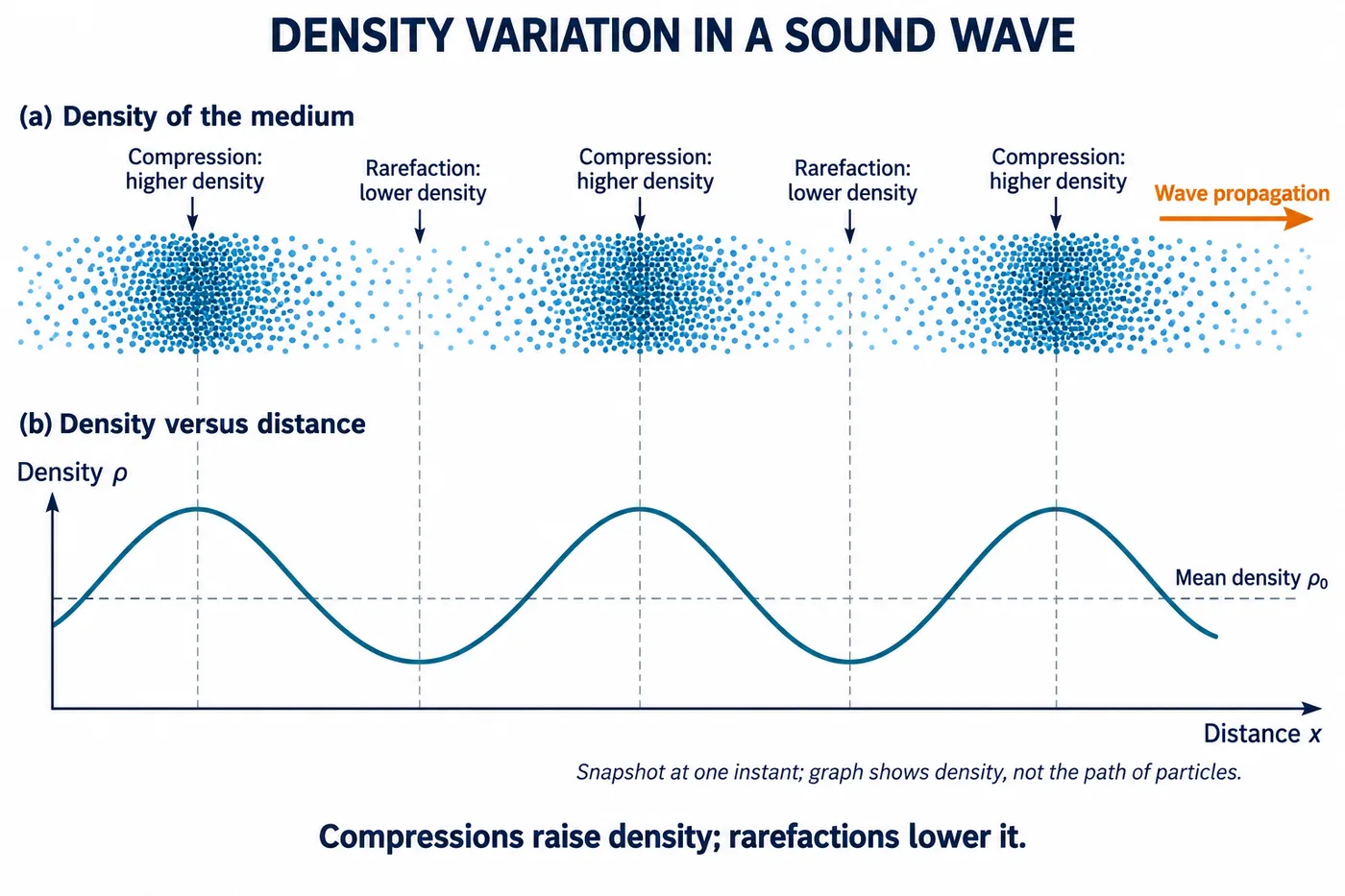
In a longitudinal wave, particles of the medium vibrate parallel to the direction in which the wave travels. Sound in air is longitudinal. Pushing and pulling one end of a slinky shows this: regions where coils are crowded are compressions (high pressure/density) and regions where they are spread out are rarefactions (low pressure/density).
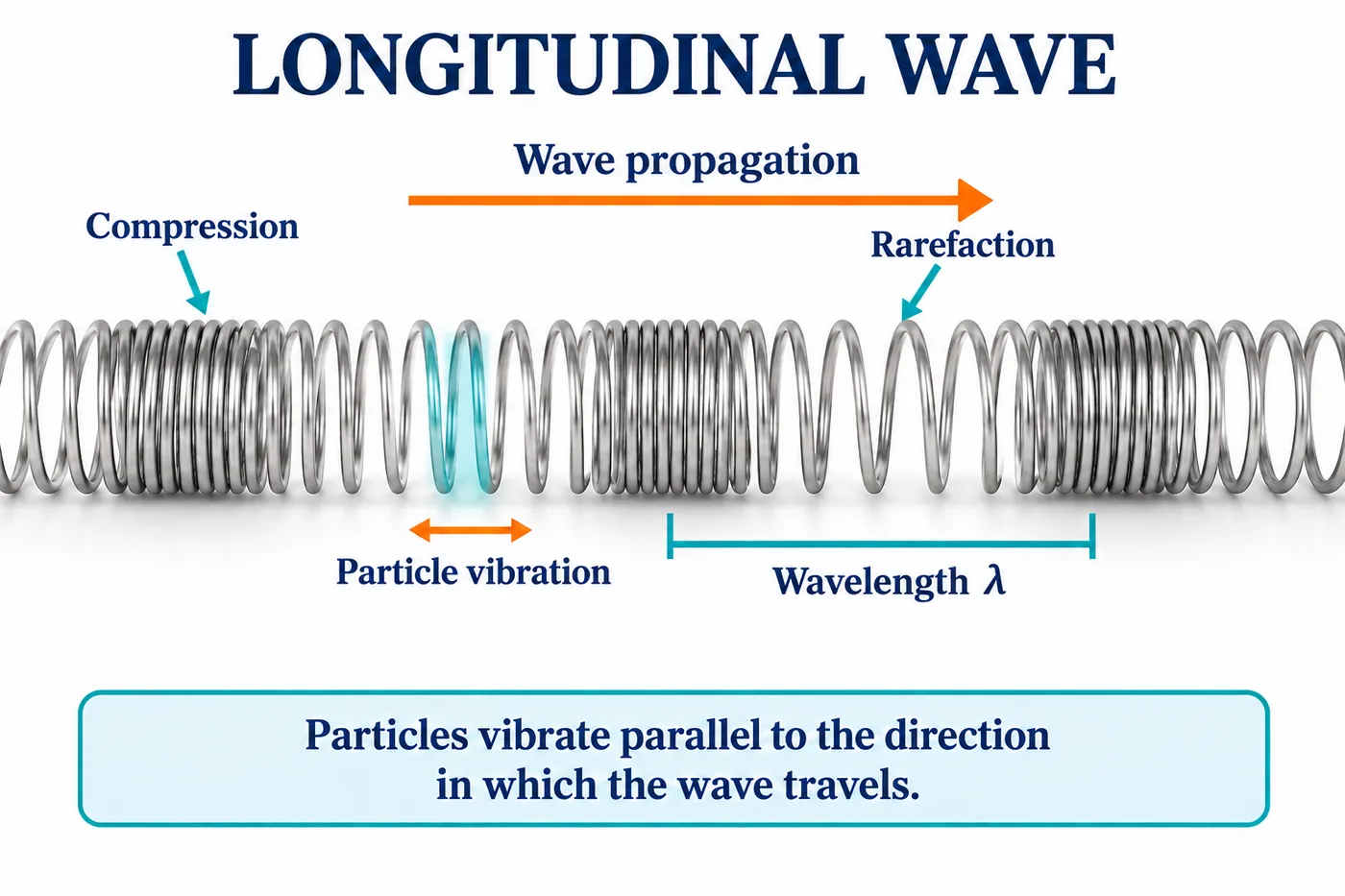
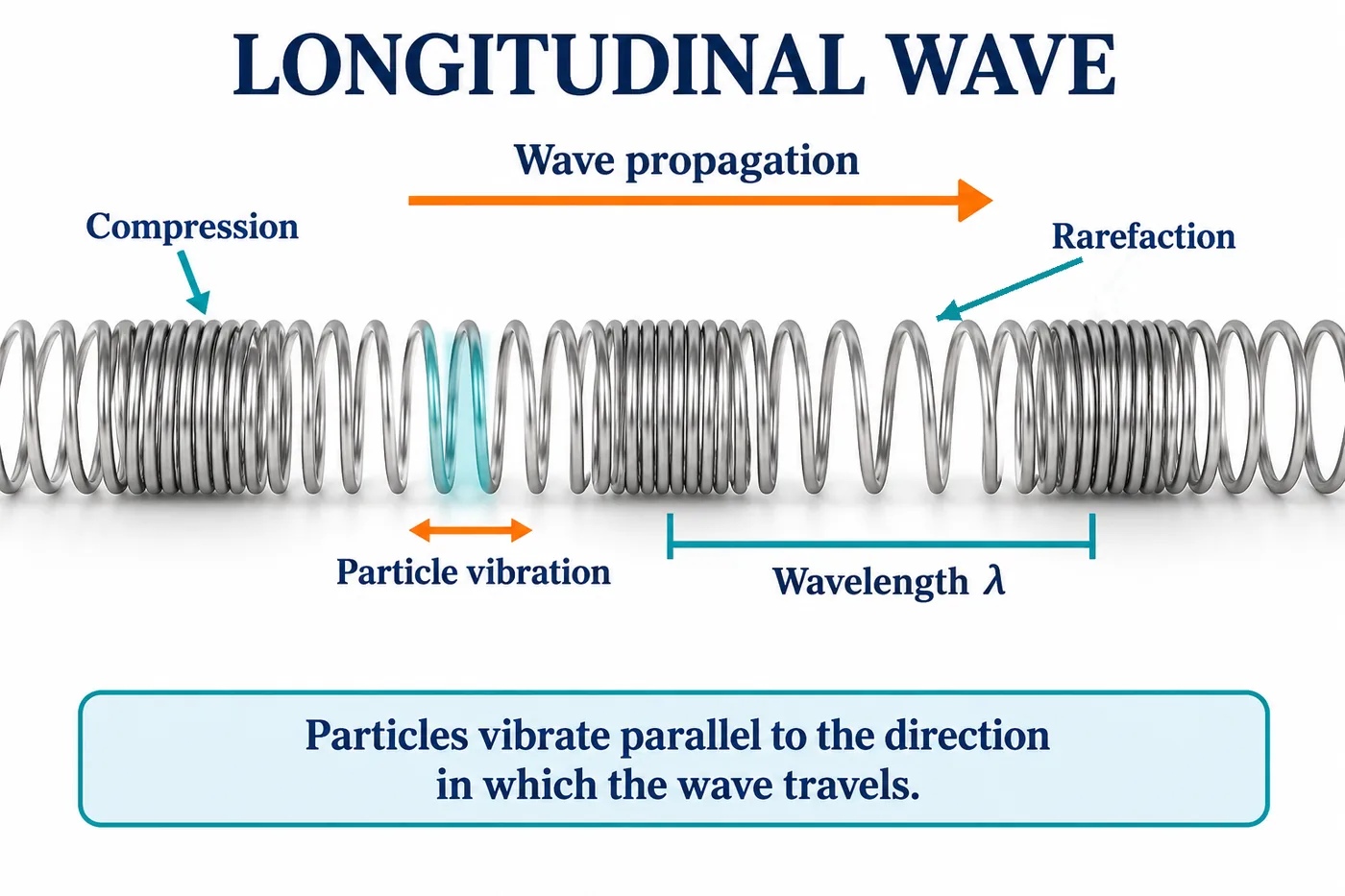
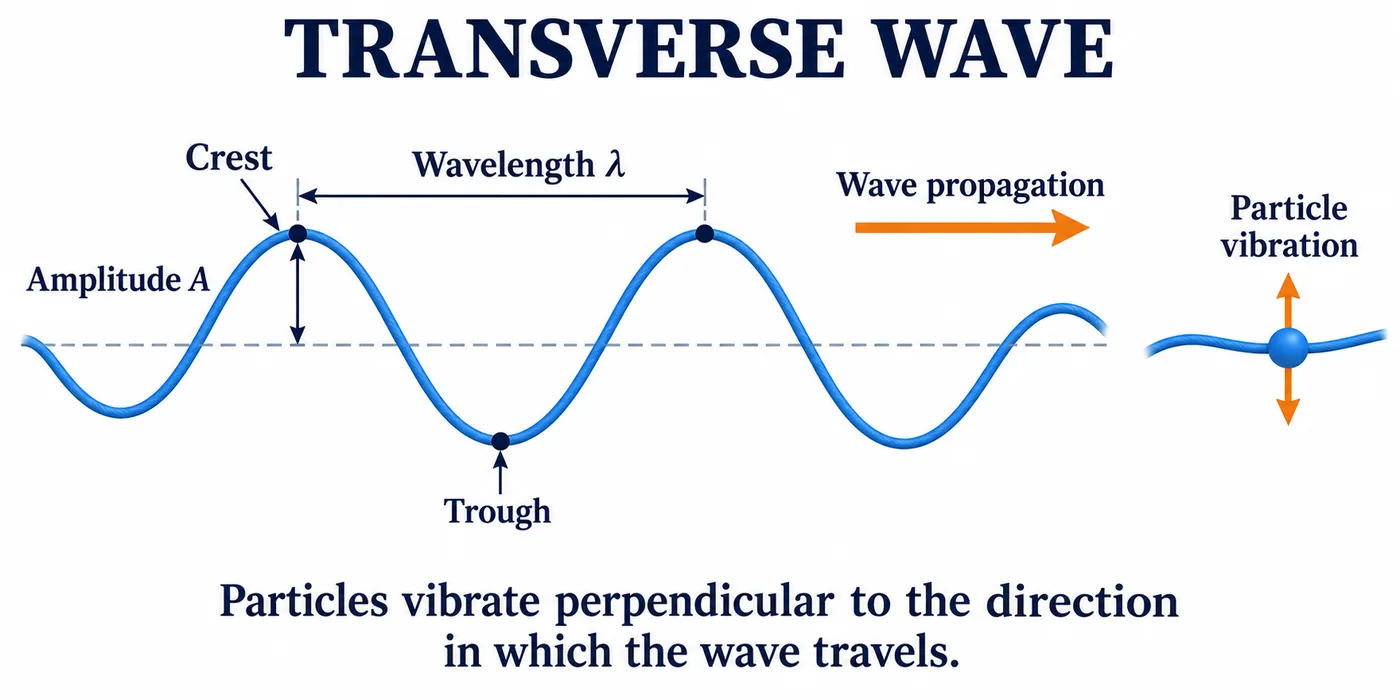
In a transverse wave, particles vibrate perpendicular to the direction of the wave — like waves on a stretched string or ripples on water. The highest points are crests and the lowest are troughs. Light is also a transverse wave (but needs no medium).
5. Characteristics of a Sound Wave
| Quantity | Meaning | SI unit |
|---|---|---|
| Wavelength (λ) | Distance between two consecutive compressions (or rarefactions); for transverse waves, crest to crest | metre (m) |
| Frequency (f or ν) | Number of complete oscillations (waves) per second | hertz (Hz) |
| Time period (T) | Time for one complete oscillation; T = 1/f | second (s) |
| Amplitude (A) | Maximum disturbance from the mean position | depends on quantity (m, Pa) |
| Speed (v) | Distance travelled by a compression per second | m/s |
Speed = Wavelength × Frequency → v = f λ
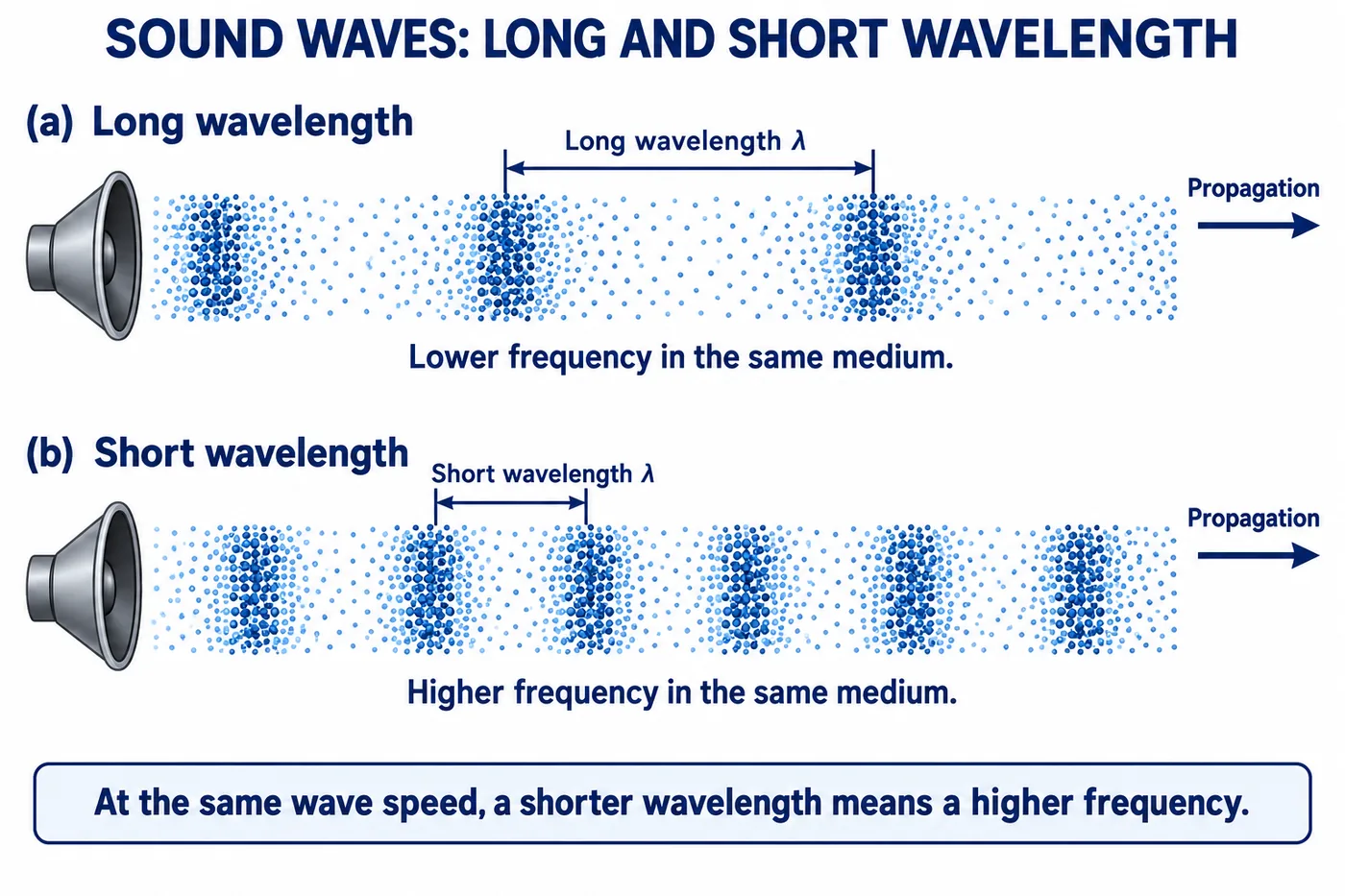
- Pitch depends on frequency — high frequency = high (shrill) pitch (a whistle, a bird); low frequency = low pitch (a drum, a lion’s roar).
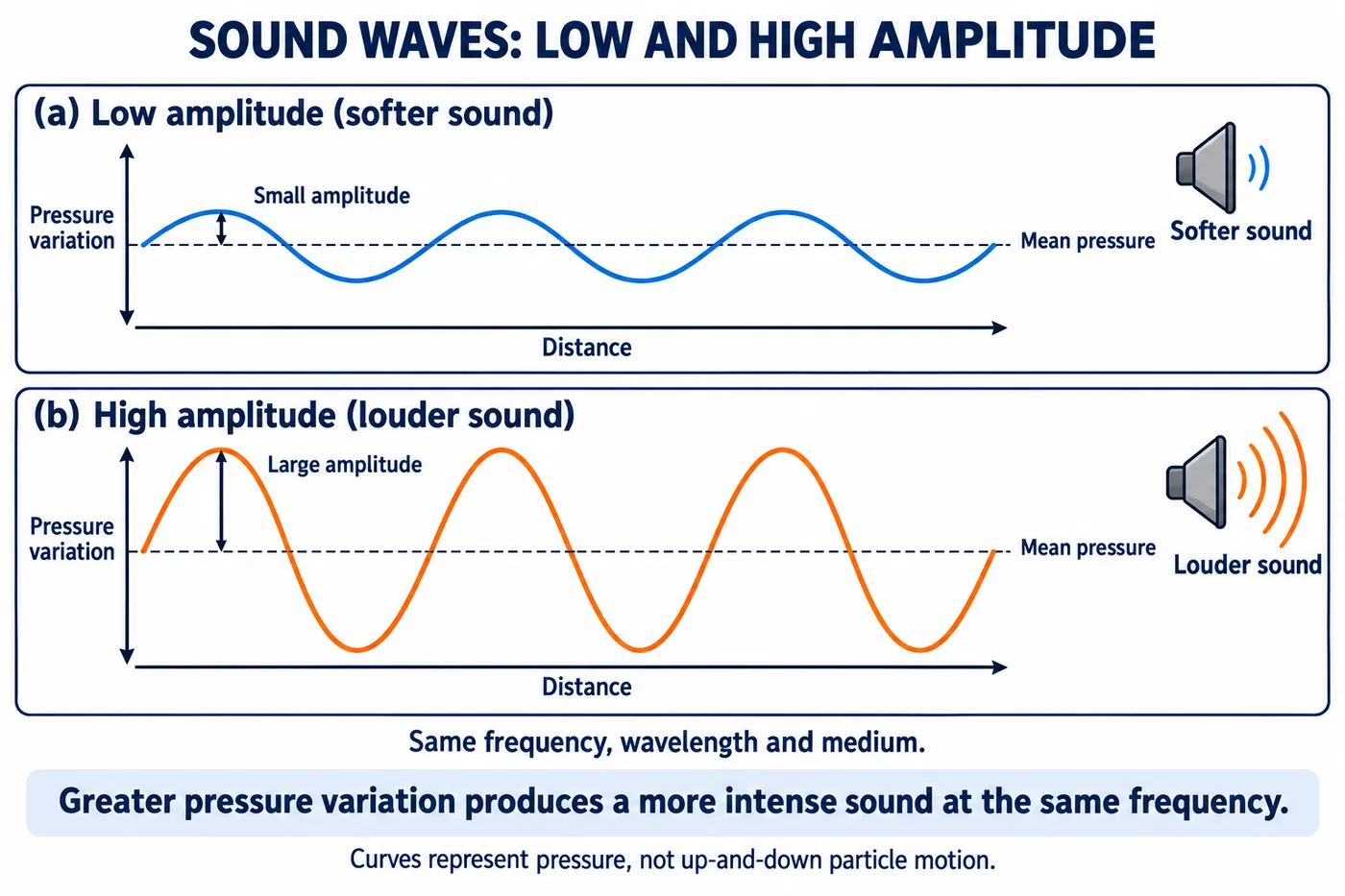
- Loudness depends on amplitude — larger amplitude = louder sound. Loudness is measured in decibels (dB).
- Quality (timbre) distinguishes two sounds of the same pitch and loudness (a flute and a violin playing the same note).
A sound wave has frequency 2 kHz and wavelength 35 cm. v = f λ = 2000 × 0.35 = 700 m/s. Time period T = 1/2000 = 0.0005 s.
6. Speed of Sound in Different Media
Sound travels faster in solids than in liquids, and faster in liquids than in gases, because particles are closer and interact more strongly. Speed also increases with temperature.
Approximate values; light (3 × 10⁸ m/s) is far faster, so lightning is seen before thunder is heard.
7. Reflection of Sound — Echo
Sound reflects from hard surfaces like walls, cliffs and buildings, obeying the same laws as light (angle of incidence = angle of reflection).
- Echo — a reflected sound heard separately. Sound persists in our brain for about 0.1 s, so the echo must arrive at least 0.1 s later. In air at 344 m/s, the sound travels 34.4 m in 0.1 s, so the reflecting surface must be at least 17.2 m away.
- Reverberation — repeated reflections that make sound persist in a big hall. It is reduced with sound-absorbing materials (curtains, fibreboard, cushioned seats).
- Uses — megaphones, horns and stethoscopes use multiple reflection; curved ceilings and soundboards in auditoriums spread sound evenly.
A boy hears the echo of his clap from a cliff after 2 s (speed of sound 340 m/s). Total distance = 340 × 2 = 680 m; distance of cliff = 680 ÷ 2 = 340 m.
8. Range of Hearing, Ultrasound and SONAR
- Human audible range: about 20 Hz to 20 000 Hz (20 kHz).
- Infrasound — below 20 Hz (produced by elephants, whales, earthquakes).
- Ultrasound — above 20 kHz (heard by dogs, bats, dolphins). Uses: cleaning delicate parts, detecting cracks in metals, ultrasonography (imaging internal organs and the foetus), echocardiography, breaking kidney stones.
- SONAR (Sound Navigation And Ranging) — ships send ultrasound pulses and receive echoes to find the depth of the sea and locate submarines, shoals of fish and shipwrecks. Bats use echolocation in a similar way.
A ship receives an ultrasonic echo from the seabed 4 s after sending it. Speed of sound in sea water = 1531 m/s. Depth = 1531 × 4 ÷ 2 = 3062 m.
9. The Human Ear
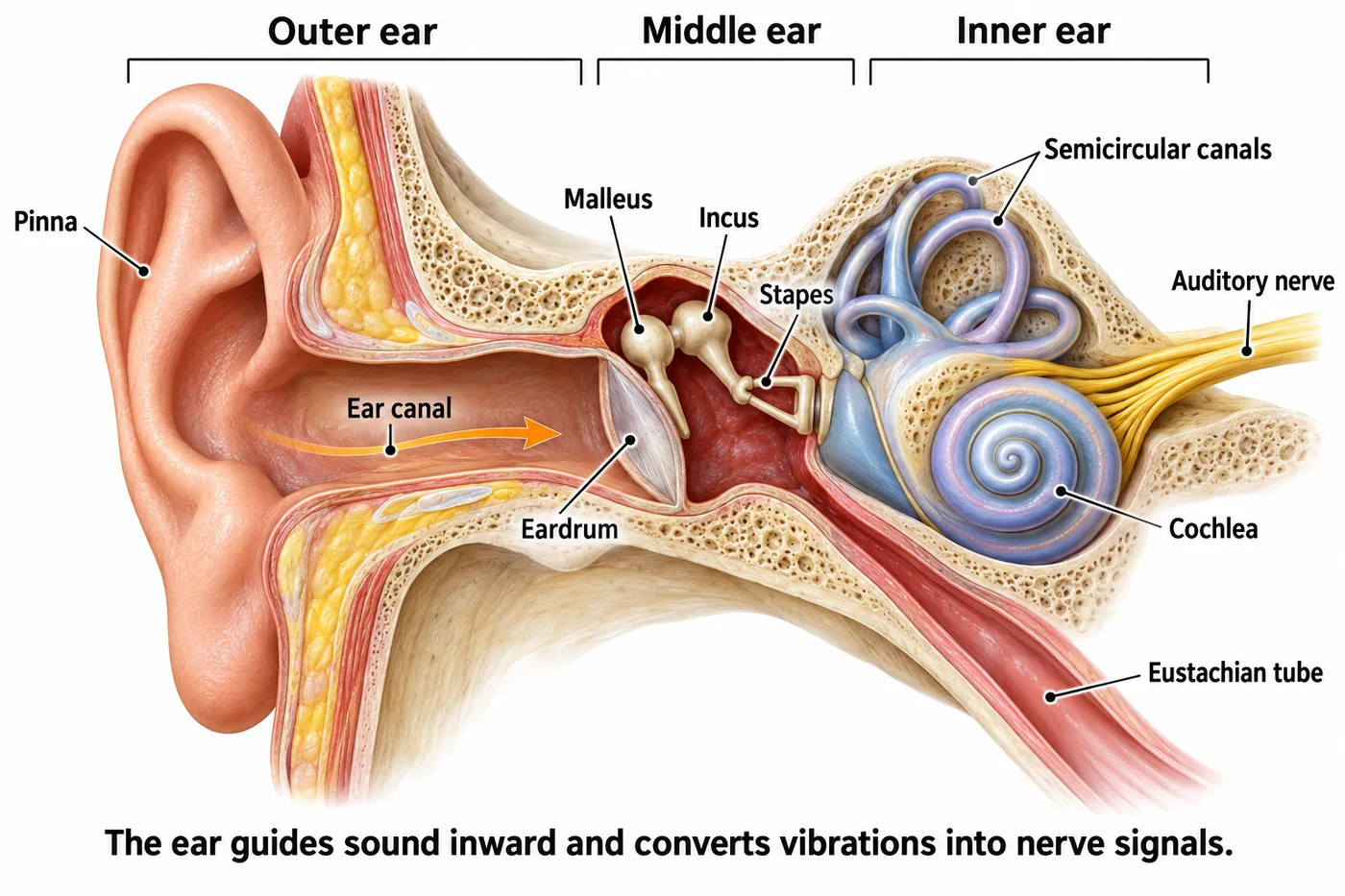
The outer ear (pinna and ear canal) collects sound and directs it to the eardrum, which vibrates. In the middle ear, three tiny bones — malleus, incus and stapes (hammer, anvil, stirrup) — amplify the vibrations and pass them to the inner ear. In the fluid-filled cochlea, the vibrations are converted into electrical signals sent by the auditory nerve to the brain. The Eustachian tube connects the middle ear to the throat and balances pressure; the semicircular canals help in balance.
Sounds above about 85 dB for long periods can damage hearing. Keep earphone volume low, avoid very loud music and never put sharp objects in the ear.
10. Master Table: Formulas and Values
| Quantity | Formula / value |
|---|---|
| Wave speed | v = f λ |
| Time period | T = 1/f |
| Echo distance | d = v t / 2 |
| Minimum distance for echo (air, 344 m/s) | ≈ 17.2 m |
| Audible range | 20 Hz – 20 kHz |
| Speed of sound in air (25 °C) | ≈ 346 m/s |
| Pitch / Loudness | Depend on frequency / amplitude |
11. Master Summary Table
| Feature | Longitudinal wave | Transverse wave |
|---|---|---|
| Particle vibration | Parallel to wave direction | Perpendicular to wave direction |
| Parts | Compressions, rarefactions | Crests, troughs |
| Wavelength | Compression to compression | Crest to crest |
| Example | Sound in air, slinky push–pull | Wave on a string, water ripples |
12. Mind Map
- Vibration
- Needs a medium
- Longitudinal: C and R
- Transverse: crest, trough
- λ, f, T, A; v = fλ
- Pitch, loudness, quality
- Echo, SONAR
- Ultrasound, the ear
13. Tips and Tricks
- “Pitch ↔ Frequency; Loudness ↔ Amplitude” — PF-LA.
- Echo and SONAR: always divide the total distance by 2.
- Convert kHz to Hz and cm to m before using v = fλ.
- Saying sound can travel in vacuum.
- Saying air particles travel from the source to the ear — only the disturbance travels.
- Confusing a rarefaction (spread-out region) with a compression.
14. Important One-liners
- Sound is produced by vibrating objects.
- Sound needs a medium; it cannot travel in vacuum.
- Sound in air is a longitudinal wave.
- Compressions are high-pressure regions; rarefactions are low-pressure regions.
- v = fλ; T = 1/f.
- Pitch depends on frequency; loudness on amplitude.
- Sound travels fastest in solids.
- An echo needs a reflector at least about 17 m away.
- Humans hear 20 Hz to 20 kHz.
- SONAR uses ultrasound to measure sea depth.
15. Exam-pattern Questions with Detailed Answers
The pitch of a sound depends on its:
- Amplitude
- Frequency
- Speed
- Wavelength only
Show answer
Higher frequency means higher pitch; amplitude decides loudness.
Answer: (B) Frequency
What is the audible range of the human ear?
Show answer
About 20 Hz to 20 000 Hz.
Answer: 20 Hz – 20 kHz
Why can’t sound travel through vacuum?
Show answer
Sound is a mechanical wave that needs particles of a medium to pass on the vibrations; vacuum has no particles.
Answer: No medium particles to carry vibrations
A sound wave travels at 340 m/s with a frequency of 680 Hz. Find its wavelength and time period.
Show answer
λ = v/f = 340/680 = 0.5 m. T = 1/680 ≈ 0.00147 s.
Answer: 0.5 m; ≈ 1.47 ms
Assertion (A): We see the lightning before we hear the thunder. Reason (R): Light travels much faster than sound.
- Both true; R explains A
- Both true; R does not explain A
- A true, R false
- A false, R true
Show answer
Both are produced together, but light (3 × 10⁸ m/s) reaches us almost instantly, while sound (~344 m/s) takes longer.
Answer: (A)
Distinguish between longitudinal and transverse waves with one example each.
Show answer
Longitudinal: particles vibrate parallel to the wave direction; compressions and rarefactions; sound in air. Transverse: particles vibrate perpendicular; crests and troughs; waves on a stretched string.
Answer: Parallel vs perpendicular vibration
Why are the ceilings of concert halls curved?
Show answer
Curved ceilings reflect sound towards all parts of the hall so that the audience everywhere hears clearly (multiple reflection of sound).
Answer: To reflect and spread sound evenly
Name the three bones of the middle ear and state their function.
Show answer
Malleus (hammer), incus (anvil) and stapes (stirrup). They amplify the vibrations of the eardrum and pass them to the inner ear (cochlea).
Answer: Malleus, incus, stapes — amplify vibrations
A person claps near a wall and hears the echo after 0.5 s. If sound travels at 346 m/s, how far is the wall? Can an echo be heard if the wall were 10 m away? Explain.
Show answer
d = 346 × 0.5 / 2 = 86.5 m. At 10 m, the echo returns in 20/346 ≈ 0.058 s, less than 0.1 s, so it merges with the original sound — no distinct echo.
Answer: 86.5 m; no — echo arrives in less than 0.1 s
Case-based: A ship sends an ultrasonic pulse and receives its echo from the seabed after 3.42 s. Speed of sound in sea water is 1531 m/s. (a) Find the depth. (b) Why is ultrasound used instead of audible sound? (c) Name an animal that uses a similar principle.
Show answer
(a) Depth = 1531 × 3.42 / 2 ≈ 2618 m. (b) Ultrasound has a short wavelength, travels in a narrow beam, is not easily deviated and gives sharper echoes from small objects. (c) Bats (echolocation), dolphins.
Answer: ≈ 2618 m; narrow beam, precise echoes; bats
Two sounds have the same frequency but different amplitudes. How do they differ to the listener? Draw (describe) their pressure–distance graphs.
Show answer
They have the same pitch but different loudness — the one with larger amplitude is louder. Graphs: both waves have the same wavelength (same spacing of peaks), but the louder one has taller peaks and deeper troughs.
Answer: Same pitch, different loudness; taller peaks = louder
Why does sound travel faster on a hot day than on a cold day, and faster in steel than in air?
Show answer
In hot air, particles move faster and pass on the disturbance more quickly. In steel, particles are tightly packed and strongly bound, so vibrations are transmitted much faster than in air, where particles are far apart.
Answer: Faster particle motion in heat; strong close bonding in solids
16. Quick Revision Summary
- Sound is produced by vibrations and needs a medium; it is a longitudinal wave in air (compressions and rarefactions).
- Wavelength, frequency (Hz), time period (T = 1/f), amplitude; v = fλ.
- Pitch ↔ frequency; loudness ↔ amplitude; quality distinguishes sources.
- Speed: solids > liquids > gases; ~346 m/s in air at 25 °C.
- Echo (≥ 0.1 s, ≥ ~17 m), reverberation; audible 20 Hz–20 kHz; ultrasound and SONAR; ear: pinna → eardrum → 3 bones → cochlea → auditory nerve.