
1. Chapter at a Glance
Everything around us is made of atoms — particles so small that about 10 million of them side by side would span just a millimetre. For a long time atoms were thought to be indivisible. Then experiments revealed that they contain even smaller particles: electrons, protons and neutrons. This chapter traces the journey from early ideas to modern atomic models, explains atomic number, mass number, electron shells and isotopes, and shows how the arrangement of electrons decides how an atom behaves.
- Roots of atomic theory — Kaṇāda and Dalton.
- Discovery of electron, proton and neutron.
- Thomson, Rutherford and Bohr models; the quantum (cloud) model.
- Atomic number, mass number, symbols; electron distribution in K, L, M shells.
- Valence electrons and valency; isotopes and isobars.
2. Rediscovering the Roots of Atomic Theory
Around 600–500 BCE (traditional dating), Indian philosopher Ācārya Kaṇāda proposed that matter is made of tiny indivisible particles called paramāṇu, which combine in pairs and groups. Greek thinkers Democritus and Leucippus called such particles atomos (indivisible). In 1808 John Dalton gave the first scientific atomic theory: matter is made of atoms that cannot be created or destroyed in chemical reactions; atoms of an element are identical; atoms combine in simple whole-number ratios (you will study this in Chapter 9). Dalton pictured atoms as solid, indivisible spheres.
3. Discovering the Sub-atomic Particles
- Electron — J. J. Thomson (1897) studied cathode rays in a gas-discharge tube at very low pressure and high voltage. The rays travelled from cathode to anode, were deflected by electric and magnetic fields towards the positive plate, and were the same for all gases. He concluded they were streams of tiny negatively charged particles present in all atoms — electrons (mass ≈ 1/1836 of a hydrogen atom).
- Proton — E. Goldstein (1886) discovered canal rays (anode rays), positively charged radiation; later the lightest such particle was identified as the proton (charge +1, mass ≈ 1 u).
- Neutron — James Chadwick (1932) discovered the neutral particle in the nucleus (no charge, mass ≈ 1 u).
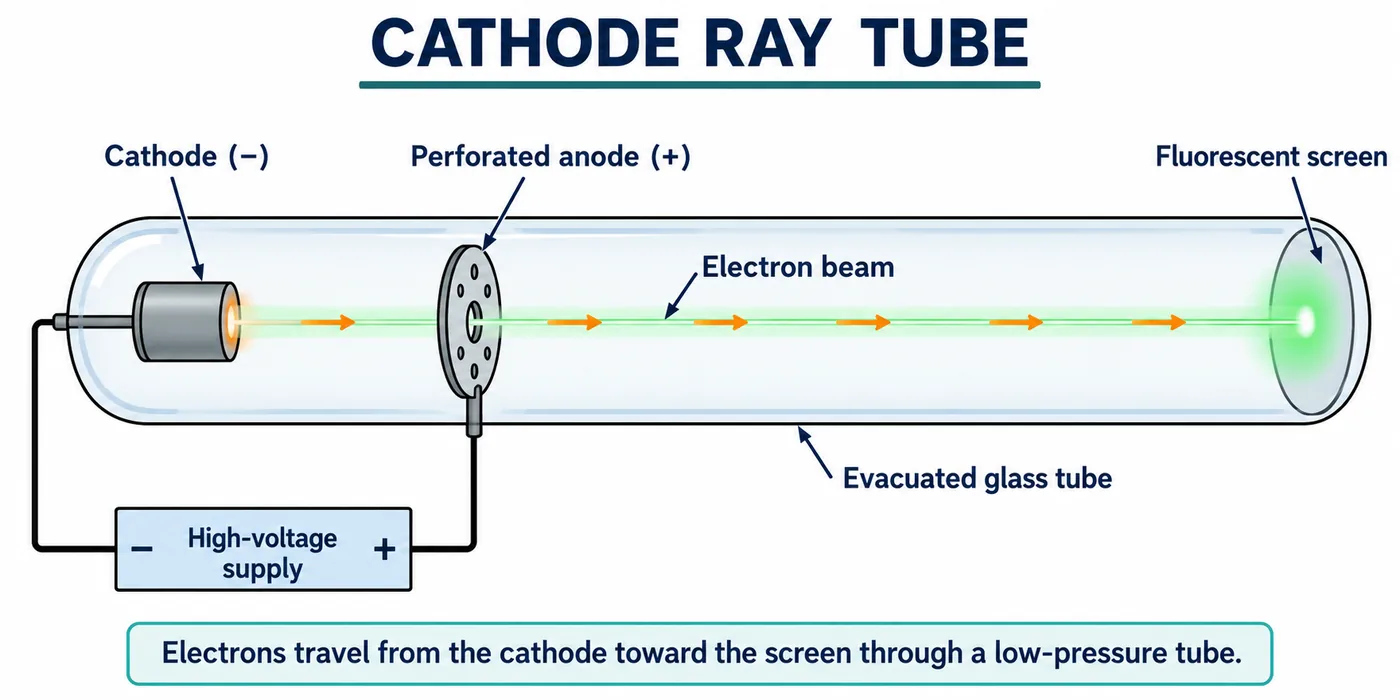
| Particle | Symbol | Charge | Relative mass | Location | Discovered by |
|---|---|---|---|---|---|
| Electron | e⁻ | −1 | ≈ 1/1836 | Shells around nucleus | J. J. Thomson |
| Proton | p⁺ | +1 | 1 | Nucleus | Goldstein (canal rays); Rutherford named it |
| Neutron | n | 0 | 1 | Nucleus | Chadwick |
4. A Short Historical Journey Through Atomic Models
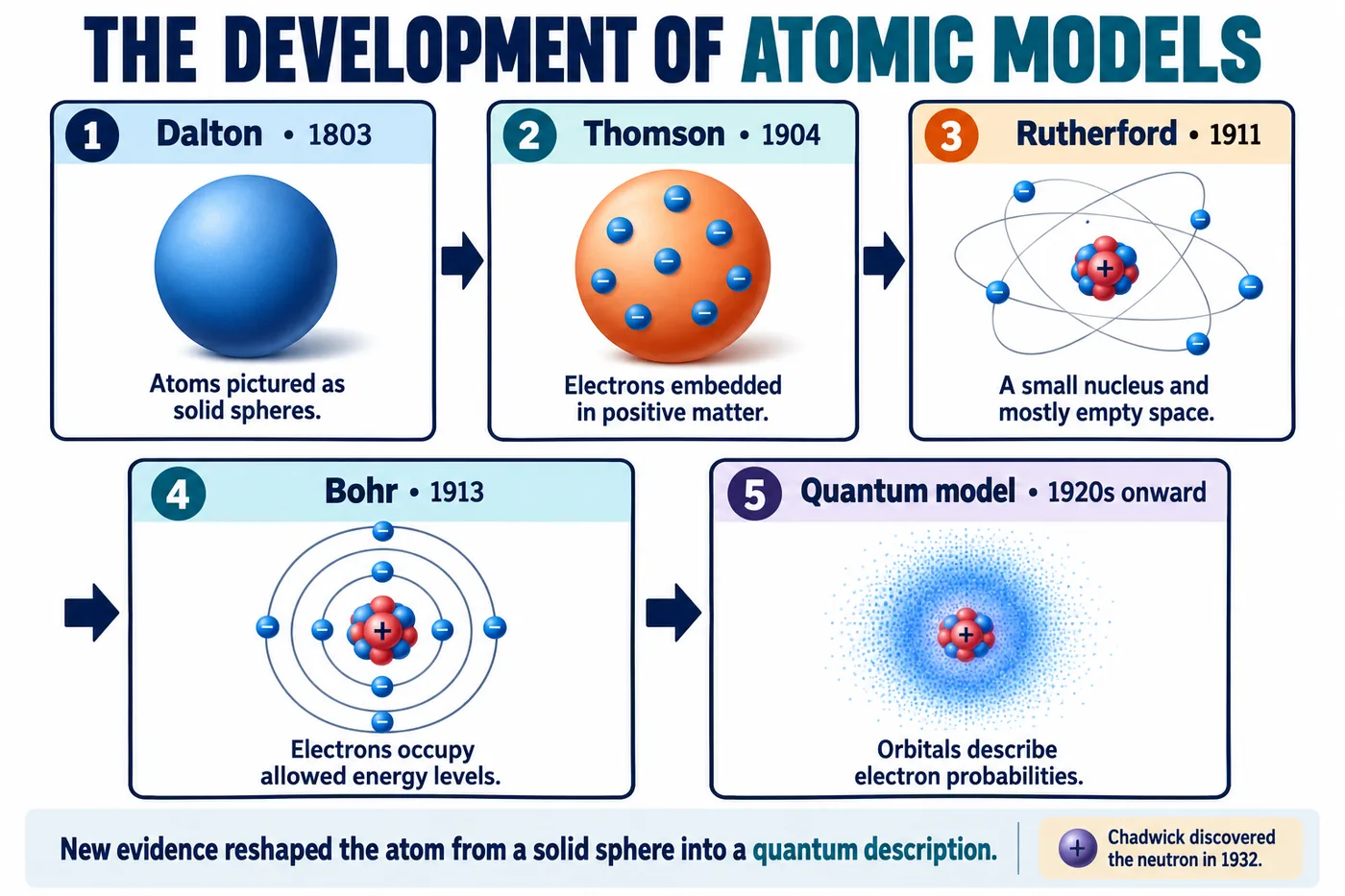
(a) Thomson’s model (1904) — “plum pudding” / watermelon model
The atom is a sphere of positive charge with electrons embedded in it, like seeds in a watermelon; overall the atom is neutral. It explained neutrality but not later experiments.
(b) Rutherford’s model (1911)
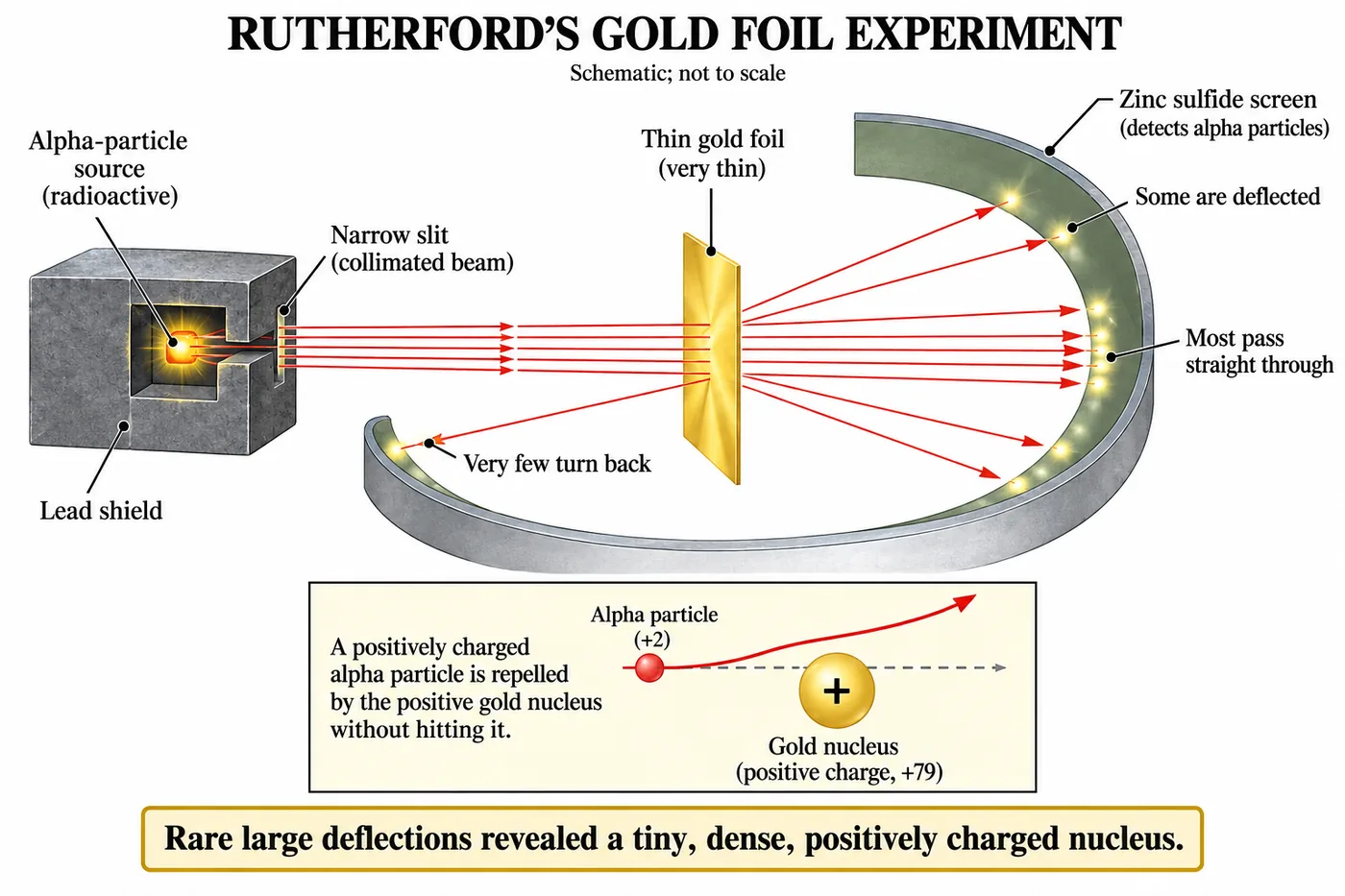
Rutherford fired fast-moving alpha particles (helium nuclei, charge +2) at a very thin gold foil.
| Observation | Conclusion |
|---|---|
| Most alpha particles passed straight through | Most of the atom is empty space |
| Some were deflected by small angles | Positive charge is concentrated in a small region |
| About 1 in 12 000 bounced back | A tiny, dense, positively charged nucleus contains almost all the mass (nucleus radius ≈ 1/100 000 of the atom) |
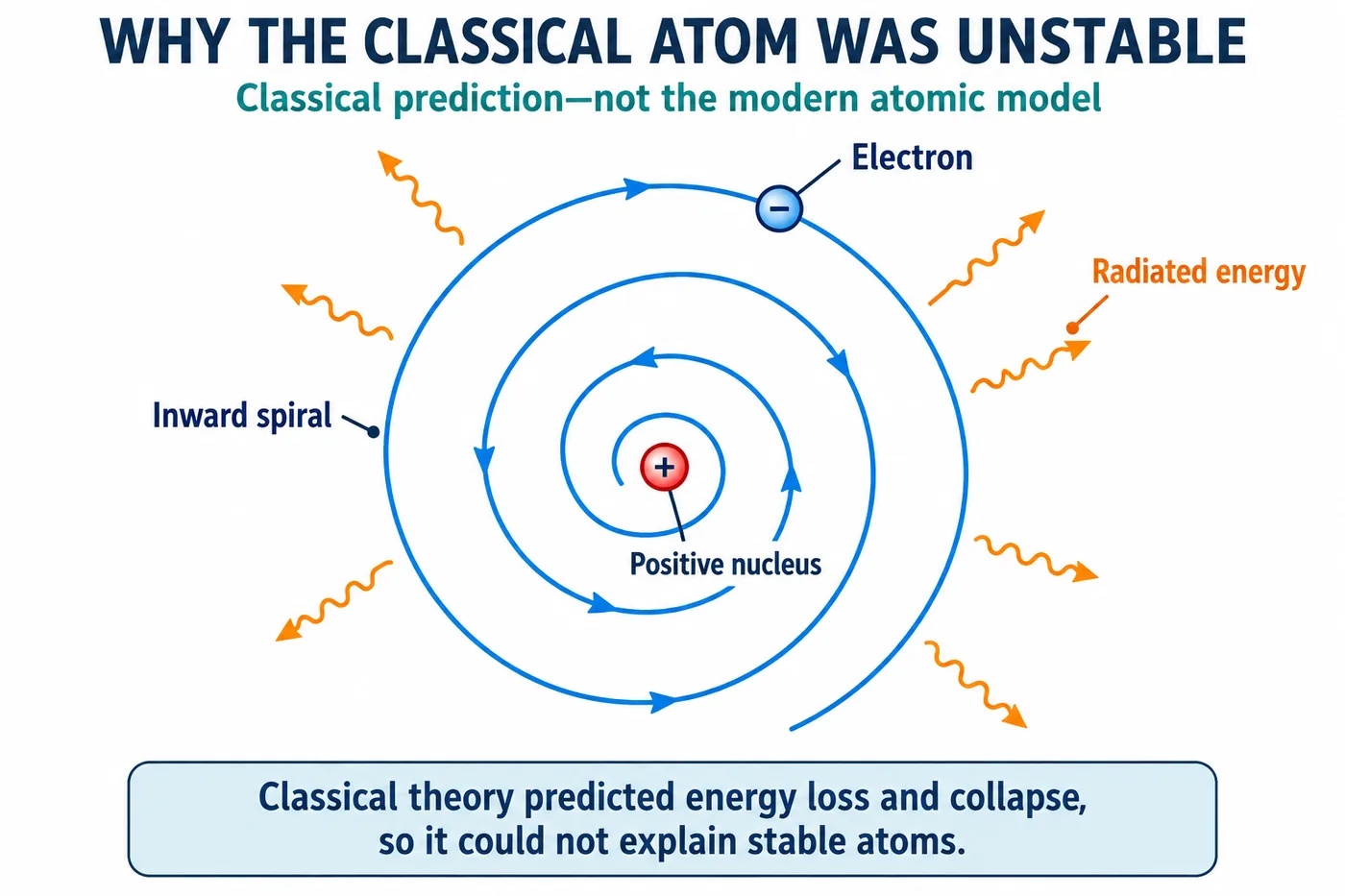
Model: a positive nucleus at the centre with electrons revolving around it in circular paths. Drawback: according to classical physics, a revolving charged particle radiates energy, so electrons should spiral into the nucleus and the atom should collapse — but atoms are stable.
(c) Bohr’s model (1913)
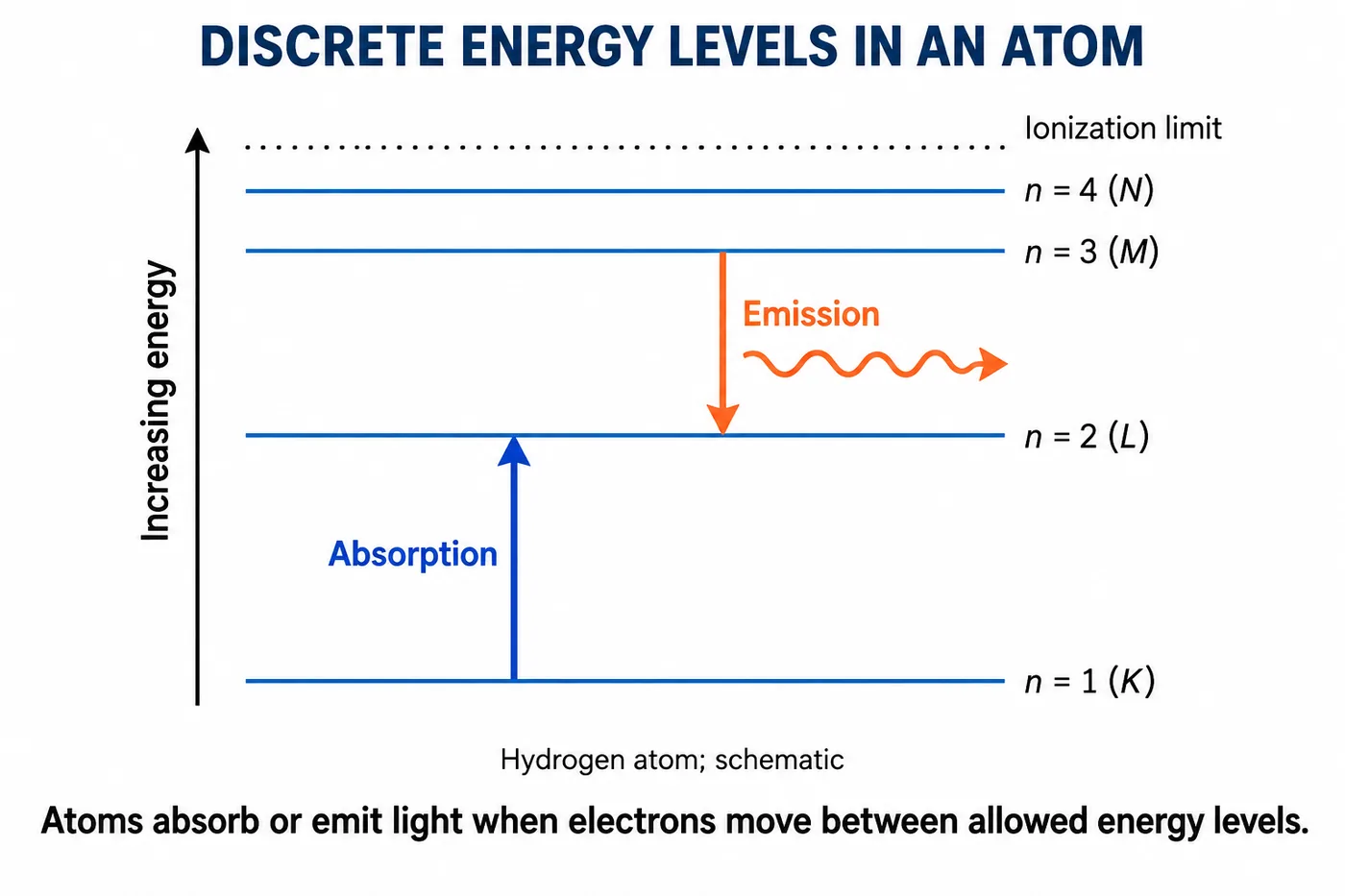
- Electrons revolve only in certain special orbits called energy levels or shells (K, L, M, N… or n = 1, 2, 3, 4…).
- While in these orbits, electrons do not radiate energy.
- Energy is absorbed when an electron jumps to a higher level, and emitted (often as light) when it falls to a lower level.
(d) Quantum (cloud) model (1920s onward)
Electrons are not tiny planets on exact paths; their positions are described by probabilities — regions called orbitals where an electron is likely to be found, forming an electron cloud around the nucleus. You will study this in higher classes.
5. Atomic Number, Mass Number and Symbols
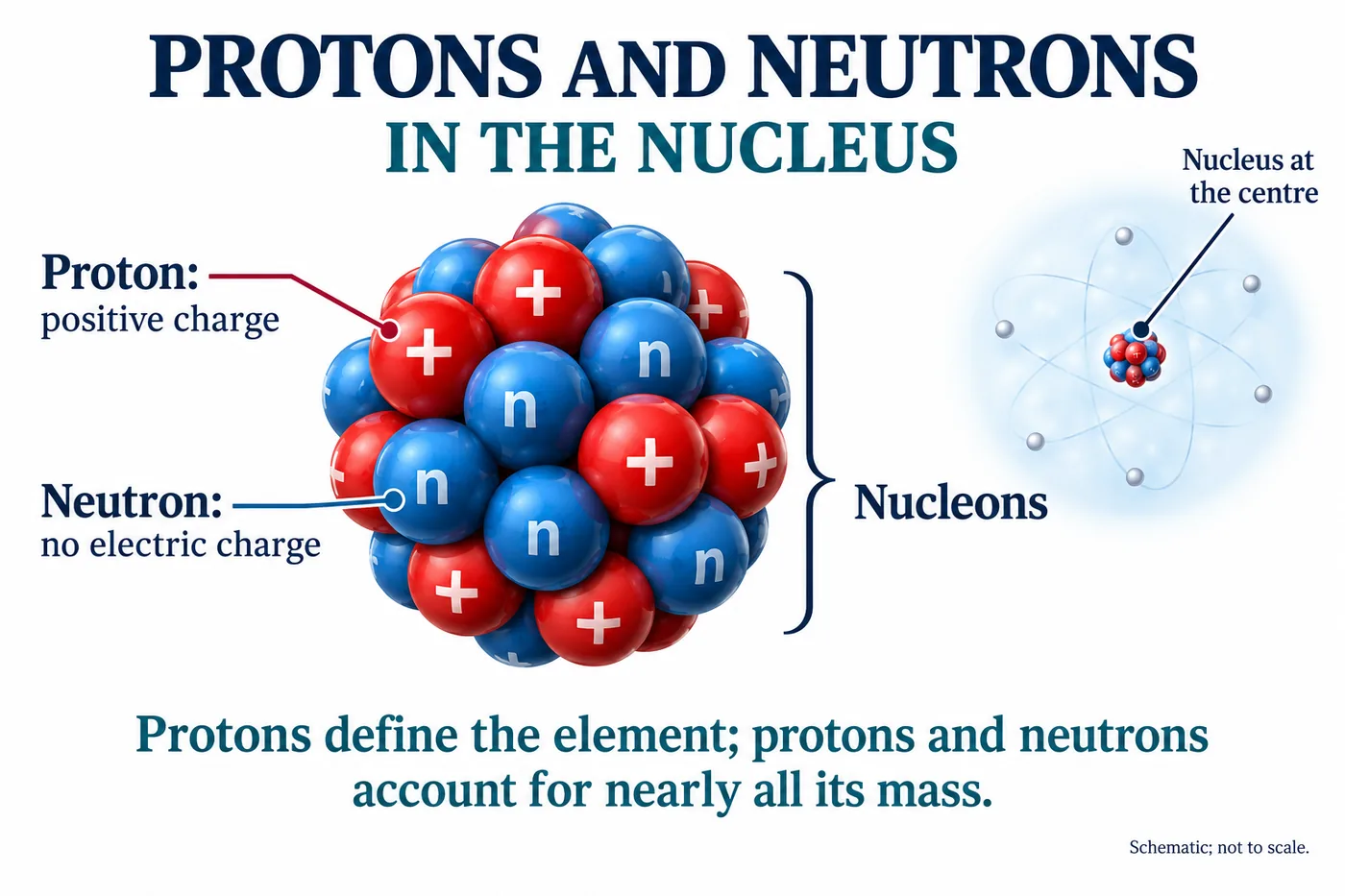
- Atomic number (Z) = number of protons. It identifies the element (all carbon atoms have Z = 6). In a neutral atom, electrons = protons.
- Mass number (A) = protons + neutrons (nucleons). Number of neutrons = A − Z.
- Notation: ᴬZX — e.g. ²³11Na has 11 protons, 11 electrons, 12 neutrons.
- Mass of atoms is expressed in atomic mass units (u); 1 u = 1/12 of the mass of a carbon-12 atom.
6. A Deeper Look — Distribution of Electrons
The Bohr–Bury rules for filling shells:
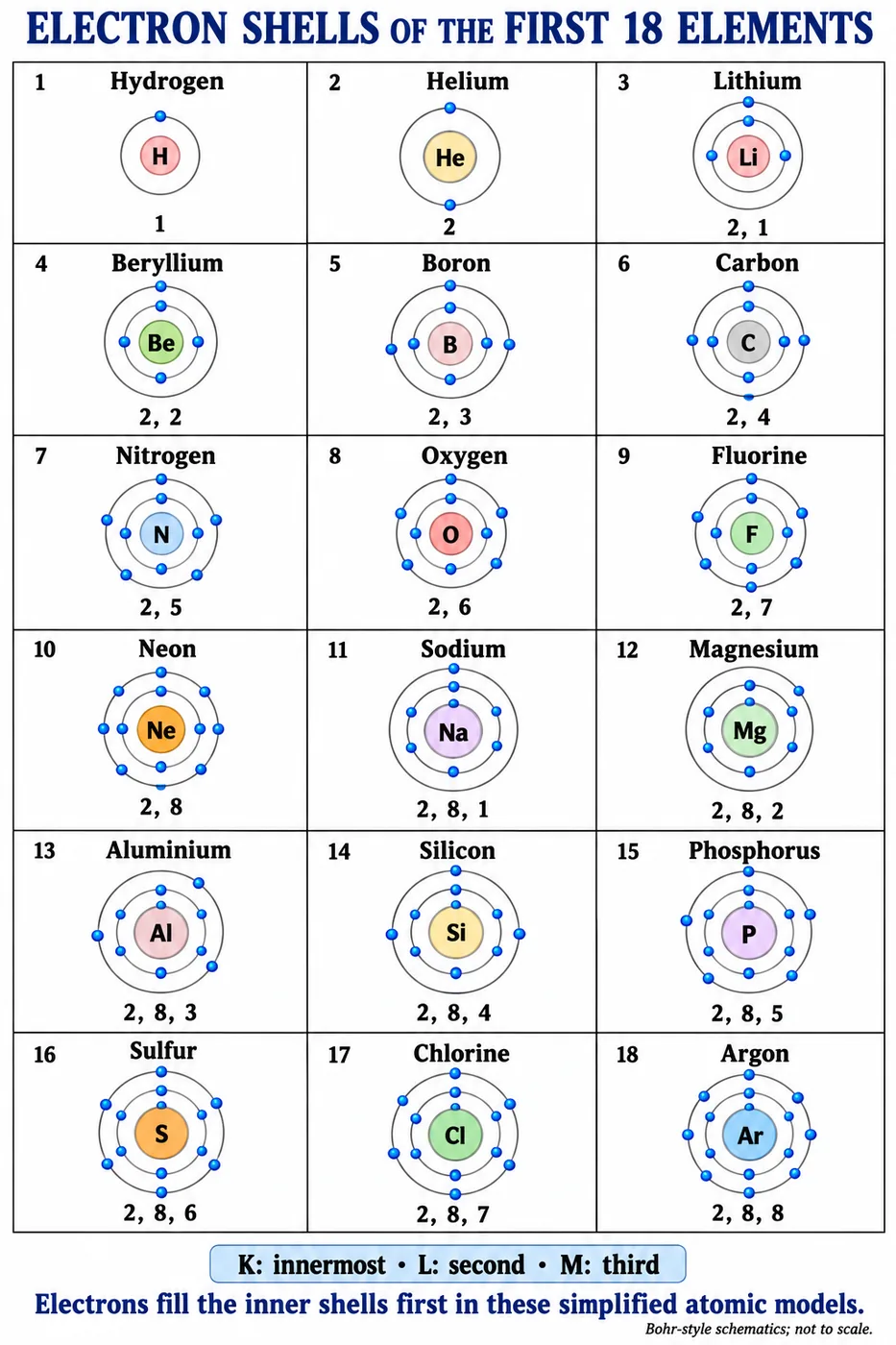
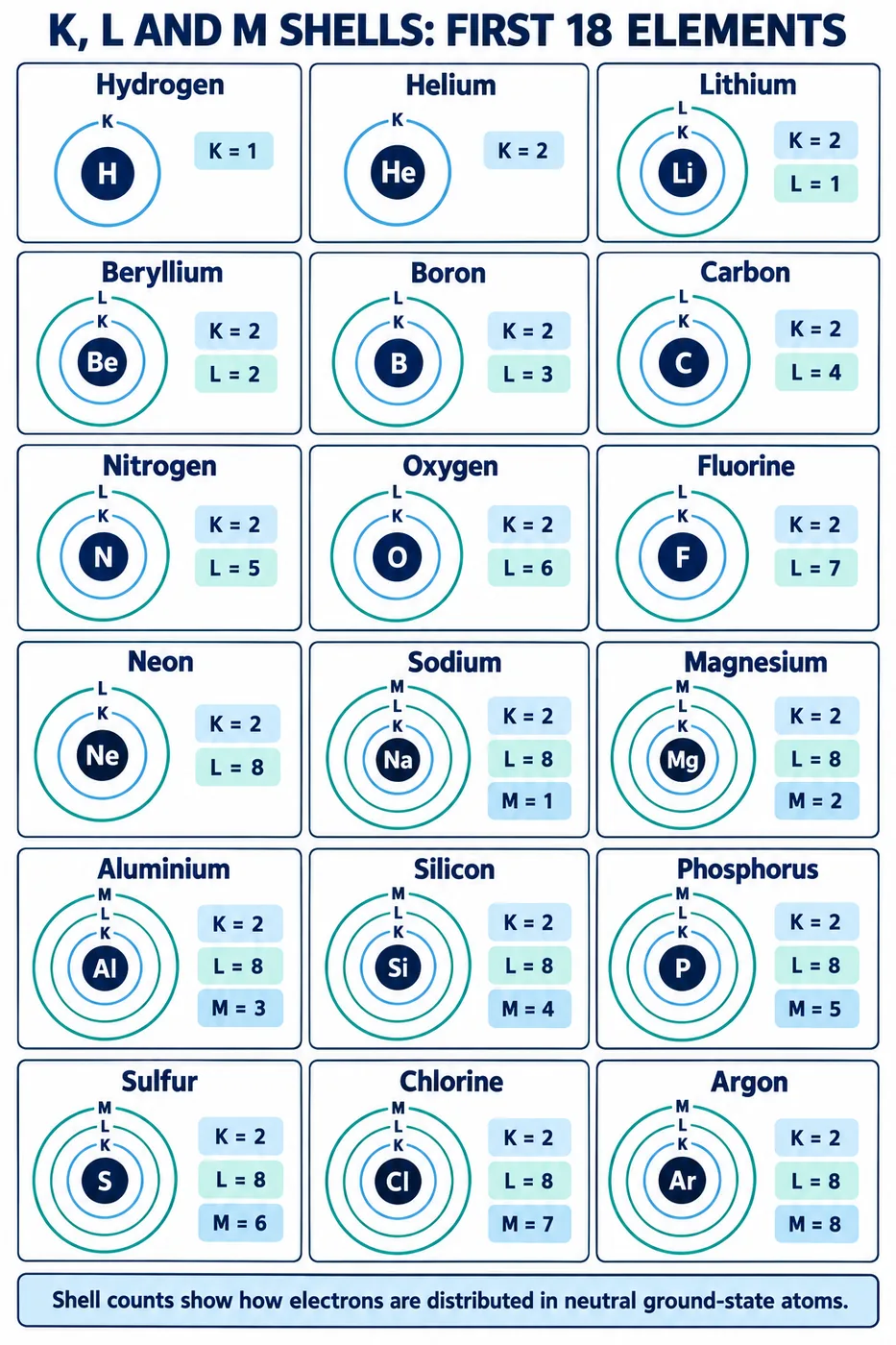
- Maximum electrons in a shell = 2n²: K (n=1) = 2, L (n=2) = 8, M (n=3) = 18, N (n=4) = 32.
- The outermost shell can hold at most 8 electrons.
- Shells are filled step by step — inner shells first.
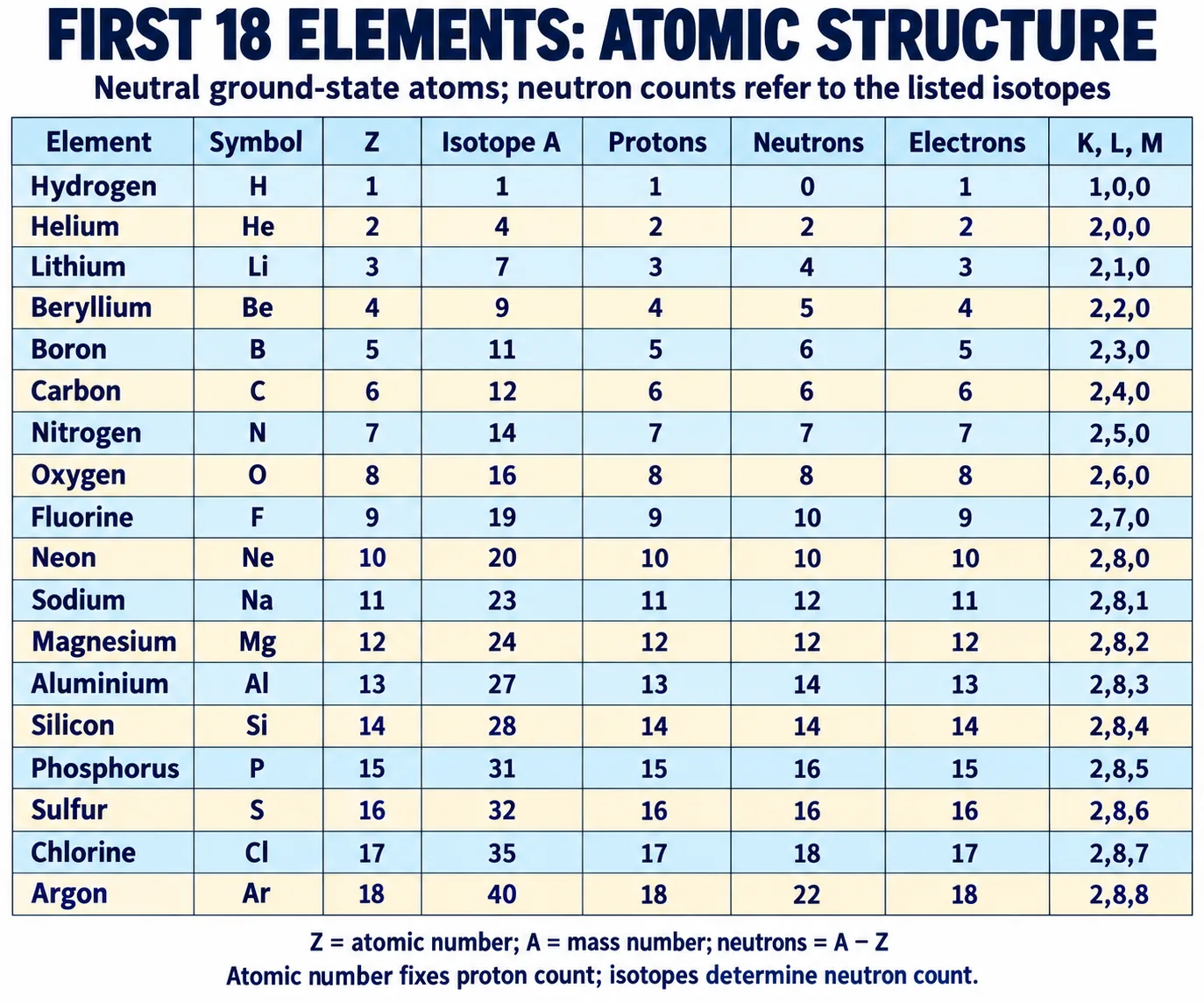
Valence electrons and valency
Electrons in the outermost shell are valence electrons; they decide chemical behaviour. Atoms with a completely filled outer shell (an octet of 8, or 2 for helium) are stable and unreactive — the noble gases. Other atoms gain, lose or share electrons to attain an octet. The combining capacity of an atom is its valency:
- If valence electrons are 1–4, valency = number of valence electrons (Na: 2,8,1 → valency 1; C: 2,4 → 4).
- If valence electrons are 5–8, valency = 8 − valence electrons (O: 2,6 → 2; Cl: 2,8,7 → 1; Ar → 0).
| Element | Z | K, L, M | Valence e⁻ | Valency |
|---|---|---|---|---|
| Hydrogen | 1 | 1 | 1 | 1 |
| Carbon | 6 | 2, 4 | 4 | 4 |
| Nitrogen | 7 | 2, 5 | 5 | 3 |
| Oxygen | 8 | 2, 6 | 6 | 2 |
| Sodium | 11 | 2, 8, 1 | 1 | 1 |
| Magnesium | 12 | 2, 8, 2 | 2 | 2 |
| Aluminium | 13 | 2, 8, 3 | 3 | 3 |
| Chlorine | 17 | 2, 8, 7 | 7 | 1 |
| Argon | 18 | 2, 8, 8 | 8 | 0 |
7. Isotopes and Isobars
Isotopes are atoms of the same element with the same atomic number but different mass numbers (different numbers of neutrons). They have the same chemical properties (same electrons) but different physical properties (mass, density, radioactivity).
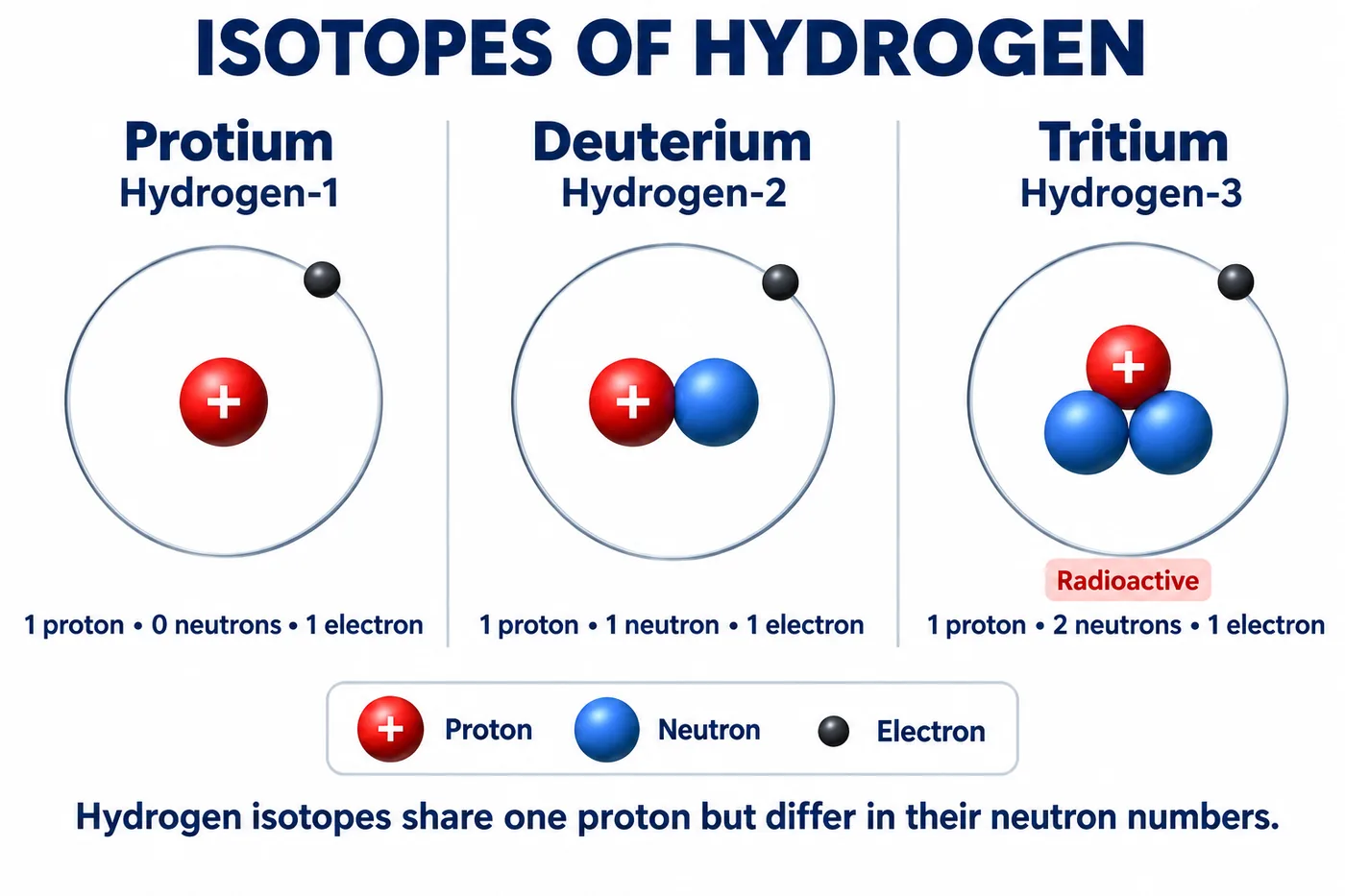
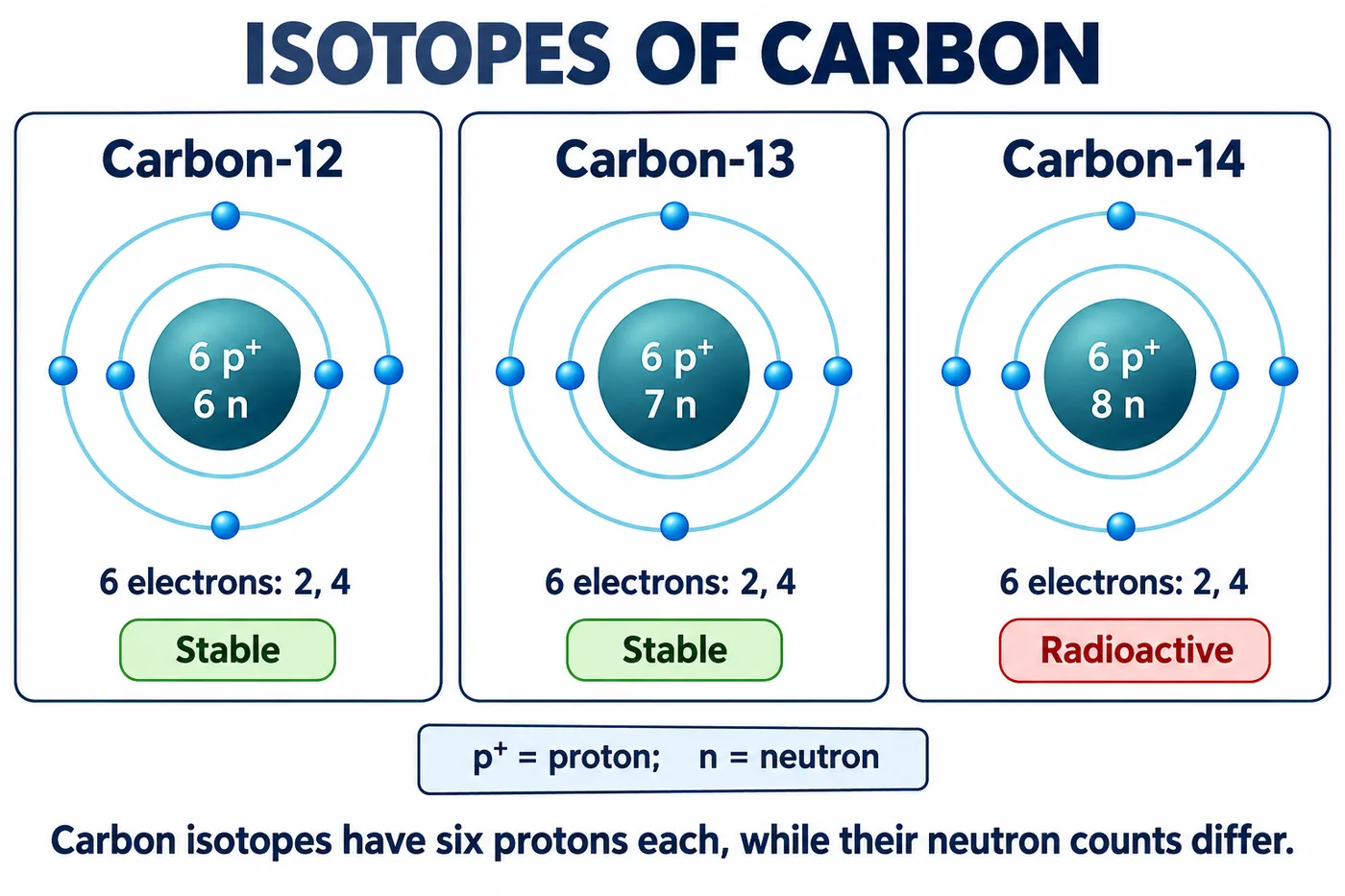
- Uses: uranium-235 as nuclear fuel; cobalt-60 in cancer treatment; iodine-131 for thyroid disorders; carbon-14 for dating ancient objects.
- Average atomic mass: chlorine occurs as ³⁵Cl (75%) and ³⁷Cl (25%); average = 35 × 0.75 + 37 × 0.25 = 35.5 u.
- Isobars — atoms of different elements with the same mass number, e.g. ⁴⁰18Ar and ⁴⁰20Ca.
8. Master Table: Key Relations
| Quantity | Relation |
|---|---|
| Atomic number Z | Number of protons (= electrons in neutral atom) |
| Mass number A | Protons + neutrons |
| Neutrons | A − Z |
| Max electrons in shell n | 2n² (K 2, L 8, M 18, N 32) |
| Valency | Valence e⁻ (if ≤ 4) or 8 − valence e⁻ |
| Average atomic mass | Σ (isotope mass × fraction) |
| 1 u | 1/12 mass of a C-12 atom |
9. Master Summary Table
| Model | Key idea | Limitation |
|---|---|---|
| Dalton (1808) | Indivisible solid spheres | Atoms have sub-atomic particles |
| Thomson (1904) | Electrons in positive sphere | Could not explain gold foil results |
| Rutherford (1911) | Tiny dense nucleus, mostly empty space | Could not explain stability |
| Bohr (1913) | Fixed energy levels; no radiation in orbit | Works well only for simple atoms |
| Quantum model | Orbitals, probability clouds | Current best model |
10. Mind Map
- e⁻ (Thomson), p⁺ (Goldstein)
- n (Chadwick)
- Thomson, Rutherford
- Bohr, quantum
- Z, A, A − Z
- 2n², octet, valency
- Same Z, different A
- Isobars: same A
11. Tips and Tricks
- Isotopes = same protons (iso-p); isobars = same bar (mass number).
- Gold foil: “Most through, some bent, few back” → empty space, positive centre, dense nucleus.
- Write configurations by filling 2, 8, 8 for the first 18 elements.
- Writing chlorine’s valency as 7 — it is 8 − 7 = 1.
- Saying isotopes have different chemical properties — they behave the same chemically.
- Putting electrons in the nucleus.
12. Important One-liners
- Kaṇāda called the smallest particles paramāṇu.
- J. J. Thomson discovered the electron using cathode rays.
- Chadwick discovered the neutron in 1932.
- Rutherford’s experiment showed a tiny, dense, positive nucleus.
- Bohr proposed fixed energy levels where electrons do not radiate.
- Atomic number = number of protons.
- Mass number = protons + neutrons.
- The maximum number of electrons in a shell is 2n².
- Isotopes have the same atomic number but different mass numbers.
- Average atomic mass of chlorine is 35.5 u.
13. Exam-pattern Questions with Detailed Answers
The neutron was discovered by:
- Thomson
- Rutherford
- Chadwick
- Goldstein
Show answer
Chadwick (1932). Thomson found electrons, Goldstein canal rays, Rutherford the nucleus.
Answer: (C) Chadwick
Write the electronic configuration of magnesium (Z = 12).
Show answer
K = 2, L = 8, M = 2 → 2, 8, 2.
Answer: 2, 8, 2
Find the number of neutrons in ²⁷13Al.
Show answer
Neutrons = 27 − 13 = 14.
Answer: 14
Assertion (A): Isotopes of an element have identical chemical properties. Reason (R): Isotopes have the same number of electrons.
- Both true; R explains A
- Both true; R does not explain A
- A true, R false
- A false, R true
Show answer
Chemical properties depend on electrons (especially valence electrons), which are the same for isotopes.
Answer: (A)
List three observations of Rutherford’s alpha scattering experiment and the conclusion from each.
Show answer
Most passed straight → mostly empty space. Some deflected by small angles → positive charge concentrated. Very few bounced back → small dense nucleus with almost all the mass.
Answer: Empty space; concentrated positive charge; tiny dense nucleus
What was the major drawback of Rutherford’s model and how did Bohr overcome it?
Show answer
A revolving electron should radiate energy and spiral into the nucleus, making atoms unstable. Bohr proposed that electrons move only in certain permitted orbits (energy levels) in which they do not radiate energy, so atoms are stable.
Answer: Instability; Bohr’s non-radiating energy levels
Determine the valency of nitrogen, sulphur and chlorine.
Show answer
N: 2,5 → 8 − 5 = 3. S: 2,8,6 → 8 − 6 = 2. Cl: 2,8,7 → 8 − 7 = 1.
Answer: 3, 2, 1
Give one use each of two isotopes.
Show answer
Cobalt-60 — cancer radiotherapy; iodine-131 — treatment of goitre/thyroid; uranium-235 — nuclear reactor fuel; carbon-14 — dating fossils.
Answer: e.g. Co-60 cancer treatment; U-235 nuclear fuel
An element X has 75.77% of isotope mass 35 u and 24.23% of mass 37 u. Find its average atomic mass. Identify X.
Show answer
35 × 0.7577 + 37 × 0.2423 = 26.52 + 8.97 = 35.49 ≈ 35.5 u. X is chlorine.
Answer: ≈ 35.5 u; chlorine
Case-based: Atom A has 8 protons and 8 neutrons; atom B has 8 protons and 10 neutrons; atom C has 9 protons and 9 neutrons. (a) Which pair are isotopes? (b) Do any form isobars? (c) Write their mass numbers and identify A.
Show answer
Mass numbers: A = 16, B = 18, C = 18. (a) A and B (same Z = 8) are isotopes of oxygen. (b) B and C have the same A (18) but different Z — isobars. (c) A is oxygen-16.
Answer: A,B isotopes; B,C isobars; A = ¹⁶O
Why is the mass of an atom concentrated in its nucleus? Support with numbers.
Show answer
Protons and neutrons each have mass ≈ 1 u, while an electron’s mass is about 1/1836 u. In ²³Na, nucleus mass ≈ 23 u, electrons’ mass ≈ 11/1836 ≈ 0.006 u — negligible. So almost all mass is in the nucleus.
Answer: Nucleons ~1 u each; electrons ~1/1836 u
Explain, using Bohr’s model, why atoms give out light of particular colours when heated.
Show answer
Heating gives energy to electrons, which jump to higher energy levels. When they fall back to lower levels they emit the energy difference as light. Since levels have fixed energies, only certain energy differences (colours) are possible — e.g. sodium gives yellow light.
Answer: Electrons fall between fixed levels, emitting specific energies
14. Quick Revision Summary
- Kaṇāda (paramāṇu), Dalton (indivisible atoms) → sub-atomic particles: e⁻ (Thomson), p⁺ (Goldstein), n (Chadwick).
- Thomson’s model → Rutherford’s nuclear model (gold foil) → Bohr’s energy levels → quantum clouds.
- Z = protons; A = protons + neutrons; neutrons = A − Z.
- Shells fill 2n² (2, 8, 18); outer shell max 8; valency from valence electrons.
- Isotopes: same Z, different A (H-1, H-2, H-3; C-12, C-13, C-14); isobars: same A, different Z.