
1. Chapter at a Glance
Almost everything around us is a mixture — air, sea water, milk, soil, crude oil, ink, even the blood in our veins. To use the components of a mixture, we must often separate them: salt from sea water, petrol from crude oil, pure water from impure water, dyes from ink. This chapter classifies mixtures (solutions, suspensions and colloids), shows how to express the concentration of a solution, and explains the important separation techniques used in laboratories, homes and industries — including India’s traditional deg–bhapka distillation of attar.
- Pure substances vs mixtures; homogeneous vs heterogeneous mixtures.
- Solutions, suspensions and colloids; the Tyndall effect.
- Concentration of a solution — mass % and mass by volume %.
- Crystallisation, simple and fractional distillation, sublimation, centrifugation, chromatography.
- Separating immiscible liquids; water treatment by coagulation.
2. How Can We Classify Mixtures?
A pure substance has a single kind of particle and fixed properties (e.g. pure water boils at 100 °C at 1 atm). A mixture contains two or more substances in any ratio, each keeping its properties.
- Homogeneous mixture — uniform composition throughout; one phase (salt solution, air, brass).
- Heterogeneous mixture — non-uniform; components can be distinguished (sand in water, oil and water, soil).
3. Solutions, Suspensions and Colloids
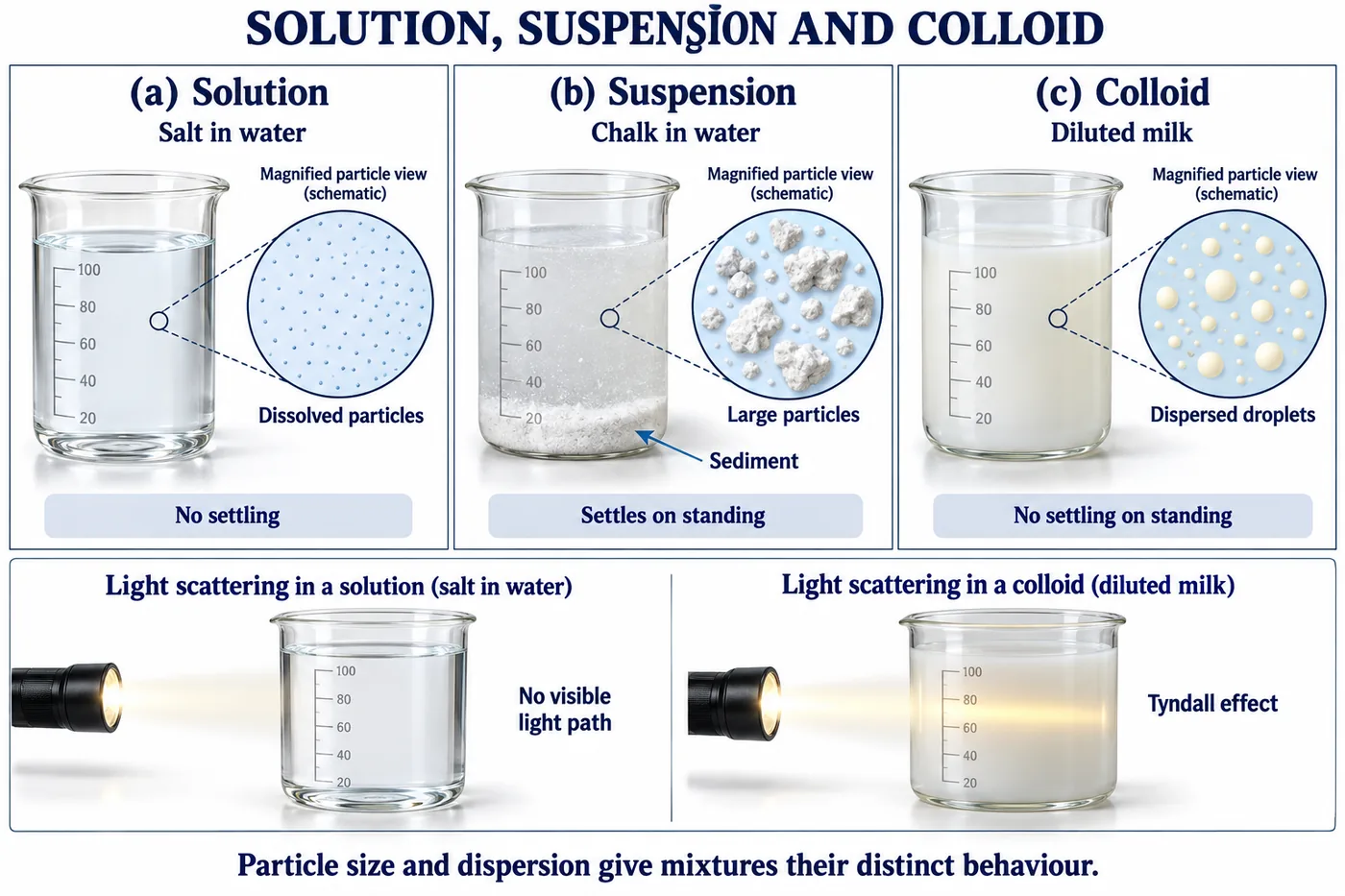
| Property | Solution | Colloid | Suspension |
|---|---|---|---|
| Particle size | Smallest (< 1 nm) | Intermediate (1–1000 nm) | Largest (> 1000 nm) |
| Appearance | Clear, transparent | Appears uniform; may be translucent | Cloudy, opaque |
| Nature | Homogeneous | Heterogeneous (looks homogeneous) | Heterogeneous |
| Settling on standing | No | No (stable) | Yes |
| Filtration | Passes through | Passes through filter paper | Can be filtered |
| Tyndall effect | No | Yes | May scatter light |
| Examples | Salt/sugar in water, air, soda | Milk, fog, smoke, jelly, shaving cream, blood | Chalk in water, muddy water, sand in water |
The Tyndall effect is the scattering of a beam of light by colloidal particles, making the path of light visible — like sunbeams in a dusty room or headlight beams in fog. A colloid has a dispersed phase (particles) spread in a dispersion medium. For example, in fog, water droplets (liquid) are dispersed in air (gas) — an aerosol; milk is an emulsion (liquid in liquid); jelly is a gel (liquid in solid).
4. Solutions and Their Concentration
A solution has a solute (smaller component, dissolved) and a solvent (larger component). A saturated solution cannot dissolve more solute at that temperature; the amount dissolved in 100 g of solvent is the solubility.
Mass percentage = (mass of solute ÷ mass of solution) × 100
Mass by volume percentage = (mass of solute in g ÷ volume of solution in mL) × 100
- 40 g of salt in 320 g of water: mass of solution = 360 g; concentration = 40/360 × 100 = 11.1%.
- A 5% (mass/volume) glucose solution: 5 g glucose in 100 mL of solution; 500 mL contains 25 g glucose.
- To make 200 g of a 10% sugar solution: sugar = 20 g, water = 180 g.
5. Crystallisation
Crystallisation obtains a pure solid in crystal form from its solution. It is better than simple evaporation because some solids decompose or char on strong heating, and soluble impurities stay behind in the solution.
- Prepare a saturated solution of impure copper sulphate in hot water.
- Filter the hot solution to remove insoluble impurities.
- Cool the filtrate slowly and leave it undisturbed.
- Collect the blue crystals (CuSO₄·5H₂O) and dry them on filter paper.
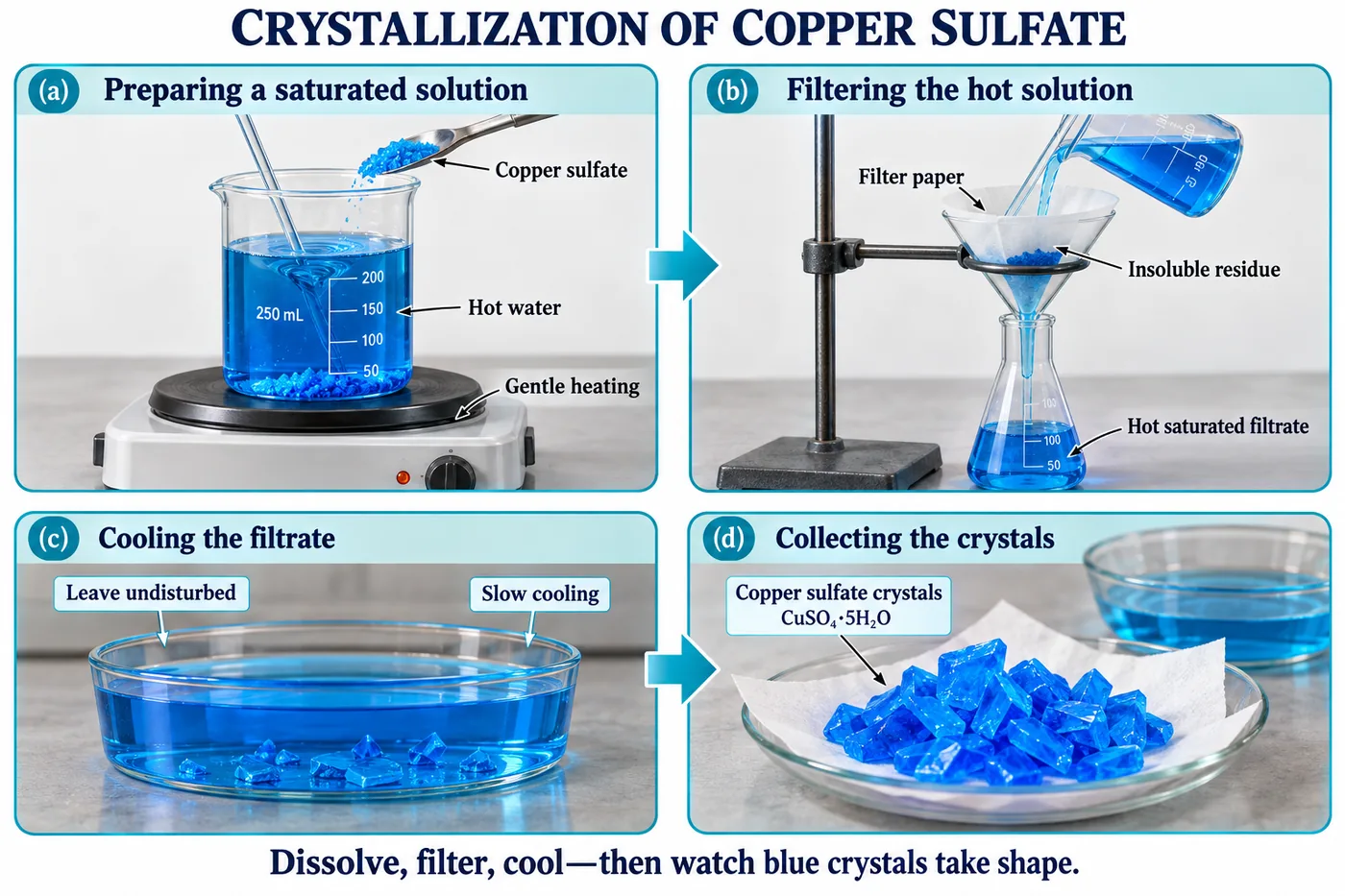
Uses: purification of salt from sea water, alum (phitkari) from impure samples, sugar from cane juice.
6. Distillation
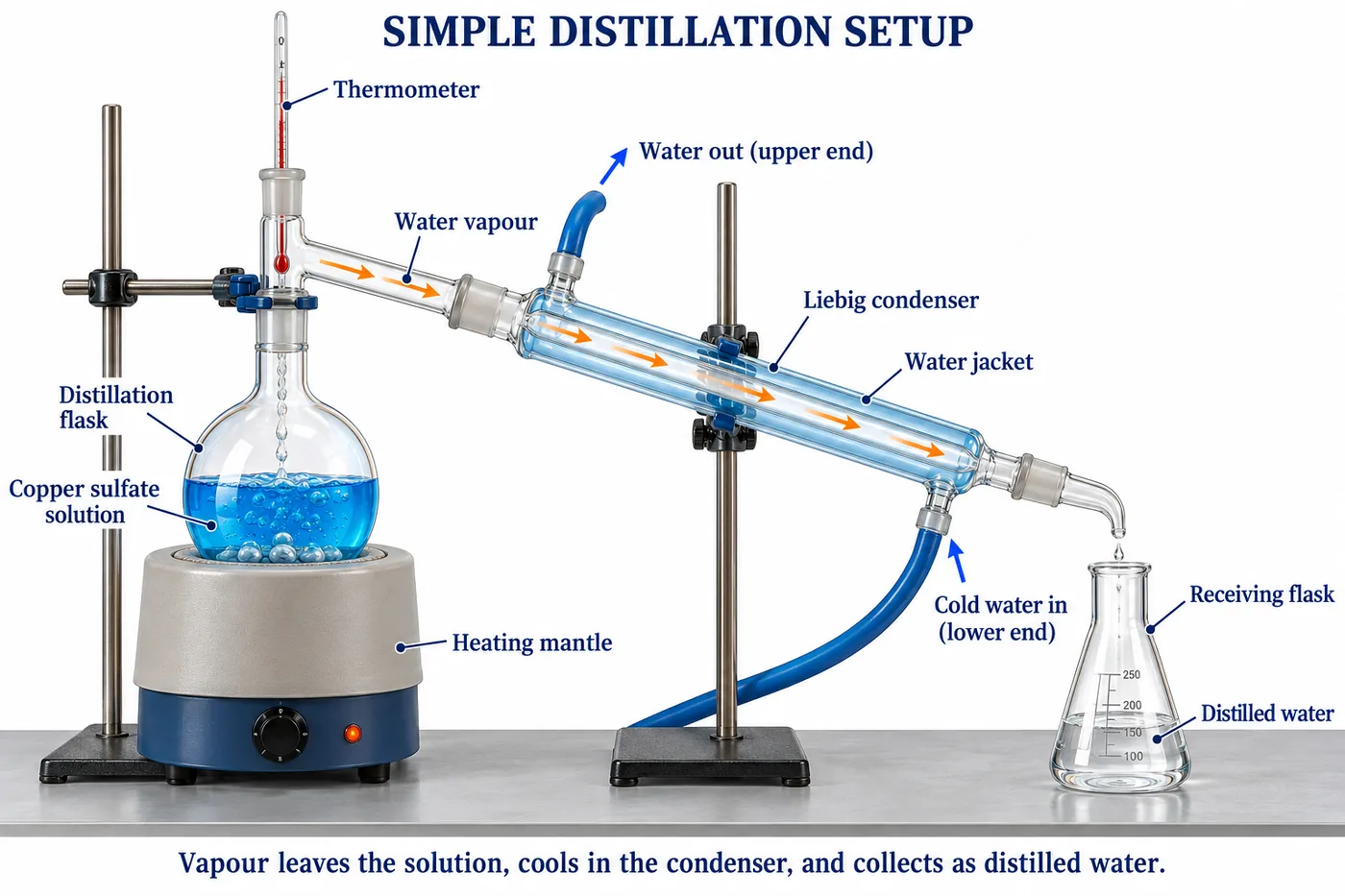
Simple distillation separates a liquid from a dissolved solid, or two miscible liquids whose boiling points differ by more than about 25 °C. The liquid is boiled; its vapour is cooled in a Liebig condenser (cold water enters at the lower end and leaves at the upper end) and collected as the distillate.
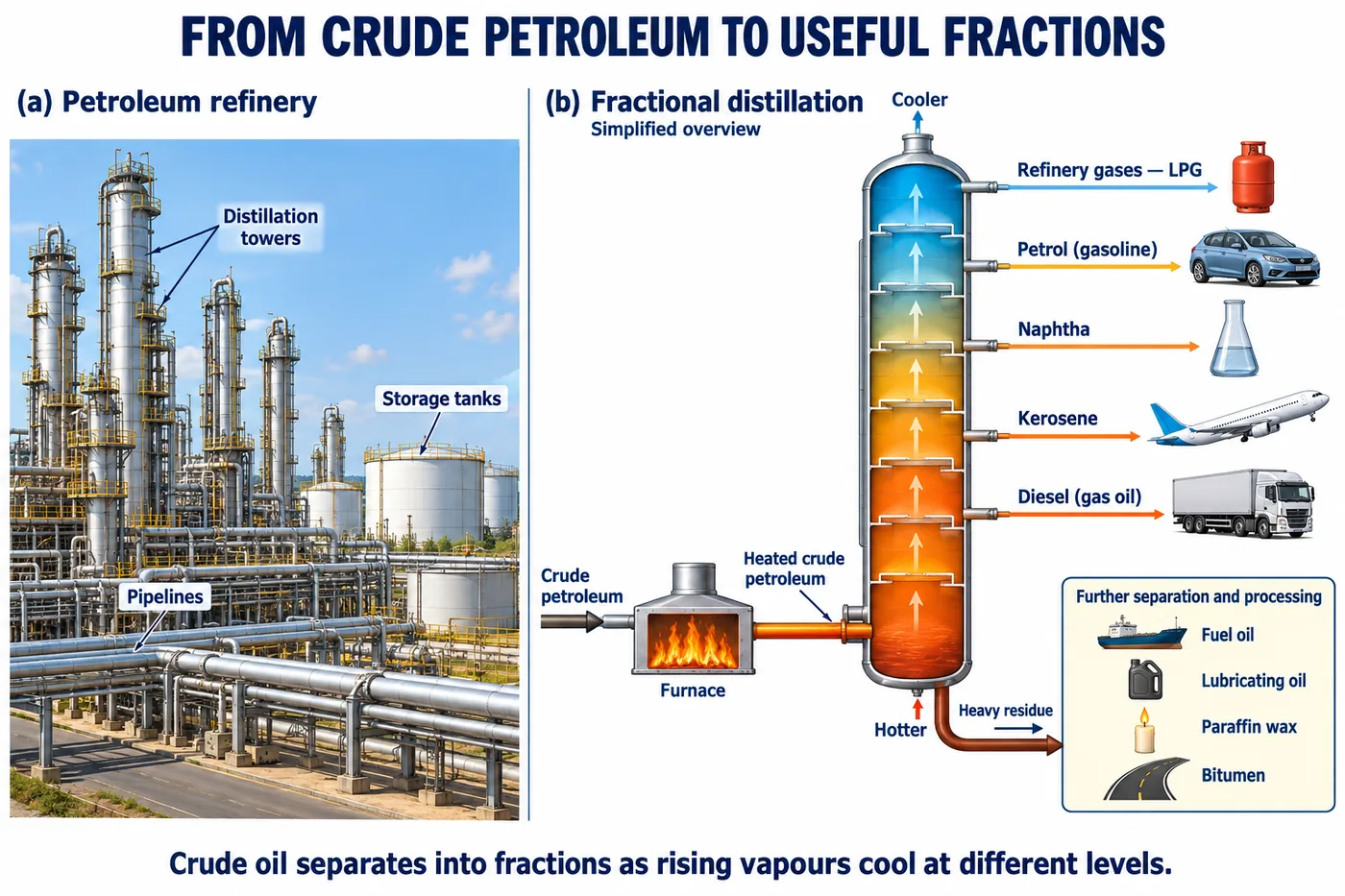
Fractional distillation separates miscible liquids with close boiling points using a fractionating column — for example, separating gases of air (nitrogen, oxygen, argon) after liquefying it, and separating crude petroleum into fractions. In a refinery tower, heated crude oil vapours rise and cool; heavier fractions condense lower (hotter) and lighter ones higher (cooler).
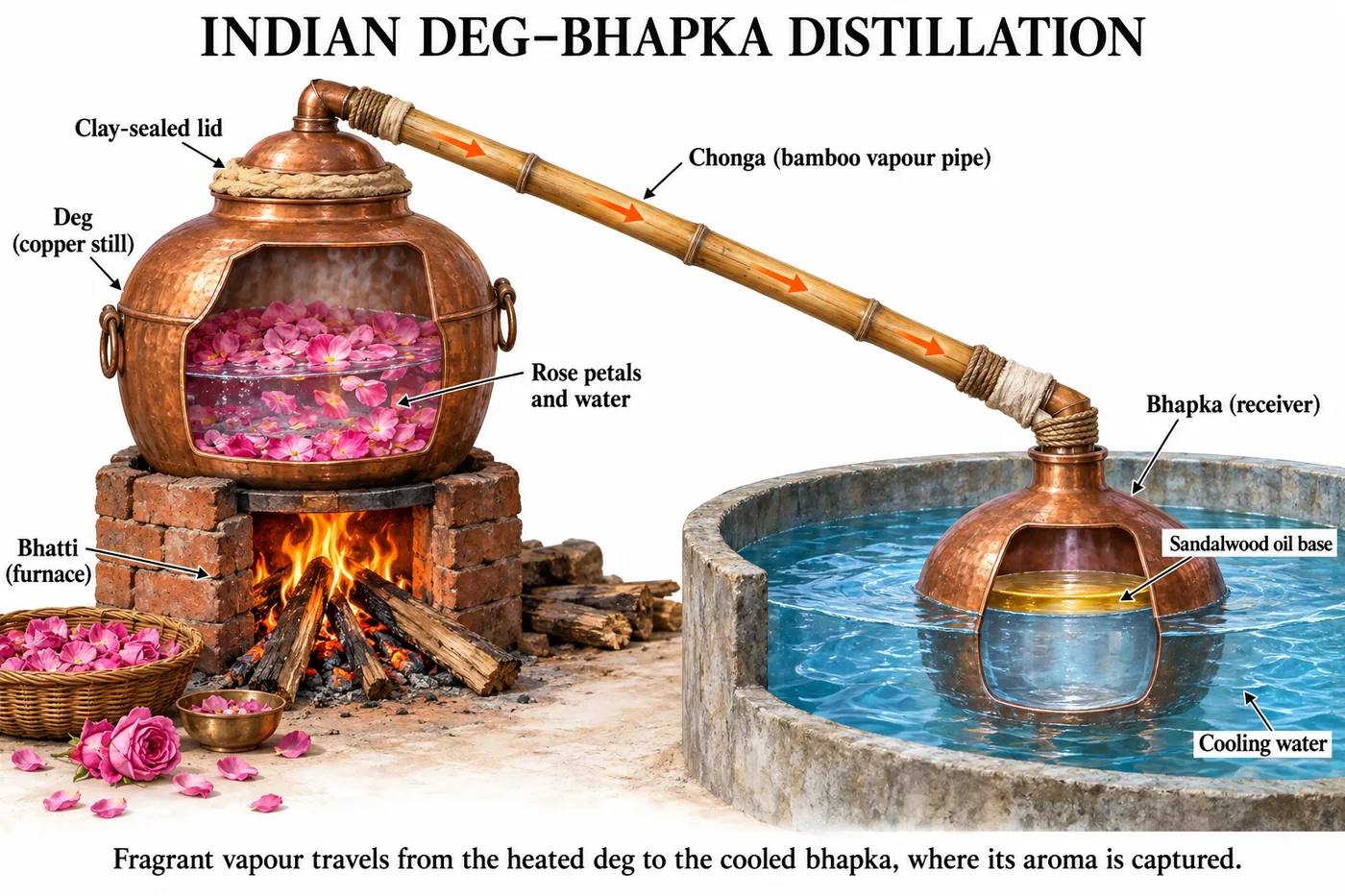
In Kannauj (Uttar Pradesh), attar has been made for centuries using copper stills. Flowers like rose are heated with water in a deg sealed with clay; fragrant vapour travels through a bamboo pipe (chonga) into a bhapka (receiver) kept in cool water, where it condenses into a base of sandalwood oil.
7. Separating Components of Heterogeneous Mixtures
| Method | Principle | Example |
|---|---|---|
| Sublimation | One component changes directly from solid to vapour | Camphor, naphthalene, ammonium chloride, iodine from sand or salt |
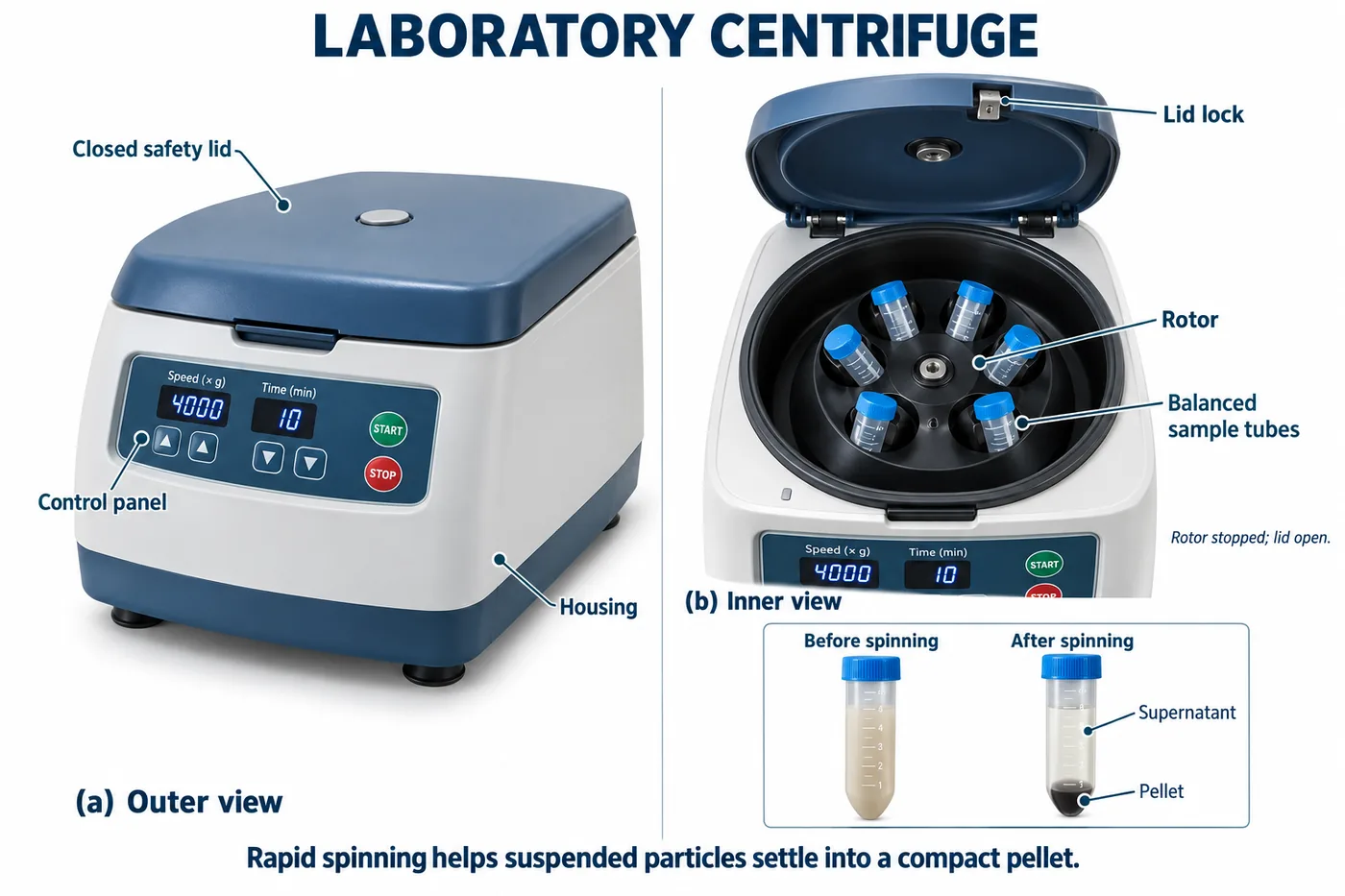
| Centrifugation | Rapid spinning forces denser particles to the bottom | Cream from milk, blood tests, washing machine drier |
| Chromatography | Components move at different speeds with a solvent | Dyes in ink, pigments in leaves, drugs in blood |
| Separating funnel | Immiscible liquids form layers by density | Oil and water, kerosene and water |
| Magnetic separation | Magnetic component attracted | Iron filings from sulphur |
Sublimation
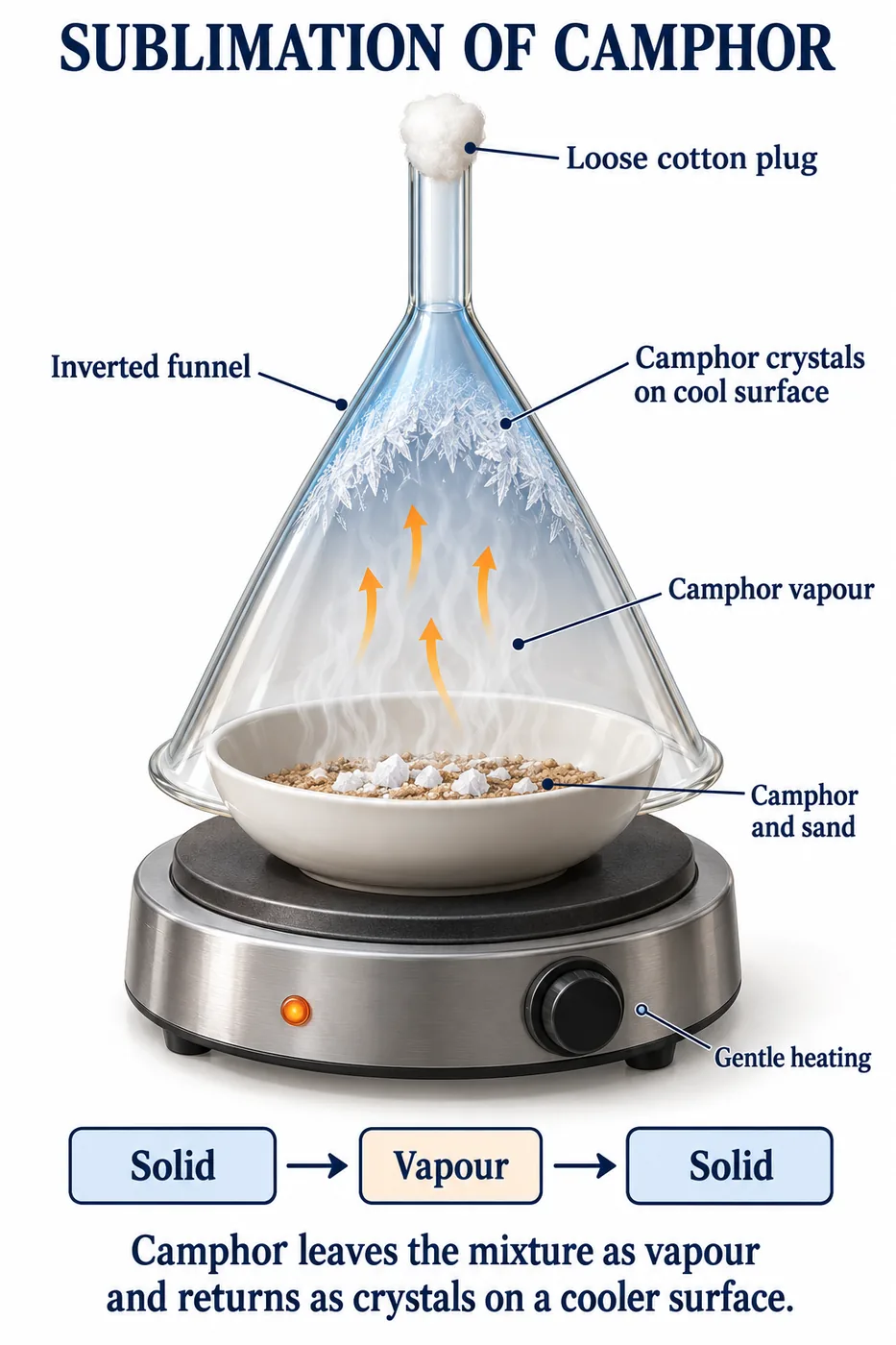
Heat a mixture of camphor and sand in a dish covered with an inverted funnel plugged with cotton. Camphor turns directly into vapour and deposits as solid crystals on the cool inner surface of the funnel; sand remains in the dish.
Chromatography
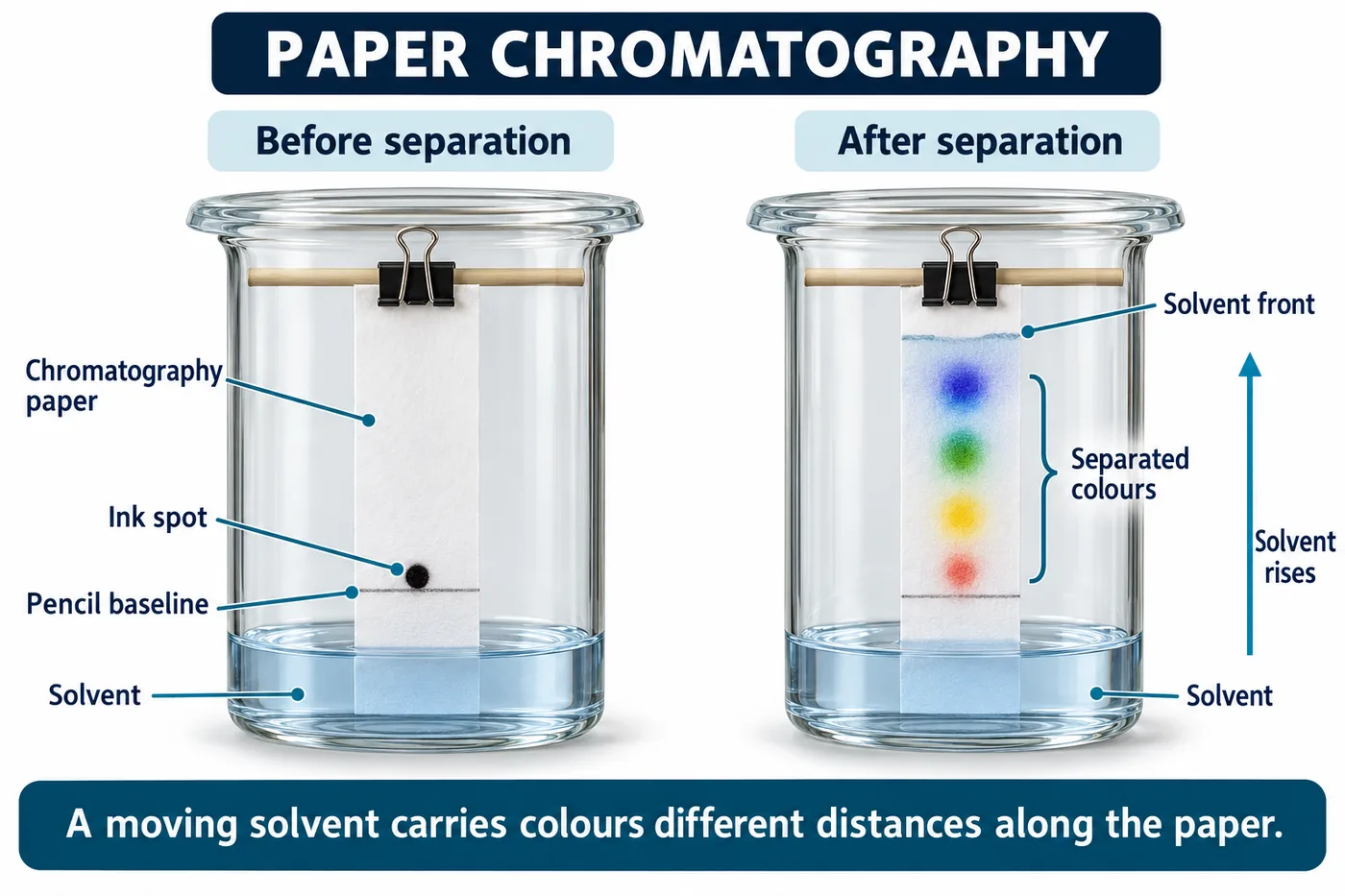
Put a spot of ink on a pencil line drawn about 3 cm from the bottom of a strip of filter paper. Dip the strip in a solvent (water or alcohol) so that the solvent level is below the spot. As the solvent rises, the dyes in the ink move with it — the more soluble dye travels farther — and separate into coloured bands. The word comes from the Greek kroma, colour.
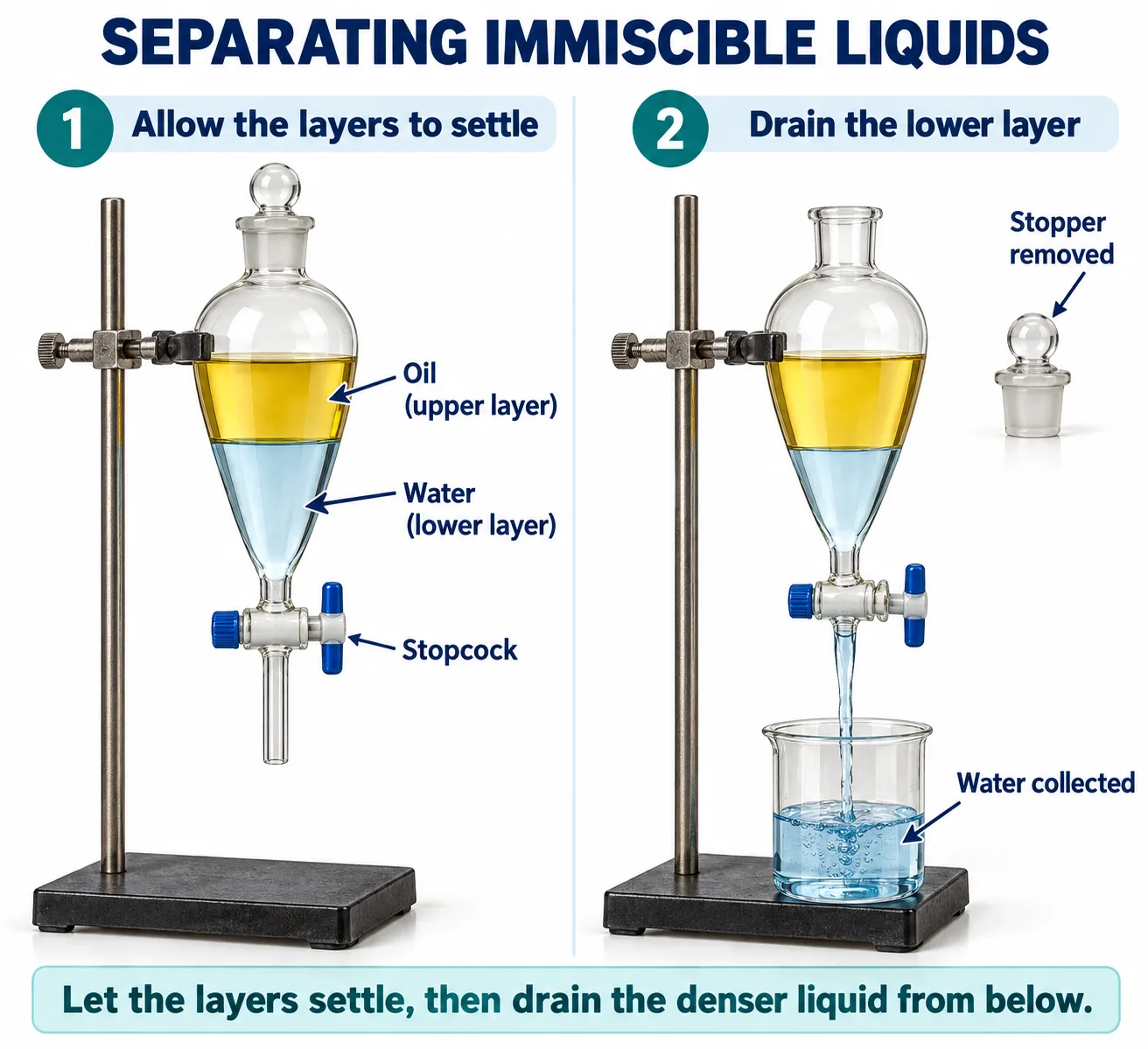
Separating immiscible liquids
Pour the mixture into a separating funnel and let it stand. The denser liquid (water) settles below; the lighter one (oil) floats above. Open the stopcock and drain the lower layer, closing it as soon as the boundary reaches the tap.
8. Water Treatment — Coagulation
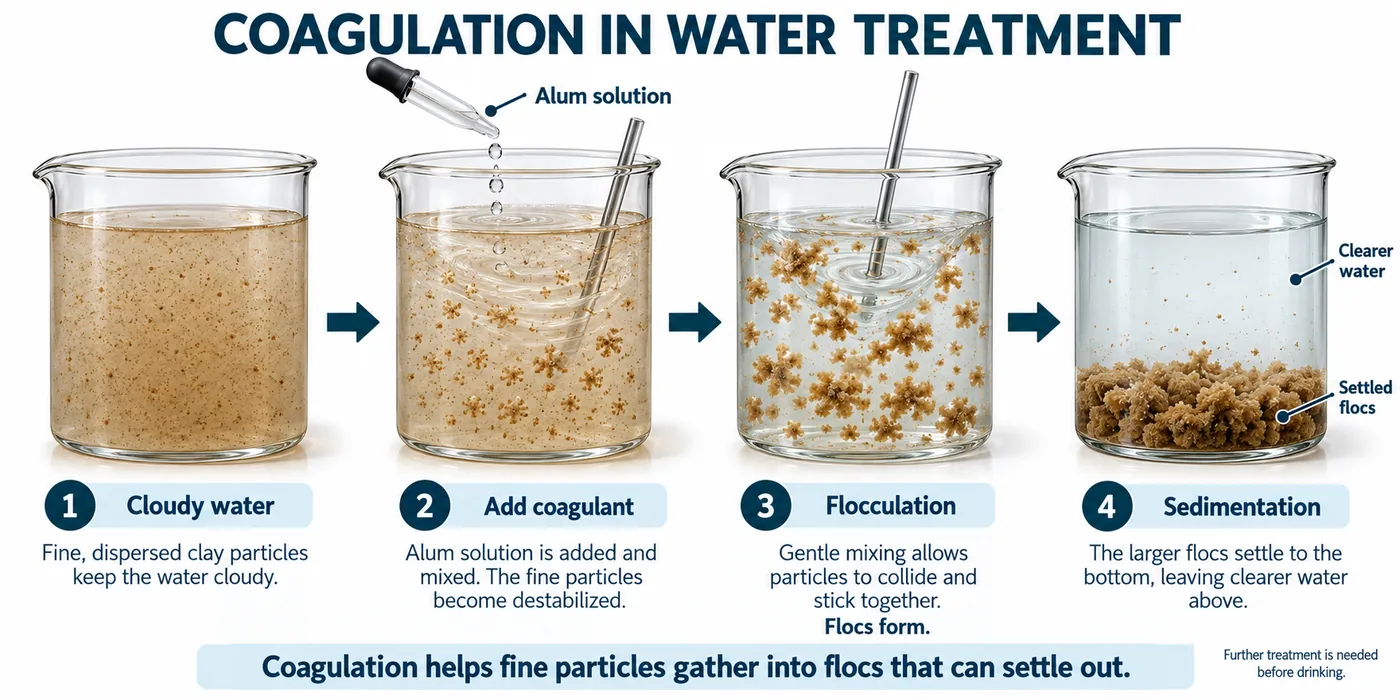
River water contains fine clay particles that do not settle easily. In water treatment plants, alum (potash alum) is added as a coagulant; it makes fine particles stick together into larger flocs (flocculation), which settle down (sedimentation). The clearer water is then filtered and disinfected (chlorination) before supply.
9. Master Table: Formulas and Methods
| Item | Formula / principle |
|---|---|
| Mass % | solute mass ÷ solution mass × 100 |
| Mass by volume % | solute mass (g) ÷ solution volume (mL) × 100 |
| Simple distillation | Boiling point difference > ~25 °C |
| Fractional distillation | Close boiling points; fractionating column |
| Sublimation | Solid → vapour directly |
| Centrifugation | Density difference under rapid spinning |
| Chromatography | Different solubility and movement with solvent |
| Tyndall effect | Scattering of light by colloidal particles |
10. Master Summary Table
| Mixture | Best method |
|---|---|
| Salt from sea water (pure crystals) | Crystallisation |
| Pure water from salt water | Simple distillation |
| Petrol, diesel from crude oil | Fractional distillation |
| Camphor from sand | Sublimation |
| Cream from milk | Centrifugation |
| Dyes in ink | Chromatography |
| Oil from water | Separating funnel |
| Clay from river water | Coagulation + sedimentation + filtration |
11. Mind Map
- Homogeneous, heterogeneous
- Solution, colloid, suspension
- Mass %
- Mass by volume %
- Crystallisation, distillation
- Sublimation, centrifuge, chromatography
- Refinery, attar
- Water treatment
12. Tips and Tricks
- Particle size order: Solution < Colloid < Suspension (“S-C-S, small to big”).
- Sublimable solids: “CANI” — Camphor, Ammonium chloride, Naphthalene, Iodine.
- Condenser rule: water in at the bottom, out at the top — keeps the jacket full.
- In mass % problems, always add solute + solvent for the solution mass.
- Using solvent mass instead of solution mass in the formula.
- Saying colloids settle on standing — they do not.
- Placing the chromatography spot below the solvent level — the dye would dissolve into the solvent.
13. Important One-liners
- A solution is a homogeneous mixture.
- Colloids show the Tyndall effect; true solutions do not.
- Particles of a suspension settle on standing.
- Milk is an emulsion; fog is an aerosol.
- Crystallisation gives purer crystals than evaporation.
- Crude oil is separated by fractional distillation.
- Camphor and naphthalene sublime.
- Cream is separated from milk by centrifugation.
- Chromatography separates dyes in ink.
- Alum helps fine particles in water form flocs that settle.
14. Exam-pattern Questions with Detailed Answers
Which of the following shows the Tyndall effect?
- Salt solution
- Sugar solution
- Milk
- Copper sulphate solution
Show answer
Milk is a colloid; its particles scatter light. The others are true solutions.
Answer: (C) Milk
Name the method to separate cream from milk.
Show answer
Centrifugation — lighter cream collects at the top on rapid spinning.
Answer: Centrifugation
Classify as homogeneous or heterogeneous: soda water, wood, air, soil.
Show answer
Homogeneous: soda water, air. Heterogeneous: wood, soil.
Answer: Soda water, air — homogeneous; wood, soil — heterogeneous
A solution contains 40 g of common salt in 320 g of water. Calculate the concentration in mass percentage.
Show answer
Mass of solution = 360 g. Concentration = 40/360 × 100 = 11.1%.
Answer: 11.1%
Assertion (A): Crystallisation is better than evaporation for obtaining pure copper sulphate. Reason (R): Some solids decompose on strong heating and soluble impurities remain in the solution during crystallisation.
- Both true; R explains A
- Both true; R does not explain A
- A true, R false
- A false, R true
Show answer
Both correct, and R gives the exact reasons why crystallisation yields purer crystals.
Answer: (A)
How will you separate a mixture of ammonium chloride and common salt?
Show answer
By sublimation. Heat the mixture in a dish covered with an inverted funnel. Ammonium chloride sublimes and deposits on the cool funnel; common salt remains in the dish.
Answer: Sublimation
Why is cold water passed into the Liebig condenser from the lower end?
Show answer
Entering from the bottom fills the jacket completely with water, giving efficient cooling along its whole length, and the coldest water meets the vapour near the outlet so condensation is complete.
Answer: Keeps the jacket full for efficient cooling
Give three differences between a colloid and a suspension.
Show answer
Colloid particles are smaller (1–1000 nm) and do not settle; suspension particles are larger and settle. Colloids pass through filter paper; suspensions can be filtered. Colloids are stable and look uniform; suspensions are unstable and cloudy.
Answer: Size, settling, filtration
How are the gases of air separated? Name the method and explain briefly.
Show answer
Air is compressed and cooled to form liquid air, then allowed to warm slowly in a fractional distillation column. Gases boil off at their own boiling points (nitrogen −196 °C, argon −186 °C, oxygen −183 °C) and are collected separately at different heights.
Answer: Liquefaction followed by fractional distillation
Case-based: A forensic team finds an ink spot on a letter and wants to check if it matches a suspect’s pen. (a) Which technique will they use? (b) Describe the procedure. (c) What result would show a match?
Show answer
(a) Chromatography. (b) Spot both inks on a pencil baseline on chromatography paper; dip the paper in a solvent kept below the baseline; let the solvent rise. (c) If both spots separate into the same coloured bands at the same heights, the inks match.
Answer: Chromatography; identical band patterns indicate a match
Suggest a scheme to separate a mixture of sand, iron filings, common salt and camphor.
Show answer
(1) Remove iron filings with a magnet. (2) Heat the remainder: camphor sublimes and is collected on a cool funnel. (3) Add water to sand and salt; stir and filter — sand remains as residue. (4) Evaporate or crystallise the filtrate to get salt.
Answer: Magnet → sublimation → dissolve and filter → evaporate
How much glucose is needed to prepare 250 mL of a 5% (mass by volume) glucose solution for a patient? Why must such solutions be prepared accurately?
Show answer
5 g per 100 mL → 250 mL needs 12.5 g glucose. Accuracy matters because too concentrated or too dilute solutions can harm body cells through osmosis and affect blood sugar.
Answer: 12.5 g; precise concentration protects cells
15. Quick Revision Summary
- Mixtures: homogeneous (solutions) and heterogeneous (suspensions); colloids lie between and show the Tyndall effect.
- Concentration: mass % and mass by volume %.
- Crystallisation for pure solids; simple distillation for liquid–solid or widely different liquids; fractional distillation for close boiling points (crude oil, air).
- Sublimation (camphor), centrifugation (cream), chromatography (dyes), separating funnel (oil–water).
- Water treatment uses alum (coagulation), sedimentation, filtration and chlorination; deg–bhapka is India’s traditional distillation.