
1. Chapter at a Glance
Why does a ball rolling on grass stop, while a puck on ice slides much farther? Why do passengers lurch forward when a bus brakes? Why does a gun recoil when fired? In Chapter 4 we described motion; now we ask what causes changes in motion. The answer is force. This chapter covers balanced and unbalanced forces, friction, Newton’s three laws of motion, inertia and momentum, and how forces act on systems of connected objects.
- Force, net force; balanced and unbalanced forces.
- Friction and its types.
- Newton’s first law (inertia), second law (F = ma, momentum) and third law (action–reaction).
- Free-body diagrams; forces on a system of objects (cart and pulley).
- Applications in daily life and safety.
2. The Concept of Force
A force is a push or pull that can change an object’s state of rest or motion, its speed, its direction or its shape. Force is a vector (magnitude + direction); SI unit: newton (N). Forces arise from interactions: contact forces (friction, normal force, tension, muscular force) and non-contact forces (gravitational, magnetic, electrostatic).
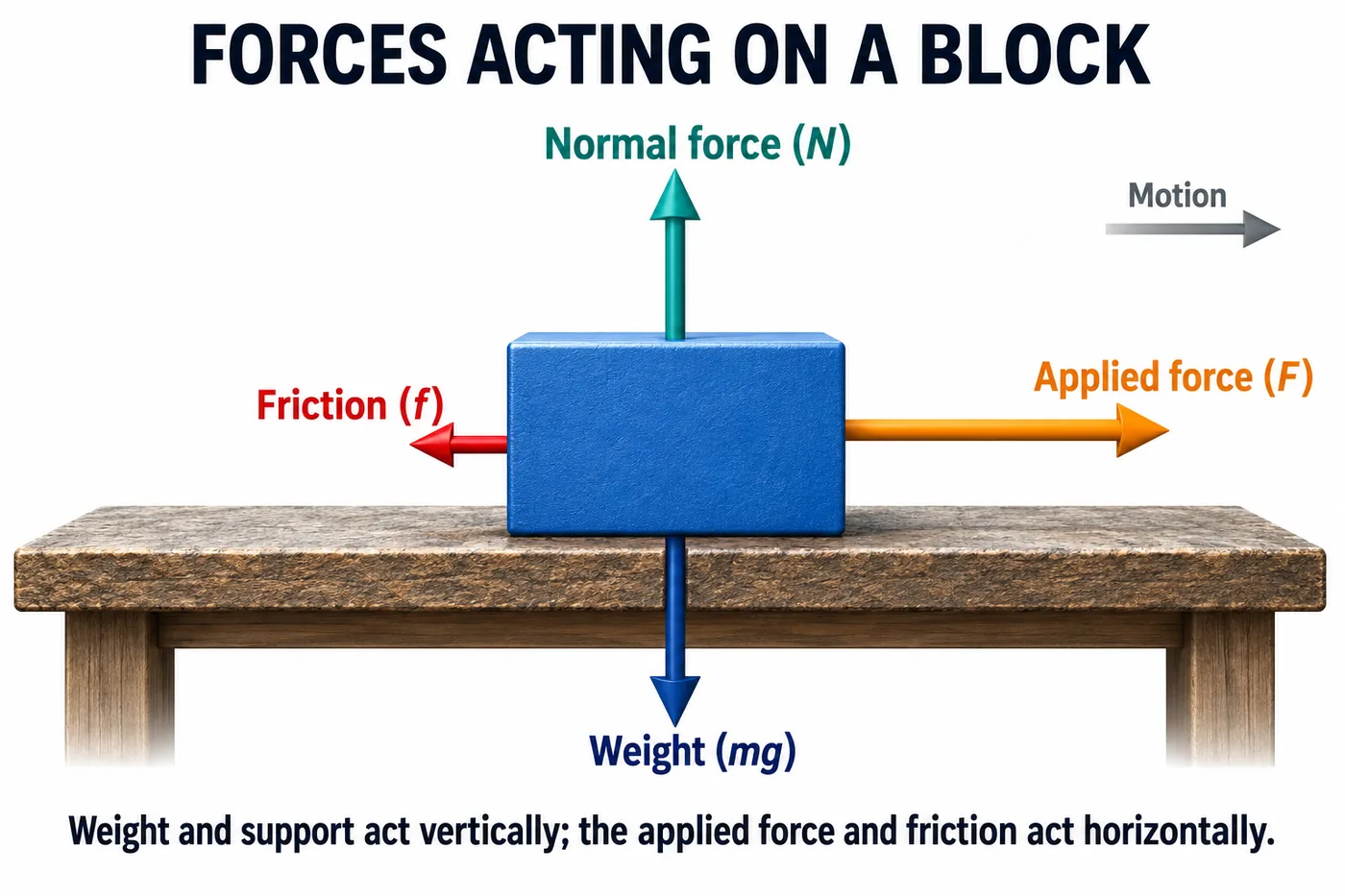
A free-body diagram shows all forces acting on one object as arrows. For a block pulled on a table: weight (mg) downward, normal force (N) upward, applied force forward and friction backward.
3. Balanced and Unbalanced Forces
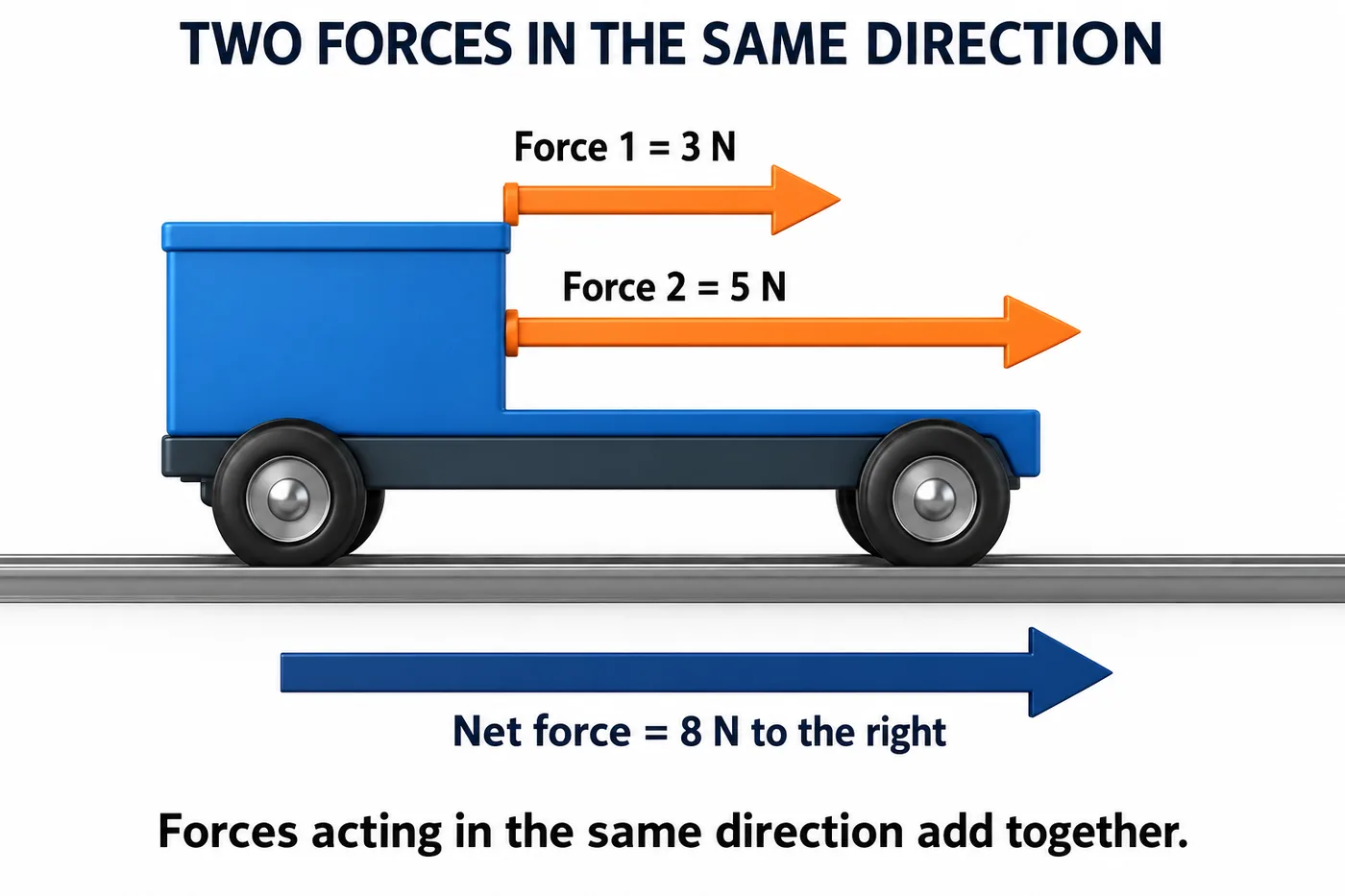
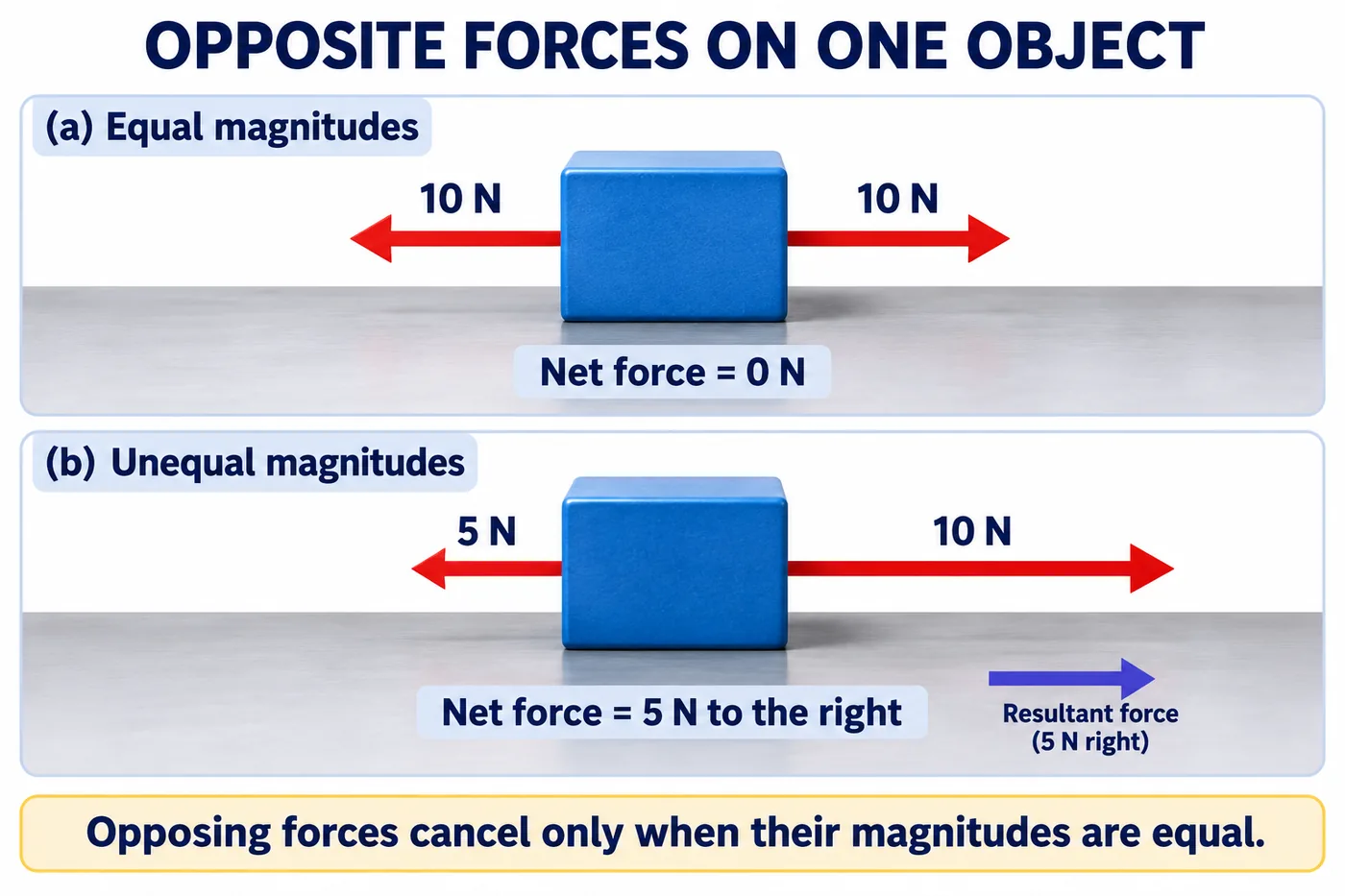
- Forces in the same direction add; forces in opposite directions subtract. The resultant is the net force.
- If the net force is zero, forces are balanced: an object at rest stays at rest and a moving object continues at constant velocity.
- If the net force is not zero, forces are unbalanced: the object accelerates in the direction of the net force.
4. The Force of Friction
Friction is the force that opposes relative motion (or attempted motion) between surfaces in contact. It arises from interlocking of surface irregularities.
- Static friction — acts when an object is not yet moving; increases with the applied force up to a maximum (limiting friction).
- Sliding (kinetic) friction — acts while sliding; slightly less than limiting static friction.
- Rolling friction — much smaller; that is why wheels and ball bearings are used.
- Fluid friction (drag) — in liquids and air; reduced by streamlined shapes.
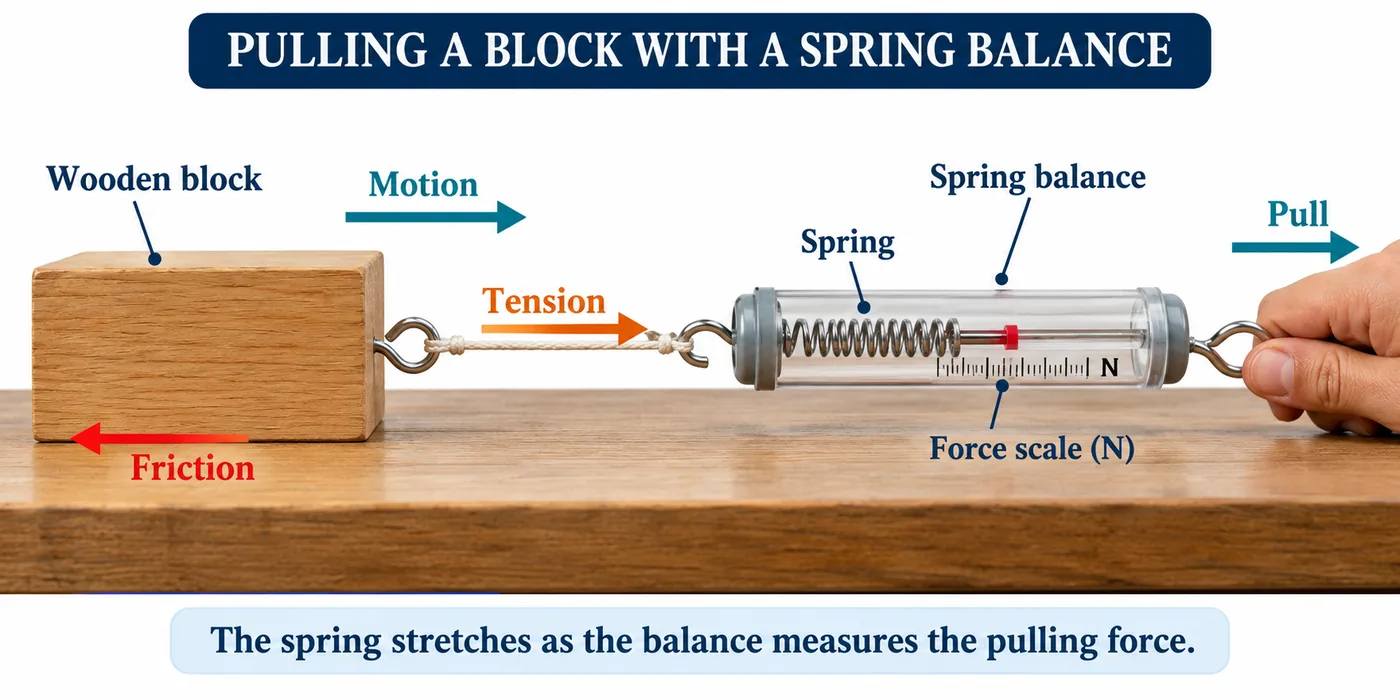
A spring balance pulling a block shows the reading rising until the block just starts to move; this maximum is the limiting friction.
5. Newton’s First Law — Inertia
An object remains in its state of rest or of uniform motion in a straight line unless an unbalanced external force acts on it.
The tendency of an object to resist change in its state of rest or motion is called inertia. Mass is the measure of inertia — heavier objects have more inertia (it is harder to push a truck than a bicycle). Galileo’s inclined-plane experiments led to this idea: without friction, a ball would keep rolling forever.
- Passengers fall forward when a moving bus stops suddenly (inertia of motion) and backward when it starts suddenly (inertia of rest) — hence seat belts.
- Shaking a tree makes fruits fall; beating a carpet removes dust.
- A coin on a card over a glass drops into the glass when the card is flicked away.
6. Newton’s Second Law — Force and Momentum
Momentum (p) of an object = mass × velocity: p = mv; SI unit kg m/s; it is a vector.
The rate of change of momentum of an object is proportional to the applied unbalanced force and takes place in the direction of the force.
F ∝ (mv − mu)/t = m(v − u)/t = ma. With suitable units, F = ma. One newton is the force that gives a 1 kg mass an acceleration of 1 m/s².
- A cricketer pulls hands back while catching a fast ball — increasing the time reduces the force on the hands.
- Sand or cushions in high-jump pits, crumple zones and airbags in cars increase stopping time and reduce force.
A force of 10 N acts on a 2 kg mass. a = F/m = 10/2 = 5 m/s². If it starts from rest, after 3 s its velocity = 0 + 5 × 3 = 15 m/s and momentum = 2 × 15 = 30 kg m/s.
A 1000 kg car moving at 20 m/s is brought to rest in 4 s. Change in momentum = 0 − 20 000 = −20 000 kg m/s. Force = −20 000/4 = −5000 N (opposite to motion).
7. Newton’s Third Law — Action and Reaction
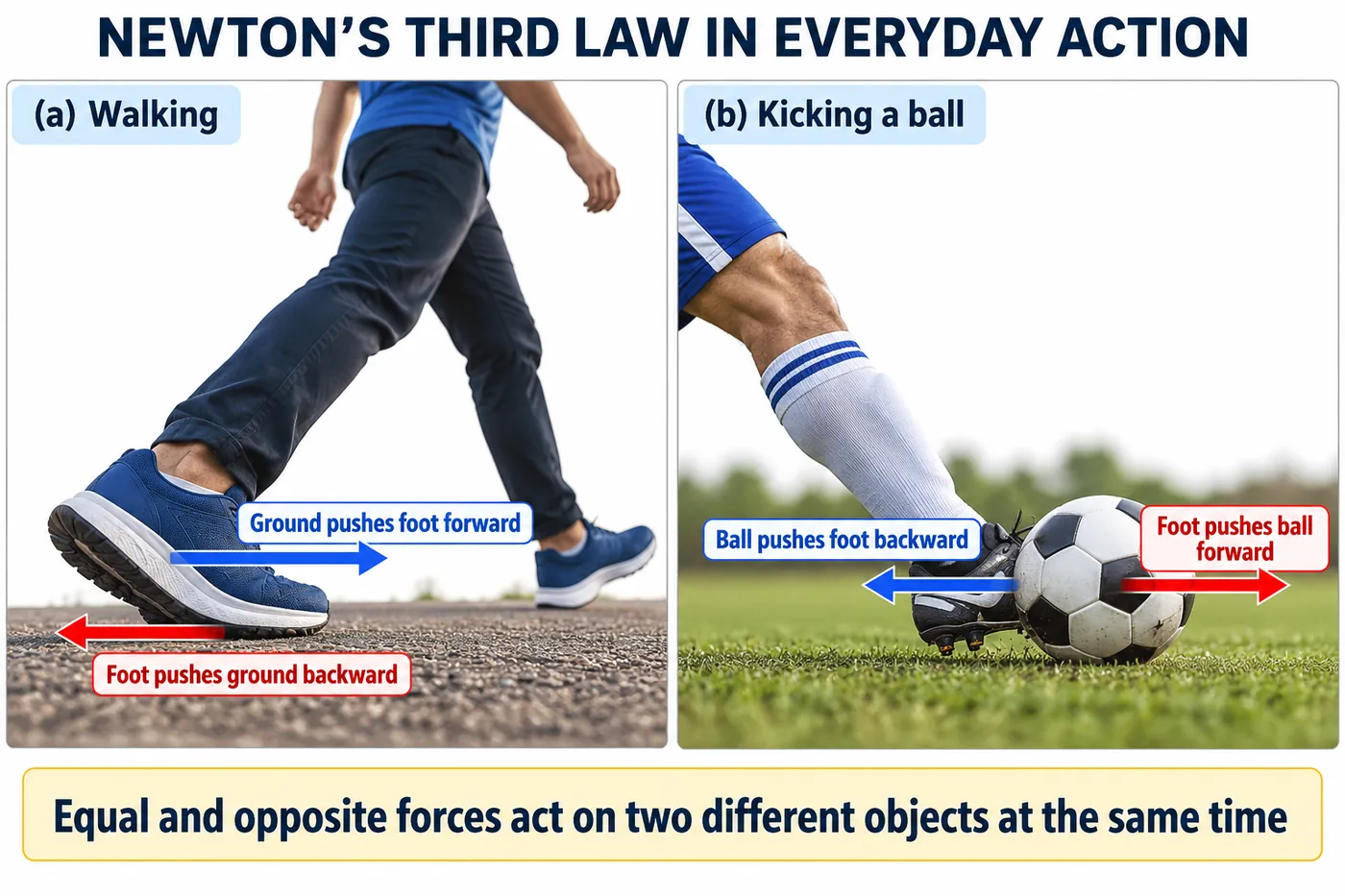
To every action there is an equal and opposite reaction. Action and reaction act on two different objects, simultaneously.
- Walking: the foot pushes the ground backward; the ground pushes the foot forward.
- Kicking a ball: the foot pushes the ball forward; the ball pushes the foot backward.
- Recoil of a gun; rockets push hot gases backward and the gases push the rocket forward.
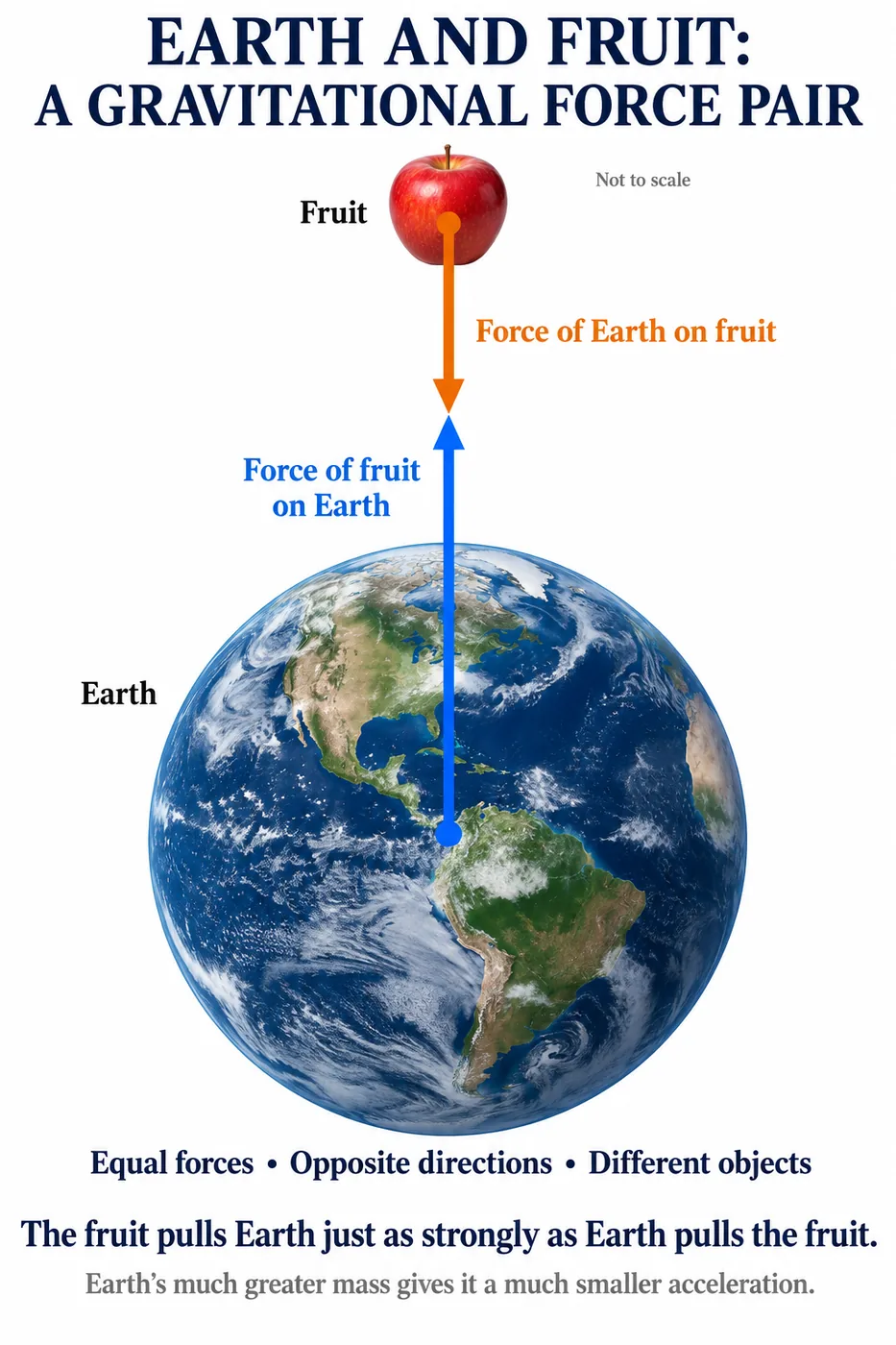
- Gravitation: the Earth pulls a fruit down; the fruit pulls the Earth up with an equal force — but the Earth’s huge mass means its acceleration is negligible.
Conservation of momentum follows from the third law: when two objects interact with no external force, the total momentum before equals the total momentum after (m₁u₁ + m₂u₂ = m₁v₁ + m₂v₂). This explains recoil of a gun.
A 4 kg gun fires a 20 g bullet at 400 m/s. Initial momentum = 0. So 0.02 × 400 + 4 × v = 0 → v = −8/4 = −2 m/s (gun recoils backward at 2 m/s).
8. Forces Acting on a System of Objects
When objects are connected — like a cart on a table pulled by a hanging mass through a string over a fixed pulley — they move together with the same acceleration. The string carries a pulling force called tension (T).
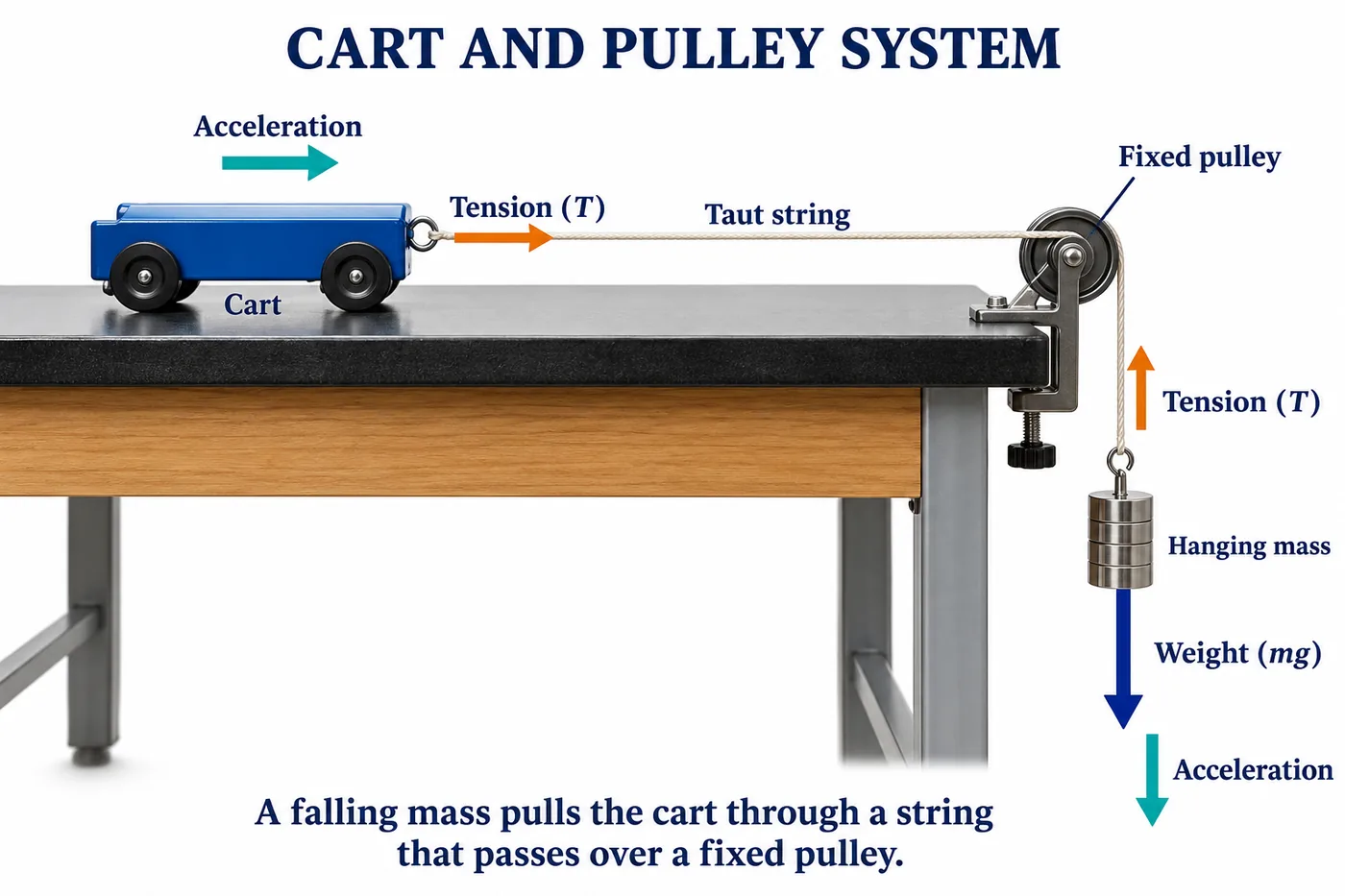
Cart mass M = 3 kg, hanging mass m = 1 kg, g = 10 m/s². Treat both as one system: net force = mg = 10 N; total mass = 4 kg. a = 10/4 = 2.5 m/s². Tension on the cart: T = Ma = 3 × 2.5 = 7.5 N. (Check for hanging mass: mg − T = ma → 10 − 7.5 = 2.5 ✓.)
9. Master Table: Laws and Formulas
| Item | Statement / formula |
|---|---|
| First law | No net force → no change in velocity (inertia) |
| Momentum | p = mv (kg m/s) |
| Second law | F = (mv − mu)/t = ma |
| 1 newton | 1 kg × 1 m/s² |
| Third law | Action = −Reaction, on different bodies |
| Conservation of momentum | m₁u₁ + m₂u₂ = m₁v₁ + m₂v₂ |
| Pulley system (no friction) | a = mg/(M + m), T = Ma |
10. Master Summary Table
| Everyday event | Law / idea |
|---|---|
| Passengers jerk forward when bus stops | First law — inertia of motion |
| Fielder pulls hands back while catching | Second law — more time, less force |
| Gun recoils | Third law and conservation of momentum |
| Rocket rises | Third law |
| Ball stops on grass | Friction — unbalanced force |
| Book at rest on table | Balanced forces (weight = normal force) |
11. Mind Map
- Balanced, unbalanced
- Friction: static, sliding, rolling
- Inertia
- Mass measures inertia
- p = mv
- F = ma
- Action–reaction
- Momentum conserved
12. Tips and Tricks
- Always convert grams to kg and km/h to m/s before using F = ma.
- For connected bodies, first find a using the whole system, then tension from one body.
- Action–reaction never cancel because they act on different objects.
- Thinking a moving object needs a force to keep moving — only a change in motion needs a net force.
- Saying the Earth pulls a fruit more strongly than the fruit pulls the Earth.
- Confusing mass (inertia, kg) with weight (force, N).
13. Important One-liners
- Force is a vector; SI unit newton.
- Balanced forces do not change motion.
- Friction opposes relative motion; rolling friction is smallest.
- Inertia is resistance to change in motion; mass measures inertia.
- Momentum p = mv.
- F = ma; 1 N = 1 kg m/s².
- Action and reaction are equal and opposite and act on different bodies.
- Total momentum is conserved when no external force acts.
- Seat belts and airbags work by reducing the force through inertia and time.
14. Exam-pattern Questions with Detailed Answers
The SI unit of momentum is:
- kg m/s²
- N
- kg m/s
- N/s
Show answer
Momentum = mass × velocity = kg × m/s. kg m/s² is newton.
Answer: (C) kg m/s
Which has more inertia — a cricket ball or a rubber ball of the same size?
Show answer
The cricket ball, because it has more mass, and mass is the measure of inertia.
Answer: Cricket ball
State Newton’s third law of motion.
Show answer
To every action there is an equal and opposite reaction, acting on two different objects at the same time.
Answer: Equal and opposite action–reaction on different bodies
What force is needed to accelerate a 1500 kg car at 2 m/s²?
Show answer
F = ma = 1500 × 2 = 3000 N.
Answer: 3000 N
Assertion (A): Action and reaction forces do not cancel each other. Reason (R): They act on different objects.
- Both true; R explains A
- Both true; R does not explain A
- A true, R false
- A false, R true
Show answer
Forces can cancel only if they act on the same object. Action and reaction act on two different bodies, so each body feels one of them.
Answer: (A)
Why does a fielder pull his hands back while catching a fast cricket ball?
Show answer
The ball’s momentum must be reduced to zero. Pulling the hands back increases the time of stopping, so the rate of change of momentum (force) on the hands decreases, preventing injury.
Answer: More time → less force (second law)
A bullet of mass 10 g moving at 150 m/s strikes a wooden block and stops in 0.03 s. Find the force exerted by the block.
Show answer
m = 0.01 kg, u = 150 m/s, v = 0. F = m(v − u)/t = 0.01 × (−150)/0.03 = −50 N. The block exerts 50 N opposite to the bullet’s motion.
Answer: 50 N (opposing)
Why do passengers fall backward when a bus starts suddenly?
Show answer
The bus and the lower body begin moving, but the upper body tends to remain at rest due to inertia of rest, so it falls backward.
Answer: Inertia of rest
A 5 kg rifle fires a 50 g bullet with a speed of 200 m/s. Find the recoil velocity of the rifle.
Show answer
Total momentum before = 0. 0.05 × 200 + 5 × v = 0 → v = −10/5 = −2 m/s. The rifle moves back at 2 m/s.
Answer: 2 m/s backward
Case-based: A 2 kg cart on a smooth table is connected over a pulley to a 0.5 kg hanging mass (g = 10 m/s²). (a) Find acceleration. (b) Find tension. (c) What happens to acceleration if friction acts on the cart?
Show answer
(a) a = mg/(M + m) = 5/2.5 = 2 m/s². (b) T = Ma = 2 × 2 = 4 N (check: 5 − 4 = 0.5 × 2 ✓). (c) Friction opposes motion, reducing the net force, so acceleration decreases.
Answer: 2 m/s²; 4 N; decreases
If the Earth pulls a falling apple with the same force as the apple pulls the Earth, why does the apple move towards the Earth and not the other way?
Show answer
The forces are equal, but a = F/m. The apple’s mass is tiny, so its acceleration is large (≈ 9.8 m/s²). The Earth’s mass is about 6 × 10²⁴ kg, so its acceleration is unimaginably small and cannot be noticed.
Answer: Same force, but Earth’s huge mass gives negligible acceleration
Derive F = ma from Newton’s second law.
Show answer
Initial momentum = mu, final = mv in time t. Rate of change of momentum = (mv − mu)/t = m(v − u)/t = ma. By the second law, F ∝ ma, so F = kma. Choosing units so that k = 1 (1 N gives 1 kg an acceleration of 1 m/s²), F = ma.
Answer: F = k·m(v−u)/t = ma with k = 1
15. Quick Revision Summary
- Net force decides motion: balanced → no change; unbalanced → acceleration.
- Friction (static, sliding, rolling, fluid) opposes motion.
- First law: inertia; mass measures inertia.
- Second law: F = rate of change of momentum = ma; momentum p = mv.
- Third law: equal and opposite forces on different bodies; momentum is conserved (recoil). Connected bodies share acceleration; tension transmits force.