
1. Chapter at a Glance
In everyday language “work” means any activity, even reading. In science, work has a precise meaning: it is done only when a force moves an object. To do work we need energy, which exists in many forms and changes from one form to another without ever being lost. This chapter explains work, the work–energy theorem, kinetic and potential energy, conservation of mechanical energy, power, and simple machines such as levers, pulleys and inclined planes that make work easier.
- Work done by a constant force: W = F s; positive, negative and zero work.
- Work–energy theorem; kinetic energy ½mv² and potential energy mgh.
- Forms of energy and transformations; conservation of mechanical energy.
- Power and its units; commercial unit kWh.
- Simple machines — lever, pulley, inclined plane; mechanical advantage.
2. Work Done by a Constant Force
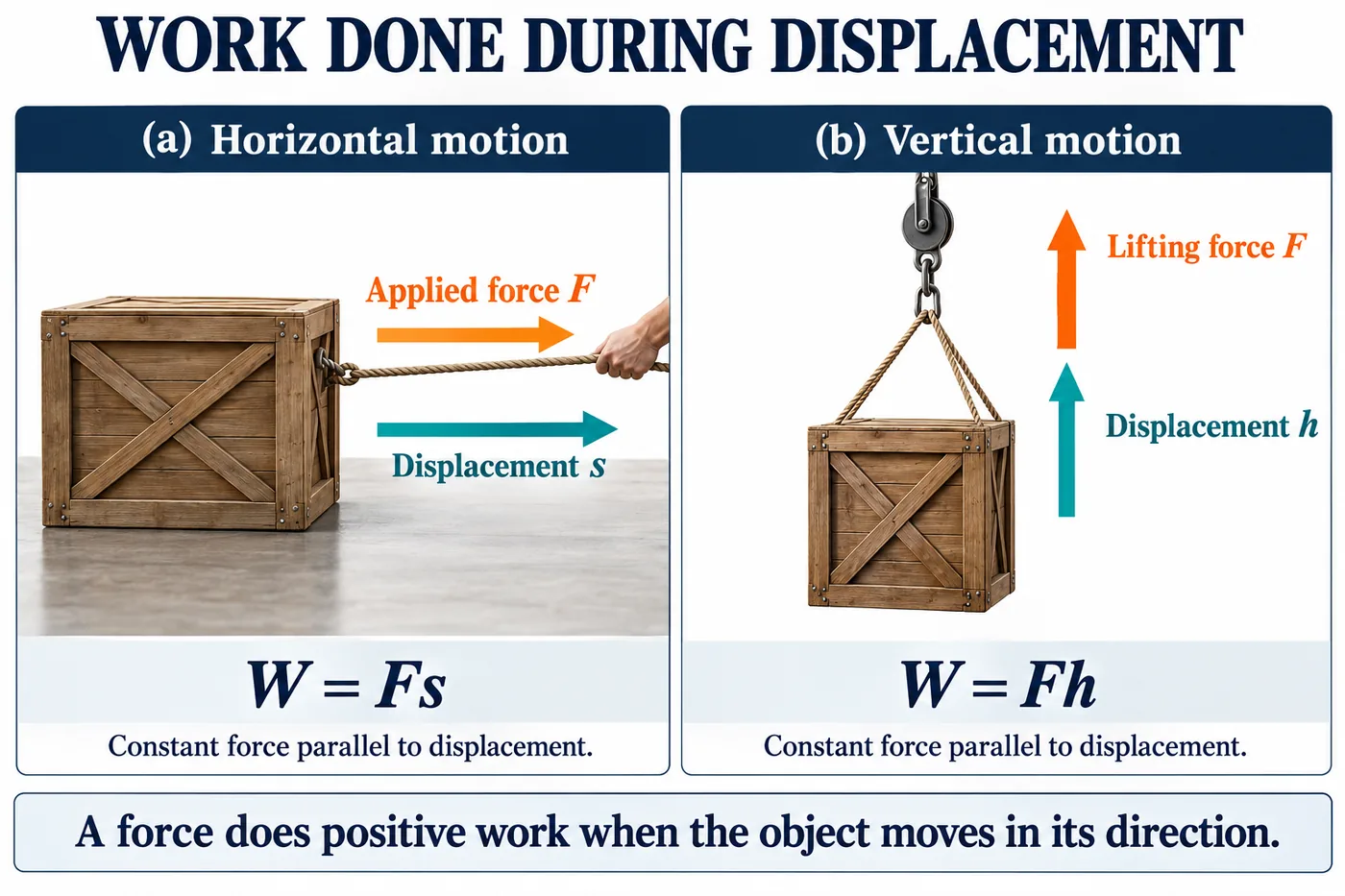
Work is done when a force acts on an object and the object is displaced in the direction of the force (or has a component of displacement along it).
W = F × s (force × displacement along the force)
SI unit: joule (J); 1 J = 1 N × 1 m. Work is a scalar.
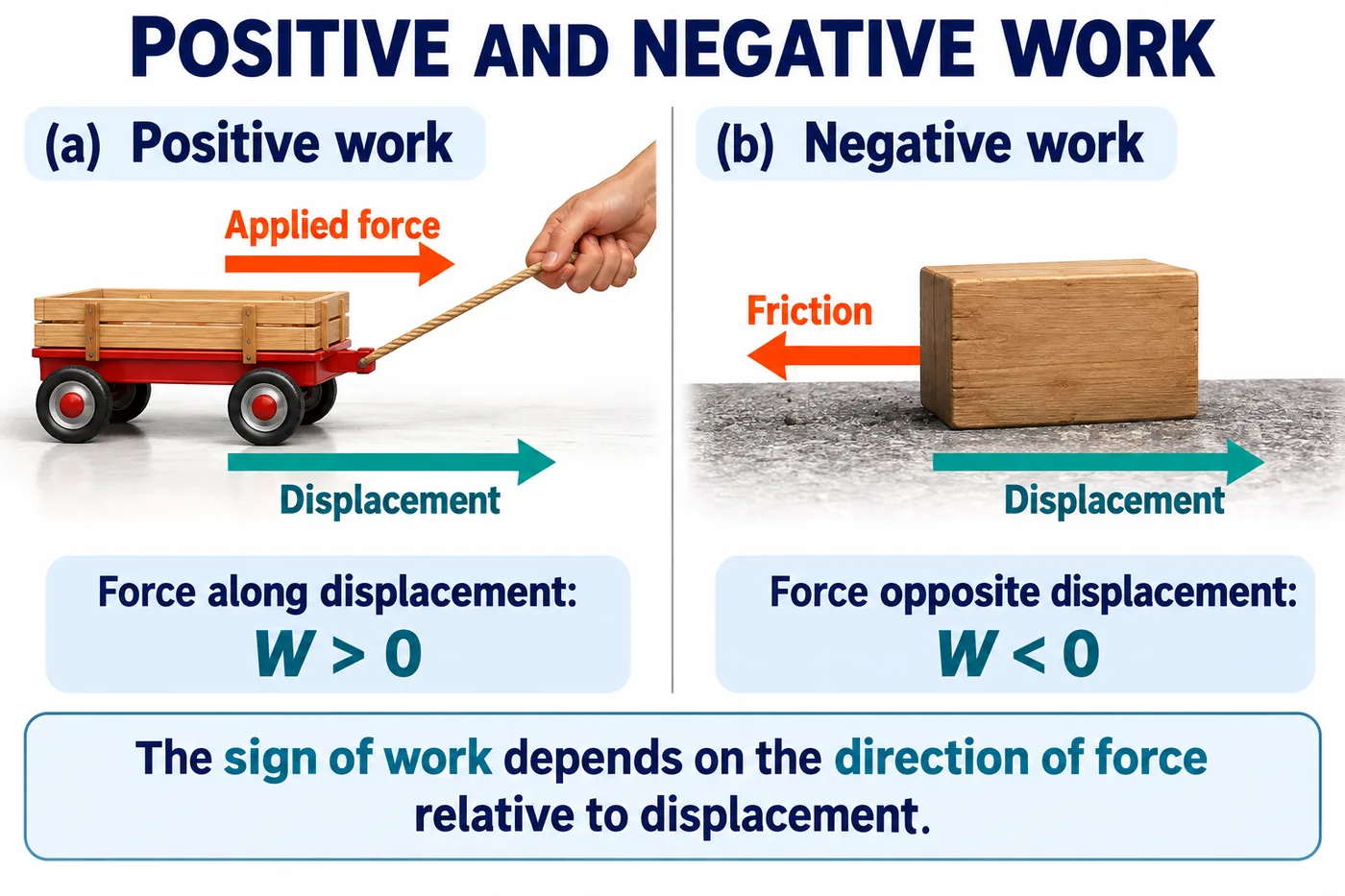
- Positive work — force and displacement in the same direction (pulling a trolley; gravity on a falling ball).
- Negative work — force opposite to displacement (friction on a sliding block; gravity on a ball thrown upward).
- Zero work — no displacement (pushing a wall) or force perpendicular to displacement (carrying a bag horizontally; gravity on a satellite in circular orbit).
A porter lifts a 15 kg bag to a height of 1.5 m (g = 10 m/s²). Force needed = weight = 150 N. W = 150 × 1.5 = 225 J. If he then walks 20 m on level ground, the work done by him against gravity is zero (force vertical, displacement horizontal).
3. Energy and the Work–Energy Theorem
Energy is the capacity to do work. Its SI unit is also the joule. An object that does work loses energy; the object on which work is done gains energy.
Kinetic energy
The energy an object has because of its motion: KE = ½ m v². Doubling speed makes KE four times.
Work–energy theorem
The net work done on an object equals the change in its kinetic energy: Wnet = ½mv² − ½mu².
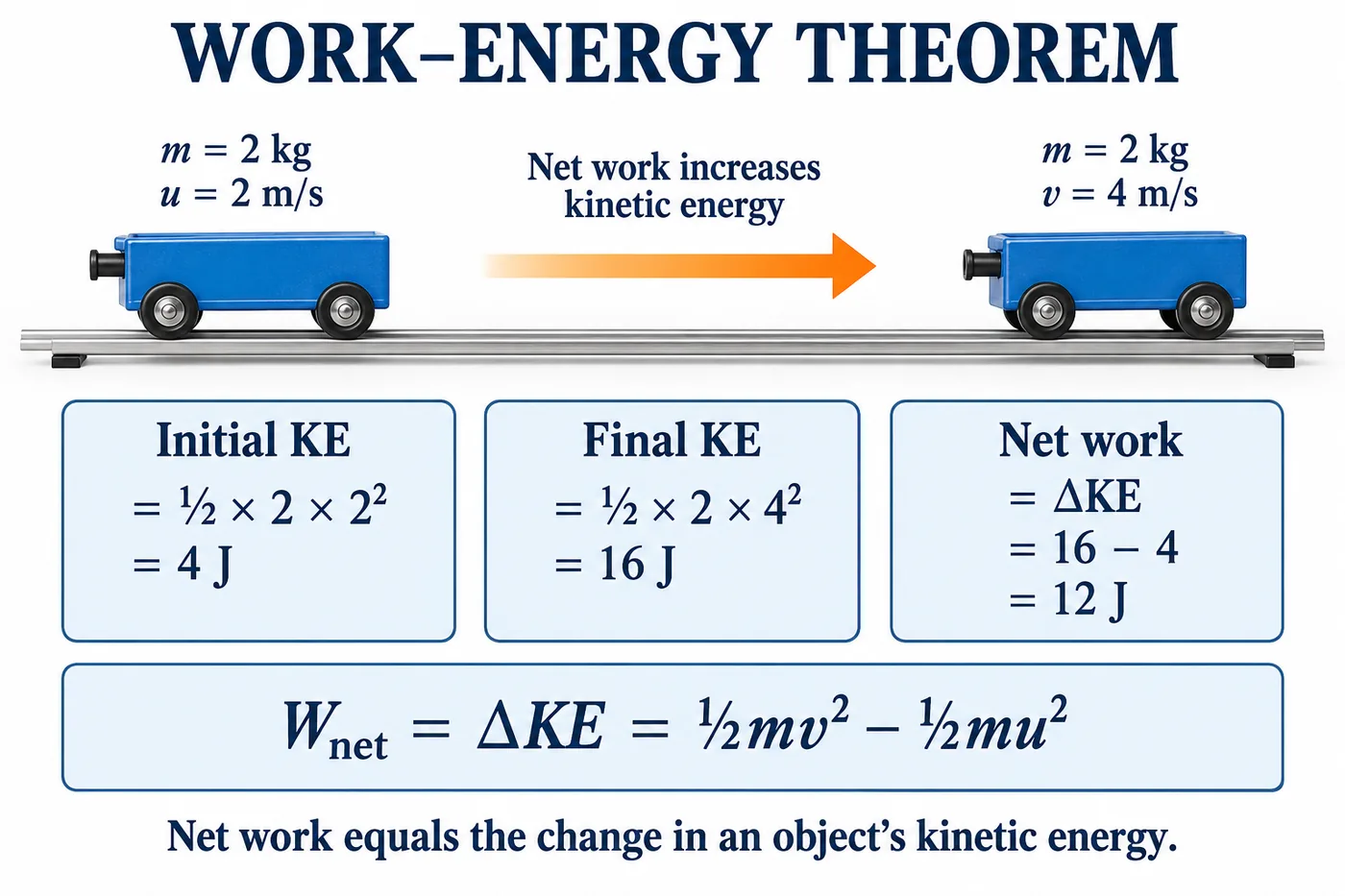
A 2 kg cart speeds up from 2 m/s to 4 m/s. Initial KE = ½ × 2 × 4 = 4 J; final KE = ½ × 2 × 16 = 16 J. Net work = 12 J.
Potential energy
Energy stored because of position or shape. Gravitational potential energy of a mass m at height h: PE = m g h (work done against gravity in lifting it). A stretched rubber band or compressed spring has elastic potential energy.
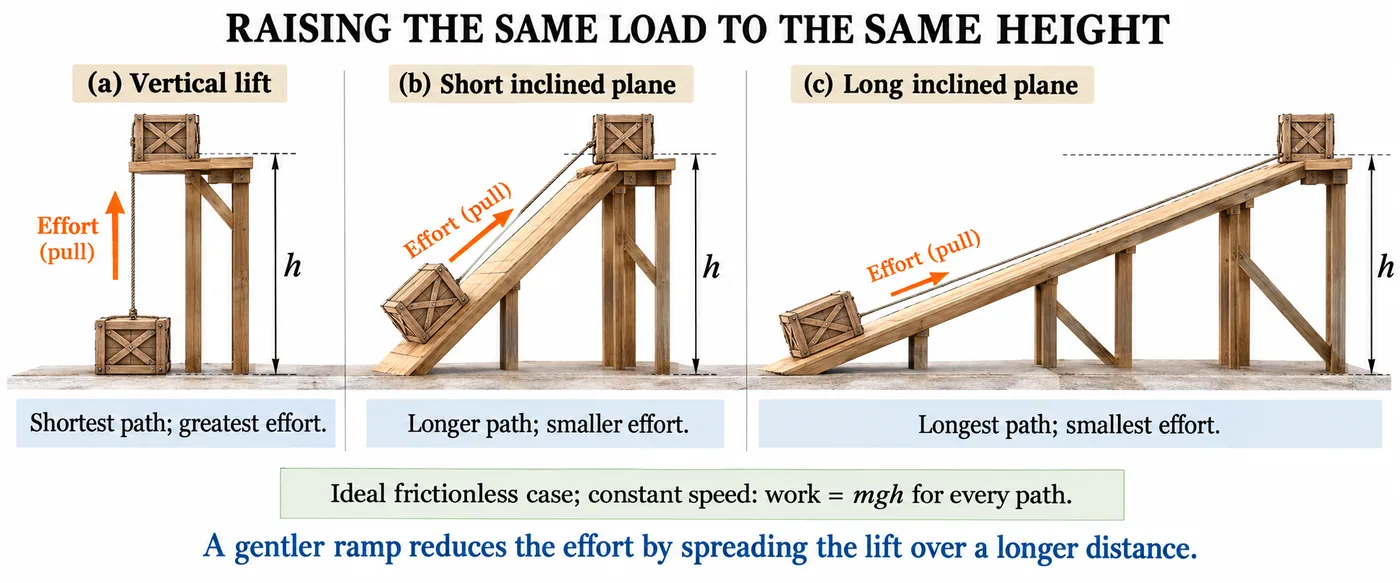
The work done against gravity depends only on the vertical height, not on the path taken — lifting a load straight up or pushing it up a smooth ramp to the same height stores the same PE (mgh).
4. Forms of Energy and Transformations
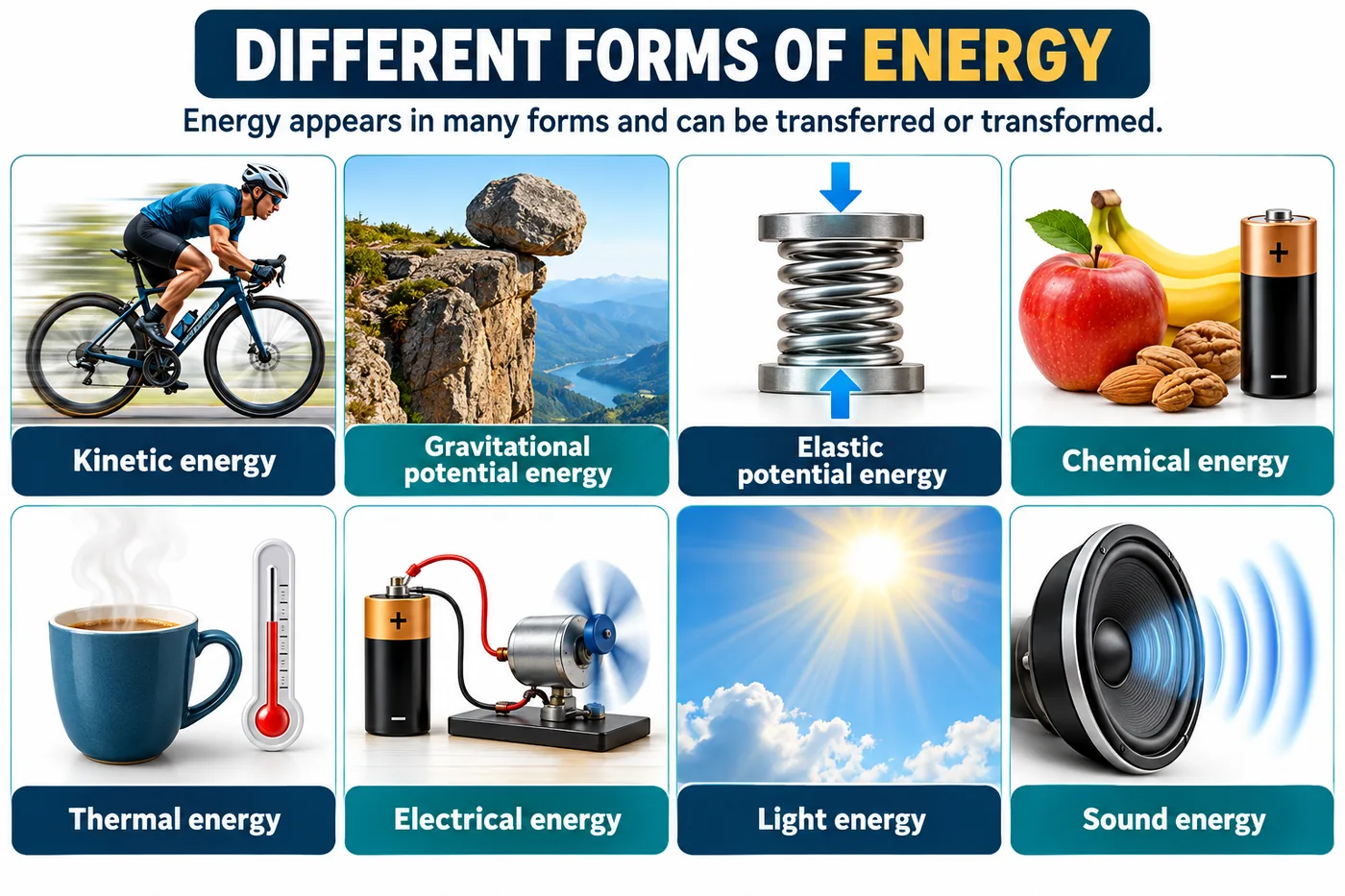
| Device / process | Energy change |
|---|---|
| Electric bulb | Electrical → light + heat |
| Electric motor / fan | Electrical → kinetic |
| Battery / cell | Chemical → electrical |
| Solar cell | Light → electrical |
| Photosynthesis | Light → chemical |
| Hydroelectric dam | Potential → kinetic → electrical |
| Loudspeaker | Electrical → sound |
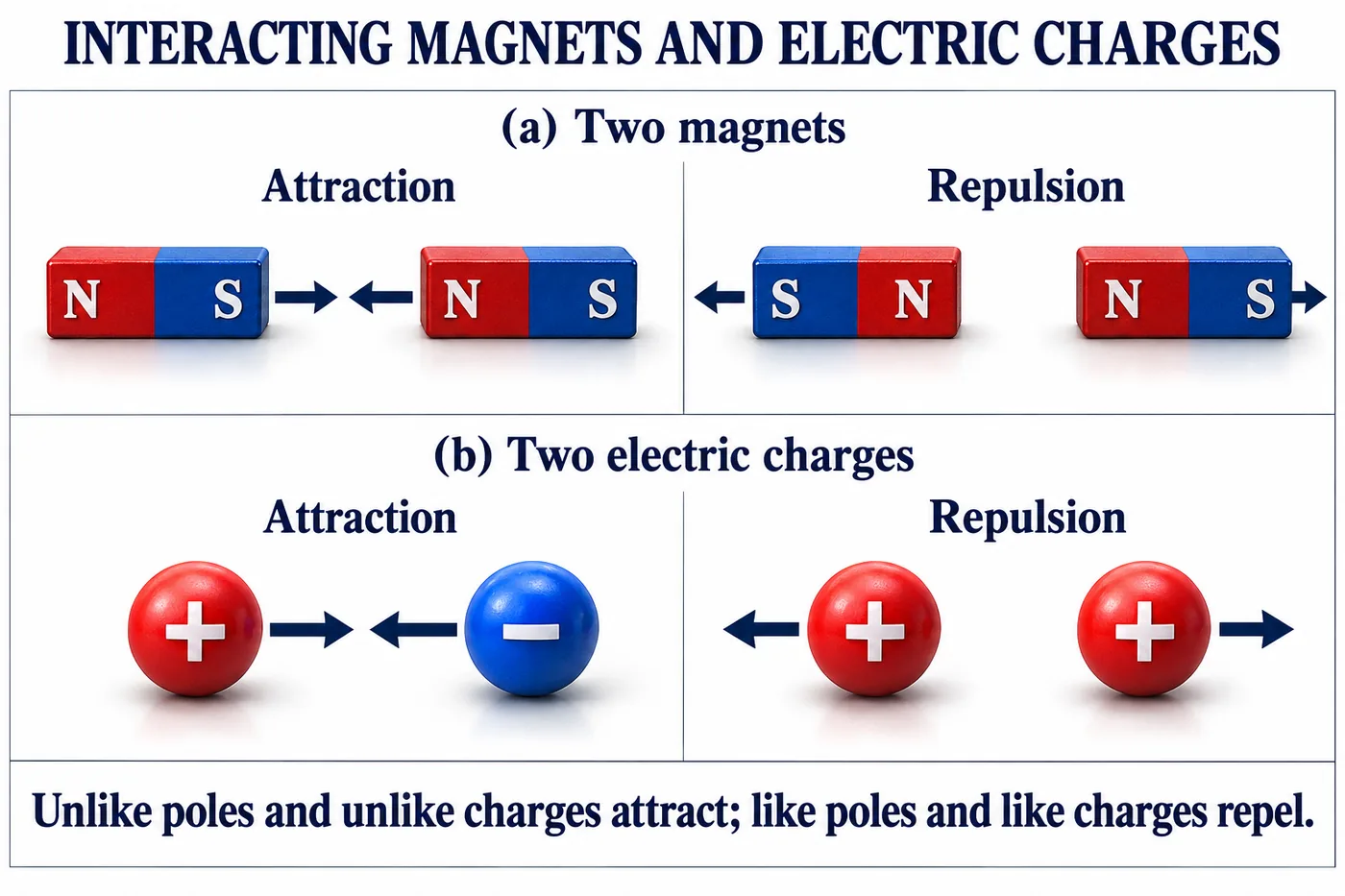
Magnets and electric charges also store energy because of their arrangement: unlike poles and charges attract, like ones repel, and work must be done to push them closer or pull them apart.
5. Mechanical Energy and Its Conservation
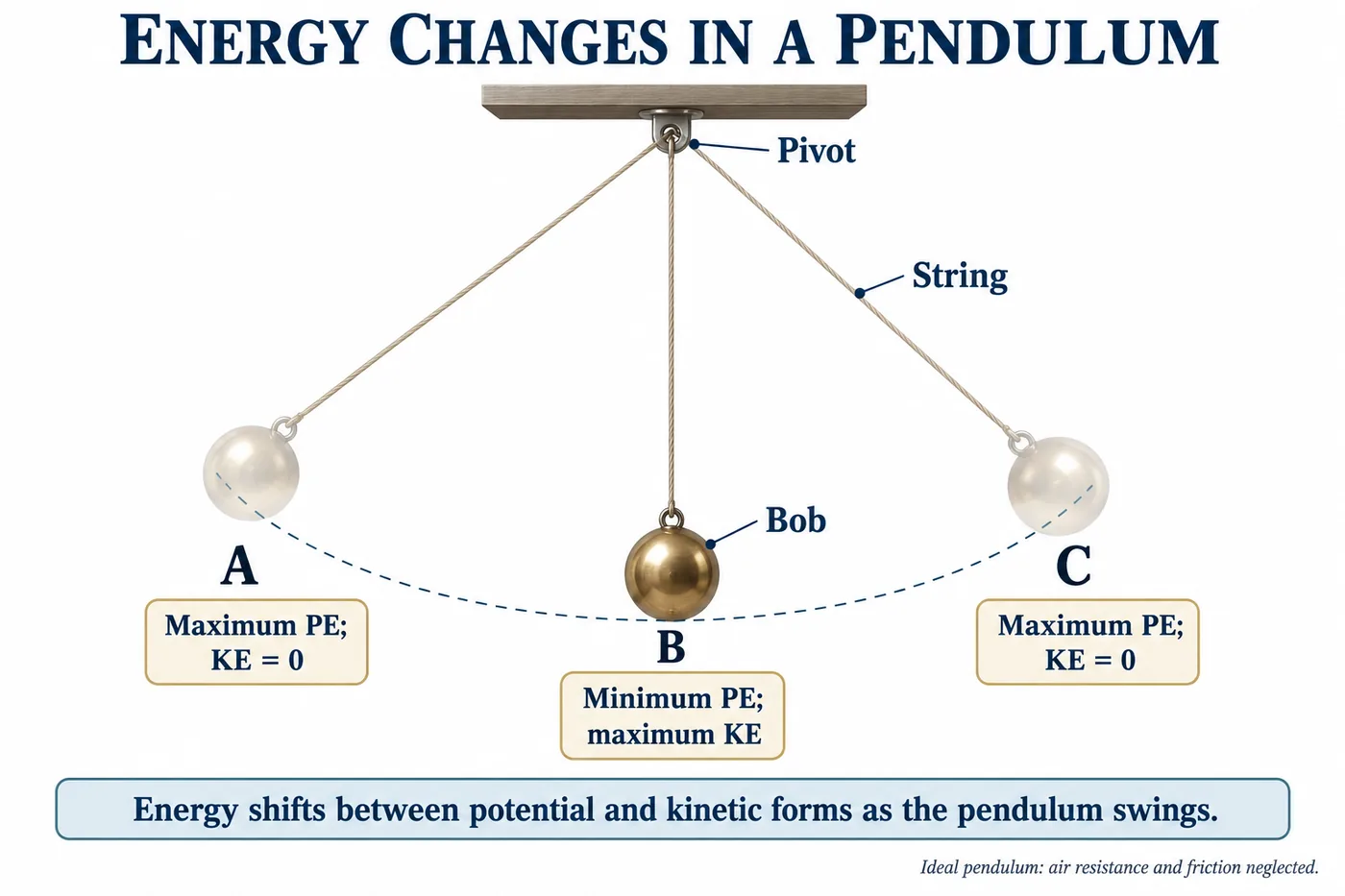
Mechanical energy = KE + PE. Law of conservation of energy: energy can neither be created nor destroyed; it can only change from one form to another, and the total energy remains constant. When friction and air resistance are negligible, mechanical energy stays constant.
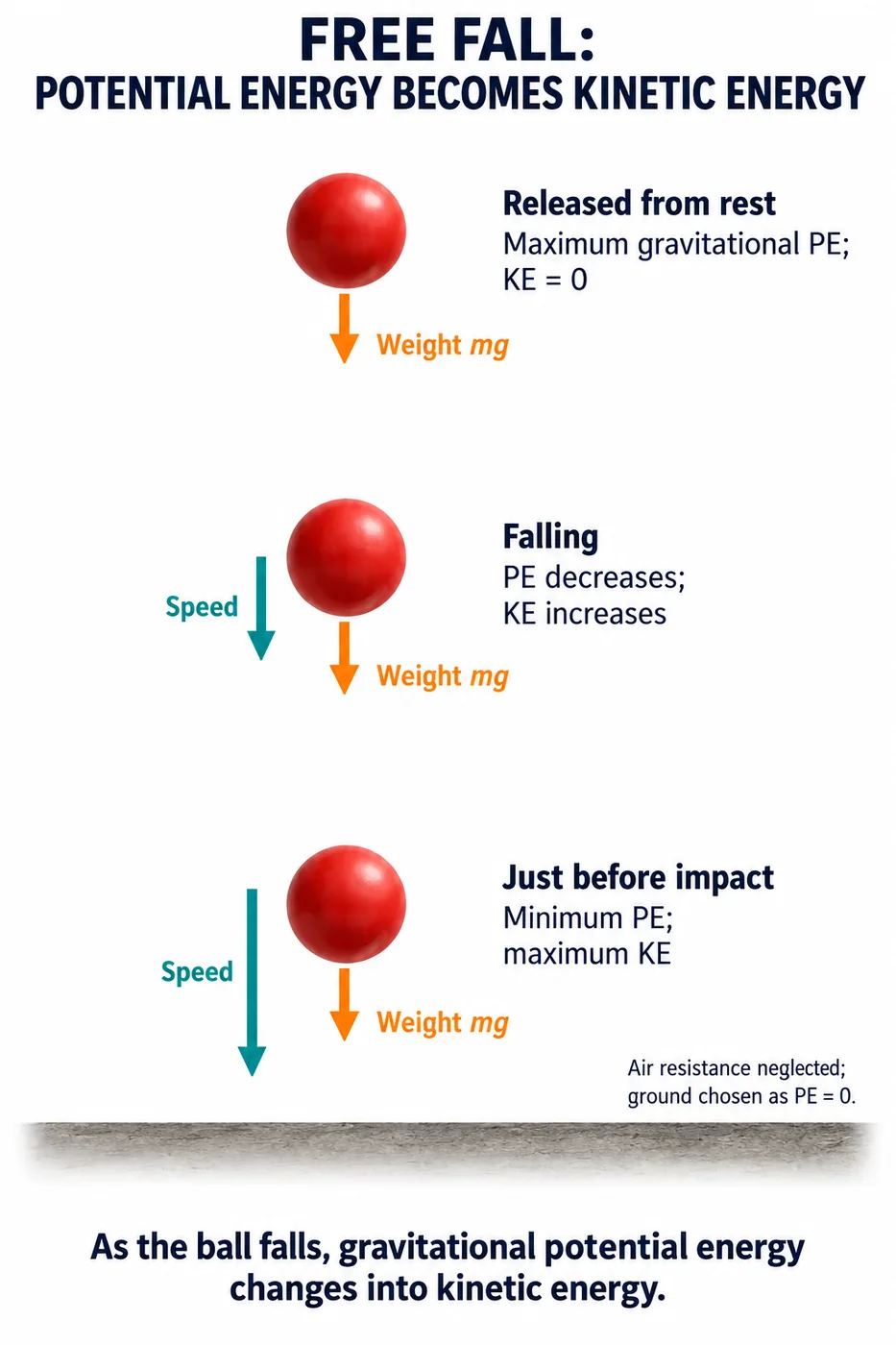
A 1 kg ball is dropped from 20 m (g = 10 m/s²). At the top: PE = 1 × 10 × 20 = 200 J, KE = 0. Halfway (10 m): PE = 100 J, KE = 100 J. Just before the ground: PE = 0, KE = 200 J → v = √(2 × 200/1) = 20 m/s. Total = 200 J at every point.
| Height (m) | PE (J) | KE (J) | Total (J) |
|---|---|---|---|
| 20 | 200 | 0 | 200 |
| 15 | 150 | 50 | 200 |
| 10 | 100 | 100 | 200 |
| 5 | 50 | 150 | 200 |
| 0 | 0 | 200 | 200 |
6. Power
Power is the rate of doing work or of transferring energy: P = W/t. SI unit: watt (W) = 1 J/s; 1 kW = 1000 W; 1 horsepower ≈ 746 W. Two people may do the same work, but the one who does it faster has more power.
The commercial unit of energy is the kilowatt-hour (kWh) — the energy used by a 1 kW appliance in 1 hour: 1 kWh = 1000 W × 3600 s = 3.6 × 10⁶ J. Electricity bills charge per kWh (“unit”).
A 60 kg girl runs up 30 steps, each 0.2 m high, in 12 s (g = 10 m/s²). Work = mgh = 60 × 10 × 6 = 3600 J. Power = 3600/12 = 300 W.
A household uses a 1.5 kW heater for 2 h daily for 30 days: energy = 1.5 × 2 × 30 = 90 kWh (90 units).
7. Simple Machines
A simple machine is a device that makes work easier by changing the size or direction of the force (or the distance over which it acts). It does not reduce the total work; ideally, work output = work input.
- Mechanical advantage (MA) = load ÷ effort.
- Velocity ratio (VR) = distance moved by effort ÷ distance moved by load.
- Efficiency = (work output ÷ work input) × 100% = (MA ÷ VR) × 100%. Friction makes real efficiency less than 100%.
Lever
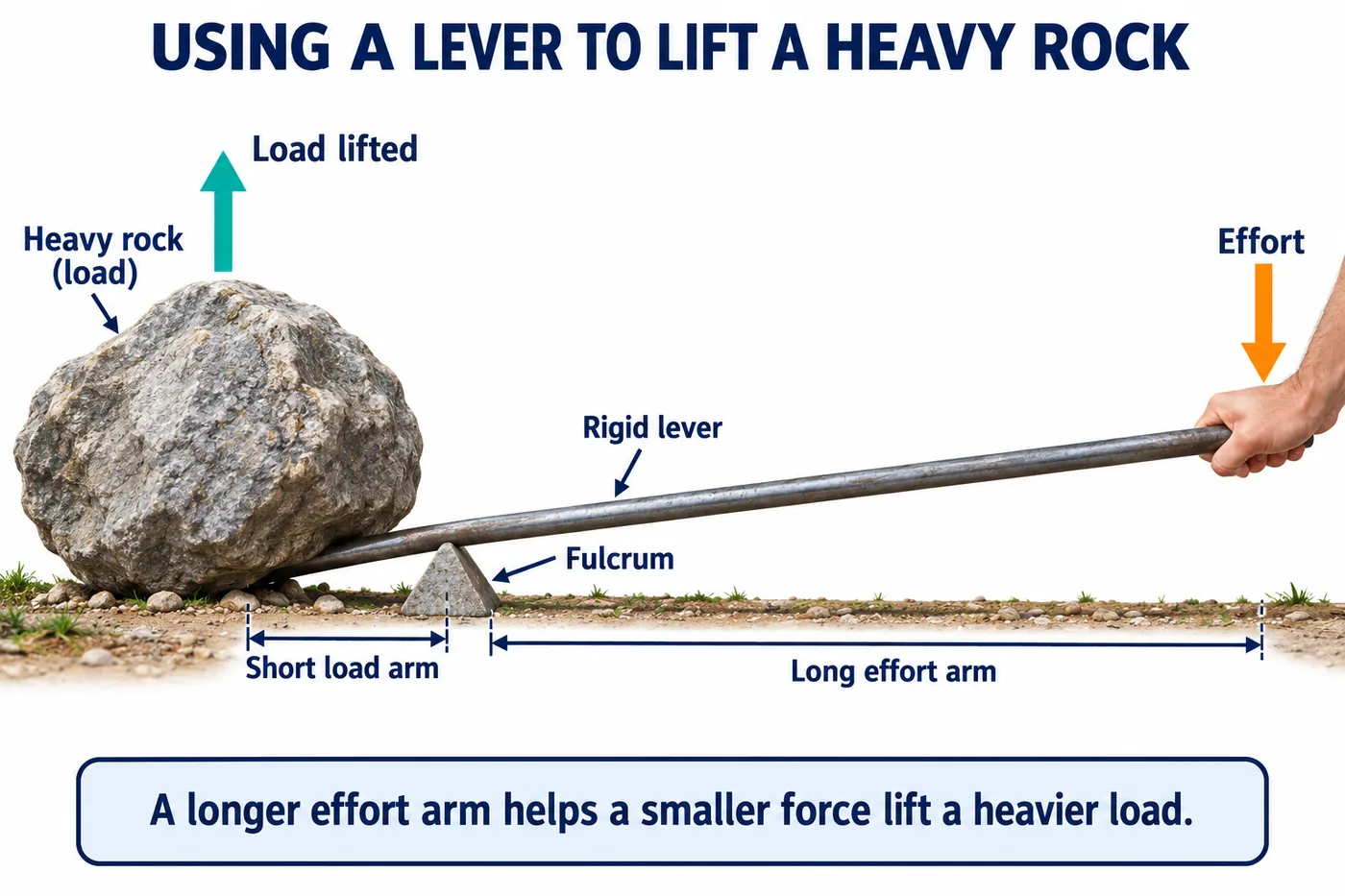
A rigid bar turning about a fixed point (fulcrum). Principle of lever (moments): Load × load arm = Effort × effort arm. A longer effort arm means a smaller effort.
| Class | Arrangement | Examples |
|---|---|---|
| First | Fulcrum between load and effort | See-saw, crowbar, scissors, beam balance |
| Second | Load between fulcrum and effort (MA > 1) | Wheelbarrow, nutcracker, bottle opener |
| Third | Effort between fulcrum and load (MA < 1) | Tongs, tweezers, human forearm, fishing rod |
A crowbar 1.5 m long has its fulcrum 0.3 m from a 600 N rock. Effort arm = 1.2 m. Effort = 600 × 0.3 ÷ 1.2 = 150 N. MA = 600/150 = 4.
Pulley
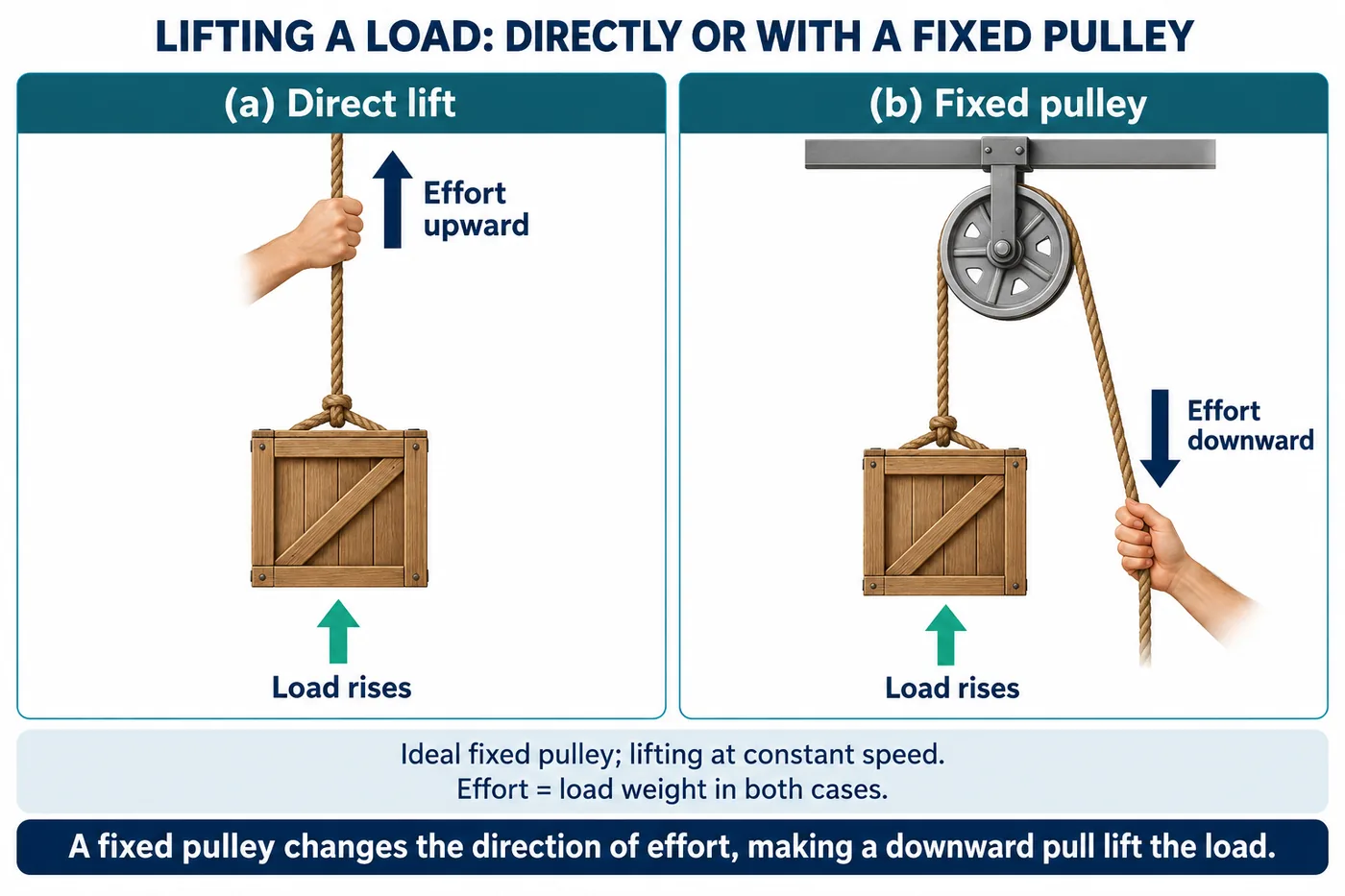
A single fixed pulley has MA = 1; it does not reduce effort but changes the direction of effort — pulling down is easier than lifting up (we can use our body weight). A single movable pulley has an ideal MA of 2.
Inclined plane
A sloping surface (ramp). Pushing a load up a longer, gentler ramp needs less effort but a longer distance. Ideal MA = length of ramp ÷ height. Screws and wedges are forms of inclined planes; mountain roads zig-zag for the same reason.
8. Master Table: Formulas
| Quantity | Formula | SI unit |
|---|---|---|
| Work | W = F s | joule (J) |
| Kinetic energy | KE = ½ m v² | J |
| Potential energy | PE = m g h | J |
| Work–energy theorem | W = ½mv² − ½mu² | J |
| Power | P = W/t | watt (W) |
| Commercial energy | 1 kWh = 3.6 × 10⁶ J | kWh |
| Mechanical advantage | MA = load/effort | — |
| Lever principle | Load × load arm = Effort × effort arm | — |
| Efficiency | (Output/Input) × 100 = MA/VR × 100 | % |
9. Master Summary Table
| Situation | Work done? | Reason |
|---|---|---|
| Pushing a wall that does not move | Zero | No displacement |
| Carrying a bag on a level road | Zero (against gravity) | Force ⟂ displacement |
| Lifting a bucket from a well | Positive | Force along displacement |
| Friction on a sliding box | Negative | Force opposite to displacement |
| Satellite in circular orbit (gravity) | Zero | Force ⟂ velocity |
Chart — energy of a 1 kg ball dropped from 20 m (see table above):
10. Mind Map
- W = Fs, joule
- Positive, negative, zero
- KE = ½mv², PE = mgh
- Conservation
- P = W/t, watt
- kWh = 3.6 MJ
- Lever, pulley, ramp
- MA, efficiency
11. Tips and Tricks
- Check direction first: work needs displacement along the force.
- Free-fall problems: use PE at top = KE at bottom → v = √(2gh).
- kWh questions: kW × hours × days = units.
- Lever classes: “FLE” — what is in the middle? 1st: Fulcrum, 2nd: Load, 3rd: Effort.
- Thinking holding a heavy bag still is “work” in physics — no displacement, no work.
- Forgetting to square velocity in KE.
- Saying machines reduce work — they reduce effort, not total work.
12. Important One-liners
- Work = force × displacement along the force.
- 1 joule = 1 newton × 1 metre.
- Work can be positive, negative or zero.
- KE = ½mv²; PE = mgh.
- Net work equals the change in kinetic energy.
- Energy can neither be created nor destroyed.
- Power = work/time; 1 W = 1 J/s.
- 1 kWh = 3.6 × 10⁶ J.
- A fixed pulley changes the direction of effort.
- A longer effort arm or ramp reduces the effort needed.
13. Exam-pattern Questions with Detailed Answers
The commercial unit of energy is:
- watt
- joule
- kilowatt-hour
- kilowatt
Show answer
kWh is used in electricity bills; watt and kilowatt are units of power; joule is the SI unit of energy.
Answer: (C) kilowatt-hour
Find the kinetic energy of a 50 kg boy running at 4 m/s.
Show answer
KE = ½ × 50 × 16 = 400 J.
Answer: 400 J
A force of 20 N moves an object 5 m in its direction. Find the work done.
Show answer
W = 20 × 5 = 100 J.
Answer: 100 J
Assertion (A): No work is done by gravity on a satellite moving in a circular orbit. Reason (R): Gravitational force is perpendicular to the direction of motion of the satellite.
- Both true; R explains A
- Both true; R does not explain A
- A true, R false
- A false, R true
Show answer
In circular orbit gravity points to the centre and velocity is along the tangent — perpendicular — so W = 0.
Answer: (A)
If the velocity of a car is doubled, how does its kinetic energy change?
Show answer
KE ∝ v². Doubling v makes KE 2² = 4 times.
Answer: Becomes four times
An electric iron of 1000 W is used for 30 minutes daily. Find the energy consumed in 30 days in kWh and joules.
Show answer
1 kW × 0.5 h × 30 = 15 kWh = 15 × 3.6 × 10⁶ = 5.4 × 10⁷ J.
Answer: 15 kWh = 5.4 × 10⁷ J
Why is it easier to push a heavy box up a long gentle ramp than to lift it straight up?
Show answer
The work needed (mgh) is the same in both cases (ideally), but on a long ramp it is spread over a longer distance, so a smaller effort is needed (effort × length = mgh).
Answer: Same work spread over more distance → less effort
Describe the energy changes in a swinging pendulum.
Show answer
At the extreme positions the bob is momentarily at rest: maximum PE, zero KE. As it swings down, PE changes into KE; at the lowest point KE is maximum and PE minimum. Rising again, KE turns back into PE. Total mechanical energy remains constant (ideally); slowly, air resistance converts some into heat.
Answer: PE ⇄ KE; total constant
A 10 kg object is dropped from a height of 10 m. Find its PE and KE at the top, at 4 m above the ground, and just before hitting the ground (g = 10 m/s²).
Show answer
Total = mgh = 10 × 10 × 10 = 1000 J. Top: PE 1000 J, KE 0. At 4 m: PE = 10 × 10 × 4 = 400 J, KE = 600 J. Ground: PE 0, KE 1000 J.
Answer: (1000, 0); (400, 600); (0, 1000) J
Case-based: A 50 kg boy and a 40 kg girl climb the same 8 m staircase in 10 s and 8 s respectively (g = 10 m/s²). (a) Who does more work? (b) Who is more powerful? (c) Give values.
Show answer
Boy: W = 50 × 10 × 8 = 4000 J; P = 400 W. Girl: W = 40 × 10 × 8 = 3200 J; P = 400 W. (a) The boy does more work. (b) Both have equal power, 400 W.
Answer: Boy more work; equal power 400 W
A load of 900 N is lifted with a lever. Load arm = 0.2 m, effort arm = 1.8 m. Find the effort and MA. To which class could this lever belong?
Show answer
Effort = 900 × 0.2 / 1.8 = 100 N; MA = 900/100 = 9. MA > 1 with the fulcrum close to the load: a first-class lever (like a crowbar) or a second-class lever (like a wheelbarrow) depending on arrangement.
Answer: 100 N; MA = 9
A 1000 kg car moving at 72 km/h is stopped by brakes. How much work is done by the brakes? Where does the energy go?
Show answer
v = 20 m/s. KE = ½ × 1000 × 400 = 2 × 10⁵ J. By the work–energy theorem, brakes do −2 × 10⁵ J of work (negative work). The kinetic energy is converted mainly into heat in the brakes and tyres (and some sound).
Answer: −2 × 10⁵ J; converted to heat and sound
14. Quick Revision Summary
- W = F s (joule); positive, negative or zero depending on direction.
- KE = ½mv²; PE = mgh; net work = change in KE.
- Energy changes form but is conserved; mechanical energy constant without friction (free fall, pendulum).
- Power P = W/t (watt); 1 kWh = 3.6 × 10⁶ J.
- Simple machines: lever (load × load arm = effort × effort arm), pulley (changes direction), inclined plane (less effort, longer distance); MA = load/effort.