
1. Chapter at a Glance
No living being lives forever, yet life on Earth has continued for billions of years. This is possible because organisms reproduce — they produce new individuals of their own kind. Some reproduce from a single parent (asexual reproduction), producing nearly identical copies; others need two parents (sexual reproduction), producing offspring with new combinations of features. This chapter explores both modes in plants and animals, the human reproductive system, pregnancy and reproductive health.
- Asexual reproduction: fission, budding, fragmentation, regeneration, spore formation, vegetative propagation.
- Artificial vegetative propagation: cutting, layering, grafting and tissue culture.
- Sexual reproduction in flowering plants: flower parts, pollination, fertilisation, seeds and fruits.
- Human reproductive systems, fertilisation and stages of pregnancy.
- Reproductive health and contraception; metamorphosis in insects.
2. Asexual Reproduction
Asexual reproduction involves a single parent, no gametes and no fertilisation. Offspring are genetically almost identical to the parent (clones). It is fast and useful when conditions are favourable.
| Method | How it happens | Examples |
|---|---|---|
| Binary fission | Parent cell divides into two equal daughter cells | Amoeba, Paramecium, bacteria |
| Multiple fission | Nucleus divides many times inside a cyst; many daughter cells released | Plasmodium (malaria parasite) |
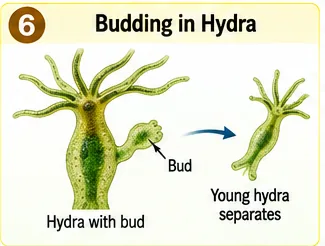
| Budding | A bud grows on the parent, develops and detaches | Hydra, yeast |
| Fragmentation | Body breaks into pieces; each grows into a new individual | Spirogyra, some flatworms |
| Regeneration | A lost part regrows or a small piece forms a whole organism | Planaria, Hydra |
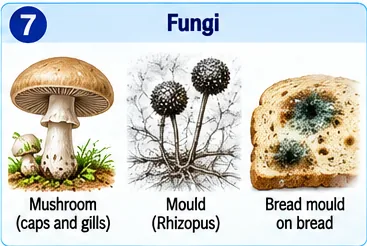
| Spore formation | Sporangia release many tiny spores that germinate in moist conditions | Bread mould (Rhizopus), ferns, mosses |
3. Vegetative Propagation
In many plants, new plants grow from vegetative parts — root, stem or leaf — instead of seeds.
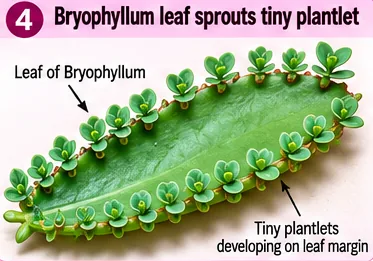
- Natural: potato (stem tuber with “eyes”), ginger (rhizome), onion (bulb), sweet potato (root), Bryophyllum (buds on leaf margins), grass (runners).
- Advantages: faster; plants that do not produce viable seeds (banana, rose, orange) can be grown; all plants keep the desired qualities of the parent.
Artificial methods
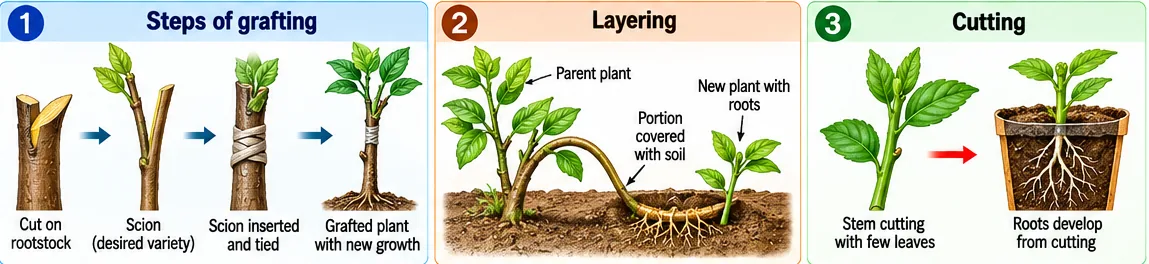
- Cutting — a piece of stem with nodes is planted; roots develop (rose, sugarcane, money plant).
- Layering — a branch is bent and covered with soil while attached to the parent; once it roots, it is cut off (jasmine, grapevine).
- Grafting — a cut stem (scion) of a desired variety is joined to a rooted plant (stock) and tied; they grow together (mango, citrus, apple).
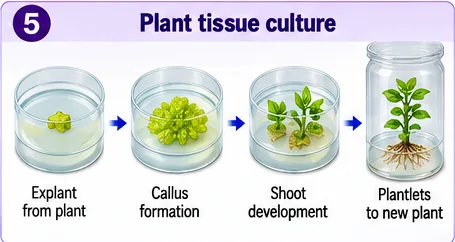
- Tissue culture (micropropagation) — a few cells (explant) are grown on a nutrient medium in sterile conditions to form a callus, which develops shoots and roots and gives thousands of identical plantlets (orchids, banana, ornamental plants).
4. Sexual Reproduction
Sexual reproduction involves two parents producing gametes (male and female sex cells) by meiosis. The fusion of gametes is fertilisation, forming a zygote that develops into a new individual. It creates variation, which helps species survive changing environments.
Sexual reproduction in flowering plants
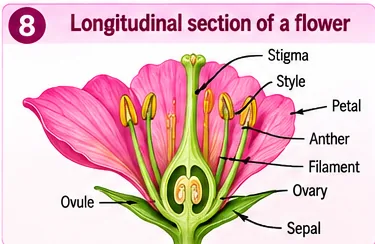
The flower is the reproductive organ. Its parts:
- Sepals (green, protect the bud) and petals (coloured, attract insects).
- Stamen — male part: anther (makes pollen grains containing male gametes) on a filament.
- Pistil (carpel) — female part: stigma (receives pollen), style and ovary containing ovules (each with an egg cell).
Flowers with both stamens and pistil are bisexual (hibiscus, mustard); those with only one are unisexual (papaya, watermelon).
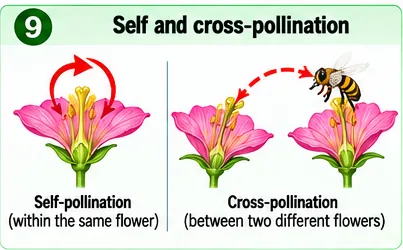
Pollination is the transfer of pollen from an anther to a stigma.
- Self-pollination — within the same flower or another flower of the same plant.
- Cross-pollination — between flowers of different plants of the same kind, by insects, birds, wind or water; it brings more variation.
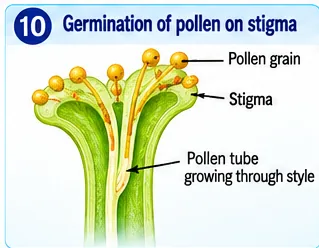
After pollination, a pollen grain grows a pollen tube down the style to the ovule, carrying the male gamete, which fuses with the egg — fertilisation. The zygote forms the embryo; the ovule becomes the seed and the ovary becomes the fruit; petals and sepals usually wither. Seeds germinate into new plants under suitable conditions.
5. Reproduction in Humans
Humans become capable of reproduction after puberty. The reproductive organs are:
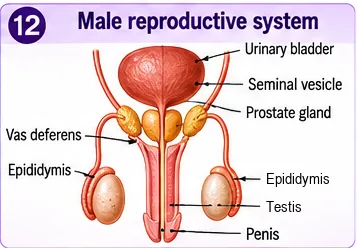
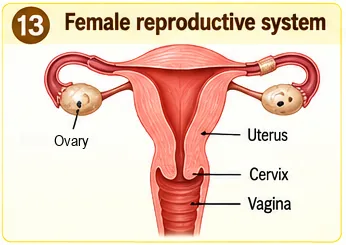
| Male organ | Function | Female organ | Function |
|---|---|---|---|
| Testes (in scrotum) | Make sperms and testosterone | Ovaries | Release eggs (ova) and make oestrogen, progesterone |
| Epididymis, vas deferens | Store and carry sperms | Fallopian tubes (oviducts) | Carry the egg; site of fertilisation |
| Seminal vesicle, prostate | Add fluids to make semen | Uterus | Embryo develops here |
| Urethra, penis | Pass semen out | Cervix, vagina | Birth canal |
Testes lie outside the body in the scrotum because sperm formation needs a temperature slightly lower than body temperature. An ovary releases one egg roughly every 28 days.
Fertilisation and pregnancy
Fertilisation takes place in the fallopian tube: a sperm enters the egg, their nuclei fuse and a zygote forms. The zygote divides into an embryo, which reaches the uterus and gets implanted in its thick wall. The placenta, a disc-like tissue, supplies food and oxygen from the mother’s blood and removes wastes. Development inside the mother takes about 9 months (three trimesters), after which the baby is born.
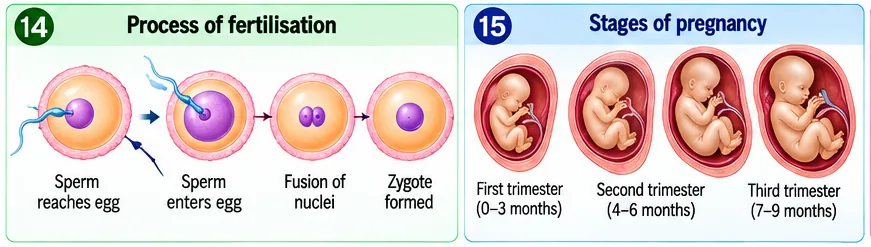
If the egg is not fertilised, the thickened lining of the uterus breaks down and comes out as menstruation (about every 28 days). Menstruation begins at puberty (menarche) and stops around 45–50 years (menopause).
6. Reproductive Health
Reproductive health means physical, mental and social well-being in all matters of reproduction. It includes awareness, hygiene, safe practices and responsible family planning. Some infections spread through sexual contact — sexually transmitted diseases (STDs), e.g. gonorrhoea, syphilis (bacterial) and HIV-AIDS (viral).
Contraceptive methods help in planning families and spacing children:
- Barrier methods — condoms (also protect against STDs).
- Hormonal methods — oral pills that prevent release of eggs (under medical advice).
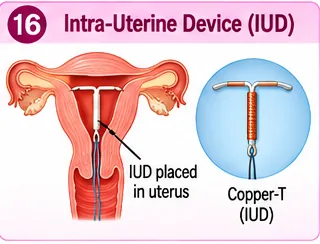
- Intra-uterine devices (IUD) such as the Copper-T, placed in the uterus by a doctor.
- Surgical methods — vasectomy (men), tubectomy (women).
Determining the sex of an unborn child for the purpose of sex-selective abortion is illegal in India (PCPNDT Act). Every girl child has an equal right to life. Early marriage and early pregnancy harm health.
7. Development and Metamorphosis in Insects
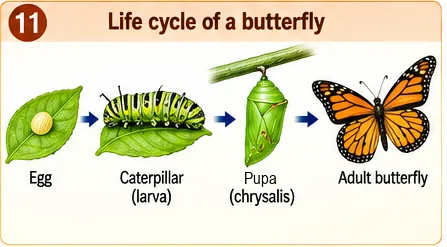
In many insects the young look very different from the adults and pass through stages — metamorphosis. A butterfly’s life cycle: egg → larva (caterpillar) → pupa (chrysalis) → adult. The caterpillar eats and grows; inside the pupa the body is reorganised into a winged adult.
8. Master Table: Key Terms
| Term | Meaning |
|---|---|
| Fission | Division of a parent cell into two (binary) or many (multiple) |
| Budding | New individual grows from an outgrowth (Hydra, yeast) |
| Vegetative propagation | New plants from roots, stems or leaves |
| Grafting | Joining scion to stock |
| Tissue culture | Growing plants from cells in a sterile nutrient medium |
| Pollination | Transfer of pollen from anther to stigma |
| Fertilisation | Fusion of male and female gametes → zygote |
| Placenta | Link between mother and embryo for food, oxygen, wastes |
| Metamorphosis | Change from larva to adult through stages |
9. Master Summary Table
| Feature | Asexual | Sexual |
|---|---|---|
| Parents | One | Two (usually) |
| Gametes | Not formed | Formed by meiosis |
| Fertilisation | Absent | Present |
| Offspring | Identical (clones) | Show variation |
| Speed | Fast | Slower |
| Examples | Amoeba, Hydra, potato | Flowering plants, humans |
10. Mind Map
- Fission, budding
- Spores, fragmentation, regeneration
- Tuber, rhizome, leaf buds
- Cutting, layering, grafting, tissue culture
- Stamen, pistil
- Pollination → fertilisation → seed, fruit
- Testes, ovaries
- Pregnancy, reproductive health
11. Tips and Tricks
- After fertilisation: “Ovule → seed, Ovary → fruit”.
- Grafting: “Scion on Stock” — the scion gives the fruit quality, the stock gives roots.
- Fertilisation in humans occurs in the fallopian tube, implantation in the uterus.
- Saying pollination and fertilisation are the same — pollination is transfer, fertilisation is fusion.
- Calling potato a root — it is a stem tuber.
- Saying the placenta passes the mother’s blood directly to the foetus — it allows exchange of materials.
12. Important One-liners
- Amoeba reproduces by binary fission; Plasmodium by multiple fission.
- Hydra and yeast reproduce by budding.
- Rhizopus (bread mould) reproduces by spores.
- Bryophyllum produces plantlets on leaf margins.
- Tissue culture produces many identical plants quickly.
- The stamen is the male part and the pistil the female part of a flower.
- The ovary develops into the fruit after fertilisation.
- Human fertilisation occurs in the fallopian tube.
- The placenta supplies nutrients and oxygen to the embryo.
- Copper-T is an intra-uterine contraceptive device.
13. Exam-pattern Questions with Detailed Answers
Hydra reproduces asexually by:
- Binary fission
- Budding
- Spore formation
- Fragmentation
Show answer
A bud grows on Hydra’s body and detaches. (Hydra can also regenerate.)
Answer: (B) Budding
Which part of a flower develops into a fruit?
Show answer
The ovary develops into the fruit; ovules become seeds.
Answer: Ovary
Where does fertilisation take place in human females?
Show answer
In the fallopian tube (oviduct).
Answer: Fallopian tube
Assertion (A): Offspring formed by asexual reproduction are very similar to the parent. Reason (R): They are produced from a single parent without fusion of gametes.
- Both true; R explains A
- Both true; R does not explain A
- A true, R false
- A false, R true
Show answer
With one parent and no mixing of genetic material, offspring are near-identical copies.
Answer: (A)
Give two advantages of vegetative propagation.
Show answer
Plants grow faster and bear flowers/fruits earlier; plants without viable seeds (banana, rose) can be grown; all offspring keep the parent’s desirable features.
Answer: Faster; seedless plants; identical quality
Distinguish between self-pollination and cross-pollination.
Show answer
Self: pollen reaches the stigma of the same flower or same plant; less variation. Cross: pollen reaches a flower on a different plant of the same kind, via insects, wind, water or birds; more variation.
Answer: Same plant vs different plants
What is the role of the placenta?
Show answer
It connects the embryo to the uterine wall; nutrients and oxygen pass from the mother’s blood to the embryo, and wastes pass back for removal.
Answer: Exchange of food, oxygen and wastes
Why are testes located outside the abdominal cavity?
Show answer
Sperm formation requires a temperature about 2–3 °C lower than normal body temperature; the scrotum keeps the testes cooler.
Answer: Lower temperature needed for sperm formation
Explain how tissue culture is used to produce thousands of banana plants. Why is it preferred?
Show answer
A small piece of tissue (explant) from the shoot tip is placed on a sterile nutrient medium with hormones. Cells divide to form a callus, which is shifted to media that make it form shoots and roots. Plantlets are hardened and planted. It is preferred because it gives a large number of disease-free, identical plants in a short time, independent of season, for a plant that does not produce seeds.
Answer: Explant → callus → plantlets; fast, disease-free, identical
Case-based: A farmer wants mangoes with the sweetness of variety A on hardy, disease-resistant trees of variety B. (a) Which method should he use? (b) Which variety is the scion and which the stock? (c) Will the fruits be like A or B?
Show answer
(a) Grafting. (b) Scion = variety A (sweet); stock = variety B (hardy roots). (c) Fruits will be like A, since the fruit-bearing shoots come from the scion.
Answer: Grafting; scion A, stock B; fruits like A
Why is variation important, and which mode of reproduction produces more variation?
Show answer
Variation means individuals differ slightly. When the environment changes (new disease, heat), some variants may survive, so the species does not die out. Sexual reproduction produces more variation because gametes from two parents combine new sets of genes.
Answer: Helps species survive change; sexual reproduction
Trace the journey from pollination to the formation of a seed in a flowering plant.
Show answer
Pollen from an anther lands on the stigma (pollination). It germinates and grows a pollen tube down the style into the ovary to an ovule. The male gamete fuses with the egg cell (fertilisation), forming a zygote that develops into an embryo. The ovule becomes the seed; the ovary becomes the fruit.
Answer: Pollination → pollen tube → fertilisation → seed and fruit
14. Quick Revision Summary
- Asexual: one parent, identical offspring — fission, budding, fragmentation, regeneration, spores, vegetative propagation.
- Artificial propagation: cutting, layering, grafting, tissue culture.
- Flowers: stamen (anther, filament) and pistil (stigma, style, ovary); pollination (self/cross) → fertilisation → seed and fruit.
- Humans: testes and ovaries make gametes; fertilisation in fallopian tube; implantation in uterus; placenta; ~9 months.
- Reproductive health: hygiene, STD prevention, contraception (condoms, pills, Copper-T, surgery); metamorphosis: egg → larva → pupa → adult.