
1. Chapter at a Glance
A single cell divides again and again to form a whole plant or animal with trillions of cells. But these cells are not all alike — some carry water, some carry messages, some contract, some protect. A group of similar cells that work together to perform a particular function is called a tissue. This chapter compares plant and animal tissues, explains the tissues that help plants grow, describes the four types of animal tissue, and shows how bones, muscles and joints work together in the musculoskeletal system.
- Why plant and animal tissues differ.
- Plant tissues: meristematic and permanent (simple and complex).
- Animal tissues: epithelial, connective, muscular and nervous.
- The musculoskeletal system: bones, muscles, tendons and ligaments.
- Types of joints and their movements.
2. Why Are Plant and Animal Tissues Different?
| Feature | Plants | Animals |
|---|---|---|
| Movement | Stationary; need strong supporting tissues | Move to find food and shelter; need muscles and nerves |
| Tissues | Many dead supportive tissues (e.g. sclerenchyma, xylem) | Mostly living tissues |
| Growth | Continues throughout life in certain regions (meristems) | Growth is uniform and stops at a certain age |
| Energy need | Lower | Higher (active movement) |
3. Plant Tissues
(a) Meristematic tissue — tissues for growth
Meristematic cells are actively dividing cells with thin walls, dense cytoplasm, a prominent nucleus and no vacuoles.
- Apical meristem — at the tips of roots and shoots; increases length.
- Lateral meristem (cambium) — on the sides; increases girth (thickness) of stems and roots.
- Intercalary meristem — at the base of leaves or internodes (as in grasses); helps regrowth.
(b) Permanent tissues
Cells formed by meristems take up specific roles and stop dividing — differentiation — forming permanent tissues.
| Tissue | Features | Function / location |
|---|---|---|
| Parenchyma | Living, thin-walled, loosely packed with air spaces | Storage, food making (chlorenchyma with chloroplasts), buoyancy in aquatic plants (aerenchyma) |
| Collenchyma | Living, elongated, walls thickened at corners | Flexibility and support in leaf stalks and young stems |
| Sclerenchyma | Dead, long, narrow, thick walls with lignin | Strength and hardness — husk of coconut, seed coats, fibres of jute |
| Epidermis | Single outer layer, often with waxy cuticle; stomata with guard cells | Protection; reduces water loss; gas exchange |
| Cork | Dead, compact cells with suberin | Protective outer bark of old stems |
| Xylem (complex) | Tracheids, vessels, xylem parenchyma and fibres | Carries water and minerals upward |
| Phloem (complex) | Sieve tubes, companion cells, phloem parenchyma and fibres | Carries food in all directions |
Xylem and phloem are called complex tissues because they are made of more than one type of cell working together, forming vascular bundles.
4. Animal Tissues
(a) Epithelial tissue — covering and lining
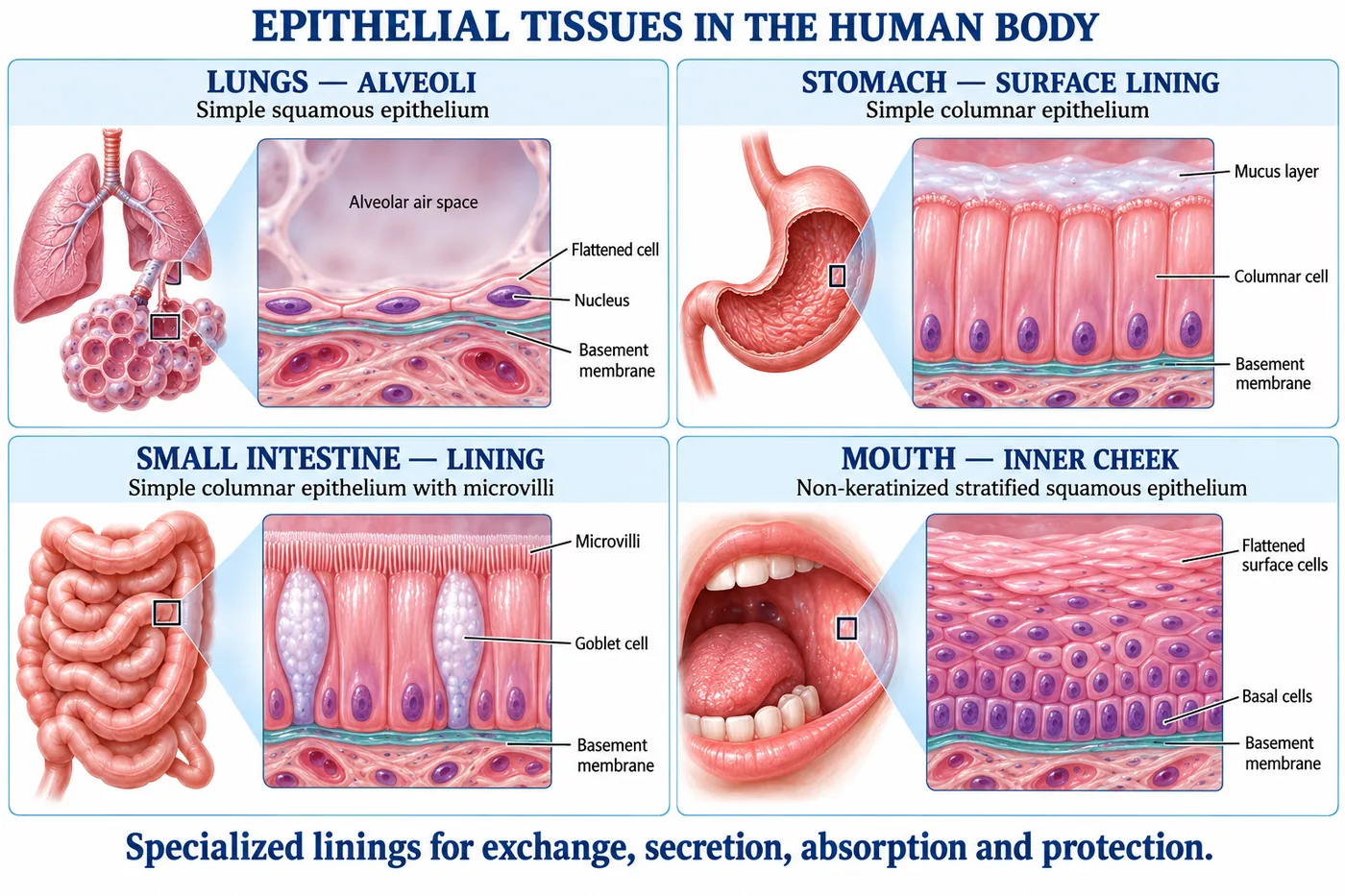
Cells are tightly packed in sheets with almost no intercellular space, resting on a basement membrane. They cover the body and line organs, protecting them and controlling exchange of materials.
| Type | Shape | Location | Function |
|---|---|---|---|
| Squamous (simple) | Thin, flat | Alveoli of lungs, blood vessels | Diffusion of gases |
| Stratified squamous | Many layers | Skin, inner cheek | Protection from wear and tear |
| Cuboidal | Cube-shaped | Kidney tubules, glands | Absorption, secretion |
| Columnar | Tall pillar-like (may have microvilli or cilia) | Stomach, intestine; respiratory tract (ciliated) | Absorption, secretion; cilia move mucus |
| Glandular | Folded epithelium | Sweat, salivary glands | Secretion |
(b) Connective tissue — binding, support and transport
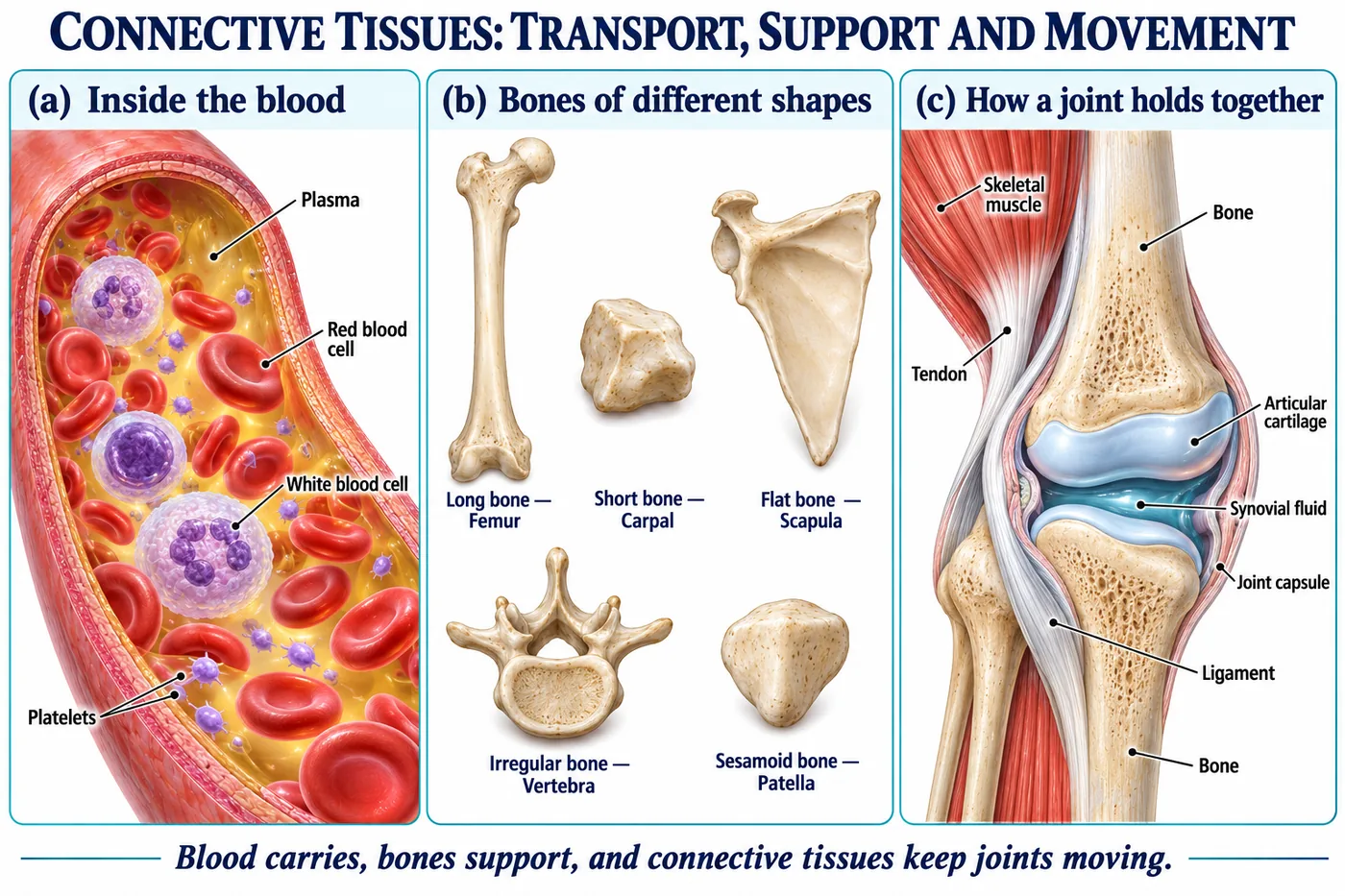
Cells are loosely spaced in an intercellular matrix, which may be liquid, jelly-like or hard.
- Blood — fluid matrix (plasma) with red blood cells (carry oxygen), white blood cells (fight infection) and platelets (clotting).
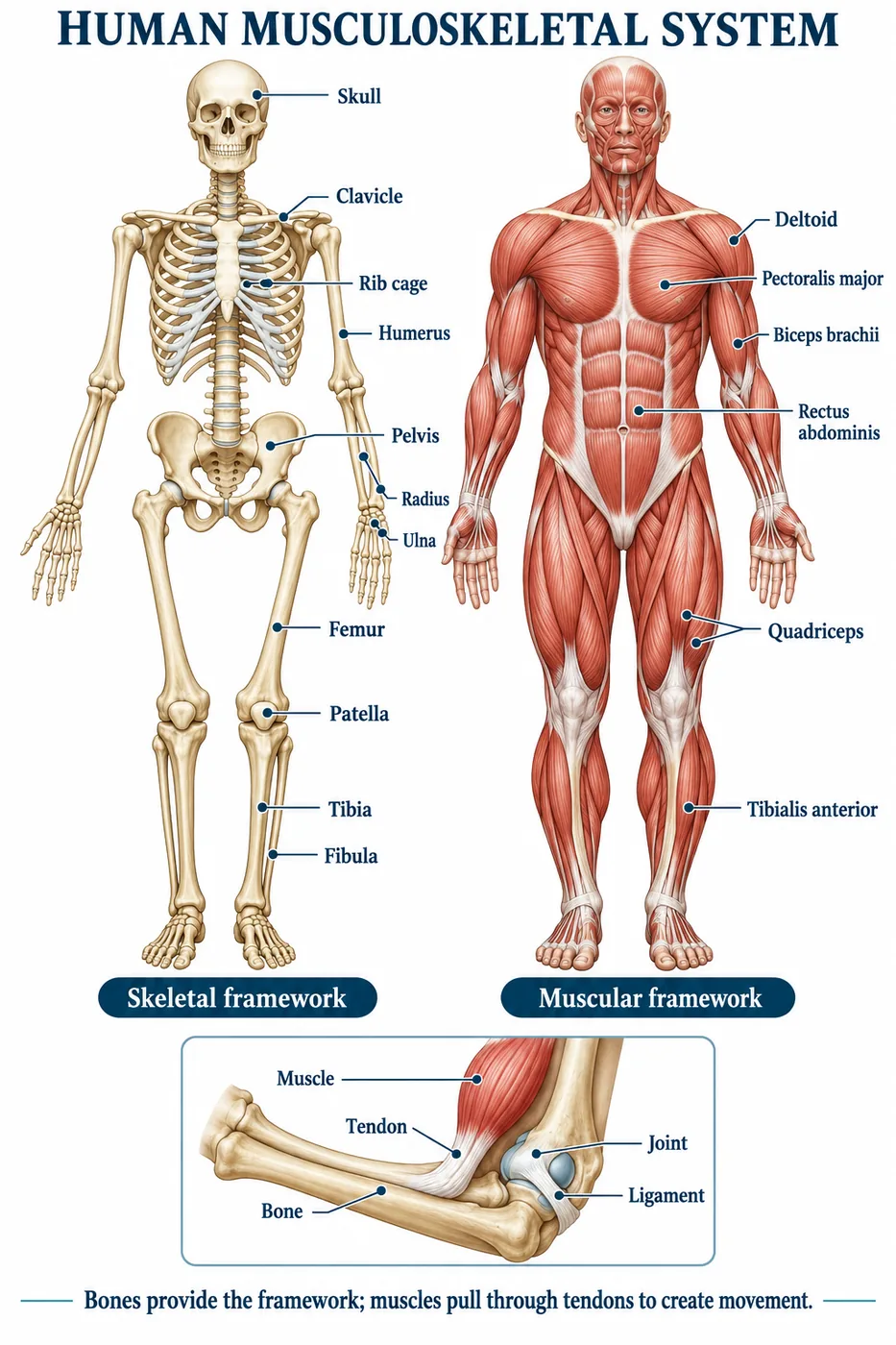
- Bone — hard matrix of calcium and phosphorus compounds; forms the skeleton, supports and protects.
- Cartilage — flexible; found at joint surfaces, nose tip, ear, rings of trachea.
- Ligament — connects bone to bone; elastic and strong.
- Tendon — connects muscle to bone; strong, less flexible.
- Areolar tissue — fills space between skin and muscles, around organs; supports and repairs.
- Adipose tissue — stores fat below the skin; insulates and cushions.
(c) Muscular tissue — movement
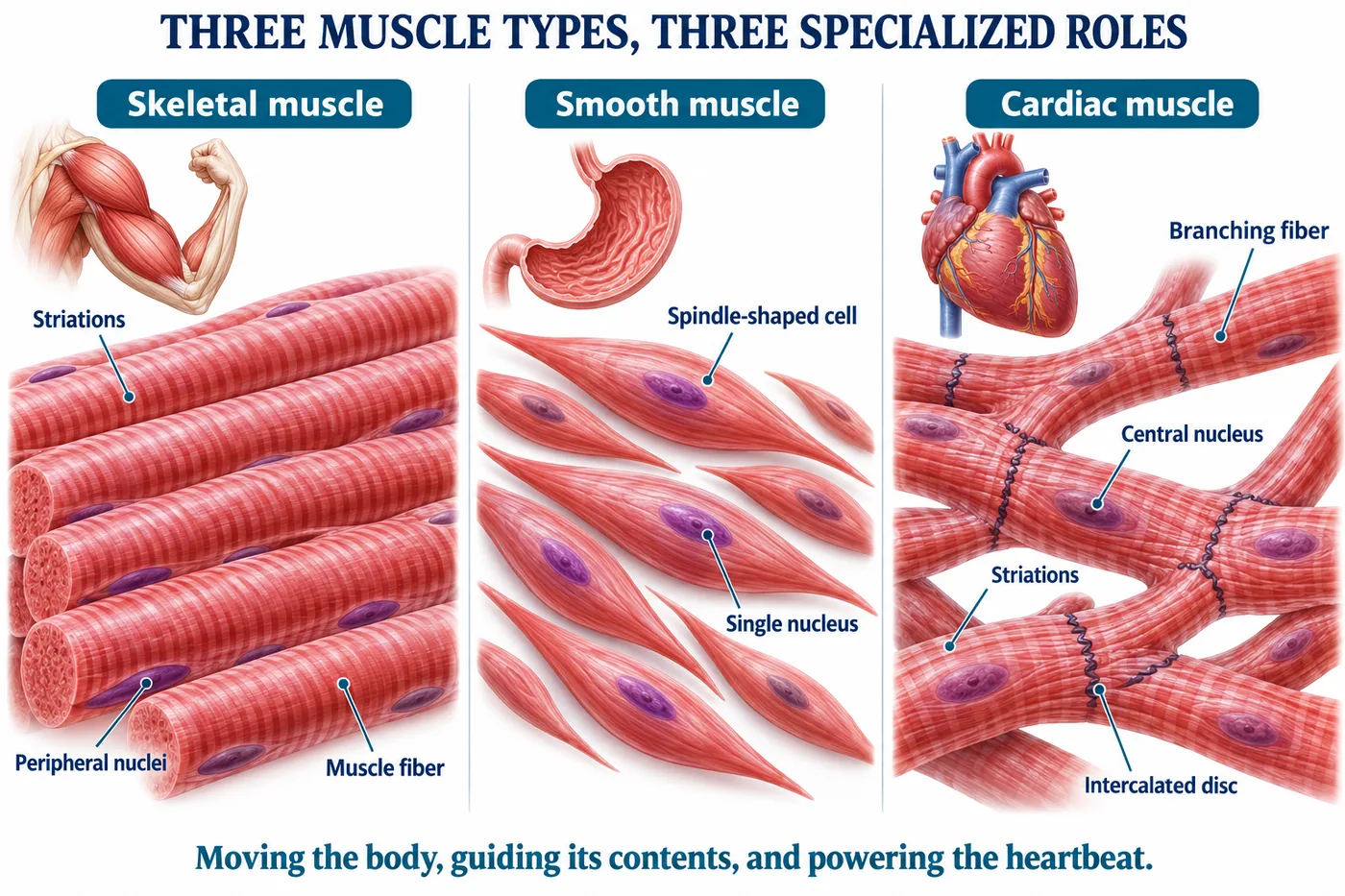
Muscle cells (fibres) contain special proteins that make them contract and relax.
| Feature | Skeletal (striated) | Smooth (unstriated) | Cardiac |
|---|---|---|---|
| Shape | Long, cylindrical, unbranched | Spindle-shaped | Cylindrical, branched |
| Nuclei | Many, at the edge | One, central | One (or two), central |
| Stripes | Present | Absent | Present, with intercalated discs |
| Control | Voluntary | Involuntary | Involuntary |
| Location | Attached to bones (limbs) | Stomach, intestine, blood vessels, iris | Heart |
| Fatigue | Tire easily | Slowly | Never tire (rhythmic throughout life) |
(d) Nervous tissue — communication
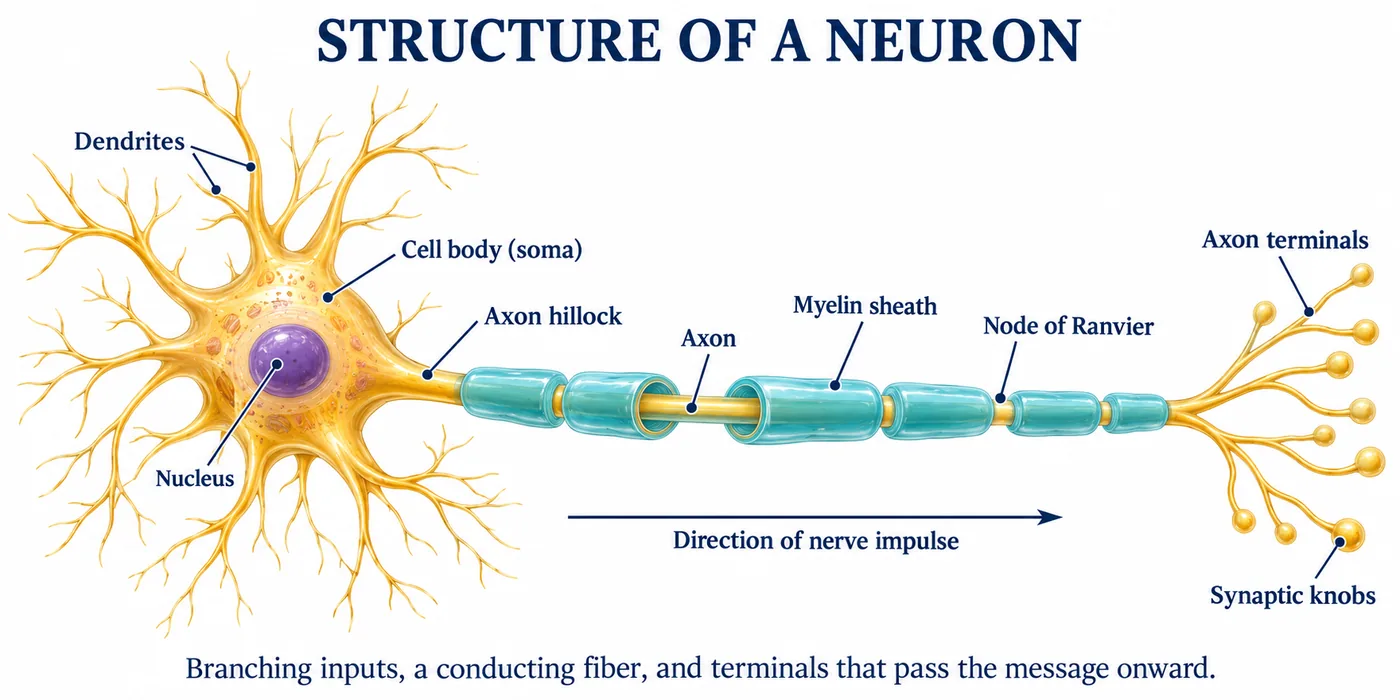
The nervous tissue of the brain, spinal cord and nerves is made of neurons. A neuron has a cell body with a nucleus, short branched dendrites that receive messages, and a long axon (often covered by a myelin sheath) that carries the impulse to axon terminals. A single neuron can be up to a metre long.
5. The Musculoskeletal System
Bones form a framework (the human adult skeleton has 206 bones); skeletal muscles attached by tendons pull on bones; ligaments hold bones together at joints; cartilage cushions joint surfaces. Muscles can only pull, not push, so they work in antagonistic pairs — when the biceps contracts the arm bends, and when the triceps contracts it straightens.
6. Types of Joints
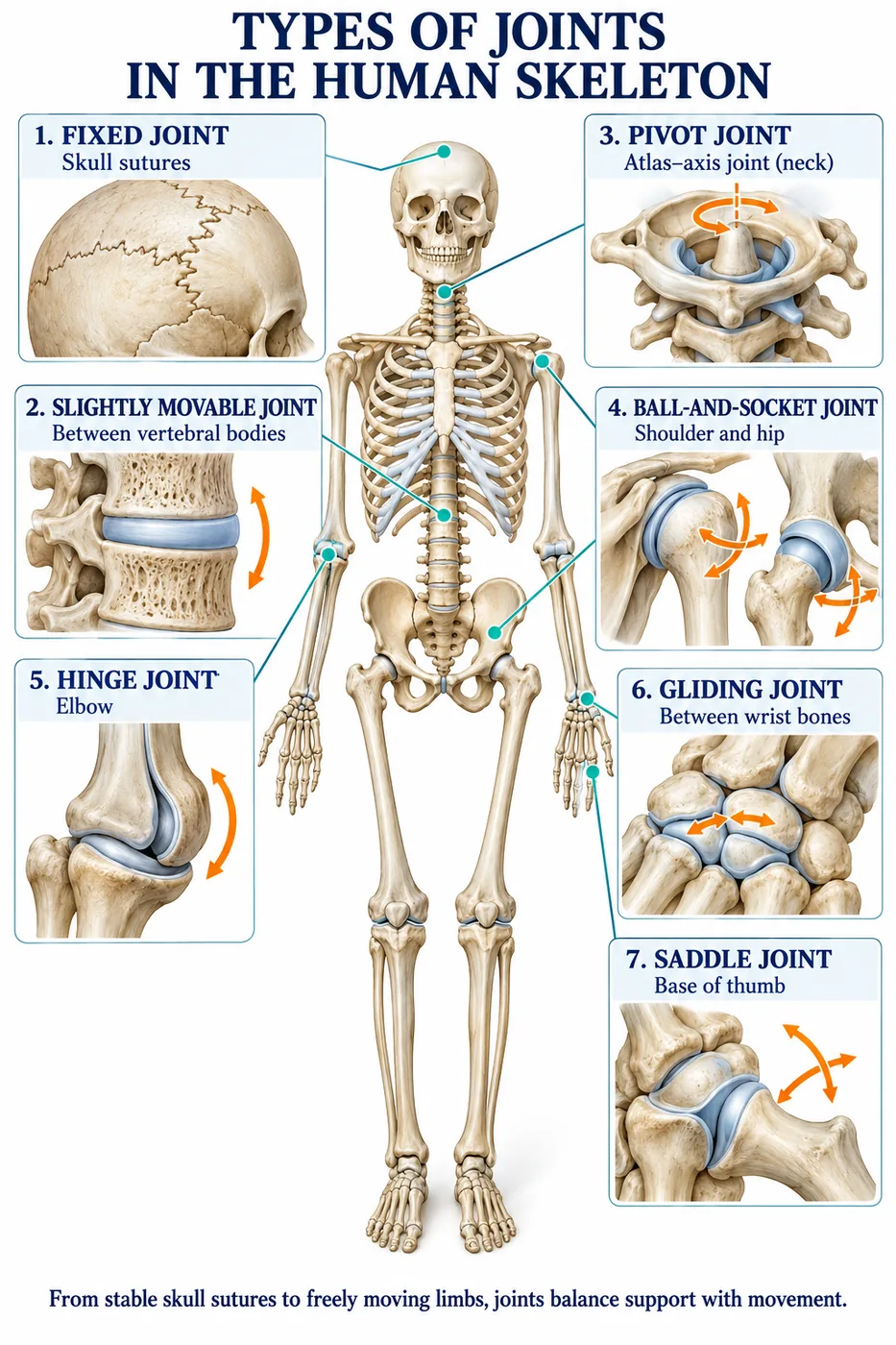
A joint is the place where two or more bones meet.
| Joint | Movement | Example |
|---|---|---|
| Fixed (immovable) | None | Sutures of the skull |
| Slightly movable | Little | Between vertebrae |
| Ball-and-socket | All directions; rotation | Shoulder, hip |
| Hinge | One plane, like a door | Elbow, knee |
| Pivot | Rotation around an axis | Neck (skull on atlas–axis) |
| Gliding | Sliding | Wrist and ankle bones |
| Saddle | Two planes | Base of the thumb |
Freely movable (synovial) joints have a capsule filled with synovial fluid that lubricates them, and cartilage that reduces friction.
7. Master Table: Key Terms
| Term | Meaning |
|---|---|
| Tissue | Group of similar cells performing a common function |
| Meristem | Dividing tissue; apical, lateral, intercalary |
| Differentiation | Cells taking up permanent shape and function |
| Simple / complex permanent tissue | One cell type / several cell types (xylem, phloem) |
| Basement membrane | Thin layer under epithelial cells |
| Matrix | Intercellular material of connective tissue |
| Tendon / Ligament | Muscle-to-bone / bone-to-bone |
| Neuron | Nerve cell: dendrites, cell body, axon |
| Synovial fluid | Lubricating fluid in movable joints |
8. Master Summary Table
| Animal tissue | Main function | Example |
|---|---|---|
| Epithelial | Covering, protection, exchange | Skin, alveoli lining |
| Connective | Support, binding, transport | Bone, blood, tendon |
| Muscular | Movement | Biceps, heart, stomach wall |
| Nervous | Receiving and conducting messages | Brain, nerves |
Chart — share of the human skeleton’s 206 bones by region (approximate):
Other bones: limbs, girdles, ear ossicles and hyoid make up the rest of the 206.
9. Mind Map
- Meristematic: apical, lateral, intercalary
- Permanent: simple, complex
- Epithelial, connective
- Muscular, nervous
- Skeletal, smooth, cardiac
- Antagonistic pairs
- Fixed, slightly movable
- Ball-socket, hinge, pivot, gliding, saddle
10. Tips and Tricks
- “Tendon Ties muscle”; “Ligament Links bones”.
- Plant tissues: “P-C-S” = Parenchyma (soft, storage), Collenchyma (corners, flexible), Sclerenchyma (strong, dead).
- Muscle control: only skeletal is voluntary.
- Calling sclerenchyma living — it is dead at maturity.
- Saying the knee is a ball-and-socket joint — it is a hinge joint.
- Saying muscles push bones — they only pull.
11. Important One-liners
- A tissue is a group of similar cells with a common function.
- Apical meristem increases length; lateral meristem increases girth.
- Sclerenchyma gives strength; its walls contain lignin.
- Xylem carries water; phloem carries food.
- Squamous epithelium lines the alveoli.
- Blood is a fluid connective tissue.
- Cardiac muscle never tires and shows intercalated discs.
- A neuron conducts impulses from dendrites to axon terminals.
- The adult human skeleton has 206 bones.
- The shoulder is a ball-and-socket joint; the elbow is a hinge joint.
12. Exam-pattern Questions with Detailed Answers
Which tissue connects muscle to bone?
- Ligament
- Tendon
- Cartilage
- Areolar tissue
Show answer
Tendons join muscles to bones; ligaments join bones to bones; cartilage cushions joints.
Answer: (B) Tendon
Name the meristem responsible for increase in girth of a stem.
Show answer
Lateral meristem (cambium).
Answer: Lateral meristem
Which type of muscle is found in the heart?
Show answer
Cardiac muscle — branched, striated, involuntary.
Answer: Cardiac muscle
Assertion (A): Squamous epithelium lines the alveoli of lungs. Reason (R): Thin, flat cells allow easy diffusion of gases.
- Both true; R explains A
- Both true; R does not explain A
- A true, R false
- A false, R true
Show answer
Thin flat cells provide a short path for oxygen and carbon dioxide to diffuse — exactly why they line alveoli.
Answer: (A)
Differentiate between parenchyma, collenchyma and sclerenchyma.
Show answer
Parenchyma: living, thin walls, intercellular spaces — storage and food making. Collenchyma: living, walls thickened at corners — flexible support. Sclerenchyma: dead, thick lignified walls — rigidity and strength.
Answer: Living/thin, living/corner-thickened, dead/lignified
Why is blood called a connective tissue?
Show answer
Like other connective tissues, its cells (RBCs, WBCs, platelets) are spread in a matrix — liquid plasma — and it connects different parts of the body by transporting materials.
Answer: Cells in a fluid matrix; links body parts by transport
Describe the structure of a neuron with a labelled description.
Show answer
Cell body (with nucleus and cytoplasm); dendrites — short branched extensions receiving impulses; axon — long fibre carrying impulses away, often covered by myelin sheath with nodes of Ranvier; axon terminals pass the impulse to the next cell.
Answer: Dendrites → cell body → axon → terminals
Why do grasses regrow quickly after being grazed?
Show answer
Grasses have intercalary meristem at the base of leaves and internodes. When the upper part is eaten, these dividing cells continue growth.
Answer: Intercalary meristem at the base
Explain why plants have more dead tissues than animals.
Show answer
Plants are stationary and must stand upright against wind and gravity for years. Dead tissues like sclerenchyma and xylem give strength and conduct water without needing energy for maintenance. Animals move actively and need living tissues (muscles, nerves) that use energy.
Answer: Support with low energy cost for stationary life
Case-based: A footballer twists his ankle and tears a tissue connecting two bones; another player injures the tissue joining calf muscle to the heel bone. (a) Name both tissues. (b) Which property makes each suited to its job?
Show answer
(a) Ligament (bone to bone); tendon (muscle to bone — the Achilles tendon). (b) Ligaments are strong and elastic, allowing limited movement at joints; tendons are very strong and less elastic, transmitting the pull of muscles to bones.
Answer: Ligament — elastic strength; tendon — tough, non-stretchy
Compare skeletal, smooth and cardiac muscles under any four headings.
Show answer
Shape: cylindrical / spindle / branched cylindrical. Nuclei: many peripheral / one central / one central. Striations: present / absent / present. Control: voluntary / involuntary / involuntary. Location: limbs / gut, vessels / heart.
Answer: See comparison above
Why are muscles said to work in antagonistic pairs? Explain with the arm.
Show answer
A muscle can only contract (pull); it cannot push. To bend the arm, the biceps contracts while the triceps relaxes; to straighten it, the triceps contracts while the biceps relaxes. Two muscles with opposite actions are needed for movement in both directions.
Answer: Muscles only pull; opposite pairs move a joint both ways
13. Quick Revision Summary
- Tissue = similar cells with a common function; plant and animal tissues differ due to lifestyle.
- Plants: meristems (apical, lateral, intercalary) and permanent tissues — parenchyma, collenchyma, sclerenchyma, epidermis, cork, xylem, phloem.
- Animals: epithelial (cover), connective (blood, bone, cartilage, ligament, tendon, areolar, adipose), muscular (skeletal, smooth, cardiac), nervous (neurons).
- Musculoskeletal system: 206 bones, muscles in antagonistic pairs, tendons and ligaments.
- Joints: fixed, slightly movable, ball-and-socket, hinge, pivot, gliding, saddle; synovial fluid lubricates.