
1. Chapter at a Glance
Regular, free and fair elections lie at the heart of democracy. Through our vote we choose representatives and hold them accountable; a government cannot simply extend its own term, and an election with only one party offers no real choice. This chapter explains direct and indirect elections, electoral systems (FPTP, majority, proportional representation, STV), the laws and institutions that run India's elections — especially the Election Commission of India (ECI) — the role of political parties, and the challenges to free and fair elections.
- Why are elections essential to democracy?
- How do electoral systems shape representation and fairness?
- Which institutions and laws ensure free and fair elections?
- What challenges do elections face?
2. Why Elections Matter
| Type | Meaning | Used for (India) |
|---|---|---|
| Direct election | Citizens vote directly for representatives | Lok Sabha, Vidhan Sabhas, panchayats and municipalities — every five years |
| Indirect election | Elected representatives choose the office-holder | President, Vice-President, Rajya Sabha (and most members of Vidhan Parishads) |
Elections ensure equality (one person, one vote), representation, accountability (representatives must seek a fresh mandate) and legitimacy (a government chosen by the people has the right to govern). Psephology — the scientific study of elections — comes from the Greek psēphos, "pebble", because ancient Greeks voted with pebbles.
3. Electoral Systems
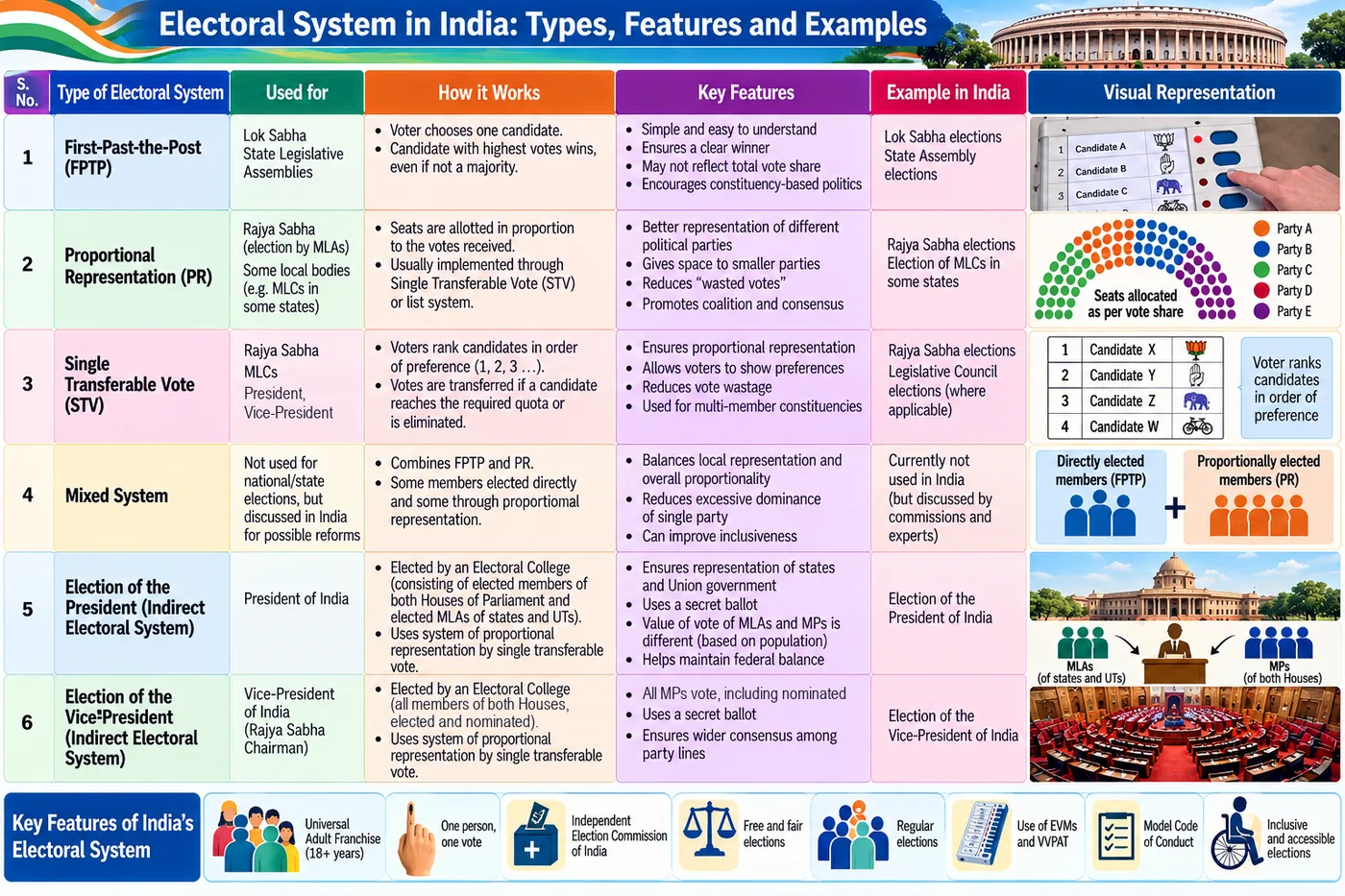
An electoral system converts votes into seats. The framers of our Constitution chose First-Past-the-Post (FPTP), the plurality system, for the Lok Sabha and Vidhan Sabhas.
| System | How it works | Illustrative result (imaginary countries, as in the textbook) |
|---|---|---|
| FPTP / plurality | One candidate per constituency; whoever gets the most votes wins, even under 50% | Party A 40%, B 35%, C 25% — Party A forms the government |
| Majority (two-round) | A winner needs over 50%; if no one gets it, the top two face a second round | X 45%, Y 40%, Z 15% — no majority; Y wins round 2 with 55% |
| Proportional Representation | People vote for parties; seats are shared in proportion to votes | M 40%, N 35%, O 15%, P 10% of votes → 40, 35, 15, 10 of 100 seats |
Single Transferable Vote (STV)
A form of PR used in India for the Rajya Sabha, Vidhan Parishads, President and Vice-President.
- Voters rank candidates in order of preference (1, 2, 3…).
- First preferences are counted; anyone reaching the quota is elected.
- The lowest candidate is eliminated and their votes pass to the next preference (surplus votes of winners can also be transferred).
- This continues until all seats are filled.
Quota = [Total valid votes ÷ (Seats to be filled + 1)] + 1 (ignoring fractions). Example: 1,000 valid votes for 4 seats → 1,000 ÷ 5 = 200, + 1 = 201 votes needed to win.
Six States have a bicameral legislature — Andhra Pradesh, Bihar, Karnataka, Maharashtra, Telangana and Uttar Pradesh. Their Vidhan Parishad (Legislative Council) members are elected by MLAs, local bodies, graduates and teachers, with some nominated by the Governor for art, science, literature, social service and co-operatives — through PR by STV.
| Office | Electoral college |
|---|---|
| President | Elected members of both Houses of Parliament + elected members of State Assemblies (and of Delhi and Puducherry); vote values differ by population |
| Vice-President | All members of both Houses of Parliament, elected and nominated |
| Rajya Sabha | Elected MLAs of each State (and some UTs) |
4. The Laws
| Law | Deals with |
|---|---|
| Representation of the People Act, 1950 | Allocation of seats, delimitation, preparing and revising electoral rolls, right of every adult citizen to be enrolled |
| Representation of the People Act, 1951 | Conduct of elections: nominations, campaigns, voting, disputes; lists corrupt practices and electoral offences |
| Presidential and Vice-Presidential Elections Act, 1952 | Elections to these two offices |
Corrupt practices include bribing anyone to contest, withdraw or vote; appealing for votes on the basis of religion, caste, race, community or language; and taking help from government officials such as gazetted officers, judges, magistrates, police or armed forces personnel.
Delimitation
Delimitation fixes the number and boundaries of Lok Sabha and Assembly constituencies so that each represents roughly the same population — otherwise one MP might represent five lakh people and another twenty-five lakh. Article 82 provides for a Delimitation Commission; India has had four — in 1952, 1963, 1973 and 2002. The long gap after 1973 was because seat numbers were frozen by constitutional amendment (to encourage population control), which also kept the number of seats per State unchanged.
5. The Election Commission of India
The ECI is an autonomous, permanent constitutional body set up on 25 January 1950 (celebrated as National Voters' Day). Articles 324–329 give it superintendence, direction and control of elections to Parliament, State Legislatures and the offices of President and Vice-President. (Panchayat and municipal elections are run by State Election Commissions.) At State level a Chief Electoral Officer supervises, with District Election Officers, Returning Officers and Electoral Registration Officers drawn from State officials.
| Function | What the ECI does |
|---|---|
| Electoral rolls | Enumerators visit homes; rolls prepared polling-station-wise; Special Intensive Revision (SIR) adds new voters (especially those just turned 18) and removes dead, shifted, duplicate or untraceable entries after hearing claims and objections |
| Schedule | Fixes poll dates considering weather, farming season, exams and festivals |
| Parties and symbols | Registers parties, recognises national/State parties, allots symbols, insists on inner-party elections, settles symbol disputes (quasi-judicial role) |
| Free and fair polls | Enforces the Model Code of Conduct, uses EVMs and VVPATs, monitors spending and security |
| Inclusion | Braille EVMs, ramps, wheelchairs, volunteers; home voting for those above 85 and persons with 40% benchmark disability (all-India for the first time in the 2024 general election) |
| Digital tool | Use |
|---|---|
| Voter Helpline App | Registration, corrections, election information |
| cVIGIL | Citizens report Model Code violations; flying squads reach the spot using location |
| ETPBS | Service voters receive and cast postal ballots electronically from outside their constituency |
| Saksham | Services for persons with disabilities |
| Suvidha | Candidates' nominations and permissions for rallies, vehicles, loudspeakers |
| ERONET / Sugam | Processing electoral-roll forms / managing vehicles for poll duty |
Through its International Election Visitors' Programme, the ECI cooperates with other countries' election bodies and international organisations such as IFES, International IDEA and the United Nations.
6. Political Parties
Parties organise public opinion, set the election agenda through manifestos, give voters meaningful choices, contest elections, form governments or act as the opposition, and take part in debates and committees. Independent candidates may also contest.
| Recognition | Criteria (any one) |
|---|---|
| State party | 6% of valid votes in an Assembly election + 2 Assembly seats; or 6% in the Lok Sabha election from the State + 1 Lok Sabha seat; or 3% of Assembly seats (minimum 3); or 1 Lok Sabha seat for every 25 seats of the State; or 8% of valid votes in the State in a Lok Sabha or Assembly election |
| National party | 6% of valid votes in 4 or more States + 4 Lok Sabha seats; or 2% of Lok Sabha seats from at least 3 States; or recognition as a State party in 4 States |
| Registered unrecognised | Registered but not meeting the above, or never contested since registration |
Changing parties after being elected on a party's ticket is defection. The 52nd Amendment (1985) added the Tenth Schedule: a member who voluntarily gives up party membership or votes against the party whip can be disqualified; the Speaker or Chairman decides. It aims at stable governments.
Coalition politics grew from 1967 in the States; in 1977, after the Emergency, the Janata Party formed the first non-Congress government at the Centre. Since the late 1990s major alliances have contested national elections.
7. Challenges to Free and Fair Elections
- Misinformation and fake news, especially online.
- Money power and muscle power; intimidation of voters.
- Appeals to caste or religion; violations of the Model Code.
- Low turnout among some groups; keeping rolls accurate for over 96.8 crore voters.
The ECI responds through the RP Acts, the Model Code of Conduct, EVMs with VVPAT paper slips, awareness drives (SVEEP) and vigilance apps. Proposals such as "One Nation, One Election" (holding Lok Sabha and Assembly polls together) are being debated for their benefits (less cost, less disruption) and limitations (federal concerns, logistics).
8. Master Table: Key Terms
| Term | Meaning |
|---|---|
| Constituency | Area electing one (or more) representatives |
| FPTP | Most votes wins, even without a majority |
| Proportional Representation | Seats shared in proportion to votes |
| STV | Ranked preferences transferred until seats fill |
| Quota | [Valid votes ÷ (seats + 1)] + 1 |
| Delimitation | Fixing constituency numbers and boundaries |
| Electoral roll | Official list of eligible voters |
| Model Code of Conduct | ECI guidelines for parties and candidates during polls |
| VVPAT | Paper slip confirming the EVM vote |
| Defection | Leaving the party on whose ticket one was elected |
| Psephology | Scientific study of elections |
9. Master Summary Table
| Body / election | Method |
|---|---|
| Lok Sabha, Vidhan Sabha | Direct, FPTP |
| Panchayats, municipalities | Direct, FPTP (State Election Commissions) |
| Rajya Sabha | Indirect, PR by STV (by MLAs) |
| Vidhan Parishad | Indirect/special constituencies, PR by STV + nominations |
| President | Indirect, PR by STV (elected MPs + MLAs) |
| Vice-President | Indirect, PR by STV (all MPs) |
Chart — Delimitation Commissions (year):
10. Mind Map
- Equality, representation
- Accountability, legitimacy
- FPTP, majority
- PR, STV
- RPA 1950, 1951
- Delimitation (Art. 82)
- Arts. 324–329
- Rolls, MCC, EVM-VVPAT
- National, State, RUPP
- Anti-defection 1985
11. Tips and Tricks
- RPA 1950 = Rolls and seats (preparation); RPA 1951 = Running the election (conduct and disputes).
- ECI birthday 25 January = National Voters' Day; Republic Day is the next day.
- Delimitation years: "52, 63, 73, 02" — the first three roughly a decade apart, then a long freeze.
- Nominated MPs vote for the Vice-President but not for the President.
- Panchayat and municipal elections are run by State Election Commissions, not the ECI.
- FPTP winners need the most votes, not necessarily over 50%.
12. Important One-liners
- The ECI was set up on 25 January 1950.
- Articles 324–329 deal with elections.
- Lok Sabha and Vidhan Sabha use FPTP.
- Rajya Sabha members are elected by MLAs using STV.
- Article 82 provides for delimitation.
- India has had four Delimitation Commissions.
- The anti-defection law came through the 52nd Amendment, 1985.
- Six States have Legislative Councils.
- cVIGIL lets citizens report Model Code violations.
- Home voting for those 85+ was extended nationwide in 2024.
- Psephology comes from the Greek word for pebble.
13. Exam-pattern Questions with Detailed Answers
Members of the Rajya Sabha are elected by:
- All citizens directly
- Members of the Lok Sabha
- Elected MLAs of the States
- The President
Show answer
Rajya Sabha members are elected indirectly by elected MLAs through PR by STV. Citizens elect the Lok Sabha directly; Lok Sabha members do not elect the Rajya Sabha; the President only nominates 12 members.
Answer: (C)
Which Act deals with the preparation of electoral rolls?
- RPA 1950
- RPA 1951
- Presidential Elections Act 1952
- Tenth Schedule
Show answer
RPA 1950 covers seats, delimitation and electoral rolls; RPA 1951 covers the conduct of elections and disputes; the 1952 Act covers Presidential and Vice-Presidential polls; the Tenth Schedule is anti-defection.
Answer: (A)
Distinguish between direct and indirect elections with examples.
Show answer
In direct elections citizens vote for representatives themselves — Lok Sabha, Vidhan Sabha, panchayats. In indirect elections elected representatives choose the office-holder — President, Vice-President, Rajya Sabha.
Answer: Voters choose directly vs through representatives
In an STV election, 2,400 valid votes are cast for 5 seats. What is the quota?
Show answer
Quota = [2,400 ÷ (5 + 1)] + 1 = 400 + 1 = 401 votes.
Answer: 401
Why is delimitation necessary?
Show answer
Populations grow and shift unevenly. Without redrawing boundaries, some MPs would represent far more people than others, so a vote in a big constituency would count for less. Delimitation keeps the population per seat roughly equal, ensuring equal representation.
Answer: To keep votes of equal value
What is SIR and why does the ECI conduct it?
Show answer
Special Intensive Revision is a house-to-house updating of electoral rolls. It adds eligible voters who were missed — especially those just turned 18 — and removes entries of the dead, shifted, duplicate or permanently untraceable, after inviting claims and objections. Accurate rolls mean no eligible voter is left out and no ineligible person votes.
Answer: To keep electoral rolls complete and accurate
Give three differences between national and State parties.
Show answer
(1) Spread: national parties have support in several States; State parties are strong in one or a few. (2) Recognition criteria differ (e.g., national: 6% votes in 4 States + 4 Lok Sabha seats, or State party in 4 States). (3) Focus: national parties address all-India issues; State parties often emphasise regional identity, language and local development. Both get reserved symbols.
Answer: Spread, criteria and focus differ
Compare FPTP and proportional representation. Why did India choose FPTP for the Lok Sabha?
Show answer
FPTP is simple, gives each constituency a clear local representative and usually produces stable governments, but seat shares may not match vote shares (40% votes can win a majority). PR matches seats to votes and helps small parties, but can fragment legislatures and weaken the voter–representative link. India chose FPTP for its simplicity for a vast, largely first-time electorate, local accountability and stability; PR (STV) is used where it suits, as in the Rajya Sabha and Presidential elections.
Answer: Simplicity, local link and stability
Ishani, a first-time voter, saw a wheelchair for her disabled brother, verified her identity with another document, saw a VVPAT slip, and her 89-year-old grandmother voted from home. Identify the ECI measures involved.
Show answer
Online voter registration; accessibility facilities (wheelchairs, volunteers) for persons with disabilities; acceptance of alternative photo identity documents listed by the ECI (such as a passport, driving licence or PAN card); VVPAT for verifying the vote; and home voting for those above 85. Police on duty can vote through postal ballots.
Answer: Registration, accessibility, alternative ID, VVPAT, home voting
Is the anti-defection law good for democracy? Discuss both sides.
Show answer
For: it stops opportunistic switching for money or office, respects the mandate voters gave to a party, and keeps governments stable. Against: it limits a legislator's freedom to vote by conscience, strengthens party leaders over members, and leaves decisions with the Speaker, who may be partisan. A balance between stability and free debate is needed.
Answer: Brings stability but restricts independent judgment
"Elections are the soul of democracy." Do you agree?
Show answer
Largely yes: elections give every citizen an equal voice, make governments legitimate and let people remove non-performing representatives. But they are meaningful only if free and fair — with accurate rolls, an independent ECI, real choice among parties, and no misuse of money, muscle or misinformation — and if democracy continues between elections through rights, courts, media and participation.
Answer: Yes, if free and fair — but democracy needs more than voting
14. Quick Revision Summary
- Direct (Lok Sabha, Vidhan Sabha, local bodies) vs indirect (President, VP, Rajya Sabha) elections.
- Systems: FPTP, majority (two-round), PR, STV; quota = [votes ÷ (seats + 1)] + 1.
- Laws: RPA 1950 (rolls, seats), RPA 1951 (conduct, corrupt practices); delimitation (Art. 82; 1952, 1963, 1973, 2002).
- ECI: 25 Jan 1950, Arts. 324–329; rolls and SIR, schedule, parties and symbols, MCC, EVM-VVPAT, apps, home voting.
- Parties: national, State, RUPP; anti-defection (52nd Amendment 1985); coalitions since 1967/1977.
- Challenges: fake news, money and muscle power; One Nation, One Election debate.