
1. Chapter at a Glance
Democracy is a form of government in which power and authority come from the citizens, who choose their representatives through free and fair elections. It rests on freedom, equality, justice, rights and duties. India — Bharat — is the world's largest democracy, with over 140 crore people and more than 96.8 crore registered voters (2024). This chapter traces India's democratic traditions, the principles of democracy in our Constitution, the forms democracy takes around the world, how democracy works at the grassroots, and the challenges it faces.
- How has the idea of democracy evolved over time?
- What forms does democracy take in India and the world?
- What are its essential features beyond government institutions?
- What challenges does Indian democracy face?
2. Democratic Traditions in India
- Vedic assemblies — the sabhā, samiti and vidatha — involved collective decision-making; rulers consulted assemblies, ministers and officers.
- The Aikyamatya Sūkta of the Ṛigveda (10.191) calls for a common counsel, a common assembly and a shared purpose — the spirit of consultation and consensus.
- Republics (gaṇas or saṁghas) such as the Vajji were run by assemblies.
- The Buddhist Saṁgha encouraged debate; members chose leaders and decided matters by voting.
- Colonial rule limited people's participation, but the freedom struggle revived democratic ideas.
- The Constituent Assembly (formed 1946) took 2 years, 11 months and 18 days to draft the world's longest written Constitution, adopted on 26 November 1949 and in force from 26 January 1950. Dr B.R. Ambedkar chaired the Drafting Committee. Article 368 allows amendment, keeping the Constitution flexible.
3. Principles of Democracy in the Indian Constitution
| Principle | Meaning | How India ensures it |
|---|---|---|
| Popular sovereignty | Ultimate power lies with the people | Universal Adult Franchise: every citizen aged 18+ votes by secret ballot |
| Rule of law | No one is above the law; equality before law and equal protection of law | Disputes settled in courts; Article 21 — no one deprived of life or liberty except by procedure established by law |
| Fundamental Rights | Protect freedom and dignity | Six rights; enforceable in courts through Articles 32 (Supreme Court) and 226 (High Courts) |
| Separation of powers | Legislature makes laws, executive implements, judiciary interprets | Checks and balances; judicial review; Public Interest Litigation (PIL) |
| Accountability and transparency | Government answers to citizens | Elections, Question Hour, audits, RTI Act 2005 |
| Multi-party system | Many parties compete; voters have real choice | Party or coalition with majority of seats forms government; largest opposing group is the opposition; Representation of the People Act, 1951 |
| Protecting vulnerable groups | Equitable sharing of resources | Article 46 — special care for weaker sections, SCs and STs |
The six Fundamental Rights
- Right to Equality (Articles 14–18)
- Right to Freedom (Articles 19–22) — includes the Right to Education (Article 21A, added by the 86th Amendment in 2002; put into effect by the RTE Act, 2009) for children aged 6–14
- Right against Exploitation (Articles 23–24)
- Right to Freedom of Religion (Articles 25–28)
- Cultural and Educational Rights (Articles 29–30)
- Right to Constitutional Remedies (Article 32)
| Democratic process | Institutions | Values promoted |
|---|---|---|
| Legislative | Parliament, State Legislatures, local bodies | Representation, deliberation, dissent |
| Electoral | Election Commission of India | Participation, equality |
| Judicial | Courts | Rule of law, justice |
| Participatory | Media, civil society | Debate, free expression |
| Accountability | CAG, Central Information Commission, Lokpal, CVC | Transparency |
| Decentralisation / federalism | Rural and urban local bodies; Union–State division of powers | Grassroots participation, devolution |
The media informs people and raises their concerns, so it is called the fourth pillar of democracy.
4. Types of Democracy
| Type | Features | Example |
|---|---|---|
| Direct | Citizens decide many issues themselves through referendums and initiatives; hard in large countries | Switzerland (combined with elected bodies) |
| Representative (indirect) | People elect representatives in periodic elections; government accountable to people | India |
| Parliamentary | Executive (PM and ministers) drawn from and accountable to the legislature; people elect the legislature, not the executive | India, Canada, UK |
| Presidential | President elected separately, independent of the legislature, fixed term | USA |
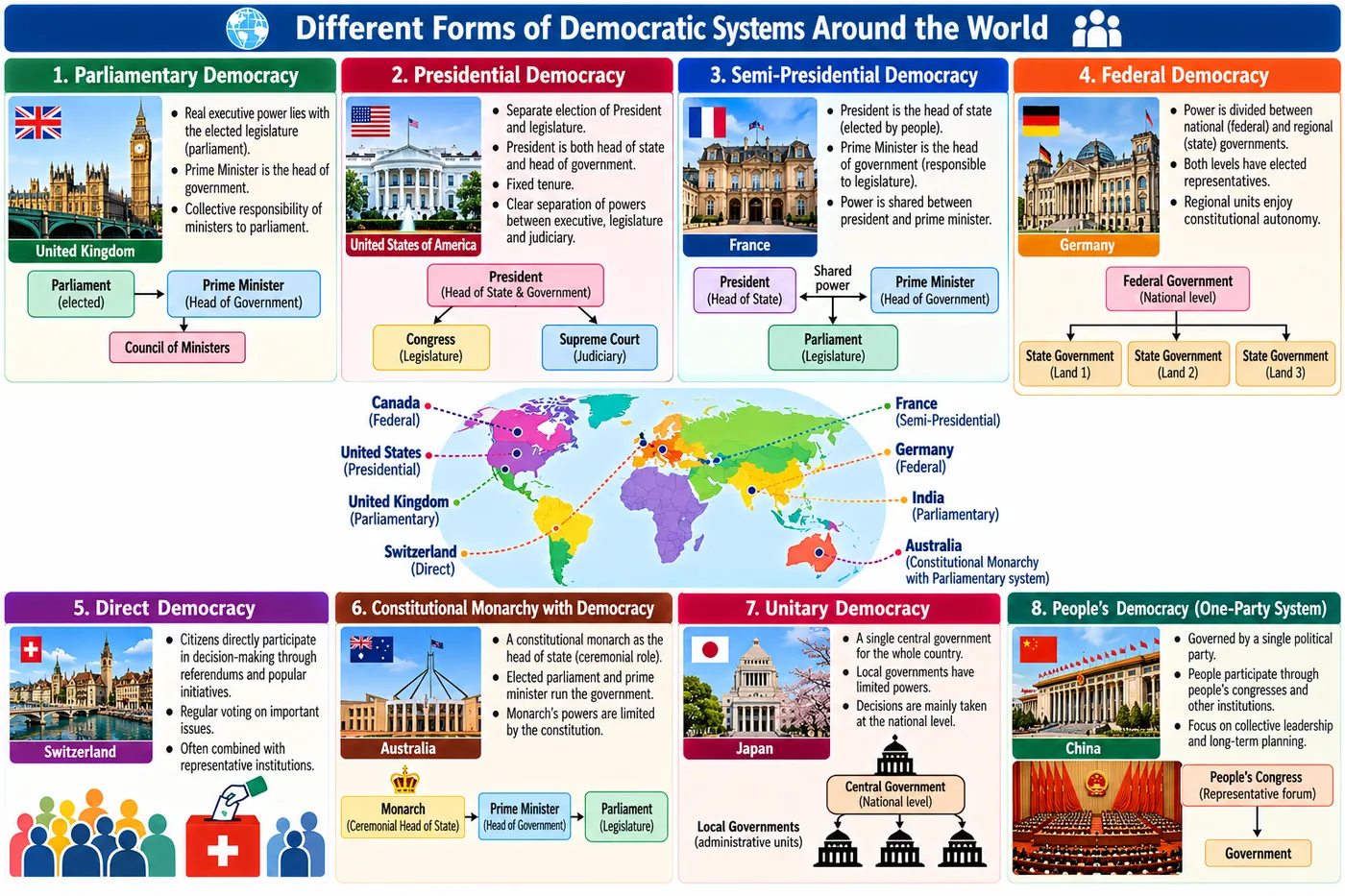
| Country | System | Head of State / Government | Key features |
|---|---|---|---|
| India | Parliamentary | President / Prime Minister | Written constitution, federalism, multi-party, Fundamental Rights and Duties |
| Canada | Parliamentary | Monarch (represented by Governor-General) / Prime Minister | Federal, multi-party |
| United Kingdom | Parliamentary with constitutional monarchy | Monarch / Prime Minister | Unwritten constitution, parliamentary sovereignty |
| Switzerland | Direct democracy elements | Federal Council (collective executive) | Frequent referendums, written constitution |
| USA | Presidential | President (both) | Written constitution, federal, two major parties |
5. India's Living Democracy
- More than 96.8 crore registered voters (2024) — more than the population of most countries.
- On average one MP represented about 25 lakh people (2019).
- Elections use 22 scheduled languages and others; election symbols let voters who cannot read vote independently.
- Over 10 lakh polling stations in mountains, forests, deserts and islands — sometimes for a single voter.
- Over 2,800 registered political parties.
Three tiers and the grassroots
India works through Union, State and Local governments. Beyond Panchayati Raj and municipalities, Autonomous District Councils in parts of the North-East protect tribal customs, and the PESA Act, 1996 makes the Gram Sabha the main decision-making body in Scheduled Areas of other States.
- Jethipura Gram Panchayat (Sabarkantha, Gujarat) won the Nanaji Deshmukh Rashtriya Gaurav Gram Sabha Puraskar (2019) for regular Gram Sabhas, special sessions, Mahila Sabhas, proper quorum and participation of SCs, STs and women.
- South Manubankul Gram Panchayat (Tripura) was recognised as a "women-friendly panchayat" for women's participation, health, sanitation and livelihood work.
Women and the vote
Women won full voting rights in the USA only in 1920 and in Britain in 1928, after long struggles. In India, the Constitution gave all adults equal voting rights from 1950. Article 243D reserves at least one-third of directly elected seats in panchayats for women and Article 243T does the same in municipalities; many States have raised this to 50%. The Nari Shakti Vandan Adhiniyam (2023) provides one-third reservation for women in the Lok Sabha and State Assemblies, to take effect after the next delimitation.
Democracy also lives in civil society, cooperatives, trade unions and community bodies. The RTI Act, 2005 grew out of public demand, committee work and parliamentary debate, and now lets citizens seek information from public authorities.
6. Challenges to Democracy
- Illiteracy, poverty, inequality, regionalism, gender inequality and social discrimination limit equal participation.
- Misinformation and fake news, especially on social media, can mislead voters and even spark conflict.
- Weak implementation of laws reduces trust; indifference and damage to public property weaken democratic values.
- The Emergency (1975–77): declared in June 1975 on grounds of "internal disturbance" by the government led by Indira Gandhi. Most Fundamental Rights were suspended, the press censored and leaders and activists jailed. Movements led by Jayaprakash Narayan (Lok Nayak) mobilised students, especially in Bihar and Gujarat. In the 1977 elections the ruling party was defeated — showing the strength of Indian democracy. (Articles 352, 356 and 360 deal with National Emergency, President's Rule and Financial Emergency.)
7. Democracy and You
Young citizens strengthen democracy by being media literate, understanding the Constitution, following Fundamental Duties, taking leadership in school and community, and joining nation-building activities such as the NCC, NSS and Bharat Scouts and Guides. Respecting others' rights, using social media responsibly and appreciating diversity are part of civic responsibility.
8. Master Table: Key Terms
| Term | Meaning |
|---|---|
| Democracy | Government in which power comes from the people |
| Popular sovereignty | Ultimate authority lies with the people |
| Universal Adult Franchise | Every adult (18+) has one equal vote |
| Sovereignty | Supreme, final and independent authority of a State |
| Rule of law | Everyone is equally subject to law |
| Federalism | Power shared between Union and States |
| Question Hour | Time when MPs question the government |
| PIL | Court case filed for the public interest |
| Civil society | Voluntary groups, NGOs, associations |
| Quorum | Minimum members needed for a valid meeting |
| Cooperative | Group sharing work, profits and responsibilities |
9. Master Summary Table
| Theme | Key points |
|---|---|
| Roots | Sabhā–samiti–vidatha, gaṇas, Buddhist Saṁgha, freedom struggle, Constituent Assembly |
| Principles | Popular sovereignty, rule of law, Fundamental Rights, separation of powers, accountability, multi-party system, protection of the vulnerable |
| Types | Direct vs representative; parliamentary vs presidential |
| Practice | 96.8 crore voters, 10 lakh+ booths, 2,800+ parties; three tiers; PESA; women's reservation |
| Challenges | Inequality, misinformation, weak implementation; lessons of the Emergency |
Chart — year women won equal voting rights:
10. Mind Map
- Sabhā, samiti, gaṇas
- Constituent Assembly
- Sovereignty, rule of law
- Rights, separation of powers
- Direct, representative
- Parliamentary, presidential
- Elections, panchayats
- RTI, women's reservation
- Fake news, inequality
- Emergency 1975–77
11. Tips and Tricks
- Fundamental Rights articles: 14–18, 19–22, 23–24, 25–28, 29–30, 32 — "Equality, Freedom, Exploitation, Religion, Culture, Remedies" (E-F-E-R-C-R).
- Women's reservation in local bodies: D comes before T, and villages come before towns — 243D for panchayats, 243T for towns (municipalities).
- Emergency articles: 352 National, 356 State (President's Rule), 360 Financial.
- In a parliamentary system people elect the legislature, not the executive directly.
- Holding elections alone does not make a country democratic — they must be free, fair and competitive, with rights protected.
- Article 21A was inserted in 2002; the RTE Act came in 2009.
12. Important One-liners
- India had over 96.8 crore registered voters in 2024.
- The Constitution came into force on 26 January 1950.
- Dr B.R. Ambedkar chaired the Drafting Committee.
- Article 368 deals with amending the Constitution.
- Article 32 is the Right to Constitutional Remedies.
- The RTI Act was passed in 2005.
- The media is called the fourth pillar of democracy.
- Switzerland is the best-known example of direct democracy.
- The USA has a presidential system.
- PESA was enacted in 1996.
- The Emergency lasted from 1975 to 1977.
13. Exam-pattern Questions with Detailed Answers
Which situation best reflects popular sovereignty?
- A law passed without public discussion
- Citizens voting to choose representatives
- A court giving a final judgment
- A minister taking an independent decision
Show answer
Popular sovereignty means power comes from the people; voting is how they exercise it. A law without discussion ignores people; a court judgment is the judiciary's role; a minister's independent decision is executive action.
Answer: (B)
The Rule of Law is violated when:
- Laws apply equally to all
- Courts review government actions
- Powerful people are treated as above the law
- Citizens challenge laws through legal means
Show answer
Rule of law means no one is above the law. Options A, B and D actually uphold the rule of law.
Answer: (C)
Why is the media called the fourth pillar of democracy?
Show answer
Alongside the legislature, executive and judiciary, the media keeps citizens informed, voices public concerns and scrutinises those in power, helping hold government accountable.
Answer: It informs people and checks power
Distinguish between parliamentary and presidential democracy.
Show answer
Parliamentary (India, UK): the executive — Prime Minister and ministers — comes from the legislature and stays in office only with its support; head of state is separate. Presidential (USA): the President is elected separately, heads both state and government, serves a fixed term and is independent of the legislature.
Answer: Executive inside and answerable to legislature vs separate and fixed-term
A school cabinet disagreed over Republic Day activities, discussed and then voted; the majority's choices were adopted. Which democratic values does this show?
Show answer
Participation, freedom of expression, equality (one member one vote), majority rule and peaceful settlement of differences. Voting resolves disagreements fairly; the majority decision gives legitimacy. Elected members must then implement it, include minority concerns where possible and report back.
Answer: Discussion, equal voting, majority rule, accountability
Explain separation of powers with an example of checks and balances.
Show answer
The legislature makes laws, the executive implements them and the judiciary interprets them. This prevents any one organ from becoming all-powerful. For example, Parliament can amend the Constitution, but courts can review whether the amendment respects its basic spirit and strike down unconstitutional laws.
Answer: Division of work with mutual checks
How did India's experience of women's voting rights differ from Britain's and America's?
Show answer
Women in the USA (1920) and Britain (1928) won the vote after decades of protest. In India the Constitution gave all adults, men and women, equal voting rights from 1950 without a separate struggle. However, social barriers still limit women's representation, which is why seats are reserved in local bodies (243D, 243T) and, from the 2023 law, will be in legislatures.
Answer: Equal franchise from the start, but representation still needs support
Is voting alone enough to make a country democratic?
Show answer
No. Elections must be free, fair and competitive with real choice among parties. Democracy also needs the rule of law, protected rights (speech, association), independent courts and media, accountability between elections (Question Hour, RTI, audits) and participation at the grassroots. A country where only approved candidates may contest or opposition is suppressed may hold elections without being democratic.
Answer: No — rights, rule of law and accountability are also essential
What lessons does the Emergency of 1975–77 teach about democracy?
Show answer
It showed how quickly rights can be suspended, the press censored and opponents jailed when power is concentrated. It also showed democracy's resilience: public movements led by Jayaprakash Narayan, and the 1977 elections in which voters defeated the ruling party. Lessons: constitutional safeguards, a free press, independent institutions and alert citizens are vital to protect democracy.
Answer: Democracy is fragile but citizens and institutions can restore it
How can social media both strengthen and weaken democracy?
Show answer
Strengthen: lets citizens share views, organise, question leaders and access information quickly. Weaken: spreads fake news and hate, polarises people, manipulates opinion and can trigger violence. Responsible use — checking sources, avoiding forwarding unverified content, respecting others — keeps it a democratic tool.
Answer: Voice and awareness vs misinformation and division
How does the PESA Act deepen democracy in tribal areas?
Show answer
PESA (1996) extends panchayats to Scheduled Areas and makes the Gram Sabha the primary decision-making body — giving tribal communities a say over local resources, customs and development plans. Decisions are taken by the people directly in the village assembly, making governance participatory, culturally sensitive and accountable.
Answer: Empowers Gram Sabhas — direct local self-rule
14. Quick Revision Summary
- Democracy = power from the people; India has 96.8 crore+ voters (2024).
- Roots: Vedic assemblies, gaṇas, Buddhist Saṁgha; Constitution adopted 26 Nov 1949, in force 26 Jan 1950; Article 368 amendments.
- Principles: popular sovereignty (UAF 18+), rule of law, six Fundamental Rights, separation of powers, RTI and accountability, multi-party system, Article 46.
- Types: direct (Switzerland), representative; parliamentary (India, UK, Canada), presidential (USA).
- Grassroots: three tiers, ADCs, PESA 1996, women's reservation 243D/243T, Nari Shakti Vandan Adhiniyam 2023.
- Challenges: inequality, fake news; Emergency 1975–77 and its lessons; youth's civic role.