
1. Chapter at a Glance
In Classes 6–8 you met Social Science through stories of people, places and events. Class 9 begins by asking what Social Science really is. Simply put, Social Science is the systematic study of human society. It explains not only what happened or where things are, but why events occur, how people live together, how the environment shapes life, how governments work, how economies run, and how the past and present shape the future. Physics, Chemistry and Biology study the natural world; Social Science studies society, institutions, cultures and human interaction.
- How Social Science is present in every part of daily life.
- India's long tradition of enquiry about society and governance.
- The four core disciplines — Geography, History, Political Science, Economics — and related fields.
- The sources and tools each discipline uses.
- Why studying Social Science matters for citizens and for the future.
2. Social Science in Everyday Life
Think of an ordinary day. Your house is built from materials brought from different places. Your food was grown, processed, transported, bought and sold by many people before reaching your plate. You travel on roads planned and maintained by public authorities, study in a school shaped by education policy, and use electricity generated at distant power stations and carried over a vast grid. Even the simplest activity depends on governance, economic production, social cooperation and the natural environment.
Look further and questions arise: Why do some people live in crowded cities and others in scattered villages? Why do communities speak different languages and follow different customs? Why do some regions farm while others focus on industry or trade? Why are some areas flood-prone? How does climate change affect us? Society does not work by chance — it is shaped by history, geography, institutions, resources and human choices. Social Science answers such questions through observation, evidence and logical reasoning.
Pick one change in your locality over the last five years — a new road, a school, mobile internet, a dried pond. Ask: What was it like before? What changed? Why? How did it affect people? You have just done a small piece of social-science research.
3. Understanding Society Through Time and Tradition
Early humans depended directly on nature; over thousands of years they learned to farm, domesticate animals, build villages, make tools, trade and organise government. Villages grew into towns and cities, and new ideas and exchanges transformed life.
India has a long tradition of enquiry through discussion, questioning and reasoning:
- Pañchamahābhūtas — the five great elements: earth (pṛithvī), water (āpaḥ), fire (agni), air (vāyu) and space (ākāśha). The idea treats nature as an interconnected system in which human life is embedded — useful for thinking about how environment shapes settlements, occupations, architecture, food and health.
- Vasudhaiva kuṭumbakam — “the world is one family” — expresses the interdependence of societies that Social Science studies.
- The Arthaśhāstra, attributed to Kauṭilya about 2,300 years ago, analysed administration, economic management, taxation and the duties of rulers to the people — systematic thinking about government long before modern disciplines.
Modern social scientists continue this tradition with new methods: they observe people's lives, conduct interviews and surveys, examine documents and compare times and places, building explanations supported by evidence. Social Science thus explains both continuity and change.
4. Social Science as a Family of Disciplines
Society is too complex for one subject. A drought, for example, affects crops (environment), farmers' income (economy), relief measures (politics), migration to cities (society) and traditional ways of coping with scarcity (culture). So Social Science is a group of related disciplines. Classes 9–10 draw mainly on four; Sociology, Philosophy, Anthropology and Psychology come later.
| Discipline | Studies | Key questions | Tools / sources |
|---|---|---|---|
| Geography | Earth, environments, location and distribution of places and people, and people–environment relations | Where? Why there? How do places influence each other? | Maps, globes, atlases, GIS, satellite data, infographics (NCERT's School Bhuvan portal lets you map your own area) |
| History | The human past and change over time | What happened, when and why? What changed and what continued? | Literary, archaeological, epigraphic and numismatic sources; science such as carbon-14 dating and genetics |
| Political Science | Governance, power, constitutions, institutions, rights and duties | Who decides? How is power shared and checked? | Constitutions, laws, policies, elections, social movements |
| Economics | Production, exchange, distribution and use of limited resources | What to produce, how, and for whom? How to balance growth and fairness? | Data on prices, output, jobs, budgets, GDP |
Geography
Geography combines a spatial view (location and its significance) with a temporal view (change over time), borrowing from both natural and social sciences. It can explain, for instance, why India's long peninsular coastline made it a hub of contact with Africa, Europe and Southeast Asia. In Classes 9–10 you will study landforms, atmosphere and climate, oceans, biomes, biosphere reserves, geospatial technology and regional geography.
History
India's itihāsa–purāṇa tradition preserved cultural memory through stories that carried values and identity. Modern history-writing (historiography) relies on empirical evidence — information gathered by observation or experiment — using archaeology, carbon dating and genetics to fix timelines.
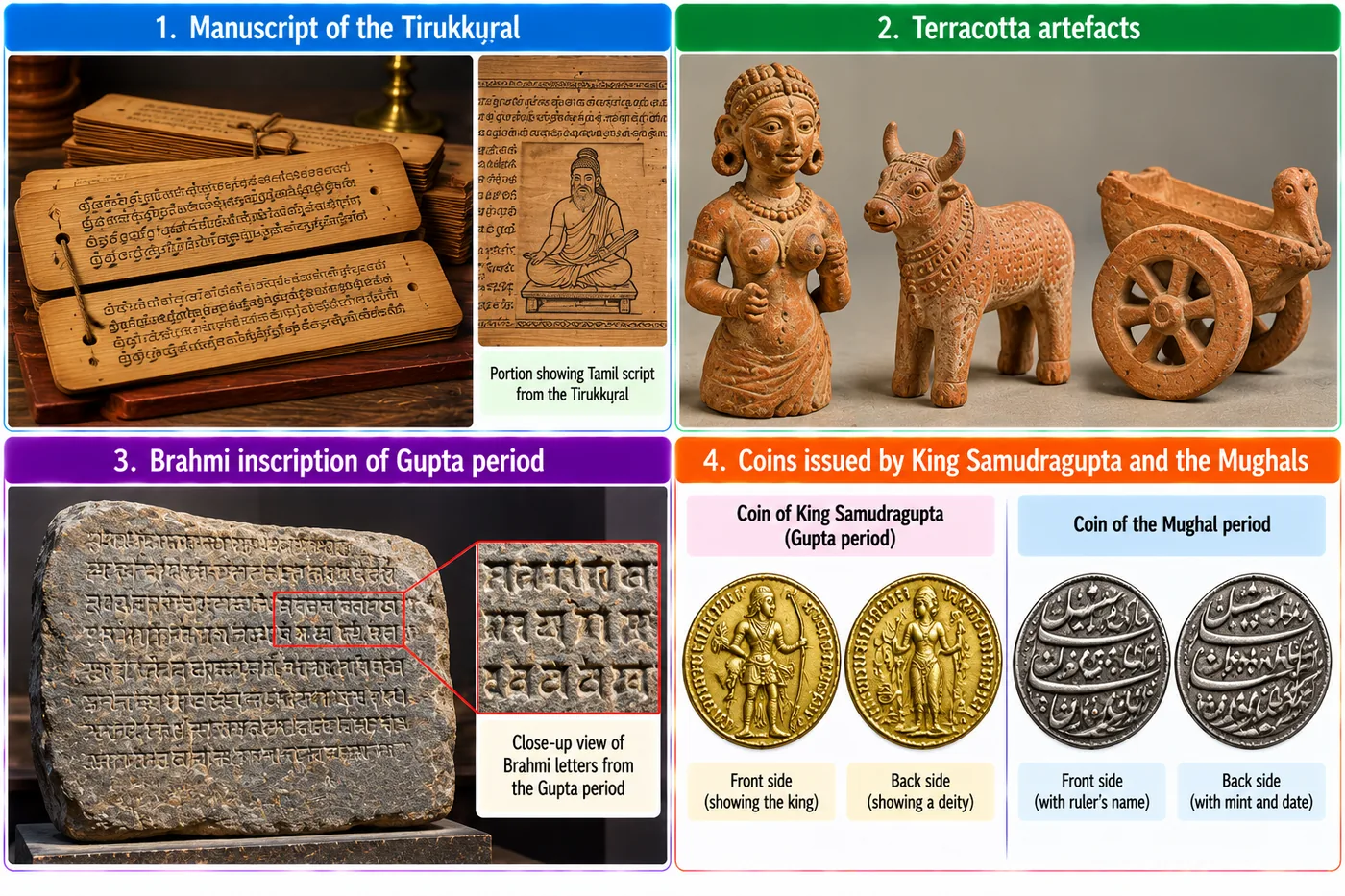
| Type of source | Meaning | Example |
|---|---|---|
| Literary | Written texts, travelogues, memoirs, letters, genealogies, folklore | Sāmaveda manuscript; palm-leaf Tirukkuṟaḷ |
| Archaeological | Material remains — monuments, sites, artefacts, art | Harappan terracotta figurine; a 12th-century Viṣhṇu sculpture |
| Epigraphic | Inscriptions on stone, metal or rock | Gupta-period Brāhmī inscription; Krishnadevaraya's Kannada inscription at Hampi |
| Numismatic | Coins and medals — telling us about economy, rulers, trade and culture | Samudragupta's gold coin; Jahangir's zodiac coin |
You will study early human history, the course of Indian history, and world landmarks such as the Greco-Roman world, the Renaissance, the Reformation, the Enlightenment, the Industrial Revolution, colonialism and anti-colonial struggles.
Political Science
It studies how power is distributed, how decisions are made and policies carried out — constitutions, governments, state institutions, social movements, nation-building and foreign policy. Power exists not only in formal offices but in social relationships and customs. Indian thought linked politics with dharma (moral duty), artha (material well-being) and rājadharma (duties of rulers), in texts from the Vedas and epics to the Śhukranīti and Arthaśhāstra, treating power as a responsibility. Today's Panchayati Raj carries this spirit of local self-government. You will study democracy, elections, authority, civil society, public policy and national security.
Economics
Economics studies how people and societies use limited resources to meet needs — how consumers decide what to buy, producers what to make, and governments how to balance growth with stability and efficiency with fairness. India was for centuries one of the world's leading economies and trading centres; colonial rule brought poverty, famines and the decline of traditional industries. Since Independence India has rebuilt — better infrastructure, education and technology, less poverty, longer lives — but must still raise incomes and share growth fairly and sustainably. You will study markets and prices, financial management and entrepreneurship, GDP and growth, international trade and the Union Budget.
5. Why Study Social Science?
- Understand the systems around us — housing, water, roads, schools, markets and digital spaces: how they developed, work and affect different groups.
- Respect diversity, recognise unity — differences in language, custom and occupation have geographical, historical and economic causes; understanding them builds respect, while India's culture binds diversity into a shared identity.
- Be an active citizen — knowing how governments decide prepares you to take part responsibly in democracy.
- Think about shared problems — environment, public health, jobs, urban growth — by asking about causes, effects and solutions.
- Link past, present and future — learning how past decisions shaped today helps us choose wisely for tomorrow.
As societies change through new technology, growing cities, environmental stress, migration and global links, Social Science will help address climate change, sustainable development, social harmony and fair use of resources — and guide the responsible use of technology. It is not about memorising dates, maps or definitions, but about understanding people, places, society, culture and power.
6. Master Table: Key Terms
| Term | Meaning |
|---|---|
| Social Science | Systematic study of human society |
| Pañchamahābhūtas | Five great elements: earth, water, fire, air, space |
| Vasudhaiva kuṭumbakam | The world is one family |
| Spatial / temporal | Related to place / related to time |
| GIS | Geographical Information System — computer mapping of data |
| Empirical evidence | Information gained by observation or experiment |
| Historiography | The writing and method of history |
| Epigraphic source | Inscription on stone, metal or rock |
| Numismatic source | Coins, currency or medals as evidence |
| Genealogical record | Document tracing family lineage |
| Rājadharma | The duties of a ruler |
| Sustainable development | Meeting present needs without harming future generations |
7. Master Summary Table
| Theme | Key takeaway |
|---|---|
| Definition | Systematic study of society — what, where, why and how |
| Everyday life | Daily activities depend on governance, economy, cooperation and environment |
| Indian tradition | Pañchamahābhūtas, vasudhaiva kuṭumbakam, Arthaśhāstra |
| Disciplines | Geography, History, Political Science, Economics (+ Sociology, Psychology, etc.) |
| Sources | Literary, archaeological, epigraphic, numismatic, scientific |
| Purpose | Understanding, respect for diversity, citizenship, problem-solving, future planning |
Chart — the four core disciplines you will study in Classes 9–10:
8. Mind Map
- Food, roads, school
- Why questions
- Pañchamahābhūtas
- Arthaśhāstra
- Maps, GIS
- 4 types of sources
- Dharma, rājadharma
- Scarce resources
- Citizenship, diversity
- Future challenges
9. Tips and Tricks
- Four disciplines “G-H-P-E”: Geography = where, History = when, Politics = who decides, Economics = how resources are used.
- History sources “L-A-E-N”: Literary, Archaeological, Epigraphic (inscriptions), Numismatic (coins).
- Five elements: “E-W-F-A-S” — Earth, Water, Fire, Air, Space.
- Epigraphy = inscriptions; numismatics = coins — don't swap them.
- Social Science is not just memorising facts; questions usually ask you to explain causes and connections.
10. Important One-liners
- Social Science is the systematic study of human society.
- The four core disciplines are Geography, History, Political Science and Economics.
- The Arthaśhāstra is attributed to Kauṭilya.
- The Pañchamahābhūtas are the five great elements.
- Geography combines spatial and temporal perspectives.
- GIS stands for Geographical Information System.
- Coins are numismatic sources.
- Inscriptions are epigraphic sources.
- Carbon-14 dating helps fix the age of ancient remains.
- Panchayati Raj embodies grassroots democracy.
- Economics studies the use of limited resources.
11. Exam-pattern Questions with Detailed Answers
A coin of Samudragupta is an example of which source?
- Literary
- Epigraphic
- Numismatic
- Oral
Show answer
Coins are numismatic sources; inscriptions are epigraphic; texts are literary.
Answer: (C)
Which discipline studies how societies use limited resources?
- Geography
- Economics
- History
- Political Science
Show answer
Economics studies production, exchange, distribution and use of scarce resources.
Answer: (B)
Define Social Science in one sentence.
Show answer
Social Science is the systematic study of human society — how people live, govern, produce and relate to their environment, and how this changes over time.
Answer: Systematic study of human society
How is Social Science different from the natural sciences?
Show answer
Natural sciences (Physics, Chemistry, Biology) study natural phenomena; Social Science studies society, institutions, cultures and human behaviour, explaining why social events happen and how they connect. Human choices make social behaviour more varied and less predictable.
Answer: Nature vs human society
Explain the idea of the Pañchamahābhūtas and its relevance to Social Science.
Show answer
It sees the world as made of five elements — earth, water, fire, air and space — forming one interconnected system with humans inside it. This helps explain how environment shapes settlements, jobs, architecture, food and health, which is relevant as societies face environmental challenges today.
Answer: Nature as an interconnected system including humans
Name four types of historical sources with one example each.
Show answer
Literary — the Tirukkuṟaḷ manuscript; Archaeological — a Harappan terracotta figurine; Epigraphic — a Gupta Brāhmī inscription; Numismatic — Jahangir's zodiac coin.
Answer: As above
What tools does a geographer use?
Show answer
Maps, globes, atlases, satellite images, GIS, infographics and field observation; NCERT's School Bhuvan portal allows students to map their own village or city.
Answer: Maps, globes, GIS, satellite data
Using a drought as an example, explain why society must be studied through several disciplines.
Show answer
Geography shows rainfall failure, soil and water stress; Economics shows falling crop output, income and rising prices; Political Science examines relief and policy responses; Sociology and History explain migration and traditional coping methods like water harvesting. Only together do they explain the full impact and suggest solutions.
Answer: One event has environmental, economic, political and social sides
How did Indian political thought view power, and how is this reflected today?
Show answer
Texts like the Arthaśhāstra, Mahābhārata and Śhukranīti linked politics with dharma, artha and rājadharma, treating power as a responsibility for public welfare, not a privilege. Today's democratic institutions, especially Panchayati Raj with local participation and accountability, reflect this idea.
Answer: Power as responsibility; local self-government today
“History today relies increasingly on empirical evidence.” Explain with examples.
Show answer
Besides stories and texts, historians test claims using physical evidence and science — excavations, carbon-14 dating of remains, DNA studies of ancient populations, metal analysis of coins and laboratory study of artefacts. This helps fix timelines and verify or correct earlier accounts.
Answer: Scientific testing of material evidence
Why is Social Science important for a citizen of a democracy?
Show answer
It explains how governments and laws work, so citizens can vote, question and take part responsibly; helps them understand and respect diversity; equips them to analyse issues like environment, health and jobs; and connects past decisions with future choices, building informed, thoughtful citizens.
Answer: Informed participation, respect, problem-solving
12. Quick Revision Summary
- Social Science = systematic study of society: what, where, why and how.
- Daily life rests on governance, economy, cooperation and environment.
- Indian tradition: Pañchamahābhūtas, vasudhaiva kuṭumbakam, Arthaśhāstra.
- Disciplines: Geography (space), History (time; four sources), Political Science (power), Economics (resources).
- Study it to understand systems, respect diversity, act as citizens and plan a sustainable future.